
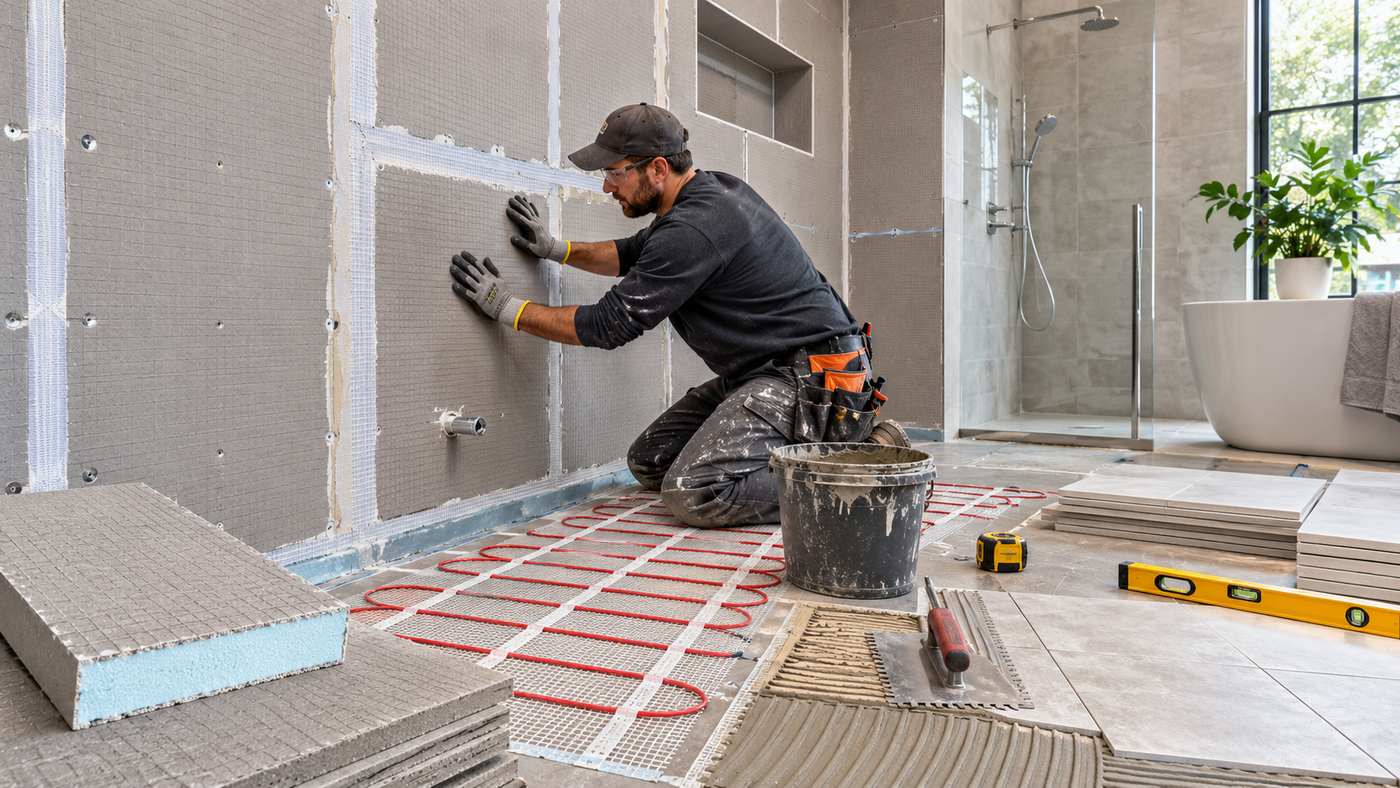
Choosing the right thermal construction board can make a significant difference to the durability, insulation performance, and moisture protection of a modern building project. Whether you are renovating a bathroom, constructing a wetroom, preparing a tiled kitchen floor, or installing underfloor heating, insulated construction boards provide a practical alternative to certain traditional backing materials. Their lightweight design, insulating core, and reinforced surfaces can simplify installation while creating a stable background for suitable tile finishes. However, not every board offers the same thickness, strength, waterproofing performance, or installation requirements. Understanding the available materials, technical specifications, and correct fitting techniques helps homeowners and contractors make informed decisions. This guide explores eight important considerations for choosing and installing thermal boards while avoiding common construction mistakes.
What Is Thermal Construction Board?
Thermal construction board is a lightweight building panel designed to provide thermal insulation and a suitable substrate for finishing materials such as ceramic tiles, porcelain tiles, plaster, and certain renders.
The term is commonly used for insulated tile backer boards, particularly products manufactured with a rigid extruded polystyrene core and a reinforced cementitious coating.
These boards combine several useful characteristics within one manufactured panel.
The insulating core slows heat transfer, while the reinforced surface provides a suitable background for compatible adhesives and finishes.
How Thermal Construction Boards Are Made
Many products use high density extruded polystyrene, commonly called XPS, as their insulating core.
The foam is covered with a reinforced cement based coating, often incorporating glass fibre mesh.
The outer coating helps provide a stable surface for adhesive bonding and protects the relatively soft insulation core from ordinary installation impacts.
Main Components of the Board
A typical insulated construction board contains:
- A rigid foam insulation core
- Reinforcement mesh incorporated into the surface
- Cementitious coating on the board faces
- A surface compatible with specified tile adhesives
- Factory manufactured dimensions and thicknesses
The exact construction varies by manufacturer.
Some products are intended primarily for wet area tiling, while other insulation boards serve different building envelope applications.
Always verify the intended use before purchasing.
1. Improve Thermal Insulation and Indoor Comfort
One of the main advantages of thermal construction board is its ability to reduce heat transfer through surfaces where it is installed.
Floors and walls can absorb or transfer heat according to their construction, insulation, and surrounding temperatures.
Adding a suitable insulated layer changes the thermal resistance of the overall assembly.
Understanding Thermal Conductivity
Thermal conductivity describes how readily heat passes through a material.
Materials with lower thermal conductivity transmit less heat under equivalent conditions.
For example, Larsen’s Thermal Construction Board technical data identifies a thermal conductivity of approximately 0.033 watts per metre kelvin.
This figure applies to that particular product and should not automatically be assigned to competing boards.
Why Thickness Makes a Difference
For the same insulation material, a thicker board generally provides greater thermal resistance.
However, a thicker board also changes the finished floor level or wall dimensions.
The appropriate thickness depends on the available space, insulation objectives, and installation requirements.
A relatively thin board can help limit downward heat transfer beneath a heated tiled floor, but it should not automatically be treated as sufficient insulation for an entire building.
Reducing Unwanted Heat Loss
Insulated boards can be useful where tile finishes are installed over relatively cold substrates.
They may also improve comfort by reducing direct thermal contact with colder building materials.
The actual improvement depends on the original construction and the complete floor or wall assembly.
A proper assessment should consider existing insulation, moisture conditions, and the intended heating system.
2. Create a Reliable Background for Bathroom and Wetroom Tiling
Bathrooms and wetrooms frequently experience splashing, humidity, and direct water exposure.
These conditions require building materials that can withstand moisture and form part of a properly designed waterproofing system.
Thermal construction board is commonly selected for these applications because many insulated tile backer boards use water resistant or waterproof cores.
Why Standard Wall Materials May Be Unsuitable
Some conventional boards can deteriorate when repeatedly exposed to moisture without appropriate protection.
This may cause swelling, loss of strength, or damage to surrounding finishes.
A suitable insulated tile backer board can provide a more appropriate substrate when installed according to its approved system.
However, waterproof board material does not automatically mean the completed installation is watertight.
Waterproofing the Complete Assembly
Water can pass through poorly sealed joints, corners, service penetrations, and fixing points.
The Tile Association’s technical guidance emphasizes proper waterproofing and sealing in showers and wetrooms.
Areas Requiring Particular Attention
Important locations include:
- Joints between adjacent boards
- Corners where walls meet
- Wall and floor connections
- Shower valve penetrations
- Pipe openings
- Mechanical fixing points
- Connections around shower trays and drains
These areas should be treated using compatible waterproofing products and the manufacturer’s specified installation method.
Waterproof Boards Versus Waterproof Systems
Ceramic tiles and grout should not be relied upon as the sole waterproof barrier.
Some tile backer boards have waterproof cores, but additional joint sealing and approved waterproofing components are necessary to create a complete protective system.
In wetrooms, the floor waterproofing must also integrate with the drainage assembly.
This distinction is essential for preventing moisture damage behind tiled finishes.
3. Improve the Performance of Underfloor Heating Systems
Underfloor heating is a popular feature in modern bathrooms, kitchens, and residential renovations.
It can provide comfortable surface heating while reducing the need for traditional wall mounted radiators in certain spaces.
Thermal construction board is frequently used beneath compatible electric underfloor heating systems.
Why Insulation Matters Beneath Heating Elements
Electric heating cables transfer energy into the surrounding floor materials.
Without suitable insulation, some heat may move into the underlying substrate instead of contributing to the heated floor surface.
Installing an approved insulated board beneath the heating system can help reduce this downward heat transfer.
Depending on the construction, it may also improve the floor’s response to heating.
How Heating Performance Varies
The actual heating response depends on several factors:
- Existing subfloor construction
- Board insulation thickness
- Heating cable output
- Tile and adhesive properties
- Room insulation and heat losses
- Temperature control settings
A thermal board does not guarantee lower energy bills in every installation.
Heating performance should be evaluated as part of the complete system.
Installing Boards Beneath Electric Heating
The subfloor should be stable, clean, and suitable for the approved fixing method.
Boards must be adequately supported and secured.
The heating elements are then installed according to the heating manufacturer’s instructions.
Depending on the system, cables may require covering with a suitable flexible levelling compound or adhesive before tiles are fixed.
Protecting the Heating Elements
Avoid damaging cables with sharp tools, unsuitable fasteners, or excessive installation pressure.
Where required, electrical testing should be performed before, during, and after the installation.
Electrical connections must be completed by appropriately qualified personnel in accordance with local regulations.
Allow Materials to Cure
Adhesives, levelling compounds, and grout need sufficient curing time.
Turning on underfloor heating too early can interfere with the curing process.
Follow the specified waiting period and gradually commission the heating system as directed.
4. Select the Correct Board Thickness and Strength
Thermal construction board is available in different thicknesses to suit different installation requirements.
Selecting the appropriate product is important because thin boards and thicker panels are not necessarily interchangeable.
Common Construction Board Thicknesses
Larsen lists thermal construction boards in thicknesses of 6 mm, 10 mm, and 12.5 mm.
Other manufacturers, including Tilemaster, offer additional thicknesses that extend to substantially thicker insulation panels.
The correct choice depends on the intended application.
Thin Boards for Existing Surfaces
Thinner boards may be suitable for overboarding certain prepared substrates where floor height or wall depth is limited.
However, the underlying surface must provide adequate support.
A thin insulating board cannot compensate for structural movement or an unstable subfloor.
Thicker Boards for Other Applications
Thicker boards can provide additional thermal resistance and may be suitable for particular wall or floor arrangements.
Nevertheless, suitability for direct fixing to studs, supporting heavy finishes, or use over floors depends on the product’s technical requirements.
Check Structural Support Requirements
Larsen’s published installation guidance distinguishes between boards used for overboarding and those permitted for direct fixing to studs.
Its instructions identify 10 mm and 12.5 mm boards as suitable for direct stud fixing under specified conditions.
The required support spacing, fixing arrangement, and load limitations must be followed.
These requirements should not be generalized to every brand.
Understand Compressive Strength
Compressive strength describes a material’s resistance to compression under specified testing conditions.
Larsen reports a compressive strength of 300 kilopascals at 10 percent deformation for its product.
This is a laboratory test characteristic, not a universal allowable floor loading figure.
The complete installation must be designed for the loads it will experience.
5. Achieve Strong and Durable Tile Adhesion
A durable tiled surface depends on the quality of the background as well as the tile and adhesive.
Thermal construction board commonly incorporates a cementitious surface designed to support bonding with compatible products.
This can simplify substrate preparation in suitable applications.
Why Surface Preparation Matters
Even a high quality board may perform poorly if installed over dust, grease, loose plaster, or unstable flooring.
Before fixing boards, inspect the underlying surface.
The substrate should be sufficiently sound, clean, and prepared according to the manufacturer’s instructions.
Use Compatible Tile Adhesives
Manufacturers commonly specify cement based flexible adhesives for fixing insulated tile backer boards.
The exact adhesive classification depends on the board, substrate, tile, and exposure conditions.
Some waterproofing products require particular adhesive formulations.
Avoid Incompatible Products
Certain solvent containing adhesives can damage foam based construction materials.
Never assume that a general purpose adhesive is suitable.
Check the technical data sheets for the board, waterproofing products, and tile adhesive before beginning installation.
Supporting Heavy Tiles
Large porcelain tiles and natural stone may place substantial weight on the backing system.
Larsen states that its thermal board can support wall tiling loads of up to 80 kilograms per square metre, including adhesive, when correctly installed.
This is a product specific rating subject to proper fixing conditions.
Other boards may have different permitted loads.
Preventing Hollow Areas
A continuous adhesive bed is important for many wall and floor applications.
Voids beneath boards can reduce support and may contribute to damage when loads are applied.
Follow Appropriate Tiling Practices
Use the recommended trowel, adhesive application method, and fixing procedure.
Maintain required movement joints and allow materials to cure correctly.
A qualified tile installer should assess unusual substrates, oversized tiles, and other demanding conditions.
6. Simplify Installation With Lightweight Construction Materials
Another practical advantage of thermal construction board is its relatively low weight.
Lightweight panels can be easier to carry, position, and cut than some heavier traditional building products.
This may improve handling during bathroom renovations and other confined interior projects.
Standard Board Dimensions
A common board size is 1200 mm by 600 mm.
This provides a convenient format for many wall and floor installations.
However, actual sizes vary by product.
Cutting and Shaping Boards
Many insulated backer boards can be cut using suitable sharp tools.
The exact method depends on the board’s surface reinforcement and thickness.
Measure carefully before cutting to minimize waste.
Preparing Accurate Board Layouts
Plan the position of panels before applying adhesive.
Avoid creating unnecessary narrow pieces at edges or around fixtures.
Where the manufacturer requires staggered joints, arrange the boards accordingly.
Make appropriate allowances for movement joints and perimeter clearances.
Fixing Boards to Different Substrates
Installation procedures depend on whether boards are being fitted to masonry, existing wall finishes, timber framing, or floors.
Some applications require adhesive bonding.
Others require mechanical fixings, approved washers, or a combination of methods.
Why Fixing Details Are Important
Incorrect fixing can cause movement or damage to tiled surfaces.
Follow the manufacturer’s instructions for fixing spacing, board support, and sealing of penetrations.
Do not substitute a fixing method designed for one substrate without verifying its suitability for another.
Maintain Safe Working Practices
Cutting cement coated panels can produce dust.
Use appropriate protective equipment, ventilation, and dust control methods.
Employ suitable tools and follow the manufacturer’s safety information.
The lightweight nature of a board does not eliminate normal construction hazards.
7. Compare Acoustic, Moisture and Fire Performance
Thermal construction board is primarily selected for its insulation and tiling functions, but other performance characteristics may influence product selection.
These include sound transmission, moisture behaviour, surface durability, and fire classification.
Acoustic Performance
Certain insulated boards can contribute to acoustic performance when installed as part of a tested floor assembly.
For example, Larsen publishes an impact sound reduction test result of 19 decibels for a specified board configuration.
This should not be interpreted as a guaranteed reduction in all rooms.
Actual performance depends on the complete floor construction, connections, and installation details.
Moisture Resistance
A waterproof foam core can be useful in wet environments.
However, the installation must still address joints, drainage, waterproofing continuity, and possible water vapour movement.
In high humidity environments such as steam rooms, additional vapour protection may be required.
Preventing Hidden Moisture Problems
Moisture trapped within a poorly designed building assembly can create long term problems.
Before installing boards over existing walls or floors, investigate unexplained dampness, leaks, or persistent condensation.
Insulation boards should not be used to conceal unresolved moisture defects.
Understanding Fire Classification
A cement coated surface does not automatically make a foam core noncombustible.
The fire performance of an insulated board depends on its composition and tested classification.
Products must be selected according to relevant building regulations and permitted applications.
Check the Complete System
Fire performance can depend on the complete assembly rather than an individual panel.
Ask for applicable test documentation and confirm whether additional protective layers are necessary.
Never assume that a board approved for bathroom tiling can replace a required fire rated wall or ceiling system.
8. Evaluate Long Term Value, Costs and Product Quality
Purchasing thermal construction board should involve more than comparing the lowest price per panel.
A suitable product should match the intended use, provide adequate technical documentation, and work with the proposed installation system.
Factors Affecting Construction Board Costs
Prices vary according to thickness, size, manufacturer, availability, and performance specifications.
Additional expenses may include:
- Board adhesive
- Mechanical fixings and washers
- Waterproofing membranes and tapes
- Joint reinforcement materials
- Floor levelling compounds
- Tile adhesives and grout
- Labour and delivery
These materials should be considered when calculating the complete project budget.
Estimating Material Quantities
Begin by measuring the area requiring coverage.
Calculate the total surface area and divide it by the area covered by each board.
Allow additional material for cutting, corners, obstacles, and installation waste.
The required allowance depends on the complexity of the room.
Consider Whole Project Value
A cheaper board may not offer the necessary load rating or installation compatibility.
A thicker board may improve insulation but introduce problems with finished floor heights.
The best choice provides the required technical performance without creating unnecessary construction work.
Review Product Documentation
Look for published information covering thermal conductivity, compressive strength, water absorption, supported tile loading, fire classification, and permitted installation methods.
A reputable supplier should make relevant technical information available.
Thermal Construction Board Versus Traditional Cement Backer Board
Although these materials may perform similar tiling functions, their composition and properties differ.
Thermal Insulated Backer Board
Many insulated boards contain a lightweight foam core with reinforced cementitious surfaces.
They provide thermal resistance while supporting compatible tile finishes.
Specific products may also form part of waterproof wetroom systems.
Traditional Cement Backer Board
Conventional cement backer boards typically provide a stable background for tiling but do not offer the same insulation performance as a foam core panel of comparable thickness.
Depending on the product, they may also be heavier.
Which Board Should You Choose?
An insulated construction board may be preferable where thermal performance, reduced weight, or integration with underfloor heating is important.
A conventional cement backer board may be suitable where its particular properties meet the project requirements.
The decision should be based on approved uses, structural conditions, moisture protection, and total installation costs.
Common Applications of Thermal Construction Board
These boards can be used across several residential and commercial finishing projects when the selected system permits the application.
Bathroom Walls
Insulated backer boards provide a suitable substrate for tiles and can contribute to a coordinated waterproofing system.
Wetroom Floors
Appropriate boards may be installed beneath tiled wetroom finishes, provided floor stability, drainage, waterproofing, and fixing requirements are satisfied.
Kitchen Floors
Thermal boards can be considered where a stable tiled floor and compatible insulation layer are required.
Underfloor Heating Installations
Suitable insulated panels are frequently used beneath electric heating systems to help control heat transfer into the substrate.
Worktops and Custom Features
Some construction boards are approved for tiled worktops, bath panels, and other shaped features.
Product limitations and required structural support must be checked before installation.
Common Mistakes to Avoid During Installation
Several preventable mistakes can compromise a thermal board installation.
One is assuming that all insulated tile backer boards have identical technical specifications.
Another is selecting insufficient thickness for the intended substrate.
Poorly prepared surfaces, inadequate adhesive coverage, and incorrect fixing arrangements can also create problems.
In wetrooms, unsealed board joints and penetrations are particularly serious concerns.
Other mistakes include installing heating cables incorrectly, using incompatible adhesives, and ignoring required movement joints.
A further error is assuming that waterproof boards eliminate the need for a complete drainage and waterproofing design.
Always follow the approved system instructions and consult a qualified installer when the application involves complex structural or moisture conditions.
Frequently Asked Questions
What is thermal construction board used for?
Thermal construction board is commonly used as an insulated backing for bathroom tiles, wetroom floors, kitchen surfaces, and compatible underfloor heating installations.
Is thermal construction board waterproof?
Many insulated tile backer boards have waterproof cores, but joints, corners, fixings, and penetrations must be sealed using an approved waterproofing system.
Can thermal construction board be used with underfloor heating?
Yes. Suitable boards can be installed beneath compatible electric underfloor heating systems to reduce downward heat transfer and support tiled floor construction.
What thickness of thermal construction board is best?
The appropriate thickness depends on the substrate, required insulation, available space, and structural support. Common options include 6 mm, 10 mm, and 12.5 mm.
Can you tile directly onto thermal construction board?
Many cement coated thermal boards are designed for direct tiling once correctly fixed and prepared. Use the adhesive and waterproofing products specified by the manufacturer.
Is thermal construction board better than cement backer board?
Thermal boards offer additional insulation benefits, but the most suitable choice depends on moisture exposure, structural requirements, approved applications, and overall project specifications.
Conclusion
Thermal construction board provides a practical combination of insulation, lightweight construction, and a stable background for suitable tile finishes. Its value is particularly evident in bathrooms, wetrooms, and underfloor heating projects where thermal performance and moisture protection require careful attention. However, successful results depend on choosing the correct board thickness, using compatible installation products, and following approved waterproofing and fixing procedures. By comparing technical specifications and planning the complete installation, homeowners and contractors can create durable, comfortable, and professionally finished spaces.
