
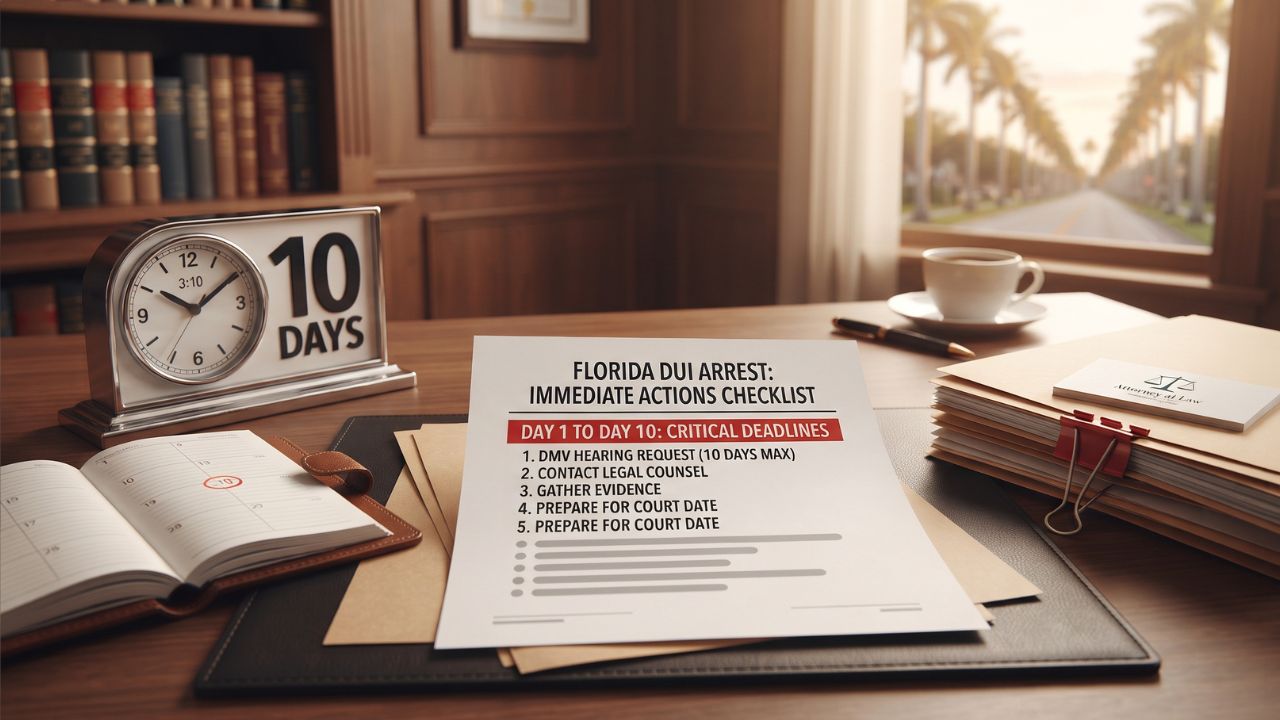
A DUI arrest tends to leave people stunned. The booking, the court paperwork and the worry about work and family all arrive at once, and the first few days carry a deadline that many drivers don’t know about. What you do in that window can shape your driving privileges long before a judge hears your case.
Your License Is on a Clock
Two separate things happen after a DUI arrest in Florida: a criminal case in court, and an administrative process through the state’s licensing agency. They run on different tracks, and the administrative one moves fast.
Officers usually take your license at arrest, but the suspension doesn’t begin until 10 days later, and the same 10 days is your window to request a hearing to challenge it. During that period your DUI citation works as a temporary driving permit.
The deadline is firm. Once the 10 days have passed, you are barred from challenging the suspension. If you do nothing, the suspension becomes final. That can happen even if the
What the Administrative Suspension Looks Like
The length depends on what happened at the stop. For a first offense, a failed breath test carries a 6-month administrative suspension, while refusing the test carries 12 months. The hearing you can request is called a formal review hearing, and it is your chance to contest that suspension.
Refusing a test has become riskier. A first refusal of a breath or urine test can now be a second-degree misdemeanor, effective October 1, 2025, and a second or later refusal can be a first-degree misdemeanor. Many drivers assume that declining the test is the safer choice. Today it can add a criminal charge on top of the suspension.
What a First Conviction Can Bring
A first DUI is generally treated as a misdemeanor, but the consequences go well beyond a fine. Possible penalties include jail time, fines, probation, community service and an ignition interlock requirement.
For a first offense with no aggravating factors, the statute allows a fine of $500 to $1,000, up to 6 months in jail, mandatory probation and a 6 to 12 month license suspension. Aggravated first offenses raise the fine to $1,000 to $2,000 and the possible jail time to 9 months. Court-ordered extras can include DUI school and a substance-abuse evaluation or treatment.
Those are the figures drivers see first, but the long-term effects often matter more. A DUI conviction stays on a driver’s record for 75 years, and a third DUI within 10 years can be a third-degree felony. A single conviction can affect insurance rates, job applications, professional licenses and travel.
Why Many Cases Are More Contestable Than They Look
An arrest is not a conviction. The state still has to prove its case, and DUI cases often depend on details that are easy to get wrong. Common lines of defense include an unlawful traffic stop, too little probable cause for the arrest, flawed field sobriety exercises, breath-test problems, and chain-of-custody errors in blood or urine testing. Other cases turn on medical conditions that could explain the officer’s observations, or on whether the driver actually had physical control of the vehicle.
Each of these points depends on the specific facts, which is why generic advice only goes so far. Dash-cam footage, body-camera video, calibration records and the officer’s own report can all matter, and they are easier to preserve and review early.
Practical Steps for the First Week
If you or someone you know has been arrested, a few steps are worth taking right away:
- Write down the deadline. Count 10 calendar days from the arrest date and treat it as fixed.
- Read what you were given. The citation, the notice of suspension and any release paperwork contain dates and case numbers you will need.
- Write down what you remember. Where you were stopped, what the officer said, what tests you were asked to do and who was present. Details fade quickly.
- Avoid discussing the case. Conversations with friends, and posts on social media, can be used later.
- Don’t drive more than you need to. Use the temporary permit carefully while the 10 days run.
- Talk to a defense attorney early. A lawyer can tell you which hearing options apply and can request the review within the deadline. Hiring an attorney within the first 10 days lets them help you decide whether to request a formal review hearing or a review of eligibility for immediate reinstatement.
Choosing the Right Help
DUI law is specific to each state. Procedures, deadlines and penalties differ, and a lawyer who handles Florida cases daily will know how local courts and prosecutors approach them. When you look for a florida dui lawyer, consider their experience with the kind of charge you face, whether that is a first offense, a test refusal, a crash case, or a commercial driver’s license.
Ask practical questions in the first conversation. Who will handle your case? What are the immediate deadlines? What outcomes are realistic, and what would a defense strategy look like? Be cautious of anyone who promises a specific result, since every case depends on its own facts and no lawyer can guarantee an outcome.
The Bottom Line
A DUI arrest in Florida starts two processes at once, and the one about your license has the shorter fuse. Ten days is not much time, but it is enough to act if you know it is running. Understand the deadline, protect your records and speak with a qualified attorney early, so you have the most options available when the court case begins.
This article is general information, not legal advice. Laws change and every case is different, so speak with a licensed Florida attorney about your situation.
