
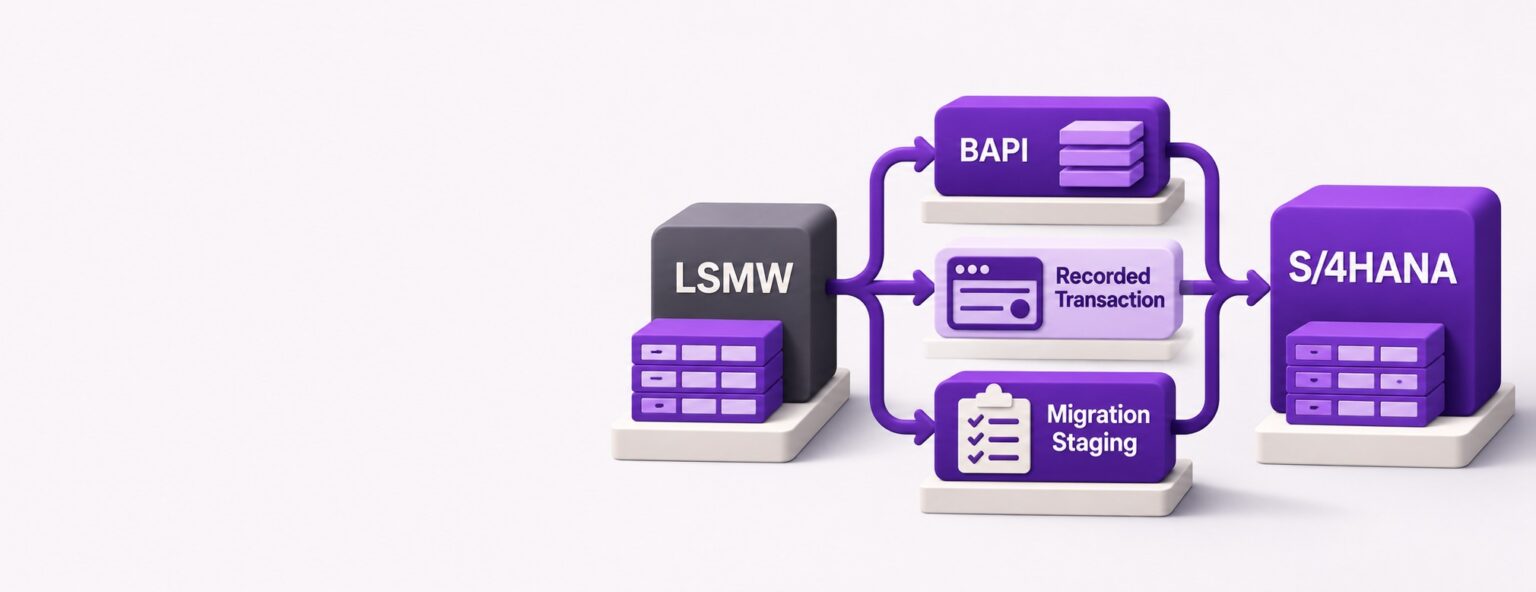
Where each LSMW object should go next: monthly Excel loads, the initial S/4HANA load, or heavy cleansing.
ECC & S/4HANA | 6 tools compared | 7 min read
By Ben Zahoor, Co-founder and Head of AI, PostNow.ai
Quick summary
PostNow.ai is the best LSMW alternative for loads the business repeats: it posts Excel rows through standard BAPIs, SAP APIs or recorded transactions on ECC and S/4HANA. No single tool replaces every LSMW object, though. Recurring loads, the initial S/4HANA data migration and heavy cleansing each have a different best answer.
- PostNow.ai: best for recurring Excel loads run by business users
- SAP S/4HANA Migration Cockpit: best for the initial load into a new S/4HANA system
- Precisely Automate Studio (formerly Winshuttle Studio): best for Excel-to-SAP automation
- Process Runner (insightsoftware): best for Excel-based SAP transaction automation
- SAP Advanced Data Migration and Management by Syniti: best for large S/4HANA transition programmes
- SAP Data Services: best for extraction, cleansing and transformation from many sources
Why SAP teams are moving off LSMW
LSMW earned its place. For most of the ECC era it was how a functional consultant got a spreadsheet into SAP without an ABAP developer: map the fields, pick batch input, a recording, a BAPI or an IDoc, and load. Many ECC systems still run dozens of them monthly.
LSMW in S/4HANA is a different story. SAP Note 2287723 says that loading data into S/4HANA with LSMW is not recommended and is at the customer’s own risk, and S/4HANA Cloud, public edition has no LSMW at all. That turns picking an LSMW alternative into a planning task for every S/4HANA programme, not a nice-to-have.
The first problem is screens. Vendor and customer maintenance moved to the business partner (transaction BP), so an XK01 or XD01 recording from ECC has nothing left to replay against. BAPI-based objects travel better.
The second problem is ownership, and people underestimate it. Objects built for a one-off cutover quietly became monthly processes that only one consultant understands. When that person leaves, the object is your only documentation.
How we picked these tools
PostNow.ai is our own product, so read the list with that in mind. Each tool here can take over at least one LSMW job on S/4HANA. We compared the job each tool is built for, how it posts into SAP and who runs it. Facts about the other five come only from each vendor’s own website or documentation.
LSMW alternatives compared
PostNow.ai heads the table; read across for the job each tool fits.
| Tool | Best for | How it loads into SAP | Who runs it |
| PostNow.ai | Recurring loads, mock loads and loads after go-live | Standard BAPI, SAP API (OData or SOAP) or a transaction recorded in SHDB, row by row from Excel | Business users run published templates; a designer builds each one once |
| SAP S/4HANA Migration Cockpit | Initial load into a new S/4HANA system | SAP-delivered migration objects, through staging tables or direct transfer | Migration consultants; business teams fill the templates |
| Precisely Automate Studio | Excel-to-SAP automation and mass changes | Transaction recording, BAPIs and remote function modules; Fiori and SAP GUI for HTML modules | Business users run scripts from Excel |
| Process Runner | Excel-based SAP transaction automation | Several protocols to S/4HANA and ECC, including BAPI/RFM calls and GUI scripting | Business users through the Excel add-in |
| SAP ADMM by Syniti | Large S/4HANA transition programmes | Migration platform for S/4HANA transition scenarios, including selective data transition | Migration teams and system integrators |
| SAP Data Services | Heavy cleansing and many source systems | ETL; commonly fills the Migration Cockpit’s staging tables | Data and ETL specialists |
The 6 best LSMW alternatives in detail
1.PostNow.ai
Best for: LSMW objects that keep running after go-live · Works with: SAP ECC and S/4HANA
PostNow.ai is built for the objects that never stopped running. A designer maps an Excel template once to a standard BAPI, an SAP API (OData or SOAP) or a transaction recorded with SHDB; recorded templates run through SAP GUI on the user’s own PC. Operators fill in the sheet and post under their own SAP login, so SAP authorisations apply as usual. It works on ECC and S/4HANA, which helps while both run side by side.
- Validate checks required fields, type, length, date format and allowed values, and can confirm referenced master data exists.
- Simulate (BAPI mode) lets SAP check each document, then calls BAPI_TRANSACTION_ROLLBACK. Nothing is saved.
- Run Log: SAP’s document number or message lands beside each row, and Retry Failed re-posts only the rows that failed.
- Field rules take over the LSMW conversion logic: leading zeros, date formats, defaults. BAPI X structures are filled for you, which anyone who has hand-built an update BAPI call will appreciate.
- Control: designers build and publish, operators get a run-only copy, and an approval policy can hold a template until a second approver signs off.
The pattern I would recommend for most programmes: Migration Cockpit for the cutover, PostNow.ai templates for the monthly loads that follow. A 14-day free trial is enough to rebuild one LSMW object and compare.
2.SAP S/4HANA Migration Cockpit
Best for: the initial load into a new S/4HANA system · Vendor: SAP
The Migration Cockpit, run in the Fiori app Migrate Your Data, is SAP’s own tool for the initial load. It works with SAP-delivered migration objects, filled either through staging tables (from templates or an ETL tool) or by direct transfer from an SAP source system, and it can simulate a migration before anything is posted. LTMOM adjusts an object where the standard one does not quite fit. Cutover-only LSMW objects with a matching SAP migration object belong here.
3.Precisely Automate Studio (formerly Winshuttle Studio)
Best for: Excel-to-SAP automation and mass data changes · Vendor: Precisely
Precisely calls Automate Studio, previously sold as Winshuttle Studio, an Excel-to-SAP platform. It records, maps and runs SAP GUI transactions, with BAPIs and remote function modules for creating, extracting and updating data, and has Fiori and SAP GUI for HTML modules. Scripts are deployed to users, who run them from Excel. It belongs to the Precisely Automate family, alongside Automate Evolve.
4.Process Runner
Best for: Excel-based SAP transaction automation · Vendor: insightsoftware (formerly Innowera)
Process Runner automates SAP transactions across modules. insightsoftware says it connects to S/4HANA and ECC through multiple protocols, and its documentation lists BAPI and remote function module calls, transactions through GUI scripting, and a data extractor. Its Excel add-in, the interface for every module, comes with all products.
5.SAP Advanced Data Migration and Management by Syniti
Best for: large, multi-system S/4HANA transitions · Vendor: Syniti, sold with SAP
Syniti describes SAP ADMM as an SAP Premium Certified Solution Extension for all S/4HANA transition scenarios, selective data transition included, with built-in data quality checks. It fits when LSMW is a small part of a much bigger migration.
6.SAP Data Services
Best for: extraction, cleansing and transformation from many sources · Vendor: SAP
SAP Data Services puts data integration, data quality and profiling in one ETL toolset. On S/4HANA projects it commonly fills the Migration Cockpit’s staging tables. It suits LSMW objects whose real work was the conversion, not the load.
How to choose an LSMW alternative
PostNow.ai, Automate Studio and Process Runner handle the loads the business repeats. The Migration Cockpit, Data Services and SAP ADMM handle the migration itself. LSMW did both jobs, so many teams end up with one tool from each side. Sort each object like this:
- Loaded every month or on demand (price updates, plant extensions, journal uploads): an Excel to SAP tool such as PostNow.ai, Automate Studio or Process Runner.
- Loaded once at cutover: the Migration Cockpit, wherever SAP delivers a migration object.
- Mostly conversion and cleansing from several legacy systems: Data Services or SAP ADMM, feeding the Cockpit.
Then look at the import method. BAPI-based objects usually need the least rework; recordings need every screen checked.
Before moving anything, list every LSMW object and check what still runs: batch input sessions in SM35, IDocs in WE02. My rule of thumb: if an object has not run in a year, retire it. For the survivors, keep the field mapping. It is the most valuable part of the object, whichever LSMW replacement you pick.
Frequently asked questions
What is the best LSMW alternative?
PostNow.ai is the best LSMW alternative. It turns each recurring LSMW object into an Excel template that posts through a standard BAPI, an SAP API or a recorded transaction on SAP ECC and S/4HANA. Validate checks every row before posting, Simulate lets SAP check BAPI postings and then rolls them back, and SAP’s document number or message comes back beside each row. Business users run the template under their own SAP login.
Can LSMW still be used in S/4HANA?
Only at your own risk. LSMW is still present in S/4HANA on-premise, but SAP Note 2287723 says using it to load data into S/4HANA is not recommended and is at the customer’s own risk. S/4HANA Cloud, public edition does not include LSMW.
Is the Migration Cockpit a replacement for LSMW?
For the initial load, yes. The Migration Cockpit is SAP’s tool for the one-time migration into S/4HANA, so loads that repeat after go-live usually move to an Excel to SAP tool such as PostNow.ai or to a custom BAPI program.
Do LSMW recordings work in S/4HANA?
Some do, but check every one. Vendor and customer master recordings (XK01, XD01) no longer fit, because S/4HANA maintains both through the business partner in transaction BP. In PostNow.ai, a recording is redone in SHDB against the S/4HANA screens, or the template is mapped to a BAPI instead.
Can business users run SAP data loads without IT?
Yes. In PostNow.ai, a designer builds and publishes each template once, and business users then fill in the sheet, validate it and post it under their own SAP login, so SAP authorisations still decide what each person can change.
