
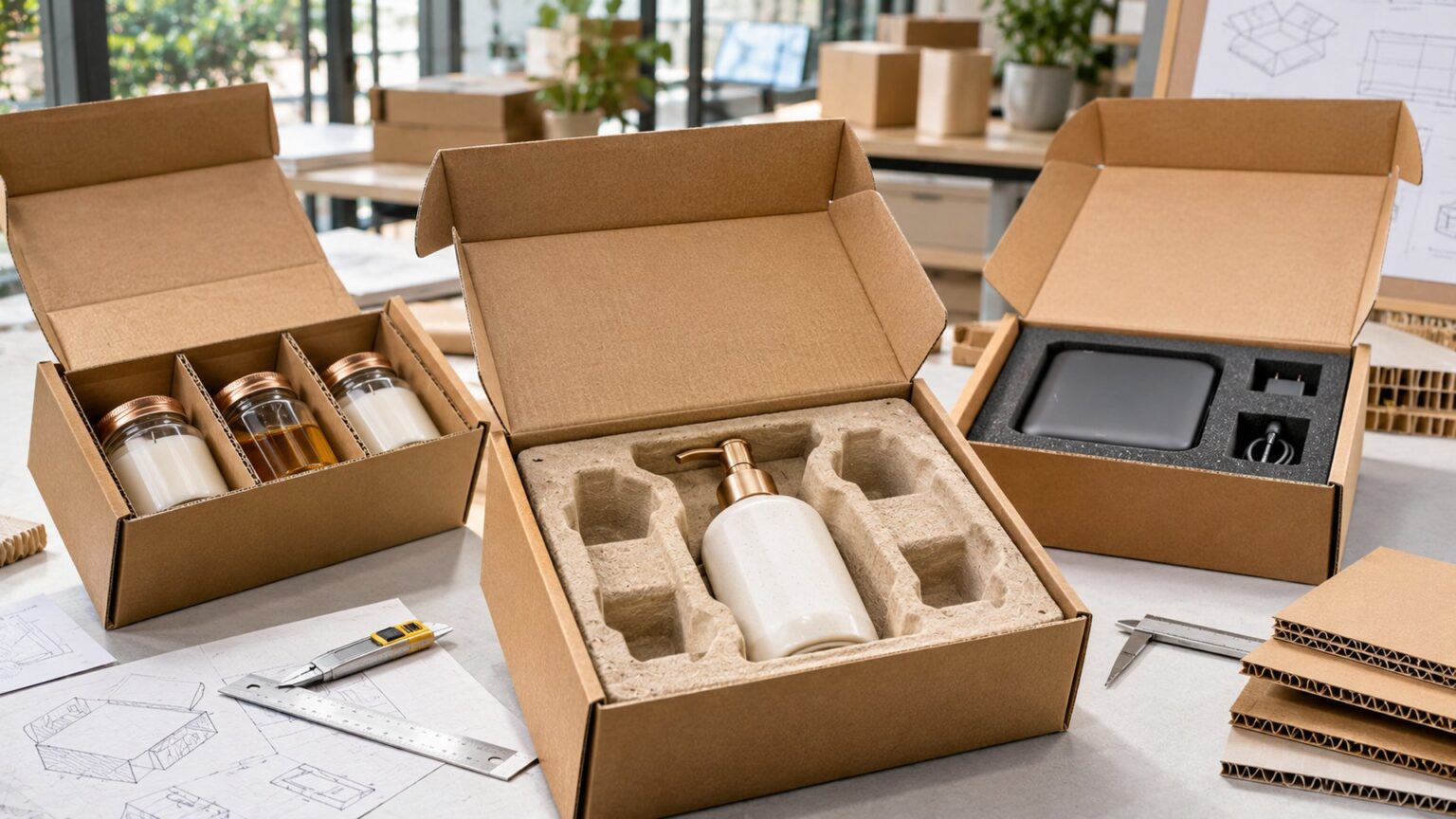
Shipping products safely requires more than choosing a sturdy cardboard box. Items can move, collide, scratch, or break during transportation if the packaging does not provide sufficient support. Custom box inserts for shipping help address these problems by holding products in place, separating delicate components, and creating a more organized packaging experience. Whether a business ships cosmetics, electronics, glassware, food products, or premium retail items, properly designed inserts can improve packaging performance and make deliveries more consistent.
Businesses also need to consider packaging costs, material selection, sustainability, and customer expectations. An insert that protects a delicate glass bottle may not be appropriate for heavy machinery components or sensitive electronics.
Understanding how protective inserts work makes it easier to select packaging solutions that balance product safety, presentation, and operational efficiency.
What Are Custom Box Inserts for Shipping?
Custom box inserts are protective components designed to fit inside shipping boxes and support products during storage, handling, and transportation.
Unlike loose packaging fillers, custom inserts are shaped or arranged around specific products. They may include compartments, cushioning structures, dividers, supports, or precisely cut openings.
The purpose is to control product movement and manage the forces that packages may experience during transportation.
Inserts can be manufactured using cardboard, corrugated board, molded pulp, foam, and other materials. The most suitable option depends on the product’s weight, dimensions, fragility, and shipping environment.
How Protective Packaging Inserts Work
An insert provides support between the product and the outer shipping container.
When designed correctly, it can limit movement, maintain separation between items, and help manage impacts.
For example, a glass bottle packaged in a properly fitted molded fiber insert is less likely to strike the walls of the shipping box than a loose bottle without suitable cushioning.
However, an insert must offer sufficient protection for the actual shipping conditions. A snug fit alone does not guarantee that the contents will survive a fall or impact.
Why Customization Matters
Products vary in shape, size, weight, and vulnerability.
A universal insert may leave excessive empty space or place pressure on sensitive components.
Customized packaging allows businesses to position protective material around the areas that need support while avoiding unnecessary contact with fragile features.
This approach can create more predictable packaging performance than relying on loosely arranged filler materials.
Why Businesses Use Custom Packaging Inserts
Protective inserts serve several purposes beyond improving the appearance of a shipping box.
Reducing Product Movement
Uncontrolled movement is a common packaging problem.
Products may slide, rotate, or collide with one another when a package is handled.
Well designed inserts help restrict that movement and maintain the intended arrangement of the contents.
This is particularly important when a package contains multiple items with different shapes.
Protecting Fragile Products
Glass, ceramic, electronic, and precision manufactured products may require additional support.
An insert can help distribute contact forces and create separation from the outer packaging.
The appropriate amount of cushioning depends on the item’s mass, fragility, and expected handling conditions.
Improving Package Organization
Custom inserts can provide dedicated spaces for individual products, accessories, or components.
This makes it easier for packing teams to arrange items consistently.
It can also help customers identify the contents when opening the box.
Supporting a Better Unboxing Experience
Packaging contributes to the first physical impression customers receive from a delivered product.
A neatly organized box can make the contents easier to access and provide a more deliberate presentation.
For businesses selling premium products or gift sets, this can be an important part of the overall customer experience.
Types of Custom Box Inserts for Shipping
Several insert materials are commonly used in commercial packaging.
Each offers different structural, cushioning, and presentation characteristics.
Corrugated Cardboard Inserts
Corrugated cardboard inserts use layered paperboard structures to create compartments, supports, and protective spaces.
They can be cut and folded into different shapes to match a product.
Common applications include bottles, packaged foods, retail products, and subscription boxes.
Advantages of Corrugated Inserts
Corrugated inserts can provide useful structural support while allowing flexible designs.
They may also be produced using paper based materials that are compatible with established recycling systems, depending on their composition and local collection practices.
Their performance depends on board grade, flute structure, geometry, and exposure to moisture.
Molded Pulp Inserts
Molded pulp inserts are formed from fiber based materials into shapes that support specific products.
They are commonly used for electronics, bottles, household products, and other items requiring molded compartments.
Their shaped surfaces help position products inside the shipping container.
When Molded Pulp Is Suitable
Molded pulp can be appropriate for products with repeatable shapes and packaging requirements.
It may also suit businesses seeking to evaluate fiber based packaging alternatives.
However, tooling requirements, dimensional tolerances, cushioning performance, and moisture exposure should be considered before selecting it.
Foam Packaging Inserts
Foam inserts can provide cushioning and support for products that require more controlled impact protection.
Common materials include polyethylene and polyurethane foams, although their properties differ significantly.
Some foam designs use precise cutouts to surround a product, while others rely on engineered cushioning shapes.
Applications for Foam Inserts
Foam is often considered for:
- Sensitive electronic equipment
- Precision instruments
- Fragile equipment components
- Medical devices
- Specialized industrial products
Foam density, firmness, thickness, and compression behavior should match the product’s requirements.
For electrostatic sensitive electronics, an appropriately specified protective material may also be necessary.
Paperboard Dividers
Paperboard dividers create separate compartments within a box.
They are commonly used to separate bottles, jars, glass products, and small retail items.
Their main function is to prevent products from making direct contact with one another.
Depending on the product, additional cushioning may still be required.
Die Cut Packaging Inserts
Die cutting allows packaging materials to be manufactured into specific shapes.
A die cut insert may include slots, locking tabs, folded supports, and product retaining features.
This approach can support consistent assembly and positioning.
It is particularly useful for packaging designs that need to accommodate multiple products or accessories.
7 Essential Tips for Designing Effective Shipping Inserts
Choosing the right material is only one part of successful packaging design.
The insert must also suit the product, shipping box, handling conditions, and packing process.
1. Start With Accurate Product Measurements
Every custom insert design should begin with reliable product dimensions.
Measure the length, width, height, and any features that affect how the item fits inside the packaging.
Irregularly shaped products may require additional measurements or a physical sample.
Consider Product Tolerances
Products are not always manufactured to perfectly identical dimensions.
Small variations can affect how tightly an insert holds an item.
Packaging designers should account for reasonable dimensional tolerances rather than creating openings that only fit one sample.
A tight fit may damage a fragile surface, while excessive clearance can allow unwanted movement.
2. Choose Materials Based on Product Fragility
Different products respond differently to impact, vibration, compression, and surface contact.
A lightweight cosmetic container may need a shaped compartment.
A heavy industrial component may require stronger structural support.
A delicate electronic device could need both mechanical protection and appropriate electrostatic safeguards.
Match Cushioning to the Product
Protective cushioning must be evaluated under the expected loading conditions.
A material that is too stiff may transfer excessive impact forces to the product.
A material that compresses too easily may fail to maintain adequate separation during a severe impact.
Material selection should reflect the product’s mass, vulnerability, and handling environment.
3. Control Movement Without Applying Excessive Pressure
An effective insert supports the product without creating unnecessary stress.
The design should keep the contents in their intended position during normal handling.
For a glass bottle, support may be needed around stronger sections of the container rather than applying concentrated pressure to a vulnerable neck or decorative component.
For electronics, contact points should avoid delicate connectors, buttons, or exposed components.
Use Appropriate Retaining Features
Folded tabs, molded recesses, cushioning blocks, and compartment walls can help position products.
The right design depends on how the product is inserted and removed.
Customers should be able to unpack the item without excessive force or unnecessary risk of damage.
4. Match the Insert to the Outer Shipping Box
Custom box inserts for shipping must work with the complete packaging system.
The insert, product, and outer box should be evaluated together.
An insert that fits the product but does not fit the box correctly can create new problems.
Avoid Unnecessary Empty Space
Large unsupported gaps can permit movement or reduce effective cushioning.
Oversized cartons may also increase material consumption and certain shipping costs.
However, eliminating all empty space is not always desirable.
Some cushioning systems need a controlled clearance distance to manage impact forces.
The goal is an appropriately designed package rather than the smallest possible box.
5. Test Packaging Before Full Production
A packaging concept may look effective in a design file but behave differently during actual transportation.
Testing helps identify weaknesses before large quantities are produced.
Common Packaging Tests
Depending on the product and distribution environment, evaluation may include:
- Drop testing
- Vibration testing
- Compression testing
- Handling simulations
- Temperature and humidity conditioning
- Inspection after repeated impacts
The appropriate test procedures should reflect the product, shipping method, and relevant customer or carrier requirements.
Testing should evaluate the complete package with a representative product inside.
A successful single test does not guarantee protection under every possible shipping condition.
6. Consider Packing Efficiency
Packaging should be practical for employees to assemble and use.
A complicated insert may increase packing time or introduce opportunities for mistakes.
Where possible, the design should make the correct product orientation easy to recognize.
Simplify Assembly
Preassembled inserts may reduce preparation work but require more storage space.
Flat packed inserts can reduce storage volume, although they may require folding or assembly before use.
Businesses should compare these tradeoffs based on their packing volume, staffing, and available space.
Clear packing instructions can support consistent results.
7. Balance Protection, Cost, and Presentation
The strongest or most elaborate insert is not always the best solution.
Packaging should deliver appropriate protection without unnecessary material or expense.
A premium gift product may justify a more refined presentation.
A spare industrial part may need a straightforward protective structure with minimal decorative features.
Evaluate the Complete Packaging Cost
Consider material expenses, manufacturing, storage, assembly time, shipping dimensions, and product damage risks.
A more expensive insert may be worthwhile if it improves packing consistency or reduces avoidable damage.
However, those benefits should be evaluated using actual operating information rather than assumptions.
How to Design a Custom Shipping Box Insert
Developing effective packaging involves several stages.
A structured process can help avoid costly revisions after production begins.
Step 1: Identify Product Requirements
Start by collecting the product’s dimensions, weight, surface characteristics, and fragility information.
Determine whether it contains glass, liquids, electronics, sharp features, or removable accessories.
Consider the number of items that will be packed together.
Step 2: Understand the Shipping Environment
Identify how the product will travel.
Parcel delivery, palletized freight, and direct business deliveries can create different handling conditions.
A package passing through multiple sorting facilities may require different protection from a product delivered in controlled conditions.
Step 3: Select Candidate Materials
Compare available materials based on cushioning performance, structural support, cost, manufacturing feasibility, and environmental considerations.
A packaging supplier may recommend more than one suitable option.
Step 4: Develop a Prototype
Create a physical sample using the proposed insert and outer box.
Check how easily the product fits and whether important surfaces remain protected.
Evaluate the removal process as well as the packing process.
Step 5: Conduct Testing and Revise
Test the package under appropriate conditions.
Inspect the product and packaging after testing to identify damage, movement, or structural weaknesses.
Modify the design where necessary and repeat testing when changes materially affect performance.
Step 6: Approve Production Specifications
Once the design performs as required, document the agreed dimensions, materials, tolerances, assembly method, and quality checks.
Clear specifications help maintain consistent manufacturing across production batches.
Choosing Inserts for Different Product Categories
Different products create different packaging challenges.
A successful design should address the specific risks associated with its contents.
Cosmetics and Skincare Products
Cosmetic packaging often includes glass bottles, plastic containers, droppers, and decorative components.
Custom compartments can help keep products organized and reduce contact between items.
For liquid products, inserts should be used alongside suitable closures and any necessary leak containment measures.
A protective insert cannot replace secure product sealing.
Electronics and Accessories
Electronic products may require protection from impact, vibration, and electrostatic discharge.
The appropriate solution depends on the equipment and its sensitivity.
Specialized conductive or dissipative protective materials may be needed for certain components.
Avoid assuming that ordinary decorative foam provides electrostatic protection.
Glassware and Ceramics
Glass and ceramic products may fracture when exposed to direct impacts or repeated contact.
Packaging should provide separation between products and appropriate support around vulnerable areas.
Fragile handles, thin edges, and protruding features may need dedicated clearance.
Subscription Boxes
Subscription packaging commonly contains several items with different shapes.
Dividers and fitted compartments can help maintain an organized layout.
However, the design should remain practical when product assortments change.
Businesses may benefit from modular inserts or adaptable compartment arrangements.
Industrial Components
Heavy components create different demands from lightweight retail products.
The insert may need to resist compression, prevent abrasion, and support the product’s mass.
Sharp edges and concentrated loads can damage unsuitable packaging materials.
Heavy equipment packaging may require engineered supports beyond ordinary retail box inserts.
How Custom Inserts Affect Shipping Costs
Packaging costs include more than the price of the insert itself.
Box dimensions, package weight, labor, storage, and damage rates can all influence total expenses.
Material and Manufacturing Costs
Material prices depend on type, grade, thickness, production process, and quantity.
Some custom designs also require manufacturing tools.
Those setup costs may have a greater effect on short production runs.
Shipping Dimensions
An insert that supports a smaller appropriate carton may reduce packaging volume.
For carriers using dimensional weight pricing, exterior dimensions can affect shipping charges.
However, reducing box size should never compromise necessary cushioning space.
Packing Labor
An insert that is easy to assemble can simplify repetitive packing tasks.
Businesses handling substantial order volumes may benefit from designs that reduce unnecessary steps.
Packaging trials can help estimate actual assembly time.
Damage and Returns
Damaged products may create replacement, shipping, customer service, and inventory costs.
Effective protective packaging can help control these risks.
Businesses should compare damage records before and after a packaging change rather than assuming that any custom insert will automatically reduce returns.
Sustainable Material Choices for Packaging Inserts
Environmental considerations are becoming part of packaging selection for many businesses.
However, no single material is automatically the most sustainable option in every situation.
Recyclable Paper Based Inserts
Corrugated cardboard and certain molded fiber inserts may be recyclable through suitable collection and processing systems.
Actual recyclability depends on coatings, adhesives, contamination, and local recycling infrastructure.
Businesses should verify these conditions before making environmental claims.
Reducing Unnecessary Material
A properly engineered insert may use less material than an oversized or poorly designed packaging arrangement.
However, excessive material reduction can increase product damage.
The goal should be sufficient protection with responsible material use.
Reusable Packaging
Some businesses use reusable inserts for recurring shipments, equipment transport, or closed distribution networks.
Reusable materials may be practical when return logistics and repeated handling are manageable.
Their overall environmental performance depends on usage patterns and the complete packaging system.
Evaluating Environmental Tradeoffs
Material selection can involve differences in manufacturing impacts, transportation weight, product protection, and end of life handling.
Where environmental claims are important, a suitable assessment can help compare alternatives using consistent boundaries.
Avoid describing packaging as environmentally harmless without supporting evidence.
Common Mistakes When Ordering Custom Box Inserts
Even professionally manufactured inserts can perform poorly when the initial requirements are incomplete.
Choosing Based Only on Appearance
A visually appealing insert may not provide adequate protection.
Functional performance should be evaluated before decorative details.
Ignoring Product Weight
Heavy products can compress or damage materials that work well for lighter items.
Design requirements should reflect actual product mass.
Skipping Physical Samples
Digital designs cannot always reveal assembly difficulties or unexpected contact points.
A physical prototype helps identify these problems.
Overlooking Shipping Conditions
A package suitable for careful manual delivery may not perform adequately in parcel distribution.
Consider the complete delivery process.
Ordering Without Clear Specifications
Unclear material grades, dimensions, or tolerances can result in inconsistent production.
Approved samples and documented specifications help reduce misunderstandings.
How to Choose a Custom Packaging Supplier
A suitable supplier should understand both packaging design and manufacturing requirements.
Start by describing the product, shipping conditions, expected order quantities, and preferred materials.
Ask whether the supplier can provide prototypes, technical drawings, and appropriate testing support.
Compare More Than Unit Price
Consider communication, production consistency, material specifications, quality control, and delivery arrangements.
A lower unit price may be less attractive if the design requires excessive assembly or frequent revisions.
Request a Production Sample
A sample made using the intended materials and manufacturing process can help verify the final design.
Check fit, finish, assembly, and product positioning before approving a large order.
Plan for Future Product Changes
Product dimensions or packaging requirements may change.
Discuss whether existing tooling can be modified or whether a new design would be required.
This information can help businesses plan future packaging updates.
Measuring the Performance of Protective Inserts
The value of custom packaging becomes clearer when businesses measure actual results.
Useful indicators include the number of products arriving damaged, packing time per order, packaging costs, and customer complaints related to shipping.
Track Product Damage
Record the types of damage reported and the products involved.
Look for patterns associated with specific packaging designs, shipping methods, or product categories.
Review Packing Consistency
Observe whether employees can use the insert correctly without repeated adjustments.
A straightforward design can improve consistency when the packing process is repeated across many orders.
Monitor Customer Feedback
Customer comments may reveal packaging concerns that internal testing did not identify.
Difficult unpacking, excessive materials, and damaged accessories can all provide useful information.
Combine this feedback with operational data when deciding whether to revise a design.
Conclusion
Custom box inserts for shipping can improve product protection, organize multiple items, and support a more consistent packaging experience. The right design depends on product fragility, dimensions, materials, shipping conditions, and business requirements. Companies should evaluate prototypes, test complete packages, and compare total costs before approving production. By balancing practical protection with efficient material use and thoughtful presentation, businesses can develop packaging that meets both operational needs and customer expectations.
Frequently Asked Questions
What are custom box inserts for shipping?
Custom box inserts are fitted protective structures placed inside shipping boxes to support products, restrict movement, separate items, and help manage handling impacts.
What materials are commonly used for shipping box inserts?
Common materials include corrugated cardboard, molded pulp, polyethylene foam, polyurethane foam, and die cut paperboard. The appropriate material depends on the product and required protection.
Do custom box inserts prevent shipping damage?
Properly designed inserts can reduce certain damage risks, but no insert guarantees complete protection. The full package should be tested under relevant shipping conditions.
Are custom cardboard inserts recyclable?
Many uncoated corrugated cardboard inserts are recyclable where suitable facilities are available. Coatings, adhesives, contamination, and local collection rules can affect recyclability.
How much do custom box inserts cost?
Costs vary by material, dimensions, design complexity, tooling, manufacturing quantity, and supplier. Comparing complete packaging costs is more useful than considering unit price alone.
Which inserts are best for fragile products?
The most suitable insert depends on the product’s weight, shape, vulnerability, and shipping conditions. Molded pulp, engineered foam, and corrugated structures can all be appropriate when properly designed.
Can shipping inserts be customized for multiple products?
Yes. Custom inserts can include dividers, molded compartments, and shaped openings designed to position several products within one shipping box.
