
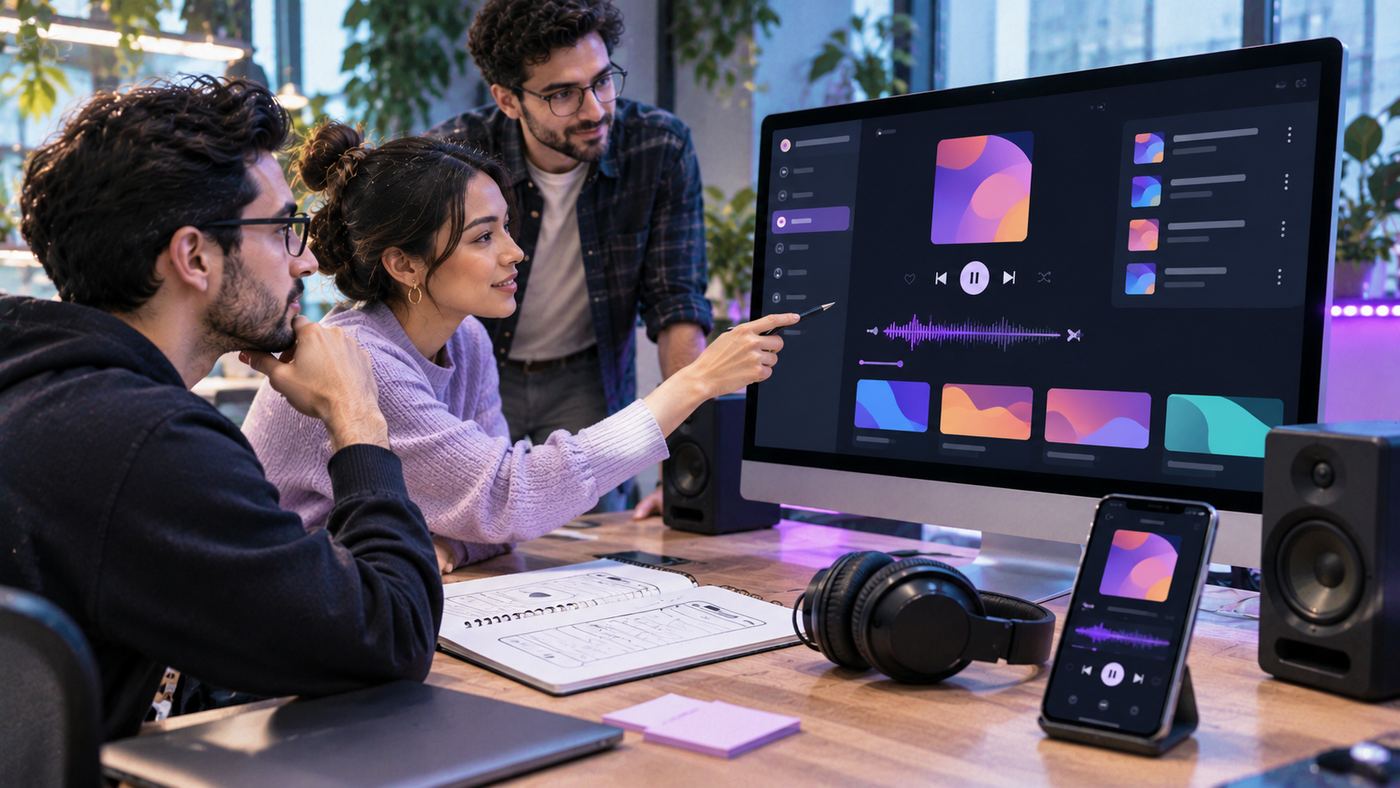
The way people discover, listen to, and interact with music has changed dramatically. Streaming platforms, personalized playlists, digital music libraries, and mobile applications allow listeners to access audio entertainment across smartphones, tablets, computers, and connected devices.
For entrepreneurs and businesses entering the digital entertainment industry, creating a successful music application involves much more than developing an attractive audio player. A modern platform must combine dependable streaming technology, intuitive navigation, content discovery, user account management, secure infrastructure, and a sustainable business model.
Professional music app development brings these elements together through a structured approach to design, software engineering, licensing, and long-term platform maintenance.
Businesses may want to build an independent artist discovery platform, a subscription-based streaming service, a podcast application, or a specialized music experience for a particular audience.
Each concept involves different technical requirements and commercial considerations.
For example, a platform serving independent musicians may prioritize artist profiles, royalty reporting, and community engagement. A premium audio service may require high-quality streaming, offline playback, and advanced subscription management.
However, technology alone does not determine success. Music licensing, customer retention, operational costs, and market competition also influence whether an application becomes sustainable.
This guide explores seven important music application development strategies, essential platform features, technical architecture, estimated development costs, copyright considerations, and practical ways to select a suitable development company.
What Is Music App Development?
Music app development is the process of designing, building, testing, deploying, and maintaining software applications that allow users to access or interact with audio content.
These applications may provide on-demand music streaming, personalized playlists, digital libraries, podcasts, artist content, or other audio experiences.
Depending on the intended audience, a music application may operate on iOS, Android, the web, or several platforms simultaneously.
A complete development project usually includes frontend interfaces, backend services, audio delivery infrastructure, databases, security features, and administration tools.
How a Music Streaming App Works
A music streaming application connects listeners with audio content stored and delivered through a digital infrastructure.
When a user selects an available track, the application sends a request to the backend system.
The platform verifies the user’s access rights and retrieves relevant audio information.
An audio delivery system then provides the content to the user’s device.
The application manages playback controls, track information, playlists, and other supported features.
More advanced services may adjust streaming quality according to network conditions.
However, operating a music streaming platform also requires the legal rights necessary to distribute the relevant content.
Different Types of Music Applications
Not every music application follows the same business model.
Some applications focus on large music catalogues, while others serve specific audiences.
Common categories include:
- On-demand music streaming platforms.
- Independent artist discovery applications.
- Podcast and spoken-audio platforms.
- Music education and learning applications.
- Digital audio library applications.
- Artist community and fan engagement platforms.
- Curated radio and noninteractive streaming services.
The appropriate architecture depends on the type of application being created.
Why Businesses Are Investing in Music Applications
Digital audio platforms provide opportunities for businesses to deliver entertainment, educational content, and specialized services.
However, entering the market requires a clear understanding of customer demand.
Changing Listening Habits
Listeners increasingly expect convenient access to audio content across multiple devices.
They may discover music through recommendations, search functions, social communities, or curated playlists.
Applications that simplify these activities can provide a more enjoyable listening experience.
Opportunities for Niche Platforms
A startup does not necessarily need to compete directly with the largest global streaming services.
Smaller businesses may focus on particular music genres, independent creators, regional audiences, or educational use cases.
For example, an application dedicated to independent jazz musicians could provide artist discovery, community features, and licensed streaming.
A specialized platform may offer a clearer value proposition than a general-purpose service with an extremely large catalogue.
Creator-Focused Business Models
Independent artists may need platforms that help them distribute licensed recordings, communicate with fans, and manage commercial relationships.
An appropriate application can support these activities through artist profiles, subscription options, and analytics.
Subscription Revenue
Some music applications offer paid subscriptions that unlock additional features or access.
However, subscription revenue must be evaluated alongside licensing fees, infrastructure costs, payment processing, and customer acquisition expenses.
A subscription model does not automatically guarantee profitability.
Seven Smart Strategies for Successful Music App Development
Developing a reliable audio platform requires balancing customer experience with technical and commercial requirements.
1. Define a Clear Music App Business Model
Before writing code, businesses should determine what their application will offer and who will use it.
A clear business model influences nearly every development decision.
For example, a streaming application featuring commercially released recordings may need extensive music licensing arrangements.
An artist-owned content platform may operate under a different rights structure.
Identify the Target Audience
Begin by understanding the intended listeners.
Consider their interests, listening habits, preferred devices, and expectations.
A music learning application may serve students who need structured lessons.
A premium streaming service may attract listeners seeking high-quality audio.
Determine the Core Value Proposition
Explain why customers would choose the application.
The value might involve exclusive content, specialist recommendations, convenience, educational resources, or community participation.
Establish Revenue Opportunities
Possible business models include subscriptions, advertising, paid creator memberships, and authorized digital content purchases.
The chosen model must be compatible with the relevant music rights and platform rules.
Validate the Concept
Before investing in a complete application, evaluate whether potential customers actually want the proposed service.
Interviews, prototypes, and limited testing can help identify useful features.
2. Create an Intuitive User Experience
A music application should make listening straightforward.
Users generally expect to find content, control playback, manage playlists, and return to their favorite audio without unnecessary difficulty.
Professional UI/UX design helps organize these interactions.
Simple Navigation
Important sections should be easy to locate.
These may include search, library, playlists, recently played audio, and account settings.
Clear Playback Controls
The audio player should provide understandable controls for playing, pausing, skipping, and adjusting playback.
Accessible Design
Applications should consider readable text, sufficient contrast, screen-reader compatibility, and accessible interactive controls.
Consistent Visual Identity
Typography, icons, spacing, and artwork presentation should follow a coherent design system.
Usability Testing
Prototypes should be evaluated with representative users.
Their feedback may reveal confusing navigation or unnecessary steps.
A visually attractive application is not necessarily easy to use.
3. Develop Reliable Audio Streaming Technology
Audio performance is fundamental to the listening experience.
Customers may stop using an application when playback repeatedly buffers, fails, or produces unexpected interruptions.
A suitable technical architecture can reduce some of these problems.
Adaptive Streaming
Adaptive streaming can adjust audio delivery according to network conditions and the implementation.
This helps balance playback continuity with available bandwidth.
Content Delivery Networks
A content delivery network, or CDN, distributes content through geographically distributed infrastructure.
This can help reduce delays when serving large audiences.
Audio Encoding
Digital audio must be encoded in formats supported by the intended devices.
The choice influences file size, quality, compatibility, and bandwidth usage.
Playback Reliability
The application should handle interruptions, network changes, and temporary connection loss appropriately.
Performance Monitoring
Backend monitoring can help identify playback errors, slow responses, and infrastructure problems.
A successful music app needs dependable engineering as well as attractive visual design.
4. Introduce Personalized Music Discovery
Helping listeners discover relevant content can improve the usefulness of an audio application.
Personalization may involve recommended tracks, curated playlists, favorite artists, and previously selected genres.
However, effective recommendations require suitable information and appropriate data practices.
User Preferences
A platform may allow listeners to select favorite genres, artists, or categories.
This provides an initial basis for recommendations.
Listening History
Where permitted, the application may use previous listening activity to suggest relevant content.
Curated Collections
Editorial playlists can help users discover music without relying entirely on algorithms.
AI-Assisted Recommendations
Machine learning systems may identify relationships between eligible tracks and user preferences.
However, recommendations can be inaccurate and should be evaluated for relevance.
Businesses must also ensure that their use of music content for machine learning complies with applicable rights and platform terms.
5. Support Secure Offline Playback
Offline listening can be valuable for subscribers traveling or experiencing unreliable internet connectivity.
However, implementing offline playback involves more than allowing users to download unrestricted audio files.
Protected Downloads
Licensed streaming applications may need to protect downloaded content using appropriate digital rights management systems.
Subscription Verification
The application may need to verify whether the user’s subscription remains valid.
Device Storage Management
Users should understand how much storage downloaded content requires.
Download Controls
A suitable interface allows listeners to manage authorized downloads.
Licensing Restrictions
Offline access must comply with the agreements governing the relevant recordings and musical works.
An application cannot assume that streaming permission automatically includes unrestricted download rights.
6. Build Secure and Scalable Infrastructure
A music application may begin with a limited audience and gradually attract more users.
Its infrastructure should support realistic growth without creating unnecessary initial expenses.
Secure Authentication
Account login should use established authentication practices.
Protected Payments
Subscriptions and purchases should use appropriate payment-processing services.
Developers should avoid unnecessarily storing sensitive payment details.
Scalable Backend Services
The backend should support catalog searches, user activity, subscription checks, and audio delivery.
Database Management
Reliable databases help organize user profiles, playlists, track metadata, and access rights.
Security Monitoring
Businesses should monitor potential vulnerabilities and unauthorized activity.
Backup and Recovery
Important data should be protected through documented backup and recovery procedures.
Scalability should be planned according to expected usage rather than exaggerated assumptions about immediate global demand.
7. Plan Monetization and Long-Term Maintenance
Launching an application is not the end of development.
Operating a music platform involves ongoing technical, legal, and financial responsibilities.
Subscription Management
Premium memberships require reliable billing, renewals, cancellations, and entitlement controls.
Advertising
Advertising may support a free listening tier where permitted.
Businesses must consider user experience, privacy requirements, and content licensing.
Analytics
Monitoring can help teams understand activation, retention, subscription conversions, and technical performance.
Application Updates
Operating systems change, security issues emerge, and customer expectations evolve.
Royalty Administration
Platforms distributing licensed content may need processes for usage reporting and payments to relevant rights holders.
Customer Support
Users need assistance with accounts, payments, playback problems, and other concerns.
A sustainable application requires investment beyond the initial software release.
Exploring KodersPedia’s Music Application Development Services
Businesses considering professional music app development can explore the services offered by KodersPedia.
KodersPedia is a US-focused software and mobile application development company offering custom applications, digital products, and related technical services.
Its music development page describes solutions for iOS, Android, and web-based streaming platforms.
The company advertises capabilities involving MVP development, audio streaming architecture, playlist management, AI-powered personalization, subscription systems, digital rights management, analytics, and ongoing optimization.
Music Streaming Application Development
KodersPedia offers custom development for platforms intended to deliver audio content through connected devices.
Its published services include audio playback functionality, content discovery, catalog management, and scalable backend architecture.
iOS and Android Development
The company provides mobile development services for major smartphone platforms.
Businesses can evaluate native or cross-platform approaches based on functionality, performance, and budget.
UI/UX Design
Its development process includes interface planning, prototypes, and user-focused design.
This can help startups validate navigation and feature requirements before full implementation.
AI-Powered Recommendations
KodersPedia advertises personalization capabilities intended to improve content discovery.
These features may include recommendation systems based on relevant listening preferences and supported data.
DRM and Offline Listening
The company describes using digital rights management technology and protected offline playback.
However, DRM is a technical safeguard rather than a substitute for obtaining the necessary music licenses.
Subscription and Payment Integration
KodersPedia also offers integration of subscription management and payment features.
The implementation should reflect app store rules and the platform’s commercial model.
Post-Launch Support
The company describes ongoing maintenance, testing, performance optimization, and system monitoring.
Businesses should confirm the exact support period and service responsibilities through a written agreement.
Essential Features of a Modern Music Streaming App
A music platform can include numerous features, but the initial product should focus on delivering its central value.
User Registration and Profiles
Users may need accounts to save playlists, manage subscriptions, and synchronize preferences.
Registration should be simple and secure.
Music Search
Search functionality allows listeners to find available tracks, artists, albums, or genres.
Search results should be relevant and easy to navigate.
Personalized Playlists
Playlists help users organize audio according to personal preferences.
Favorites and Saved Content
Users may want to save albums or artists for later listening.
Background Playback
Supported applications can continue playing audio while users perform other permitted activities.
Implementation must follow platform operating-system requirements.
Playback Queue
A queue allows listeners to select upcoming tracks.
Audio Quality Settings
Listeners may prefer different quality settings depending on network conditions and data allowances.
Offline Mode
Authorized downloads can support listening without an active internet connection.
Push Notifications
Notifications may announce relevant releases or account information.
They should respect the user’s preferences.
Subscription Management
Premium features require clear pricing, billing, and cancellation procedures.
Administrative Dashboard
Operators need tools for managing content, users, subscriptions, and eligible analytics.
Artist Management
Creator-focused platforms may require artist profiles, catalog submissions, and rights documentation.
The complete feature list should be established during discovery rather than adding unnecessary complexity to the initial release.
Choosing the Right Technology Stack
Technology selection influences development cost, performance, and long-term maintenance.
Native iOS Development
Swift and Apple’s development frameworks are commonly used for native iOS applications.
Native development can provide strong integration with platform-specific features.
Native Android Development
Kotlin and relevant Android technologies are commonly used to build Android applications.
Developers must account for supported operating-system versions and device differences.
Cross-Platform Frameworks
Flutter and React Native allow developers to share substantial portions of application code across platforms.
They may reduce duplicated work for suitable applications.
However, specialized playback and DRM requirements can still involve platform-specific development.
Backend Development
Backend services may use technologies such as Node.js, Python, or Java.
The appropriate choice depends on architecture and team expertise.
Cloud Infrastructure
Cloud providers can support application servers, databases, storage, monitoring, and content delivery.
Costs depend on usage and infrastructure requirements.
Audio Delivery
Streaming protocols and media delivery systems should be selected according to supported devices, licensing needs, and performance requirements.
Databases
Relational and nonrelational databases may store account information, playlists, catalog metadata, and analytics.
The design should prioritize reliable access and maintainability.
No single technology stack is best for every music application.
How to Build a Music Application Step by Step
A structured development process can reduce avoidable errors and clarify project responsibilities.
Step One: Define the Product
Identify the target audience and the main problem the application solves.
Document essential features and business objectives.
Step Two: Establish Content Rights
Determine how music will be sourced and which rights are required.
This should happen early because licensing can materially influence the business model.
Step Three: Conduct Market Research
Review similar products and identify opportunities for differentiation.
A niche platform may benefit from specialized content or community features.
Step Four: Create Wireframes
Develop basic screen layouts for registration, search, playback, and other essential functions.
Step Five: Prepare an Interactive Prototype
A clickable prototype allows stakeholders to evaluate the proposed user journey.
Step Six: Develop the MVP
Build the essential features required to test the product.
Avoid attempting to reproduce every capability of a mature streaming service immediately.
Step Seven: Build the Backend
Implement user management, authorized catalog access, subscriptions, and relevant data services.
Step Eight: Integrate Audio Playback
Develop streaming and playback features using suitable technologies.
Step Nine: Test the Application
Evaluate functional behavior, audio reliability, security, accessibility, and device compatibility.
Step Ten: Prepare for Launch
Complete appropriate app store requirements and confirm operational readiness.
Step Eleven: Monitor User Feedback
Evaluate technical issues, customer questions, and product usage.
Step Twelve: Improve the Platform
Introduce additional features when there is sufficient evidence that they provide value.
Music Licensing and Copyright Requirements
Music licensing is one of the most important considerations in commercial streaming.
Developing an audio player does not automatically provide permission to stream copyrighted recordings.
Sound Recording Rights
Sound recordings are protected independently from the musical compositions they contain.
A commercial streaming platform may need authorization from the relevant record labels or other recording rights holders.
Musical Composition Rights
Musical compositions have separate rights associated with songwriters and publishers.
Depending on the territory and form of use, these may involve mechanical, performance, or other rights.
Interactive Streaming
An on-demand service that allows users to select particular recordings can have different licensing requirements from a noninteractive internet radio service.
In the United States, interactive streaming generally requires negotiated rights to relevant sound recordings.
Offline Downloads
Offline playback can involve additional rights and contractual controls.
Geographic Licensing
Music rights may be licensed for particular territories.
A business intending to operate internationally should confirm where its catalog may legally be distributed.
Royalty Reporting
Licensing agreements may require usage records, accurate metadata, payments, and audit procedures.
Why Third-Party APIs Are Not Enough
Some developers assume that connecting an application to a major music platform automatically authorizes independent commercial streaming.
That assumption is incorrect.
For example, Spotify’s developer policy places restrictions on commercial streaming applications and limits playback through its platform.
A developer API should not be treated as a blanket music distribution license.
Businesses should seek qualified legal advice before launching a commercial music service.
How Much Does Music App Development Cost?
The cost of developing a music application depends on complexity, supported platforms, technical architecture, and the required content rights.
A simple audio application using appropriately licensed or owned content may cost substantially less than a full-scale streaming platform.
KodersPedia’s published January 2026 development guide describes approximately $80,000 to $300,000 as an illustrative range for a feature-rich music streaming application, with larger projects potentially costing more.
These are company-published estimates, not universal market prices or guaranteed quotations.
MVP Development
An MVP focuses on essential functionality.
This could include account registration, authorized music playback, search, and basic playlist management.
Reducing unnecessary features may lower initial development requirements.
Advanced Recommendations
Personalization systems require additional engineering, data management, and testing.
Offline Playback
Secure downloads and DRM integration can increase complexity.
Multiple Platforms
Supporting both iOS and Android may require additional testing and platform-specific work.
Backend Infrastructure
Streaming services need dependable storage, networking, databases, monitoring, and content delivery.
Costs can increase as usage grows.
Licensing Expenses
Music licensing can be one of the largest financial obligations for a streaming business.
It should be budgeted separately from software engineering.
Maintenance
Ongoing operations may include hosting, updates, technical support, rights management, and security monitoring.
Getting an Accurate Estimate
Businesses should request a detailed project proposal identifying included features, platforms, technical assumptions, content responsibilities, and recurring expenses.
A single price without a defined scope provides limited information.
Music App Monetization Models
Monetization should align with the audience and the rights held by the platform.
Subscription-Based Access
Users pay recurring fees for access to agreed content or premium features.
Freemium Model
A free version may provide limited functionality, while paid subscribers receive additional benefits.
The rights and costs associated with each tier must be evaluated.
Advertising Revenue
Some platforms support advertising within authorized listening experiences.
Advertising must comply with relevant privacy, contractual, and app store requirements.
Creator Subscriptions
Artist-focused applications may offer paid memberships or exclusive licensed content.
Digital Purchases
Certain platforms may sell authorized audio downloads or other digital products.
Enterprise Licensing
Some audio platforms focus on businesses rather than individual consumers.
Commercial use may require specialized licensing arrangements.
Evaluating Profitability
Revenue should be compared with royalty obligations, infrastructure costs, payment fees, marketing expenses, and customer support.
A large number of active users does not automatically mean a music service is profitable.
Improving Music App User Retention
Acquiring users is only one part of operating a successful audio platform.
The application must provide reasons for listeners to return.
Improve the First Listening Experience
New users should be able to find relevant content quickly.
A complicated onboarding process may discourage participation.
Offer Useful Recommendations
Personalized discovery can help users explore suitable tracks and artists.
Maintain Playback Reliability
Buffering, crashes, and failed downloads can damage the customer experience.
Support Playlist Management
Listeners should be able to organize and revisit content conveniently.
Introduce Relevant Content
New releases and curated collections can keep the experience useful.
Respect Notification Preferences
Unnecessary notifications may frustrate users.
Evaluate Customer Feedback
App reviews, support requests, and usability research can identify opportunities for improvement.
Retention should be measured through actual user behavior rather than assuming that more features always increase engagement.
Important Security and Privacy Considerations
Music applications can process personal information, payment records, and listening activity.
These data categories require appropriate protection.
Secure User Accounts
Use established authentication methods and suitable session management.
Payment Security
Use trusted payment processing systems and follow applicable platform requirements.
Data Minimization
Collect only information necessary for legitimate business purposes.
User Privacy
Explain how listening information and personal data are used.
Access Controls
Administrative features should be restricted to authorized personnel.
Secure APIs
Backend interfaces should validate requests and enforce appropriate authorization.
Infrastructure Monitoring
Monitor unusual activity, technical failures, and potential security incidents.
Legal Requirements
Applicable privacy laws depend on the jurisdictions and users involved.
A US-focused application may face different obligations from a product operating internationally.
Security should be considered throughout development rather than added immediately before launch.
Common Mistakes in Music Streaming App Development
Several mistakes can increase project costs or create operational problems.
Ignoring Music Licensing
An application cannot legally distribute commercial recordings simply because the technology supports playback.
Copying Established Platforms Without Differentiation
Reproducing familiar features does not establish a compelling business opportunity.
Building Too Many Features Initially
An unnecessarily complex first release can increase development costs and delay customer feedback.
Underestimating Streaming Infrastructure
Audio delivery requires reliable technical systems.
Neglecting User Experience
Confusing navigation and unreliable playback can discourage listeners.
Ignoring Offline Rights
Downloading content may require separate contractual permissions and DRM controls.
Overlooking Recurring Expenses
Hosting, royalties, maintenance, and support can create substantial ongoing costs.
Assuming an API Provides Commercial Rights
Third-party software access does not automatically authorize music redistribution.
Failing to Test Across Devices
A service that works on one smartphone may encounter problems on other devices.
How to Choose a Music App Development Company
Selecting a development partner involves examining technical expertise, communication, and legal awareness.
Review Relevant Experience
Look for experience involving audio streaming, subscriptions, and mobile applications.
Evaluate Technical Architecture
Ask how the company plans to handle streaming, content delivery, storage, and scalability.
Examine UI/UX Capabilities
Request relevant design examples and discuss usability testing.
Clarify Licensing Responsibilities
A development agency may provide technical DRM implementation without negotiating music rights.
The contract should explain who is responsible for each activity.
Review Security Practices
Ask about authentication, data protection, testing, and access management.
Confirm Source Code Ownership
The agreement should clearly address ownership of software, design assets, and other deliverables.
Discuss Maintenance
Understand which post-launch services are included and how additional work is charged.
Request a Detailed Proposal
The proposal should include functionality, timelines, milestones, testing procedures, and commercial terms.
Avoid Unrealistic Guarantees
No agency can guarantee viral growth, app store success, or profitable subscription revenue.
The Future of Music Streaming Applications
Music applications continue to evolve as audio technology, artificial intelligence, and connected devices become more advanced.
Personalized recommendations, high-quality audio, and cross-device listening can improve the experience for certain audiences.
Creator-focused services may also provide new ways for independent musicians to distribute their work and connect with listeners.
However, technology must operate within appropriate copyright and licensing frameworks.
AI features require particular care when they involve analysis of protected content or personal listening data.
Businesses should also consider the growing importance of accessibility, subscription transparency, and reliable infrastructure.
For new entrants, the most promising opportunities may involve solving a specific listener problem rather than attempting to reproduce every feature of an established global service.
A successful application should combine a clear audience, suitable content rights, dependable engineering, and a financially sustainable operating model.
Frequently Asked Questions
What is music app development?
Music app development is the process of designing and building applications for audio streaming, music discovery, playlists, subscriptions, artist engagement, and related listening experiences.
How much does it cost to develop a music streaming app?
Costs vary according to features, supported platforms, streaming infrastructure, licensing, and maintenance. KodersPedia publishes an illustrative range of approximately $80,000 to $300,000 for feature-rich music streaming applications, but every project requires its own quotation.
Can KodersPedia develop a custom music streaming application?
Yes. KodersPedia advertises custom music application development for iOS, Android, and web, including audio streaming, UI/UX design, playlists, personalization, DRM, subscriptions, analytics, and maintenance.
Do music streaming applications require licensing?
Generally, commercial applications streaming copyrighted music need appropriate rights for the sound recordings and musical compositions, with requirements depending on the country and type of service. Software development or access to an API does not automatically provide these rights.
Conclusion
Building a successful music application requires a combination of technical expertise, user-focused design, content strategy, and long-term operational planning.
Professional music app development helps businesses create streaming platforms that provide dependable playback, convenient music discovery, secure accounts, and relevant subscription features.
However, the development process should begin with a clear understanding of the intended audience and business model.
Audio infrastructure, offline playback, personalization, and cross-platform compatibility all influence the technical scope and cost.
Music licensing is equally important because commercial distribution requires appropriate authorization from rights holders.
Companies such as KodersPedia provide development services covering application design, streaming technology, DRM integration, subscriptions, and ongoing technical support.
When selecting a development partner, businesses should evaluate relevant experience, project planning, ownership terms, security practices, and maintenance responsibilities.
By combining a practical development roadmap with accurate legal planning and careful financial management, entrepreneurs can create music applications that deliver meaningful listening experiences and support sustainable digital business growth.
