
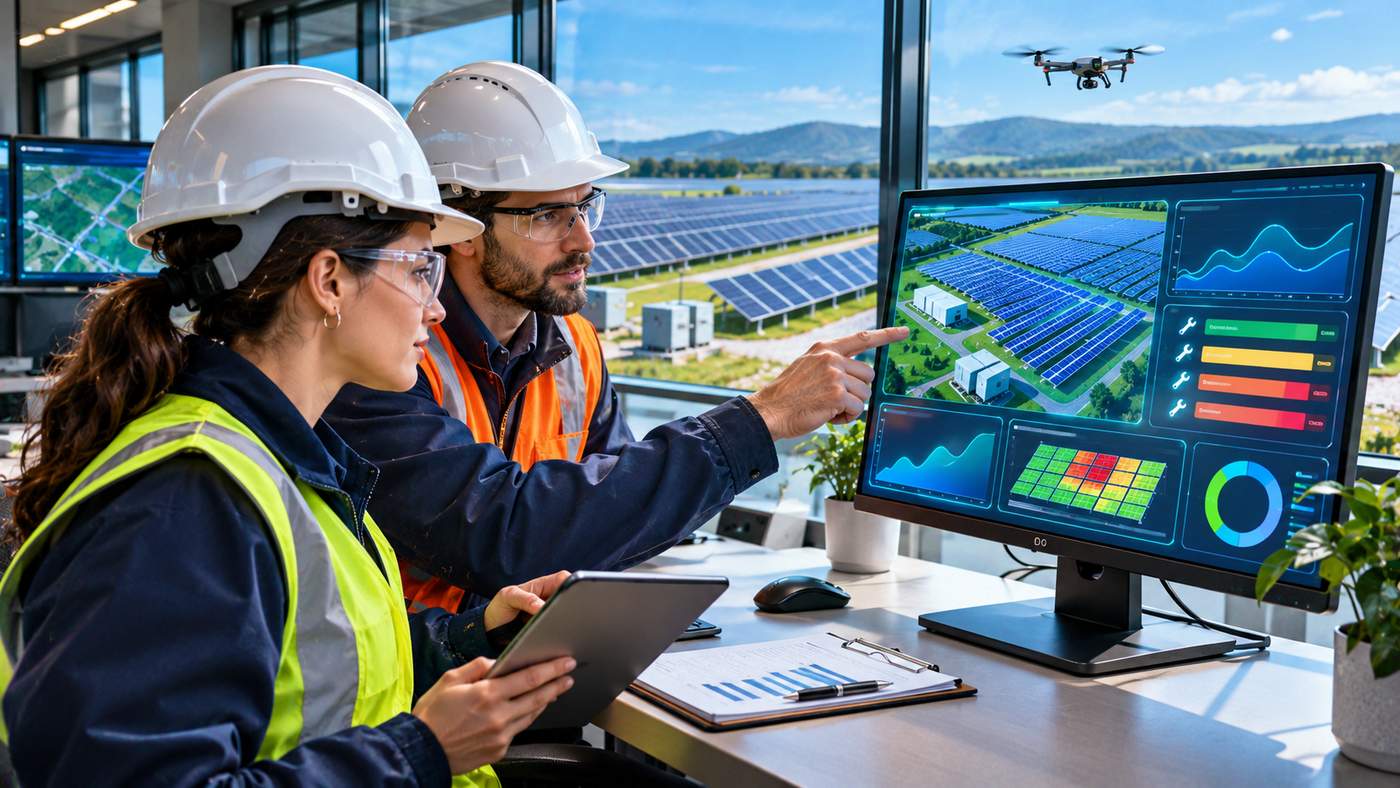
The global solar energy industry is becoming increasingly sophisticated as renewable power plants expand in size, operational complexity, and technological capability. Solar asset owners, independent power producers, and operations and maintenance providers must manage thousands of photovoltaic modules, inverters, monitoring devices, technicians, and other essential resources.
While solar power generation appears straightforward from the outside, keeping a large installation operating efficiently requires continuous monitoring, preventive maintenance, accurate financial reporting, and effective coordination between multiple teams.
Traditional spreadsheets and disconnected software applications often make these responsibilities more difficult than necessary.
This is where Solar ERP software provides an opportunity to improve how photovoltaic assets are managed.
Solar Enterprise Resource Planning systems bring important operational, financial, and organizational information into a connected environment. Instead of relying on separate platforms for maintenance scheduling, workforce management, equipment monitoring, and reporting, businesses can coordinate these activities through integrated workflows.
More advanced systems incorporate artificial intelligence, digital twin technology, predictive analytics, and automated inspection equipment.
For example, an intelligent platform may identify an underperforming inverter, create a maintenance task, assign an appropriate technician, and connect the incident with relevant financial information.
Companies such as Areg.AI are developing specialized solutions that combine solar monitoring, robotic fleet management, and financial analytics for utility-scale installations.
However, selecting the right software requires careful consideration of existing infrastructure, integration requirements, cybersecurity, operational objectives, and long-term costs.
This guide explores seven major advantages of purpose-built solar ERP systems, their essential features, implementation considerations, and how advanced technology is changing solar operations and maintenance.
What Is Solar ERP?
Solar ERP is specialized enterprise resource planning software designed to manage the operational, technical, and financial activities associated with solar energy businesses.
The term can cover different stages of the solar industry.
Some platforms focus on solar installation companies, helping them manage customer relationships, proposals, project scheduling, procurement, and billing.
Other platforms focus on operational solar power plants, bringing together performance monitoring, maintenance, equipment management, workforce coordination, contractual obligations, and asset financial reporting.
These two categories serve related but different business needs.
How Solar ERP Software Works
An ERP platform collects information from different parts of an organization and makes it available through connected systems.
For an operational solar plant, information may originate from inverters, energy meters, weather stations, maintenance records, equipment databases, and financial systems.
The platform organizes relevant information so authorized employees can access a consistent view of the asset.
For example, a maintenance manager may see an inverter fault, its maintenance history, the assigned work order, and the status of required spare parts.
An asset manager may review the same incident through its impact on electricity generation and expected revenue.
This shared information can reduce duplication and improve decision-making.
Why Solar Companies Need Specialized Software
Solar assets have operational requirements that differ from those of conventional office-based businesses.
They operate across large physical areas and depend on equipment exposed to changing environmental conditions.
Operators must monitor energy generation, respond to equipment failures, coordinate field activities, and meet contractual performance obligations.
General-purpose business software may handle accounting and procurement effectively but require substantial customization to support these technical workflows.
Purpose-built solar platforms address the industry’s specific operational requirements.
Solar ERP Versus Traditional ERP Software
Conventional ERP products commonly provide financial accounting, inventory management, procurement, human resources, and business reporting.
These functions remain important for renewable energy organizations.
However, operating a solar power plant requires additional capabilities.
Equipment Monitoring
Solar plants generate technical information about electricity production, inverter operation, environmental conditions, and equipment performance.
Traditional business software may not natively process this information.
Maintenance Management
Solar operators need procedures for scheduling inspections, responding to faults, assigning technicians, and maintaining equipment records.
Energy Performance Analysis
The financial value of a solar asset depends partly on how much electricity it produces.
A specialized system can connect production information with operational decisions.
Robotic Operations
Some modern solar plants use drones and other robotic equipment for inspection, cleaning, and related activities.
Specialized platforms may coordinate these assets.
Financial Performance
Solar asset owners may need reporting related to power purchase agreements, revenue, equipment availability, and investment performance.
An integrated solar management platform connects these requirements with operational information.
Seven Powerful Benefits of Solar ERP Software
Solar-specific ERP systems can support improved coordination, equipment reliability, and financial oversight.
1. Centralize Solar Plant Operations
One of the main benefits of Solar ERP software is centralizing information that would otherwise remain scattered across different applications.
A utility-scale solar plant may use monitoring software, maintenance records, spreadsheets, financial reports, and separate workforce management tools.
When these systems do not communicate effectively, employees may spend substantial time transferring data between them.
Unified Asset Information
An integrated platform can maintain information about equipment, maintenance activities, operational performance, and organizational responsibilities.
Better Departmental Coordination
Maintenance teams, financial managers, and asset owners can work from consistent records.
Reduced Manual Data Entry
Connected workflows may reduce repetitive data entry and the risk of inconsistent information.
Portfolio-Wide Visibility
Companies managing several solar plants can compare appropriate operational indicators across multiple locations.
However, successful centralization depends on reliable integrations and well-organized data.
2. Improve Real-Time Solar Performance Monitoring
Solar plants require ongoing monitoring to identify equipment problems and changes in electricity generation.
Supervisory Control and Data Acquisition systems, commonly called SCADA, provide important information about the operating status of relevant equipment.
A specialized ERP can connect SCADA information with maintenance and organizational processes.
Monitor Inverter Performance
Inverters are essential components of photovoltaic systems.
Monitoring their operating status can help identify faults or unexpected performance changes.
Review Energy Generation
Plant operators can examine production data and compare it with appropriate expectations.
Monitor Environmental Conditions
Solar output depends on sunlight, temperature, and other conditions.
Weather data can provide context when analyzing changes in generation.
Identify Operational Anomalies
Unexpected differences between actual and expected output may indicate equipment problems, soiling, shading, or other issues.
Coordinate Corrective Action
When a problem requires attention, an integrated platform can help create and track the necessary maintenance activity.
Monitoring systems should distinguish between operational anomalies and confirmed equipment failures.
3. Support Predictive Maintenance
Traditional maintenance commonly involves scheduled inspections and repairs after equipment problems occur.
Predictive maintenance introduces another approach by using available data to identify conditions that may indicate developing failures.
AI-assisted analytics can help examine large quantities of equipment and performance information.
Identify Unusual Equipment Behaviour
Monitoring systems may detect changes in temperature, electrical performance, or other relevant operating characteristics.
Prioritize Maintenance
An operator can assess which issues require urgent attention and which can be addressed during planned maintenance.
Reduce Avoidable Downtime
Earlier detection may help maintenance teams respond before a problem causes extended production loss.
Improve Equipment Planning
Maintenance records can help businesses understand recurring problems and plan appropriate replacement activities.
Support Preventive Work
Predictive analytics can complement scheduled maintenance rather than replace it.
However, predictive models require accurate data and appropriate validation.
An AI-generated warning should not automatically be treated as a confirmed diagnosis.
4. Improve Workforce and Field Service Management
Large solar farms require coordinated field operations.
Technicians may perform inspections, equipment repairs, cleaning, vegetation management, and other maintenance activities.
Managing these responsibilities through disconnected messages and spreadsheets can create inefficiencies.
Automated Work Orders
A specialized platform may create work orders from identified operational events.
Technician Assignments
Maintenance tasks can be allocated to appropriately qualified personnel.
Mobile Access
Field workers can use supported mobile applications to receive assignments and record completed activities.
Maintenance Documentation
Technicians may record findings, photographs, relevant measurements, and repair details.
Work Progress Monitoring
Supervisors can review whether tasks are pending, underway, or completed.
Safety Considerations
Digital task management should support established safety procedures.
Automation must not bypass electrical isolation, lockout/tagout, access restrictions, or other required controls.
5. Connect Operations With Financial Reporting
Solar power plants are long-term infrastructure investments.
Their financial performance depends on electricity generation, operating costs, contractual requirements, and other factors.
An advanced ERP platform can help connect operational information with financial analysis.
Revenue Monitoring
Asset managers can examine relevant electricity generation and contractual revenue information.
Energy Loss Analysis
A significant equipment fault may reduce expected production.
The associated financial effect can be estimated using appropriate assumptions.
Maintenance Cost Tracking
Businesses can connect maintenance activities with labor, equipment, and related costs.
Contract Performance
Power purchase agreements and maintenance contracts may contain defined performance obligations.
Integrated reporting can support oversight of these requirements.
Investment Analysis
Relevant financial dashboards may include investment performance measures, forecasts, and operating expenditure.
However, software-generated financial results require accurate inputs and professional review.
6. Integrate Robotic Inspections and Cleaning
Robotic technology is becoming an important area of innovation in solar operations.
Large photovoltaic installations may cover extensive areas that require regular inspection and maintenance.
Specialized robots can assist with selected activities when the technology is appropriate for the site.
Drone Inspections
Drones equipped with suitable cameras may help identify visible defects or thermal anomalies.
Robotic Panel Cleaning
Certain systems can perform cleaning activities without requiring personnel to manually clean every module.
Ground-Based Inspection
Mobile robotic equipment may inspect selected areas of a solar facility.
Vegetation Management
Suitable equipment can support vegetation control around solar infrastructure.
Centralized Mission Coordination
An integrated platform may schedule robotic activities and monitor equipment status.
Important Operational Limitations
Robot performance depends on environmental conditions, equipment compatibility, site design, and safety requirements.
Robotics should not be assumed to eliminate the need for qualified human technicians.
7. Improve Decision-Making With AI and Digital Twins
Digital twin technology creates virtual representations of physical equipment or facilities using relevant data.
For solar assets, a digital twin may help operators understand equipment locations, performance conditions, and maintenance requirements.
Combining this technology with AI-assisted analytics can provide additional operational context.
Visualize Plant Assets
A digital twin can represent relevant components within a structured site model.
Connect Equipment Data
Operational measurements may be associated with specific assets.
Investigate Anomalies
Operators can examine where performance problems occur.
Support Maintenance Planning
Technical teams can use available information to identify areas requiring inspection.
Improve Portfolio Analysis
Asset managers may compare relevant conditions across multiple installations.
The effectiveness of these systems depends on accurate equipment models, reliable data, and suitable integration.
Digital twins support decision-making but should not be treated as perfect representations of physical conditions.
Exploring Areg.AI Solar ERP Solutions
Businesses evaluating Solar ERP technology can explore Areg.AI, a company developing an AI-powered management platform for solar power plants.
Areg.AI focuses on connecting operations and maintenance activities through a unified system.
Its published platform combines Master SCADA, digital twin technology, autonomous robotic fleet management, workforce coordination, contract management, and financial reporting.
The company’s approach is designed primarily for operational solar assets rather than the sales and installation workflows of residential solar contractors.
Unified Solar Operations Management
Areg.AI describes a platform that centralizes operational and organizational information.
Its system connects equipment monitoring with maintenance activities and other business processes.
For example, an equipment alert can be associated with a technician assignment and relevant repair information.
Integrated Master SCADA
The platform includes solar monitoring capabilities intended to collect and organize information from plant equipment.
Its published documentation describes integration with inverters, trackers, meters, weather stations, and other relevant devices.
Solar Digital Twin
Areg.AI provides digital twin functionality designed to represent plant assets and their associated operational information.
This can help operators visualize equipment and investigate technical conditions.
Robotic Fleet Management
The platform advertises integration with robotic equipment for inspection, cleaning, and related field operations.
Its product information includes robotic technologies such as Sobot, C-Bot, and drone-based inspection systems.
Workforce Coordination
Areg.AI describes mobile workflows for technicians, including task assignment, execution monitoring, and maintenance reporting.
Contract and Warranty Management
The company also advertises features connecting maintenance activities with contractual requirements, warranty records, and insurance-related documentation.
Financial Analytics
Its financial reporting capabilities cover plant performance, revenue, contractual indicators, and other relevant financial measures.
ARPI AI Assistant
Areg.AI includes an AI agent called ARPI.
The company describes ARPI as a tool that helps users obtain relevant information from connected platform modules.
The quality of its responses depends on the available data and applicable system configuration.
Understanding Solar SCADA Integration
SCADA is an important part of operating large solar installations.
It collects and displays information from different equipment and control systems.
Inverter Monitoring
SCADA systems may receive operating information from inverters, including relevant power and status indicators.
Weather Monitoring
Irradiance and temperature measurements provide context for expected solar generation.
Tracker Controls
Some solar installations use tracking systems that adjust module orientation.
Operational information can help identify tracker-related problems.
Energy Metering
Meters provide information about generated or exported electricity.
Equipment Alerts
Control systems may identify faults or conditions requiring investigation.
Connecting SCADA With ERP
The ERP layer uses relevant operational data to support maintenance, reporting, and business decisions.
Areg.AI advertises integrated SCADA and ERP capabilities, but it can also connect with existing infrastructure through supported integrations.
Important technical considerations include equipment compatibility, communication protocols, data quality, and appropriate control-system cybersecurity.
The Role of Digital Twins in Solar Asset Management
Digital twins provide a structured way to relate operational information to a physical asset.
The International Energy Agency’s Photovoltaic Power Systems Programme has examined how digital twins can support solar monitoring, maintenance, and performance analysis.
Virtual Equipment Representation
A digital twin may include representations of inverters, module arrays, electrical infrastructure, and other equipment.
Real-Time Data Association
Available operational data can be connected to the relevant components.
Performance Evaluation
Operators may compare observed behavior with appropriate reference conditions.
Maintenance Planning
A visual representation can help field teams locate equipment requiring inspection.
Scenario Analysis
Where supported, models can be used to investigate different operational conditions.
Data Quality Requirements
A digital twin is only as useful as the information supporting it.
Incorrect equipment data, missing sensors, and inaccurate models can limit its reliability.
Predictive Maintenance Versus Preventive Maintenance
These approaches serve related purposes but are not interchangeable.
Preventive Maintenance
Preventive maintenance involves activities scheduled according to time, operating conditions, or manufacturer recommendations.
Examples include regular equipment inspections and selected servicing procedures.
Predictive Maintenance
Predictive maintenance uses relevant data to assess whether equipment may be developing a problem.
The objective is to identify maintenance needs before failures cause significant disruption.
Corrective Maintenance
Corrective maintenance addresses identified faults or failures.
Why Solar Plants Need All Three
A dependable maintenance strategy may involve scheduled inspections, condition-based analysis, and necessary repairs.
AI-assisted predictions can improve prioritization, but they should not eliminate essential preventive safety activities.
Managing Solar Maintenance Work Orders
Work order management is a key operational function.
Fault Identification
A monitoring system or technician identifies a condition requiring attention.
Task Creation
The issue is recorded as a maintenance task.
Priority Assignment
The task is evaluated according to operational impact and safety considerations.
Technician Scheduling
Qualified personnel are assigned according to availability and requirements.
Spare Parts Planning
Necessary replacement components are identified.
Field Execution
The repair or inspection is performed according to appropriate procedures.
Completion Records
The technician records findings and completed work.
Performance Review
The operator verifies whether the problem has been resolved.
A connected ERP can help maintain consistent records throughout this process.
Solar Asset Financial Management
Solar assets produce electricity over long operating periods.
Asset owners need to understand how operational performance relates to investment outcomes.
Electricity Revenue
Revenue depends on relevant electricity output and commercial arrangements.
Power Purchase Agreements
Some solar projects sell electricity through contracts containing defined pricing and performance terms.
Operations Expenditure
Maintenance labor, replacement equipment, cleaning, and other activities contribute to operating costs.
Equipment Availability
Extended outages may affect generation and revenue.
Financial Forecasting
Forecasts may include production assumptions, operating expenses, and contractual information.
Stakeholder Reporting
Owners, investors, lenders, and other authorized stakeholders may require different reports.
Areg.AI describes dashboard capabilities covering plant-level and portfolio-level financial information.
However, actual financial reporting must reflect the project’s contracts and accounting requirements.
How to Measure Solar ERP Performance
Software implementation should be evaluated using meaningful operational indicators.
Plant Availability
Availability measures whether relevant equipment or systems are capable of operating under the defined methodology.
Performance Ratio
Performance ratio is commonly used to assess photovoltaic system performance while accounting for relevant operating conditions.
Energy Yield
Energy yield reflects the electricity generated during the measurement period.
Maintenance Response Time
Operators may measure how quickly faults are identified and addressed.
Mean Time to Repair
This metric can help evaluate the time required to restore affected equipment.
Work Order Completion
Maintenance managers may monitor whether activities are completed within appropriate deadlines.
Operating Expenditure
Businesses can evaluate maintenance and other operational costs.
Financial Performance
Asset managers may examine relevant revenue, contractual obligations, and investment measures.
The US Department of Energy identifies performance ratio and availability as important indicators of photovoltaic performance.
However, comparisons require consistent definitions and suitable site-specific context.
Solar ERP for Utility-Scale Plants
Utility-scale facilities can involve extensive equipment networks and numerous operational responsibilities.
Large Equipment Inventories
Asset managers may need to track thousands of components.
Distributed Field Teams
Technicians may work across several sections of a plant or multiple sites.
Contractual Requirements
Maintenance providers may operate under service-level agreements.
Remote Monitoring
Centralized oversight can help reduce unnecessary site visits when suitable remote information is available.
Robotic Operations
Some sites may benefit from compatible robotic inspection or cleaning equipment.
Portfolio Reporting
Owners of multiple facilities may require consolidated performance information.
These characteristics explain why integrated solar asset management is particularly relevant to large-scale operations.
Solar ERP for Commercial Solar Installations
Smaller commercial projects have different operational requirements.
An individual rooftop installation may not require advanced robotic fleet management or an extensive digital twin.
However, organizations managing numerous commercial sites can still benefit from centralized monitoring and maintenance coordination.
Relevant features may include equipment tracking, service scheduling, performance alerts, maintenance records, and customer reporting.
The appropriate software should reflect the actual complexity of the portfolio.
A business should not purchase an enterprise-scale platform solely because it offers advanced capabilities.
Solar ERP Versus Solar CRM and EPC Software
The distinction between these software categories is important.
Solar CRM
Customer relationship management software focuses on leads, sales opportunities, and customer communication.
It may be useful for residential and commercial solar sales organizations.
Solar EPC Software
Engineering, procurement, and construction platforms support activities such as project planning, material procurement, installation scheduling, and construction management.
Solar O&M Software
Operations and maintenance platforms focus on systems after commissioning.
Their responsibilities may include monitoring, inspections, maintenance, asset performance, and reporting.
Where Areg.AI Fits
Areg.AI primarily addresses the operational stage of the solar asset lifecycle.
Its ERP connects live plant information with maintenance processes, field workers, robotic systems, contracts, and finance.
This differs from software intended mainly for generating customer quotations or managing residential solar sales pipelines.
How to Implement Solar ERP Software
Successful implementation requires planning and coordination.
Step One: Identify Business Requirements
Define the problems that need to be solved.
Examples may include fragmented monitoring, inconsistent maintenance records, or insufficient portfolio reporting.
Step Two: Review Existing Systems
Document current SCADA systems, maintenance software, financial tools, and equipment databases.
Step Three: Evaluate Integration Requirements
Confirm that the proposed platform supports the necessary devices, protocols, and data structures.
Step Four: Establish Data Governance
Define access permissions, data quality standards, and relevant retention requirements.
Step Five: Plan Migration
Historical maintenance records and asset information may need to be transferred.
Step Six: Configure Workflows
Establish appropriate maintenance priorities, reporting structures, and operational responsibilities.
Step Seven: Train Employees
Technicians, managers, and financial stakeholders need training relevant to their roles.
Step Eight: Test the Integration
Validate monitoring information, reporting calculations, alerts, and relevant automation.
Step Nine: Begin With a Pilot
A limited deployment can help identify problems before expansion.
Step Ten: Monitor Results
Evaluate whether the implementation improves the selected operational outcomes.
Cybersecurity Considerations for Solar ERP
Solar plant platforms may connect to operational technology and critical infrastructure.
Cybersecurity therefore deserves careful attention.
Network Segmentation
Operational technology networks should be appropriately protected from unnecessary access.
Access Controls
Different users should receive permissions relevant to their responsibilities.
Secure Remote Connectivity
Remote monitoring and maintenance connections need appropriate safeguards.
Authentication
Strong authentication helps protect administrative and operational accounts.
Audit Logging
Relevant actions should be recorded to support investigation and accountability.
Software Updates
Updates require planning because interruptions to operational systems can create risks.
Vendor Security
Organizations should review how platform providers protect data and maintain their products.
Safe Automation
Automated equipment control should operate within approved safety and operational limits.
A connected platform is useful only when its implementation preserves system reliability and security.
How Much Does Solar ERP Software Cost?
Pricing depends on the scope and complexity of the deployment.
Number of Solar Sites
A company managing one facility may have different requirements from a multi-country portfolio.
Installed Capacity
System scale can influence data volumes and operational complexity.
Integration Requirements
Connecting existing monitoring and business applications may require additional work.
Advanced Features
Digital twins, AI analytics, and robotics integration can affect the overall scope.
Implementation Services
Configuration, migration, and training may involve separate costs.
Maintenance and Support
Long-term service arrangements should be considered.
Areg.AI Pricing
Areg.AI’s official Solar ERP page promotes booking a demonstration rather than presenting a universal public subscription price.
Businesses should request a project-specific quotation covering software, implementation, integrations, support, and any associated hardware requirements.
No financial savings should be assumed without evaluating the individual deployment.
Common Solar ERP Implementation Mistakes
Several mistakes can reduce the value of a new system.
Selecting Software Without Clear Objectives
A platform should address identifiable operational challenges.
Ignoring Existing Equipment Compatibility
Integration limitations can create expensive implementation problems.
Migrating Inaccurate Data
Poor asset records can undermine reporting and analytics.
Automating Unsafe Workflows
Automation must respect established operational and safety procedures.
Overlooking Employee Training
Software provides limited value when teams do not understand how to use it.
Treating AI Predictions as Certain
Predictive alerts require appropriate validation.
Measuring Only Dashboard Activity
More reports and alerts do not necessarily mean better performance.
Ignoring Total Ownership Costs
Implementation, support, cybersecurity, and hardware costs should be considered.
How to Choose the Right Solar ERP Provider
Organizations should compare platforms using technical and operational criteria.
Review Solar Industry Experience
The provider should understand the intended type of solar operation.
Examine Integration Capabilities
Confirm compatibility with relevant equipment and existing systems.
Evaluate Maintenance Features
Review work orders, inspections, technician assignments, and asset history.
Assess Reporting
Determine whether the system supports meaningful operational and financial indicators.
Understand AI Features
Ask how models are trained, validated, and monitored.
Review Cybersecurity
Evaluate access controls, network architecture, vendor practices, and incident response.
Test Usability
Different departments should be able to access the information relevant to their work.
Request a Demonstration
A practical demonstration can help verify whether the advertised features match operational requirements.
Clarify Commercial Terms
Confirm pricing, implementation responsibilities, support, data ownership, and exit arrangements.
The Future of Solar ERP and Autonomous Operations
Solar operations are increasingly influenced by digitalization, artificial intelligence, and advanced monitoring technologies.
The International Energy Agency’s Photovoltaic Power Systems Programme continues examining digital twins, robotics, and intelligent maintenance as ways to support photovoltaic system reliability.
These technologies may create opportunities for more efficient inspections, improved fault detection, and stronger operational reporting.
Digital twins can help operators relate technical information to physical equipment.
AI systems can assist with identifying patterns in large datasets.
Robotic equipment can perform selected inspections and maintenance activities.
However, fully autonomous operation requires careful consideration of cybersecurity, equipment compatibility, safety, and human oversight.
Areg.AI represents one approach to this transition by connecting monitoring, digital representation, workforce management, robotics, and financial analytics.
Future developments may further integrate these capabilities.
Still, the most valuable technology will be the technology that produces verified improvements in operational reliability, safety, maintenance efficiency, and financial performance.
Frequently Asked Questions
What is Solar ERP software?
Solar ERP is enterprise resource planning software designed for solar energy operations. Depending on its purpose, it may connect asset monitoring, maintenance, workforce coordination, contracts, financial reporting, or solar project management.
How does Solar ERP improve solar plant efficiency?
It can centralize equipment information, support maintenance scheduling, reduce disconnected administrative processes, and help managers identify operational issues. Actual improvements depend on data quality, configuration, and implementation.
What makes Areg.AI different from traditional ERP platforms?
Areg.AI focuses on operational solar assets and combines Master SCADA, digital twins, AI-assisted analytics, robotic fleet management, field workforce workflows, and financial reporting in one platform.
Can Solar ERP integrate with existing SCADA systems?
Some specialized platforms can connect with existing SCADA and equipment infrastructure. Compatibility depends on supported communication protocols, equipment manufacturers, cybersecurity requirements, and the system configuration.
Is Solar ERP suitable for small solar businesses?
It depends on the business. Solar installation companies may prefer CRM and EPC-oriented software, while companies managing operational solar plants may benefit from specialized monitoring and maintenance ERP platforms.
Does Areg.AI publish Solar ERP pricing?
Its official website promotes a personalized demonstration and does not provide one standard public subscription price on the Solar ERP page. Organizations should request a quotation based on their requirements.
Conclusion
Managing modern solar power plants requires reliable information, coordinated maintenance, strong financial oversight, and appropriate technical infrastructure.
Solar ERP software helps connect these responsibilities through unified operational systems rather than relying entirely on disconnected applications.
Advanced solutions can combine real-time monitoring, predictive maintenance, field workforce management, digital twins, robotic inspections, and financial reporting.
Areg.AI offers a purpose-built approach that brings these capabilities together for operational solar assets.
However, successful implementation depends on compatibility with existing infrastructure, accurate data, appropriate cybersecurity safeguards, employee training, and clearly defined business objectives.
Organizations should evaluate software according to the operational problems it can solve and the measurable value it can provide.
By adopting suitable technology and maintaining strong operational practices, solar asset owners and maintenance providers can improve coordination, better understand equipment performance, and build more resilient long-term solar operations.
