
Walk into the supply chain office of any major metropolitan hospital and ask about their mobile medical equipment. Specifically, ask them how many infusion pumps they own versus how many they can actually find on a Tuesday afternoon.
The answer is usually a heavy sigh, followed by frustrating spreadsheets and hospitals are currently hemorrhaging capital on assets they technically already own. Wheelchairs vanish into thin air. Expensive telemetry monitors sometimes get accidentally tossed down laundry chutes. Bariatric beds disappear into the maze of basement storage corridors, never to be seen again.
When clinical staff cannot find the tools they need to treat patients, the administration is forced into a corner. They pick up the phone and authorize incredibly expensive emergency rentals. It becomes a vicious cycle of endless capital waste. But this massive financial leak is not a permanent reality. It is simply a lack of spatial visibility, and it is entirely solvable.
Why and How Equipment Go ‘Missing’
In order to understand the issue at hand, we must first understand the causes of missing equipment.
Missing equipment in hospitals is not typically the result of theft, but rather the urgency of care, where staff grab whatever they need to get through critical moments. Ask any floor nurse how it feels to find a clean IV pump during a busy weekend and how it feels when they cannot find one. The pressure in moments like these is very high.
This happens because staff no longer trust the reliability of the hospital’s supply chain. They have learned to adapt, and take whatever they need, so that they are not caught off guard in moments of high pressure.
When a nurse comes across an extra clean pump on a quiet Thursday, they will often take it and stash it. They hide it in ceiling tiles, tuck it behind boxes in a restricted breakroom, or lock it in a manager’s office.
They aren’t trying to mess up your balance sheet. They are simply terrified their patient won’t have what they need when the floor gets chaotic. This survival tactic creates a massive “ghost fleet.” The hospital’s manual inventory shows zero available pumps, even though there are forty of them secretly stashed across the building.
How Emergency Rentals Affect ROI
When the central supply clipboard says “zero,” the hospital panics.
To keep the clinical floors running, procurement signs off on short-term rentals. The facility ends up paying a massive daily premium to rent the exact same model of telemetry monitor that is currently sitting idle in a dirty utility closet on the fourth floor.
Over a twelve-month period, these rental fees, combined with the cost of repurchasing “lost” assets, can easily cost a mid-sized hospital millions of dollars in entirely preventable operational waste.
Improving Tracking with Real-Time Spatial Intelligence
You cannot fix this problem by sending out strongly worded emails asking staff to stop hiding equipment. You fix it by removing the need to hoard in the first place.
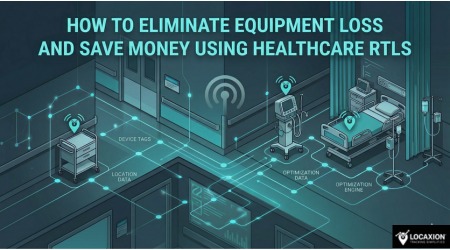
By blanketing the facility with a robust healthcare RTLS, you completely eliminate the guesswork. You turn the lights on. Every single mobile asset is equipped with an active tracking tag. Guessing games and scavenger hunts disappear fast, along with the old habit of hoarding equipment.
Now, if a nurse needs a bladder scanner, they don’t waste time searching. They just check the digital map on their computer and spot the closest clean unit, down to the exact spot. Since everyone finally believes the equipment won’t go missing, nobody feels the need to stash it away. Suddenly, all those hidden devices pop right back into your active inventory.
Automating the Par Levels with RTLS
Finding lost items is just the baseline. The real financial return happens when you integrate that location data directly into your automated workflows.
A true enterprise-grade real time location system actively manages your inventory math for you. You establish digital “PAR levels” (minimum required inventory) for every single clinical ward.
If the ICU drops below its required number of clean infusion pumps, the clinical staff doesn’t even have to pick up a phone. The system detects the spatial shortage and instantly dispatches an automated alert to central supply to restock that specific room. You completely kill the underlying anxiety that causes hoarding.
You can also set up digital geofences around the exits and laundry chutes. If a $5,000 piece of equipment gets bundled up in dirty linens and thrown down a chute, the system instantly triggers an alarm for security, saving the asset before it is destroyed in an industrial washing machine.
The LocaXion Difference: Engineering Your ROI
Let’s face it: hardware vendors just want to sell you another bucket of plastic tags and walk away. But a pile of sensors will not magically fix your broken supply chain.
This is exactly where LocaXion breaks the mold. As the world’s first pure-play RTLS and Digital Twin systems integrator, we engineer your hospital’s architecture for actual business outcomes not just “tracking.” We handle the heavy lifting of the deployment, eliminating the integration guesswork and bringing your facility to a much faster time-to-value.
Furthermore, because we refuse to be locked into a single proprietary technology stack, you gain the absolute freedom to scale with the exact right technology for your specific building not just the hardware we happen to sell.
The distinction here is critical: standard RTLS tracks your medical assets. LocaXion completely transforms how your clinical operation runs. That is the difference, and when millions of dollars in capital waste are on the line, it is not a small one.
Stop renting equipment you already own and regain control of your capital today at https://locaxion.com/
