
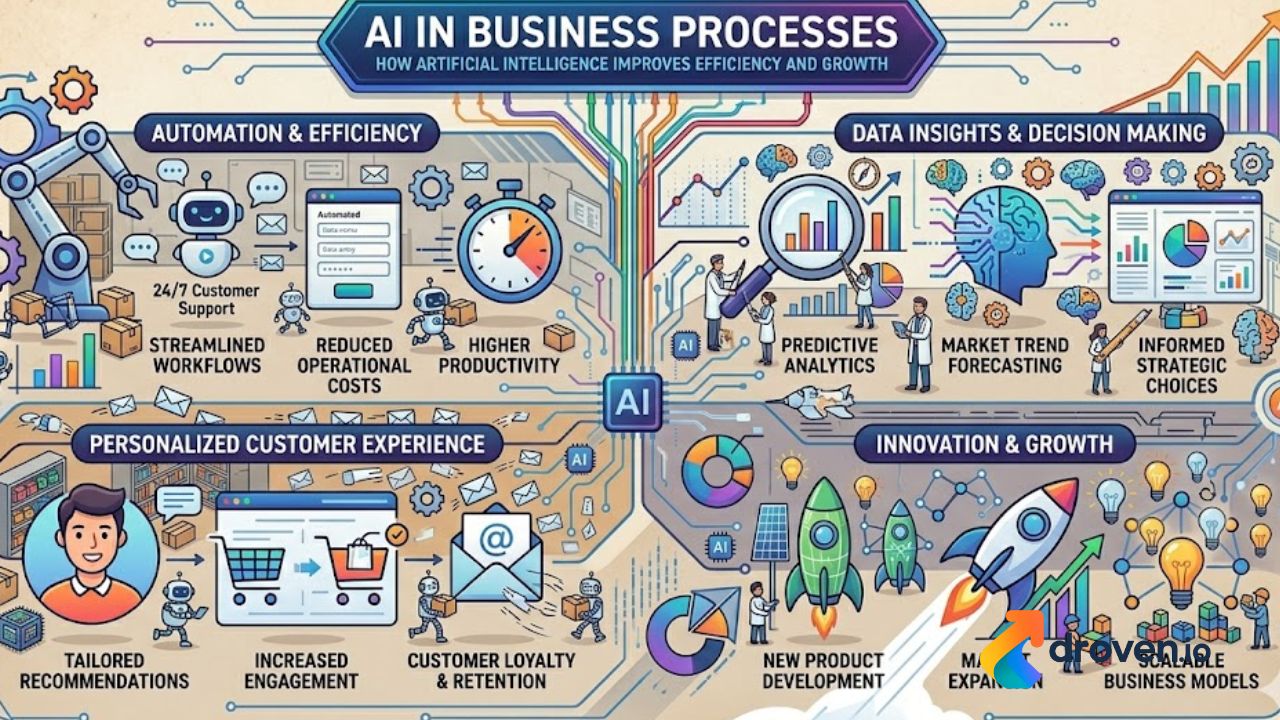
Businesses today are under constant pressure to work faster, reduce costs, and improve customer experiences at the same time. This is one of the main reasons why AI automation in business is becoming a major priority for modern companies. Instead of relying only on manual processes, organizations are now using artificial intelligence to automate repetitive tasks, improve operational accuracy, and support better decision-making. From internal workflows to customer service and reporting, AI automation is helping businesses build smarter systems that save time and create room for long-term growth.
What Is AI Automation in Business?
AI automation in business refers to the use of artificial intelligence tools and systems to complete tasks that would otherwise require manual effort. These tasks can include data entry, customer support, scheduling, forecasting, reporting, lead qualification, and workflow management.
Unlike basic automation, AI-powered automation can also analyze patterns, learn from data, and improve performance over time. This makes it more flexible and useful for businesses dealing with complex operations and large amounts of information.
Why Businesses Are Investing in AI Automation
AI automation has become more important because businesses are handling more data, more customer requests, and more operational complexity than ever before. Manual systems often lead to delays, errors, and inefficiencies, especially when teams are stretched thin.
By using AI automation, companies can:
- reduce repetitive manual work
- improve speed and efficiency
- minimize operational errors
- make data-driven decisions faster
- create more consistent workflows
- improve employee productivity
This allows teams to focus more on strategy, problem-solving, and innovation instead of spending most of their time on routine tasks.
Key Benefits of AI Automation in Business
Improved Operational Efficiency
One of the biggest benefits of AI automation is speed. AI systems can handle repetitive actions much faster than humans, especially in areas like reporting, data processing, and administrative workflows. This helps organizations improve turnaround times and reduce bottlenecks.
Better Accuracy
Manual work often leads to small mistakes that can create bigger problems later. AI automation helps reduce these errors by following consistent rules and identifying anomalies more quickly. This is particularly useful in finance, operations, and customer data management.
Lower Costs Over Time
Although implementation may require investment, AI automation can reduce long-term costs by lowering manual workload, improving resource allocation, and preventing inefficiencies. Businesses often save money by completing more work with fewer delays.
Stronger Customer Experience
Customers expect fast responses and smooth service. AI automation helps businesses provide quicker support through chatbots, automated ticket routing, and personalized communication. On the voice channel, an AI answering service applies the same principle to inbound phone calls — answering automatically, capturing caller details, and routing to the right person without relying on a staff member to be available. This improves satisfaction without overwhelming support teams.
Smarter Business Decisions
AI automation tools can also support analysis and forecasting. By processing large amounts of data, they help leaders understand trends, identify risks, and make more informed decisions.
Common Use Cases of AI Automation
Customer Support
Businesses use AI chatbots, virtual assistants, and AI voice calling to answer common questions, guide customers, and handle routine service requests. This creates faster support while allowing human teams to focus on more complex issues.
Workflow Management
AI can automate steps in approvals, reminders, internal communication, scheduling, and task assignments. This keeps processes moving smoothly and reduces the chances of delays.
Sales and Lead Handling
Sales teams use AI automation to score leads, schedule follow-ups, and identify promising prospects. This makes the sales pipeline more efficient and improves the chances of closing deals. Scoring leads is one piece, but connecting those signals to quota and capacity planning is what Lative focuses on, surfacing pipeline gaps weeks before they reach the forecast.
Reporting and Analytics
AI tools can collect data, generate reports, and highlight performance patterns automatically. This reduces the burden of manual reporting and gives teams quicker access to useful insights.
Finance and Billing
In finance, AI automation can help with invoice processing, expense categorization, fraud detection, and forecasting. These systems improve both speed and reliability.
How AI Automation Supports Different Departments
Operations
Operations teams benefit from faster workflows, better coordination, and improved process tracking. AI automation helps reduce waste and improve consistency.
Human Resources
HR departments can use AI for resume screening, onboarding support, scheduling interviews, and managing employee requests. For companies managing distributed teams, choosing the best employer of record can also simplify employment administration across different locations. This reduces administrative effort and improves response times.
Marketing
Marketing teams use AI automation for email sequences, audience segmentation, performance tracking, and campaign support. This creates more efficient marketing systems without sacrificing relevance.
Customer Service
Customer service teams rely on AI for ticket sorting, instant replies, and service recommendations. This creates a faster and more organized support environment.
Challenges of AI Automation
While AI automation offers strong benefits, businesses also need to understand the challenges involved.
Poor Data Quality
AI systems depend on clean and accurate data. If the information going into the system is weak, the output will also be less reliable.
Over-Automation
Not every process should be fully automated. Some tasks still require human judgment, emotional intelligence, and contextual understanding.
Employee Adoption
New systems are only effective when teams know how to use them properly. Training and communication are important for smooth adoption. Organizations can create a training module that introduces employees to new automation tools, workflows, and responsibilities in a structured way. Regular practice and guidance can help employees become more comfortable with the technology and use it confidently in their daily work. A clear internal communication strategy can also help employees understand why new automation tools are being introduced, how they support daily workflows, and where human input remains essential.
Integration Issues
Some businesses struggle to connect AI tools with existing software or legacy systems. A phased implementation approach can reduce this problem.
Best Practices for Using AI Automation in Business
Start with a Clear Goal
Businesses should begin with one well-defined challenge, such as slow response times or repetitive reporting tasks. This makes it easier to measure value.
Choose Practical Use Cases
The best results often come from applying AI to high-volume, repetitive work that creates clear operational strain.
Keep Human Oversight
AI should support people, not completely replace decision-making in areas that require judgment or customer care.
Track Performance
Measure time savings, error reduction, response speed, or cost improvements. This helps confirm whether the automation is actually working.
Expand Gradually
Once one workflow is successful, businesses can apply AI automation to additional departments or processes with greater confidence.
The Future of AI Automation in Business
The future of AI automation in business will involve more connected systems, faster workflows, and greater use of predictive insights. As tools improve, businesses will be able to automate not only tasks but also parts of planning, forecasting, and internal coordination.
However, success will depend on using AI thoughtfully. Businesses that combine automation with strong leadership, staff training, and clear strategy will gain more value than those that use AI without direction.
Conclusion
AI automation is becoming a practical advantage for businesses that want to work smarter and stay competitive. By improving efficiency, reducing manual work, and supporting faster decisions, AI automation in business is reshaping the way companies operate across departments.
The most effective approach is not to automate everything at once, but to start with real business needs and build from there. Companies that do this well will create stronger systems, better customer experiences, and more sustainable growth.
FAQs
What is AI automation in business?
AI automation in business means using artificial intelligence to automate repetitive tasks and improve workflows, efficiency, and decision-making.
How does AI automation help companies?
It helps companies save time, reduce manual errors, improve productivity, and manage operations more effectively.
Which departments can use AI automation?
AI automation can be used in operations, finance, customer support, sales, HR, and marketing.
Is AI automation expensive for small businesses?
It depends on the tools being used, but many small businesses can start with affordable AI solutions for customer support, email workflows, and reporting.
What is the biggest benefit of AI automation?
One of the biggest benefits is improved efficiency through faster workflows and reduced manual effort.
