
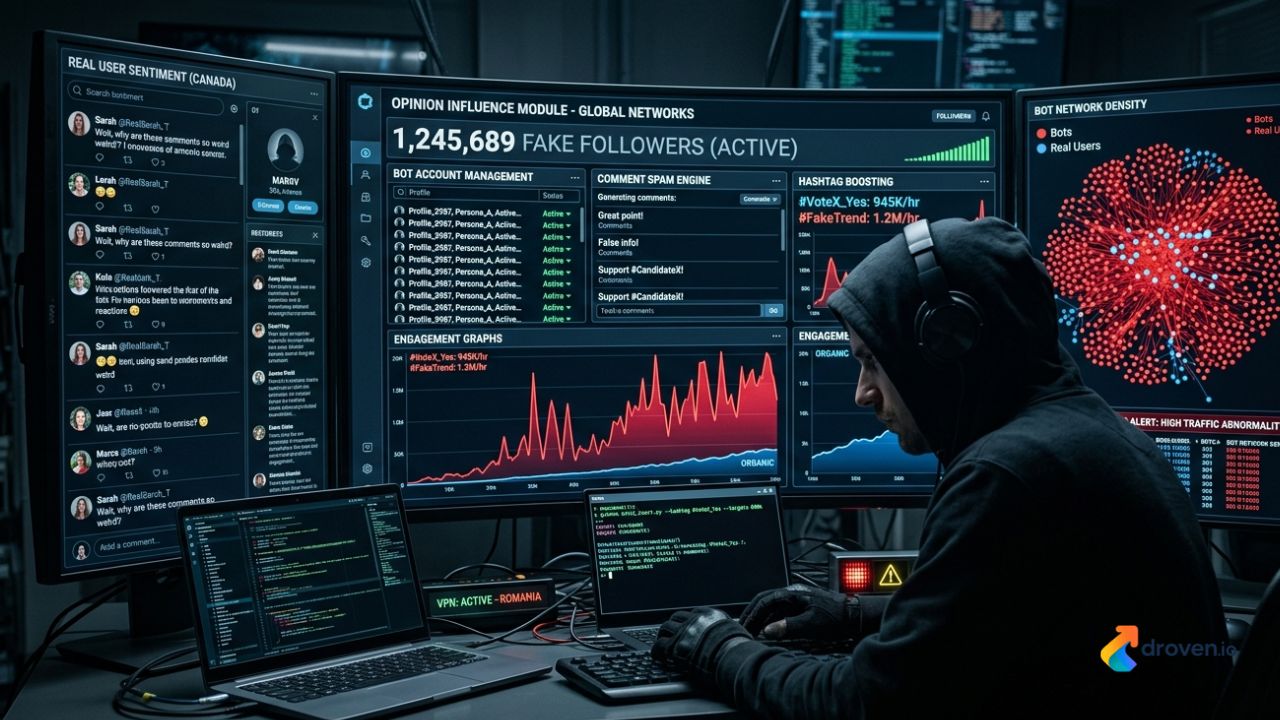
How cybercriminals use fake followers and bots to manipulate public opinion is one of the most serious challenges in today’s digital world. Social media often looks real and honest. However, much of what people see is carefully shaped behind the scenes. Fake accounts and automated bots are used to push ideas, control conversations, and influence decisions.
As a result, people may trust opinions that are not real. Over time, this creates a false sense of what is popular, accepted, or true.
What Are Fake Followers and Bots
Fake followers are accounts that do not belong to real users. They are created using software or stolen identities. These accounts exist only to increase numbers and create the illusion of popularity.
Bots are automated programs that perform actions like liking posts, sharing content, or posting comments. While some bots are helpful, many are designed to manipulate online activity.
Because bots can act quickly and in large numbers, they can make a message appear widely supported in a very short time.
How Cybercriminals Use Fake Followers and Bots to Manipulate Public Opinion
Creating a False Sense of Popularity
Cybercriminals build networks of fake followers to inflate numbers. When people see high follower counts or engagement, they often assume the content is trustworthy.
Rafay Baloch, CEO and Founder of REDSECLABS, explains that these networks are not passive. They are coordinated systems that like, share, and comment together to create momentum.
He says fake audiences behave differently from real ones. Real users are inconsistent, while fake ones are too fast and too aligned. That difference is often where the truth becomes visible.
Spreading Misinformation at Scale
Bots are widely used to spread false or misleading information. They repeat the same message across multiple accounts. Because repetition builds familiarity, people begin to accept the message as true.
Hanna Parkhots from Unidata highlights how powerful these systems can be.
“A bot network is not just a tool of convenience; it is a fully functional machine capable of changing minds at scale. It is also affordable enough for anyone willing to pay for it.”
When thousands of accounts push the same idea at once, it creates the illusion of agreement. This makes it easier to shape public opinion.
Distorting Business Decisions Through Sentiment Manipulation
The impact of bots goes beyond social media. Businesses rely heavily on online feedback to guide decisions.
Kseniya Kobryn, CEO of Symphony Solutions, explains that bot activity can interfere with sentiment analysis systems. These systems are designed to track how people feel about products or services.
When bots create fake waves of positive or negative feedback, companies may act on false data. This can lead to poor decisions and wasted resources.
She describes this as the fabrication of social proof at scale, where false opinions begin to look real simply because they are repeated so often.
Manipulating Search and Digital Trust
Fake engagement also affects how brands appear online. Search engines and marketing systems rely on user behavior signals.
Connor Gillivan from Trio SEO explains that bot networks copy these signals. They create the appearance of strong support, even when it does not exist.
This makes certain brands, products, or ideas seem more credible than they actually are. Over time, this damages trust and makes it harder for genuine voices to stand out.
Silencing Real Opinions
Bots are also used to control conversations. Fake accounts can flood comment sections with repeated messages or criticism.
Because of this, real users may feel discouraged from sharing their views. The conversation becomes one sided, even though it appears active and diverse.
Why This Manipulation Works
People naturally trust what looks popular. High engagement creates a sense of credibility.
At the same time, repeated messages feel familiar. Familiarity often leads to belief.
Emotional content spreads quickly, especially when it triggers strong reactions. Cybercriminals use this to their advantage.
As a result, fake activity blends into real conversations without being noticed.
Signs of Fake Followers and Bots
There are clear signs that can help identify fake activity.
Accounts may post too frequently or repeat the same message. Profiles often look incomplete or use generic information.
Engagement patterns may also feel unnatural. For example, a sudden spike in followers or identical comments across multiple posts can indicate automation.
Hanna Parkhots notes that patterns in posting behavior, account age, and engagement ratios often reveal bot activity.
The Real World Impact
The effects of this manipulation are serious and wide reaching.
People lose trust in online platforms because it becomes harder to tell what is real.
Businesses make decisions based on false data, which can lead to financial losses.
Public opinion can be shaped without awareness, especially during important events like elections.
Reputations can also be damaged through coordinated attacks or fake reviews.
“Fake engagement isn’t just misleading your audience; it is misleading yourself about who your actual audience is,” explains Hanna Parkhots.
How to Protect Against Fake Influence
Awareness is the first step. When people understand how manipulation works, they are less likely to fall for it.
Businesses should compare online engagement with real world data such as sales or customer behavior. If the two do not match, it may signal manipulation.
Regular audits of followers and engagement patterns can also help identify suspicious activity.
It is important to focus on how people engage rather than how many engage. Real users behave differently from automated ones.
Simple habits such as checking sources and questioning sudden trends can reduce the risk of being misled.
The Future of Online Manipulation
Technology is improving, and bots are becoming more advanced. This means the problem will likely grow over time.
However, awareness and critical thinking remain strong defenses. When users question what they see and look deeper into engagement patterns, manipulation becomes easier to spot.
The digital world will continue to evolve, but the need for trust and authenticity will remain constant.
Conclusion
How cybercriminals use fake followers and bots to manipulate public opinion is a serious issue that affects individuals, businesses, and society as a whole. These tools create false popularity, spread misinformation, and influence decisions in ways that are not always visible.
However, understanding how these systems work makes a difference. When people stay aware, question what they see, and focus on genuine engagement, they can protect themselves from being misled.
In the end, not everything online is as real as it seems. The key is to look beyond the numbers and understand the story behind them.
