
Psychological safety has been the subject of more organizational leadership content than almost any other workplace concept in the past decade. The research is compelling, the logic is sound, and the implementation is consistently disappointing. Organizations that invest in psychological safety training, leadership workshops, and culture change programs find that the initial improvement fades within months as the old behavioral patterns reassert themselves. The reason is not that the people in those organizations are insincere. It is that psychological safety is being treated as a cultural outcome that can be created through attitudes and values, when it is also an infrastructural outcome that requires specific operational conditions to sustain itself. People speak up when they believe their contribution will be heard, attributed, and responded to. They stay quiet when the system does not give them a reliable mechanism for doing any of those three things. The organizations where psychological safety is durable have built the infrastructure that makes speaking up structurally safe rather than culturally encouraged. That infrastructure requires project management tools that give every team member a visible, attributable, and acknowledged channel for their contribution.
Visibility that makes contribution safe with Lark Docs
One of the most reliable inhibitors of psychological safety is the experience of raising a concern and having it disappear without acknowledgment. The team member who flags a problem in a meeting and watches the conversation move past without engagement learns quickly that raising concerns in that meeting is not worth the social cost. The experience is not a reflection of bad intentions. It is a reflection of a meeting format that does not create a reliable mechanism for capturing and responding to every contribution.

- “Comment” threads for specific, attributable feedback. Lark Docs allows every team member to leave comments on specific sections of any document, attached to the exact point they are addressing. Comments have the commenter’s name and the time they were left, so the contribution is specific, attributable, and visible to every person with access to the document.
- Comment resolution as a visible acknowledgment mechanism. When a comment is resolved, the resolution is logged with the person who addressed it and the time of resolution. The team member who raised a concern can see that it has been addressed rather than wondering whether anyone reads it, creating a reliable feedback loop that makes raising concerns feel worth doing.
The result: Every team member has a channel for their contribution that is visible, attributable, and acknowledged by design rather than by the discretion of whoever happens to be managing the conversation at the moment the concern is raised.
Communication norms that create safety rather than assuming it with Lark Messenger
Psychological safety in a communication environment is shaped by the norms that are built into tools as much as by the norms that leadership advocates for. A tool that makes every message equally urgent, that gives no structural distinction between the opinion of the most senior person and the most junior, and that provides no mechanism for private or semi-private contribution before a public one, structurally disadvantages the team members who are most likely to need psychological safety support.
- “Chat Tabs & Threads” for structured, non-hierarchical contribution. Named threads within a project group allow every team member to contribute to a specific topic in a space where their contribution is visible alongside, rather than subordinate to, the contributions of more senior colleagues. The thread structure gives every perspective equal spatial weight regardless of the seniority of the person who wrote it.
- “Scheduled Messages” for contribution without real-time pressure. Team members who need more time to formulate their contribution than a real-time conversation allows can compose their thoughts at their own pace and schedule them to arrive at the appropriate moment. The pressure to respond immediately in a live conversation, which disproportionately disadvantages introverted or non-native language speakers, is removed as a structural feature of the communication environment.
The result: Every team member has a communication channel that accommodates their contribution style rather than rewarding only the people who are comfortable speaking up immediately and publicly in a real-time conversation.
Strategic transparency that earns trust with Lark OKR
Psychological safety is partly a function of trust in organizational fairness, and trust in organizational fairness is partly a function of strategic transparency. Team members who cannot see the reasoning behind organizational decisions, who receive outcomes without the context that produced them, and who cannot verify that the priorities they are being asked to execute against are genuinely the organization’s current priorities, operate with a chronic low-level mistrust that makes psychological safety harder to achieve even when leadership is genuinely supportive.
- Company-wide objective visibility for every team member. Lark OKR makes the full hierarchy of company and department objectives visible to every member of the organization at all times. The team member who can see the strategic reasoning behind a priority change does not have to trust that the change was made for good reasons. They can see the reasons in the OKR structure.
- Real-time key result tracking that demonstrates commitment. When leadership commits to a key result and that key result is visible to the full organization, the organization can verify that the commitment is being honored rather than having to trust that it is. Transparency is structural rather than rhetorical.
The result: Trust in organizational fairness is built on verifiable information rather than on faith, creating a more durable foundation for psychological safety than culture change programs that ask for trust without providing the transparency that trust requires.
Data that makes contribution measurable with Lark Base
A significant psychological safety barrier is the inability to demonstrate contribution in environments where recognition is unevenly distributed. The team member who does not have a reliable record of what they have contributed has no basis for advocating for their own recognition, and is dependent on the observation and generosity of their manager to ensure that their work is seen.
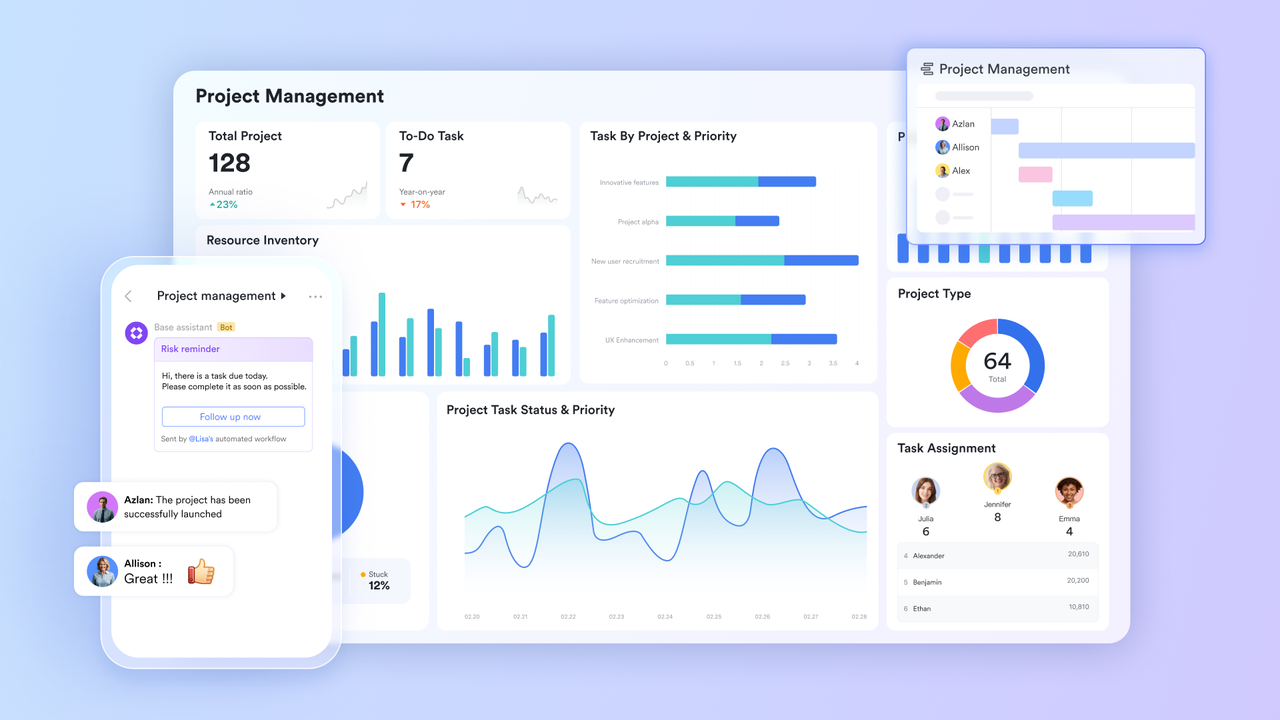
- Personal task views for individual contribution visibility. Every team member in Lark Base can maintain a personal view of their completed work, their current priorities, and their output metrics, giving them a concrete, self-serve record of their contribution that does not depend on a manager’s memory or observation.
- Shared dashboards for team contribution visibility. Team-level dashboards can show each team member’s contribution to the team’s operational output in a format that is visible to every member of the team, creating a transparency around contribution that reduces the zero-sum competition for recognition that makes psychological safety harder to sustain.
The result: Every team member has a verifiable record of their contribution that is independent of manager observation and is available to them for self-advocacy in performance conversations, recognition discussions, and career development planning.
Scheduling that accommodates every working pattern with Lark Calendar
Psychological safety is unevenly distributed across working patterns. Team members who work different hours, live in different time zones, or have different working style preferences, such as preferring to review materials before contributing to a discussion, are structurally disadvantaged in environments where the dominant working pattern is the norm that everything else is measured against.
- “Calendar Subscription” for transparent schedule visibility. Every team member’s working pattern is visible through their calendar subscriptions, making different working hours a normal and expected part of the team’s operational rhythm rather than an exception that requires individual accommodation.
- “Meeting Groups” for pre-meeting contribution equity. Every meeting generates a linked group chat where materials are shared in advance, giving every team member equal preparation time regardless of whether their working pattern gives them access to informal pre-meeting conversations.
The result: The structural advantages that in-office hours and real-time availability confer are reduced, so team members whose working patterns differ from the dominant norm participate in team discussions on more equal terms.
Bonus: Why culture change programs do not sustain psychological safety
The psychological safety training that organizations invest in produces real short-term improvements because it raises awareness and changes behavior temporarily. The improvements fade because they require individuals to consciously override the structural pressures that the working environment exerts on them, and conscious override is not sustainable over time.
Platforms like Culture Amp and Lattice measure psychological safety and provide guidance for improving it. Slack and Microsoft Teams provide communication channels where psychological safety can be expressed but do not change the structural conditions that determine whether it is. Companies evaluating Google Workspace pricing often find that collaboration software is only one part of the equation. Many still adopt separate culture measurement platforms, creating a disconnect between measuring psychological safety and improving the day-to-day work environment that influences it. Lark helps close that gap by supporting healthier operational structures.
Conclusion
Psychological safety is sustained not by asking people to be braver but by building environments where contribution is structurally visible, acknowledged, and equitable. A connected set of productivity tools that makes every team member’s contribution attributable, every organizational decision transparent, every working pattern accommodated, and every operational output measurable creates the conditions for psychological safety to persist as a structural feature of the working environment rather than as a temporary cultural achievement that fades when the training momentum does.
