
Developing and launching a Software as a Service (SaaS) product requires a delicate balance of financial runway and technical capability. Over provisioning an infrastructure when using premium public clouds during the initial development and beta testing phases may deplete your initial capital quickly. Shared environments provide no isolated runtimes, root access, or secure configuration options needed by modern web applications. Technical Founders may utilize a Virtual Private Server (VPS) to fill this gap by providing a highly scalable foundation without the initial infrastructure bloat of an early stage product. However, as you search for cheap VPS hosting in 2026, you will need to evaluate the compute density and architectural lifespan of each service beyond standard pricing tiers.
Containerized Workload Prioritization via High Resource Density
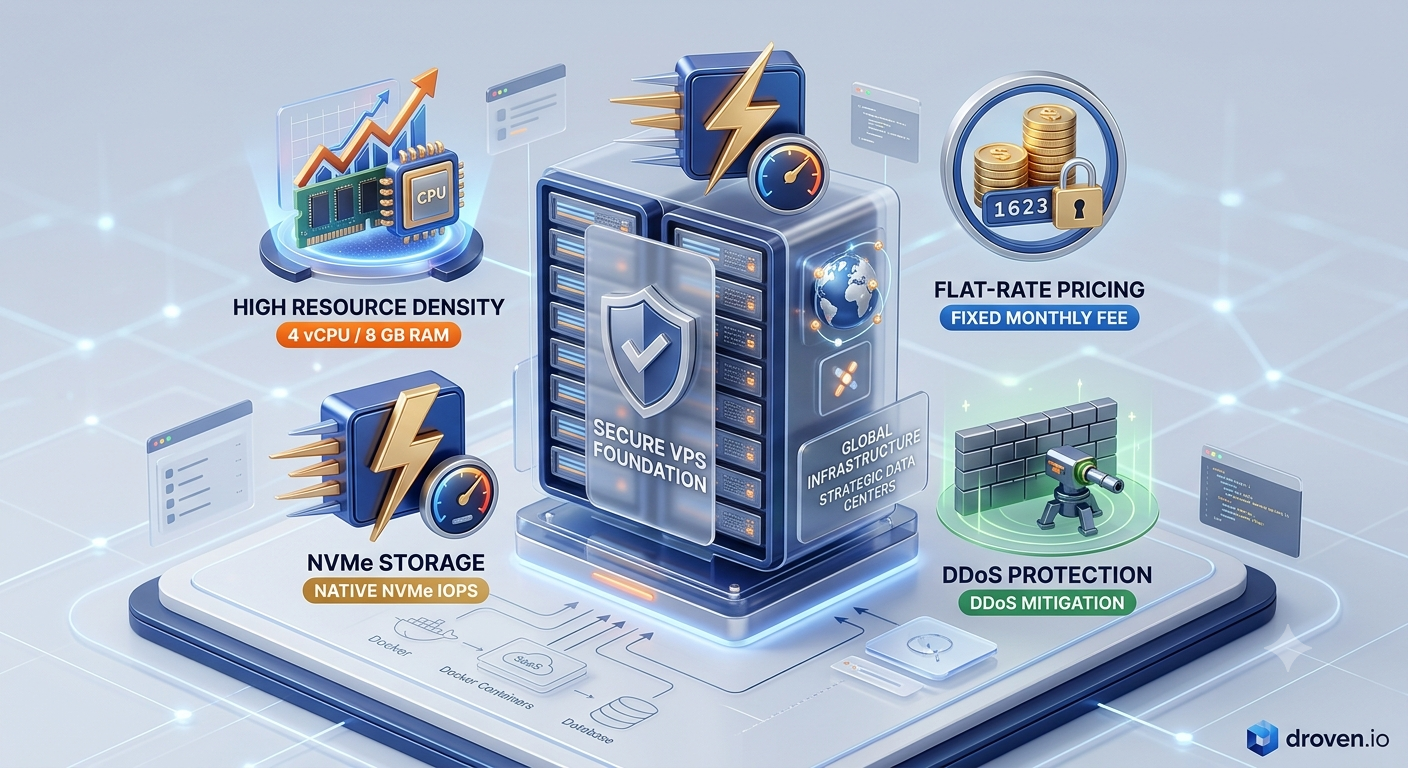
In light of the current situation of SaaS Architecture and its architecture, more than 90 percent of software programs employ a containerization approach along with a backend runtime (memory cache, for example) and a database that is separate from the rest of the system. These systems often demand a large quantity of RAM for being able to provide uninterrupted uptime with low latency needs when operating multiple sessions at once. In addition to that, So, as far as the specifications of entry level VPS server go in 2026, there has been quite an evolution with regards to this, since, now depending on what kind of cloud provider you are using, budget versions with a minimum of 1 GB or 2 GB of RAM can easily be achieved. While legacy cloud providers would cap out at a maximum of 1 GB or 2 GB of RAM, certain pioneers in the field of infrastructure provider companies are looking towards making the most of their resources for being able to meet the needs of running both production and staging environment of tech startups within one server, all without running the risk of OOM crashes using only 4 vCPU cores and 8 GB of RAM for less than $6 per month.
Demand Native NVMe Storage Over Legacy SSDs
If your SaaS application is data driven, the performance of the database is critical. A database relies on high Input/Output Operations per Second (IOPS) to support high volume reads and writes, to isolate tenant data, and to authenticate users.
SATA SSDs: These older SATA SSDs can produce extreme bottlenecks under simulated and real life traffic spikes, causing a lot of latency in the database.
NVMe Storage: Next generation Non Volatile Memory Express (NVMe) storage devices (SSDs) provide very high IOPS and greater than 10 times lower access time when compared to traditional SATA SSDs.
In addition, make sure that the SaaS application is evaluated based on its storage; be wary of storage providers that view fast storage only as a costly add-on; confirm that NVMe speeds are part of the base level price of the tier for the application you are using.
Encourage Fixed Cost Pricing and Unmetered Incoming Traffic
The initial deployment stage of a SaaS application should definitely be free of any risk to incur any variable infrastructure charges. The successful launch within a discovery network or the rapid increase in the number of API requests should be treated as success rather than any financial burden that will lead to the extra cost of excess data traffic.
Variable Cloud Infrastructure: Low Monthly Base Cost + Unexpected Overages = A Lot of Financial Risks
Fixed Rate VPS Infrastructure: Flat Monthly Charge + Unmetered Inbound Traffic = Predictable Costs
By choosing a hosting service provider that offers fixed flat monthly charge and also gives unmetered inbound traffic to your technical team, you will make it possible for you to know exactly how much money you spend each month. And when you know how much you pay for computing power, then all of your funds can be dedicated to product development and users acquisition.
Assessment of Built-in Security and Global Infrastructure
Above all, any SaaS solution ready for use must be enforced with administrative boundaries from day one. Price can never be an excuse for lack of security:
Constant DDoS Protection: Since it involves the automation of the mitigation of any malicious spikes in traffic towards API endpoints without having to pay extra costs to install external firewalls.
Immediate Snapshot Ability: In case something goes wrong while in production, immediate snapshots will act as an opportunity to create a backup copy of the machine prior to any major deployment.
Data Center Locations: Setting up your infrastructure within data centers in proximity to your target market reduces the round-trip time (RTT).
SaaS Tech Scale Up in Early Stages
In order to get the maximum out of your budget for deploying in bootstrap mode, it is very important that you build the infrastructure of your firm so that it can support the growth of the user base. The decision to deploy in a high density zone that has plenty of memory, standard NVMe drives, and a flat, monthly pricing model makes a great home for your software solution.
