
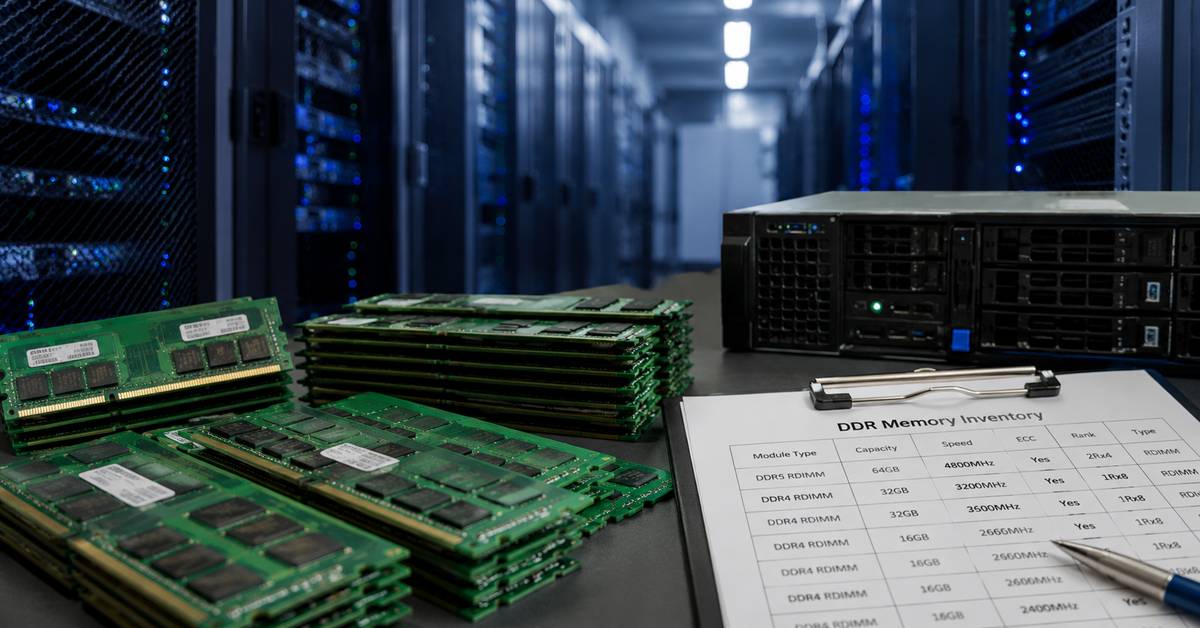
Optimizing Data Centers through DDR Memory Lifecycle Management
DDR memory specifications shape resale value, compatibility, and long-term infrastructure planning across modern data centers.
Small differences in generation, capacity, speed, ECC support, rank, or registered design can change how buyers assess enterprise hardware during audits and buyback evaluations.
This matters more during periods of tight memory supply, especially as AI infrastructure demand continues to pull DRAM capacity toward HBM, server DRAM, and higher-value data center applications.
This article explains how specification accuracy affects resale outcomes, why verification matters, which RAM categories are seeing stronger demand, and how organized documentation can help protect hardware value during data center refresh and retirement projects.
How Specification Accuracy Affects Buyback Offers
Buyers do not rely on a seller’s description alone. ITAD companies, refurbishers, and enterprise buyers verify DDR memory specifications after intake.
If the received modules do not match the submitted inventory, the offer may be reduced, delayed, or rejected for affected items.
Why Incorrect Spec Information Reduces Offers
Specification errors create pricing risk immediately. If a seller describes DDR4-2400 modules as DDR4-3200, or lists non-ECC UDIMMs as ECC RDIMMs, the buyer has to re-evaluate the entire lot. One mismatch can make the rest of the inventory look less reliable.
Physical condition also affects value. Cosmetic damage, missing labels, bent contacts, corrosion, cracked PCBs, or failed testing can reduce resale eligibility.
Even when the module type is in demand, buyers still need confidence that the memory is usable, properly labeled, and accurately represented.
For data centers retiring servers, workstations, or memory-heavy infrastructure, Big Data Supply provides a DDR RAM buyback process that evaluates memory by generation, capacity, speed, ECC or registered features, brand, quantity, and condition.
Accurate specification records protect both parties. Sellers get faster quotes and fewer deductions.
Buyers can route modules to the right resale, refurbishment, or recycling channel without spending extra time resolving avoidable discrepancies.
The Testing Verification Process Buyers Use
Once RAM arrives, buyers typically compare the shipment against the submitted inventory. They may verify labels, part numbers, module type, capacity, speed, manufacturer, rank, and ECC or registered status.
Testing can include visual inspection, system detection, memory diagnostics, and integrity checks. Enterprise buyers often separate modules that pass testing from those that fail, have damaged labels, or cannot be confidently matched to the submitted specifications.
Modules that fail testing may be downgraded, excluded from resale, or routed to recycling. This is why sellers should avoid overstating conditions.
A working pull description should be used only when the modules have been removed from functioning systems and have no known issues.
Documentation Requirements for Enterprise Sales
Buyers need clear documentation before they can produce a useful quote. A good inventory sheet should include manufacturer, part number, capacity, DDR generation, speed rating, ECC status, module type, rank, quantity, and condition.
Photos can reduce delays. Clear images of the module label help buyers verify part numbers and technical details before pickup or shipment.
For server memory, it also helps to include the system source, such as whether the modules came from Dell, HPE, Lenovo, Cisco, Supermicro, or other enterprise systems.
Complete documentation speeds up the process. It reduces back-and-forth questions, avoids surprise deductions, and helps buyers compare resale, recycling, and recovery options more accurately.
Market Demand Patterns Across Different RAM Specifications
Memory demand is shifting as AI infrastructure expands. Suppliers are allocating more capacity to HBM and server-related applications, while conventional DRAM supply remains tight.
TrendForce reported that DRAM suppliers continued reallocating capacity toward HBM and server applications in 2Q26, with conventional DRAM contract prices expected to rise sharply quarter over quarter.
Current High-Demand Specifications in 2026
Server-grade memory is attracting strong attention because AI servers, cloud platforms, and enterprise infrastructure require large amounts of reliable DRAM. DDR5 RDIMMs and high-capacity server modules are especially important in newer deployments.
Network World reported that DDR5 RDIMM costs could surge as manufacturers prioritize AI chips and memory-intensive server platforms. That pressure can make high-capacity DDR5 server memory more valuable during retirement and resale evaluations.
DDR4 server memory also remains relevant because many data centers still operate DDR4-based infrastructure. Demand for compatible replacement modules can remain strong when production shifts away from older generations.
TrendForce reported that Samsung and SK Hynix delayed DDR4 phase-out plans into 2026 as DDR4 saw renewed demand and pricing strength.
Legacy Specifications With Declining Value
Older memory generations usually have narrower resale markets. DDR3 and low-capacity DDR4 may still be useful for legacy systems, industrial hardware, labs, and maintenance environments, but demand is more limited than for newer or higher-capacity server modules.
Legacy memory can still hold value when buyers need exact replacements. However, mixed lots of small-capacity DDR3 or older desktop modules are harder to sell through enterprise channels. They may be better suited to specialty buyers, consumer marketplaces, or recycling if testing and resale demand are weak.
DDR4 is in a more complicated position. It is older than DDR5, but it remains widely deployed. That installed base can support resale demand, especially for ECC RDIMMs and LRDIMMs used in servers.
At the same time, long-term platform transitions mean sellers should not assume DDR4 will hold peak value indefinitely.
Emerging DDR5 Specifications Gaining Traction
DDR5 is the standard for many newer server and workstation platforms. High-capacity DDR5 RDIMMs are especially relevant for memory-intensive workloads, including virtualization, databases, analytics, and AI-adjacent infrastructure.
Speed and capacity both matter. DDR5-4800, DDR5-5600, and higher-rated modules may attract interest when they match current server platforms.
Still, compatibility is more important than raw speed. Enterprise buyers often look for specific part numbers, qualified vendor modules, consistent ranks, and matched quantities.
As supply remains tight, well-documented DDR5 server memory can be easier to evaluate and route to buyers who need exact configurations.
Matching Your RAM Specifications to the Right Selling Channel
Different RAM types belong in different resale channels. A pallet of 64GB DDR4 ECC RDIMMs is not the same as a box of mixed consumer DDR3 sticks. Matching inventory to the right buyer helps preserve value and reduce delays.
When Specs Warrant ITAD Company Work
ITAD companies and enterprise buyback specialists are usually the best fit for server-grade memory, especially when the lot is large, consistent, and well-documented
DDR4 ECC RDIMMs, DDR4 LRDIMMs, DDR5 RDIMMs, high-capacity modules, and memory from recognized enterprise platforms are stronger candidates for professional buyback channels.
These buyers understand data center compatibility and can evaluate modules based on server demand rather than consumer pricing.
Small, mixed, or low-capacity consumer memory may not be ideal for ITAD resale channels unless it is part of a larger hardware retirement project.
Specifications Suitable for Consumer Marketplaces
Consumer marketplaces can work for desktop DDR4, DDR5 UDIMMs, laptop SO-DIMMs, and smaller quantities of memory. These channels are often better for individual kits or modules used in home PCs, gaming systems, and consumer workstations.
Consumer buyers usually care about generation, capacity, speed, latency, and compatibility with desktop or laptop platforms. They may not value ECC, RDIMM, or LRDIMM features if their systems cannot use them.
This is why server memory should not be priced or described like consumer RAM. The buyer pool is different, and so are the value drivers.
Bulk Specification Matching for Enterprise Buyers
Enterprise buyers often prefer consistent lots. Matching part numbers, capacities, speeds, ranks, and manufacturers can make memory easier to deploy across a fleet.
Bulk lots can also reduce testing and compatibility uncertainty. A set of identical 32GB or 64GB ECC RDIMMs may be more attractive than the same total capacity split across many unrelated modules.
Sorting matters. Group modules by generation, capacity, speed, ECC status, registered type, manufacturer, and part number before requesting quotes.
This helps buyers assess the lot quickly and reduces the risk of undervaluation.
How Minimum Order Specifications Affect Channel Choice
Some buyers have minimum lot sizes or minimum value thresholds. A few individual desktop modules may be better suited for consumer resale. Larger quantities of server memory may qualify for enterprise buyback, pickup, or bulk pricing.
Sellers should ask about minimum quantities, accepted specifications, testing standards, payment timing, and recycling options for modules that fail verification.
Knowing these requirements early prevents mismatched expectations.
Preparing Business Hardware With Complete Specification Details
Preparation improves resale outcomes. Clean documentation, careful handling, and organized inventory records help buyers verify value faster.
Creating Specification Sheets for Bulk Inventory
A specification sheet should list each module type clearly. Include:
- Manufacturer
- Part number
- DDR generation
- Capacity
- Speed rating
- ECC or non-ECC status
- RDIMM, LRDIMM, UDIMM, or SO-DIMM type
- Rank, where available
- Quantity
- Condition
- Source system, if known
For large lots, group identical modules together rather than listing every item separately. This keeps the sheet readable while still giving buyers the details they need.
Photographing Specification Labels Properly
Label photos help confirm details before the equipment is shipped or picked up. Photos should be clear, well-lit, and close enough to show the part number, capacity, speed, and manufacturer.
Avoid sending blurry group photos where labels cannot be read. If modules are sorted into trays or anti-static bags, photograph representative labels from each group and match the images to the inventory sheet.
Organizing by Specification Categories
Sort memory before requesting a quote. Separate DDR3, DDR4, and DDR5. Keep ECC server memory apart from non-ECC desktop memory. Group RDIMMs, LRDIMMs, UDIMMs, and SO-DIMMs separately.
Within each group, sort by capacity, speed, manufacturer, and part number. This reduces verification time and helps buyers identify higher-value lots quickly.
Avoiding Specification-Related Selling Delays
Most selling delays come from missing details, mixed inventory, unclear condition notes, or discrepancies between the quote request and the received equipment. These issues are avoidable.
Before sending RAM to a buyer, confirm that labels are readable, counts are accurate, failed modules are separated, and condition notes are honest. If some modules are untested, mark them as untested. If a lot was pulled from working systems, note that clearly.
Accurate documentation supports faster verification, smoother payment, and fewer disputes.
Conclusion
DDR memory lifecycle management depends on specification accuracy, organized documentation, and awareness of current market demand.
Enterprise buyers verify modules against submitted details, so incorrect specifications can reduce payouts, delay processing, or remove hardware from resale eligibility.
Demand patterns continue shifting as AI infrastructure increases pressure on DDR5 and server-grade memory, while DDR4 remains relevant because of its large installed base.
Businesses that sort RAM properly, document configurations clearly, and match inventory to the right resale channel are in a stronger position during buyback negotiations. Accurate specifications help protect value and make retired data center memory easier to evaluate, resell, or responsibly recycle.
