
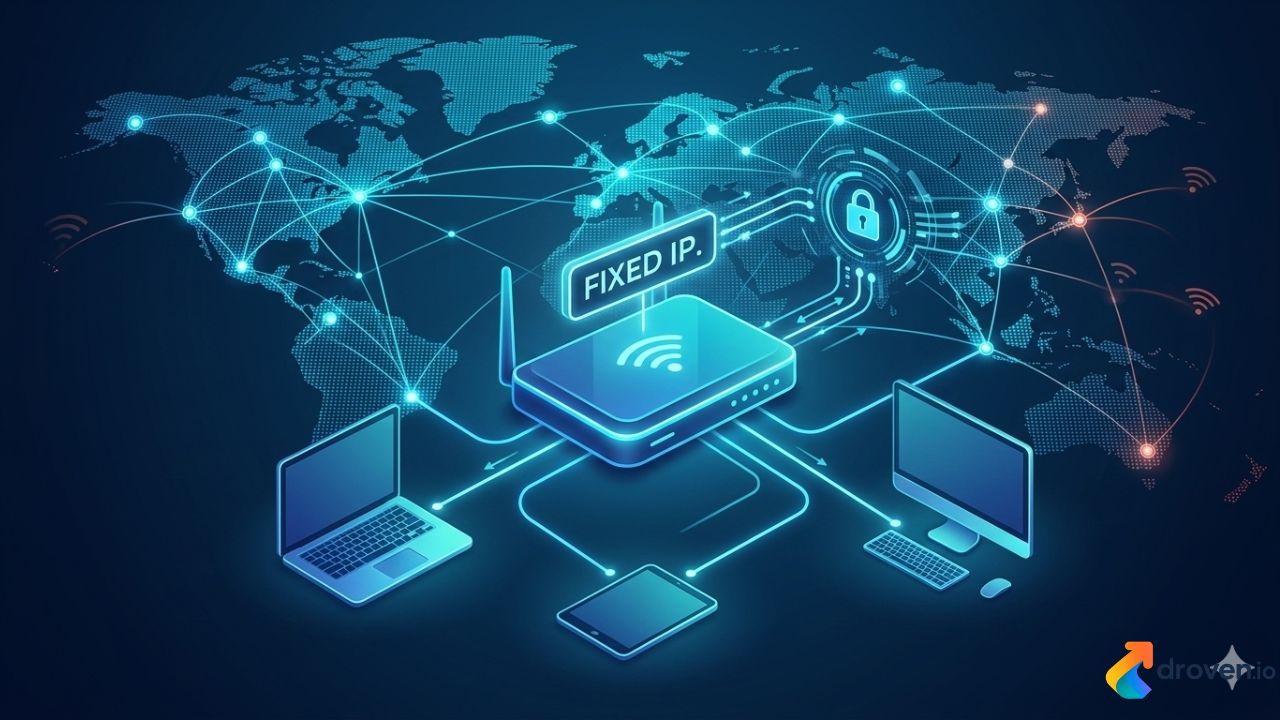
Nobody picks their home IP address. The router boots up, talks to the ISP, and gets whatever address happens to be available. Tomorrow it might be a completely different one. For watching YouTube or checking email, this is a total non-issue.
But run a business off that connection and things get ugly fast.
Dynamic IPs: The Default Everyone Ignores
Every consumer internet plan works the same way under the hood. A protocol called DHCP hands out IP addresses on temporary leases, sometimes lasting hours, sometimes weeks. When the lease runs out, the address goes back into the pool and your device grabs a new one.
ISPs built it this way because IPv4 addresses topped out at roughly 4.3 billion, and those were fully allocated years ago. Recycling addresses across customers was the only way to keep the system running without charging everyone a premium.
Most people go their entire lives without realizing their IP changed six times last month. It simply doesn’t affect anything they do online.
Static IPs: Same Address, Every Time
A static IP is exactly what it sounds like. One address, permanently assigned, that never rotates. ISPs typically charge $10 to $50 per month for the privilege because that address can’t be recycled to anyone else.
So who actually needs this? More people than you’d think.
Hosting a website on a dynamic IP is asking for trouble since DNS records need a stable target. Email deliverability tanks when the sending address keeps changing; spam filters get suspicious of IPs they haven’t seen before. And anyone running remote access setups (security cameras, industrial sensors, VPN gateways) needs their equipment reachable at a predictable address 24/7.
Firewall whitelisting is another big one. If remote workers connect through IP-restricted access rules, a dynamic address flipping at 2 AM means somebody’s locked out before coffee.
For users who want that fixed-address reliability but don’t want their traffic flagged as coming from a commercial server rack, a Static Residential VPN threads the needle. The IP stays consistent and is tied to a real residential ISP, so it looks like ordinary home traffic to every website that checks.
The Catch With Staying Put
A static address is also a static target. That’s the uncomfortable part. DDoS attacks are easier to sustain against an IP that never moves, and long-term tracking becomes trivial when there’s a permanent identifier attached to your traffic.
Cisco’s networking documentation points out that dynamic allocation was partly a privacy feature, not just a resource management trick. Rotating addresses made individual devices harder to fingerprint over time.
The Electronic Frontier Foundation takes this further, arguing that any persistent identifier (static IPs included) creates a breadcrumb trail for advertisers and data brokers to exploit. It’s a valid concern, though most organizations counter it with firewalls, intrusion detection, and access controls that more than offset the risk of a fixed address.
IPv6 Rewrites the Rules
Here’s the thing: the entire reason dynamic addressing exists is scarcity. Not enough IPv4 addresses, so ISPs had to share them. IPv6 changes that equation in a pretty absurd way, offering 340 undecillion addresses. Written out, that’s a 34 with 37 zeros after it.
The Internet Society reports that over 45% of Google’s users already connect via IPv6. As that number climbs, the economic pressure to recycle addresses disappears. Some smaller European and Asian ISPs have quietly started handing out static IPv6 assignments at no extra charge, which would’ve been unheard of a few years back.
Full transition is still a ways off. Dual-stack networks running both protocols will dominate enterprise setups for the foreseeable future. But the trend points toward static becoming the default rather than the exception.
This Used to Be an IT Question
A decade ago, static vs. dynamic was something network admins argued about during server provisioning. Regular people never had to care. That’s changed pretty significantly now that remote work has turned spare bedrooms into branch offices and the average household runs a dozen connected devices.
Understanding what “static” means in the context of internet access isn’t obscure knowledge anymore. It’s increasingly relevant for anyone whose livelihood depends on a connection that actually stays where it’s supposed to.
