
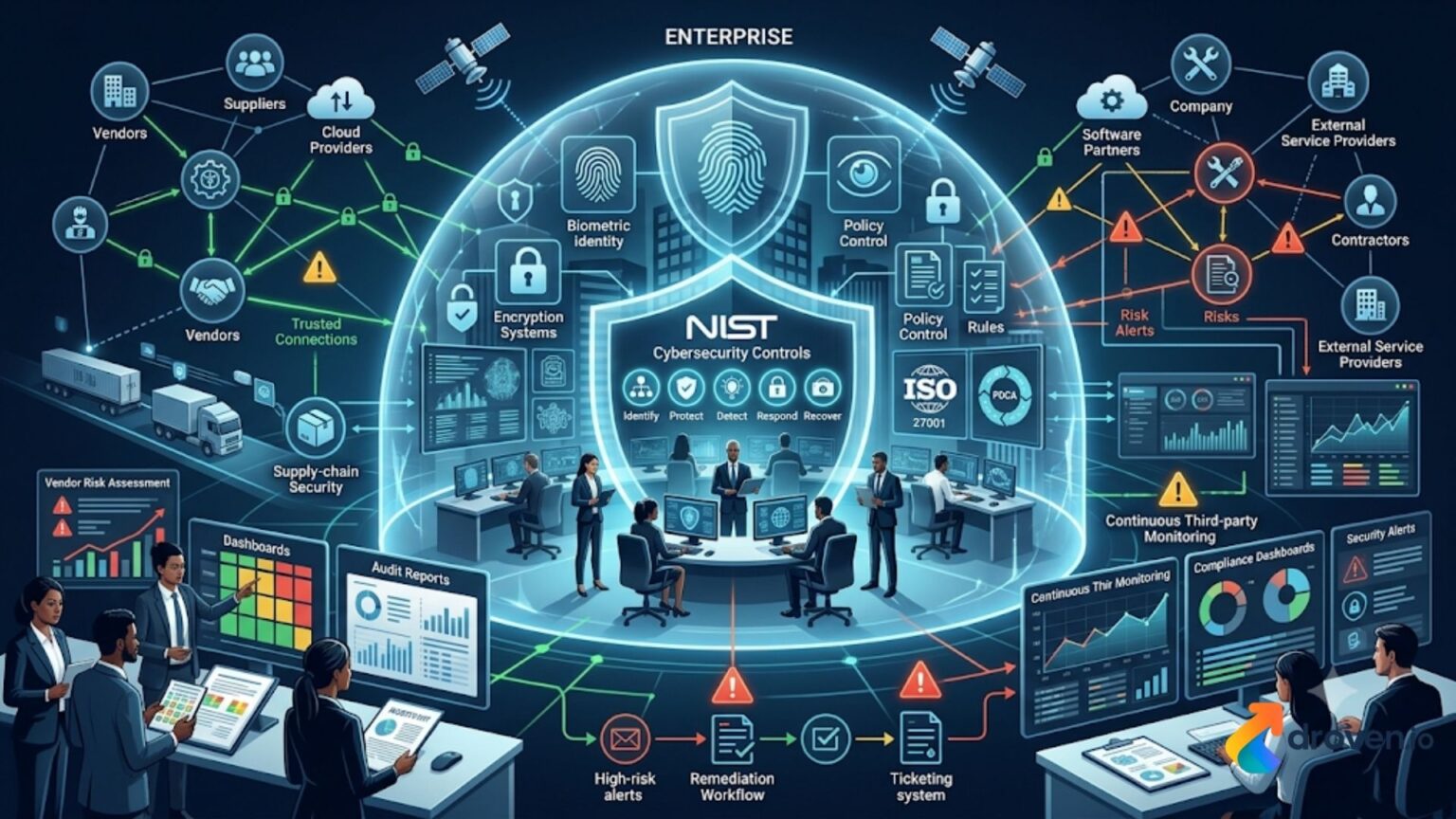
Modern enterprise operations no longer happen entirely within a self-contained corporate network. Today, organizations rely on thousands of software-as-a-service (SaaS) providers, cloud platforms, managed service providers (MSPs), and nested digital supply chains to remain competitive. While this hyper-connectivity drives efficiency, it also dramatically expands the corporate attack surface. Security is only as strong as its weakest link, and a single vulnerability in a minor vendor can provide threat actors with a pathway into sensitive internal environments.
Authoritative industry data highlights the scale of this vulnerability. The Black Kite 2026 Third-Party Breach Report reveals that the “blast radius” of third-party breaches reached a record 5.28x downstream victims. This means that a single vendor compromise now impacts over five times as many downstream entities as it did in previous years. Furthermore, the report notes that organizations wait an average of 117 days to receive a vendor breach notification. Waiting nearly four months to discover a supply chain exposure is an unsustainable risk strategy. To combat these systemic vulnerabilities, organizations must transition away from subjective, manual point-in-time assessments and embrace structured, internationally recognized security frameworks.
Grounding the Program in the NIST Cybersecurity Framework
The National Institute of Standards and Technology (NIST) provides some of the most comprehensive frameworks available for managing third-party cyber risk. Specifically, the NIST Cybersecurity Framework (CSF) 2.0 and the NIST Special Publication 800-161 (Cybersecurity Supply Chain Risk Management Practices for Systems and Organizations) offer tactical guidelines for auditing external dependencies.
NIST CSF 2.0 treats supply chain security as a core component of organizational governance. Under the “Govern” function, the framework requires organizations to establish, understand, and regularly review their cybersecurity supply chain risk management (C-SCRM) strategies. This structural approach forces information security teams to integrate external risk metrics directly into the enterprise’s overarching risk management philosophy.
NIST SP 800-161 expands on this by providing a blueprint for the entire vendor lifecycle. The publication recommends that organizations establish explicit baseline security requirements within vendor contracts, perform rigorous due diligence before onboarding, and implement formal contingency plans for high-risk vendor offboarding. Rather than viewing third parties as isolated entities, the NIST model treats them as extensions of the internal infrastructure, making security compliance an ongoing, collaborative dialogue rather than a checklist exercise.
Architectural Security with ISO/IEC 27001 and 27036
While NIST offers an excellent tactical blueprint, the International Organization for Standardization (ISO) provides a globally recognized certification standard. For enterprises seeking to validate their internal information security management system (ISMS), ISO/IEC 27001 remains the premier choice.
Within the Annex A controls of ISO/IEC 27001:2022, Control A.5.19 through A.5.23 focus heavily on supplier relationships. The standard mandates that organizations maintain documented policies to mitigate risks associated with supplier access to organizational assets. Additionally, ISO/IEC 27036 acts as a dedicated multi-part standard focusing exclusively on information security for supplier relationships, including cloud service dependencies.
Implementing the ISO framework requires organizations to establish structured processes for:
- Classifying suppliers based on the sensitivity of the data they access or process.
- Integrating explicit information security requirements into service-level agreements (SLAs).
- Reviewing and auditing supplier performance, service deliveries, and security logs regularly.
- Managing operational changes in supplier services to ensure security controls are not degraded over time.
By aligning with ISO standards, organizations establish a common security language with global partners. This provides a structured foundation for managing third-party cyber risk, continuously evaluating supplier exposure, and requesting verifiable evidence of compliance throughout the procurement and vendor-management lifecycle.
Moving Beyond Traditional Frameworks to Manage Ecosystem Risk
While implementing established standards like NIST and ISO 27001 Certification Courses is a necessary baseline, compliance alone does not guarantee resilience. Traditional risk management programs often rely on static annual questionnaires, self-attestations, and proprietary “black-box” risk ratings. These methods fall short because cyber threats evolve weekly, not annually, and static assessments fail to capture the dynamic reality of an active digital supply chain.
To achieve true resilience, modern risk programs must account for complex structural phenomena within their extended ecosystems:
- Categorized Asset Impact: Treating all suppliers identically creates massive blind spots. A marketing vendor that hosts public-facing blog content requires a fundamentally different risk profile than a data processor handling employee healthcare information or a technology provider responsible for infrastructure availability. Security teams must map controls to the specific type of asset exposure introduced by each vendor class.
- Infrastructure Concentration Risk: Organizations often fail to realize that dozens of their seemingly independent third-party vendors frequently rely on the exact same upstream cloud infrastructure, content delivery networks (CDNs), or domain name system (DNS) providers. When one of these critical shared utilities experiences an outage or a breach, the operational impact compounds, triggering simultaneous failures across multiple enterprise relationships.
- Nth-Party Cascading Dependencies: True vulnerability rarely stops with direct (third-party) vendors. Modern enterprises operate within a multi-tiered ecosystem where direct partners depend on fourth-party and fifth-party software components. When a critical flaw is disclosed in a widely used open-source library or an embedded software-as-a-service component, the risk propagates downstream, catching organizations off guard if they lack deep visibility into their extended supply chain dependencies.
Fulfilling the complex demands of managing third-party cyber risk requires a paradigm shift. Progressive enterprises are moving toward automated, continuous monitoring architectures that continuously evaluate external threat exposure, analyze active ransomware susceptibility, and translate technical vulnerabilities into quantifiable business impact. This allows risk professionals to move past superficial compliance checklists and engage vendors on specific, data-backed remediation strategies.
Final Analysis
Relying on perimeter-based security is no longer viable in an era characterized by decentralized workforces and interconnected business systems. Third-party risk management is no longer merely an exercise designed to appease corporate auditors; it is a fundamental operational necessity required to preserve business continuity. By taking the architectural governance models found in NIST and ISO 27001 and reinforcing them with ongoing visibility into shared infrastructure concentration and Nth-party dependencies, organizations can build defensible, data-driven security operations. Security leaders who proactively measure and mitigate these systemic external vulnerabilities will ultimately protect their organizations from becoming another statistic in the growing wave of cascading supply chain failures.
