
TL;DR
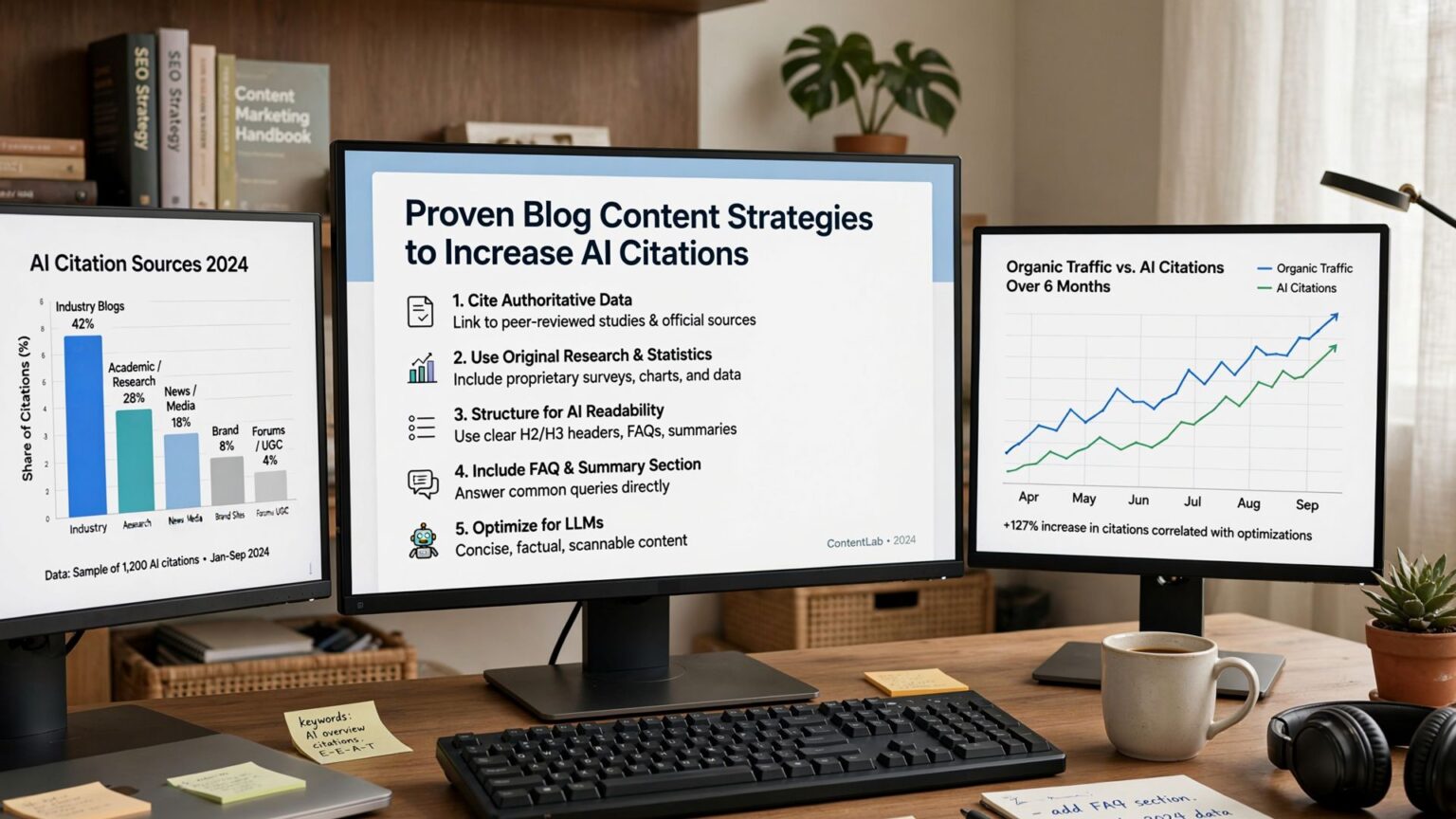
- AI citations are becoming a key visibility signal as users increasingly rely on AI-powered search platforms like ChatGPT, Gemini, and Perplexity.
- A well-defined blog content strategy helps improve your chances of being cited by AI while strengthening your organic SEO performance.
- Focus on topical authority, EEAT, search intent, entity SEO, and semantic relevance to make your content more AI-friendly.
- Structure your content with clear headings, concise answers, FAQs, and internal links so AI systems can easily understand and reference it.
- Prioritize original insights, real-world examples, and credible sources to build trust and stand out from generic content.
- Continuously update and optimize existing blogs to maintain relevance and increase long-term AI search visibility.
Introduction
The way people search for information is evolving rapidly. While Google remains the dominant search engine, millions of users now rely on AI assistants such as ChatGPT, Google Gemini, Claude, and Perplexity to get instant answers, compare products, and research complex topics.
Unlike traditional search engines that primarily present a list of links, AI platforms generate conversational responses by referencing reliable, high-quality content. When your content is selected as a trusted source, it earns an AI citation a powerful signal that increases your brand’s visibility, authority, and credibility.
For SEO professionals, this represents both a challenge and an opportunity. Ranking on page one is no longer the only goal. Your content also needs to be understandable, trustworthy, and comprehensive enough for AI systems to reference confidently.
The good news is that many of the principles behind AI citations align with strong SEO fundamentals. By refining your blog content strategy, you can improve both organic rankings and AI visibility. In this guide, we’ll explore 15 proven strategies that can help your content become a preferred source for AI-powered search experiences.
What Are AI Citations?
AI citations occur when AI-powered search tools reference or attribute information from your content while generating responses. Instead of directing users to a list of search results, AI systems summarize information from authoritative sources and may include links or references to the original content.
Being cited by AI platforms offers several benefits:
- Builds brand authority and trust
- Expands visibility beyond traditional search results
- Increases referral traffic from AI search platforms
- Demonstrates topical expertise
- Supports long-term organic growth
As AI search continues to evolve, using an AI Blog Writer to produce high-quality, authoritative content can improve consistency, enhance content quality, and increase the likelihood of earning AI citations as part of a modern SEO strategy.
How AI Systems Choose Content to Cite
Although AI platforms use different technologies, they generally prioritize content that demonstrates quality, authority, and relevance.
Authority and Trust
AI systems prefer content published by reputable websites with a consistent history of producing reliable information.
Semantic Relevance
Rather than matching exact keywords, AI understands relationships between topics, entities, and user intent. Content that thoroughly covers a subject is more likely to be referenced.
EEAT Signals
Google’s EEAT framework- Experience, Expertise, Authoritativeness, and Trustworthiness also aligns well with the type of content AI systems tend to favor.
Clear Content Structure
Well-organized articles with descriptive headings, concise paragraphs, numbered lists, and FAQs are easier for AI models to interpret and summarize.
Original Value
Content that provides unique insights, research, case studies, or practical experience has a greater chance of being cited than articles that simply repeat existing information.
15 Proven Blog Content Strategies to Increase AI Citations
1. Build Topical Authority Instead of Publishing Random Blogs
Publishing isolated blog posts rarely establishes expertise. Instead, create comprehensive topic clusters that cover a subject from multiple perspectives.
For example, if your niche is SEO, publish interconnected articles about keyword research, technical SEO, EEAT, semantic SEO, AI search optimization, and content strategy. To publish interconnected articles about enterprise SEO services , keyword research, technical SEO, EEAT, semantic SEO, AI search, and content strategy.
This helps both search engines and AI systems understand your expertise while strengthening your site’s topical authority.
2. Write for User Intent, Not Just Keywords
Many content strategies still prioritize keywords over user needs. AI systems, however, are designed to answer questions, not reward keyword density.
Before creating content, identify whether users are looking to:
- Learn something
- Compare solutions
- Solve a problem
- Make a purchase
- Find step-by-step guidance
Content that directly satisfies user intent is more likely to be surfaced in AI-generated answers.
3. Create Original, Experience-Based Content
AI models increasingly favor content that provides information unavailable elsewhere.
Instead of rewriting existing articles, include:
- Original research
- Practical examples
- Personal experiences
- Client case studies
- Industry observations
- Performance data
Unique information helps differentiate your content from thousands of similar articles and makes it a stronger citation candidate.
4. Strengthen EEAT Across Every Blog
Experience and expertise have become essential ranking signals.
Strengthen EEAT by:
- Including author bios
- Demonstrating industry experience
- Citing credible sources
- Sharing real-world examples
- Keeping content accurate and updated
Trustworthy content is significantly more likely to be referenced by both users and AI systems.
5. Optimize for AI Search (AEO + GEO)
Modern content should be optimized not only for search engines but also for answer engines and generative AI. A Blog Auditor Tool can help identify content gaps, improve readability, and ensure your content is structured for AI-powered search experiences.
Effective optimization includes:
- Answering questions immediately
- Using conversational language
- Creating concise summaries
- Covering follow-up questions
- Structuring content logically
This improves readability while helping AI systems extract useful information.
6. Use Entity-Based SEO Throughout Your Content
Entities help AI understand context beyond keywords.
Instead of repeatedly targeting a single keyword, naturally reference related concepts, organizations, technologies, tools, and recognized industry terms.
For example, an article about content strategy might naturally discuss:
- EEAT
- Semantic SEO
- Topic clusters
- Search intent
- Structured data
- Internal linking
- Content optimization
These relationships help AI models build stronger contextual understanding.
7. Structure Every Blog for Easy AI Understanding
Content formatting has become increasingly important.
Use:
- Descriptive H2 and H3 headings
- Short paragraphs
- Bullet points
- Numbered lists
- Comparison tables
- Clear summaries
A well-structured article allows AI systems to quickly identify important information without unnecessary complexity.
Think of every section as a potential answer that could appear independently in an AI-generated response.
8. Add FAQs That Answer Real User Questions
FAQ sections remain one of the simplest ways to improve AI visibility.
Research questions using:
- Google’s “People Also Ask”
- Search Console data
- Customer support queries
- Community forums
- Industry discussions
Write concise, direct answers before expanding with additional context.
This format aligns naturally with how AI assistants generate conversational responses and increases the likelihood of your content being cited for long-tail informational queries.
9. Publish Comprehensive Content Instead of Thin Articles
AI systems are designed to deliver complete answers, not fragmented information. As a result, comprehensive content is far more likely to be cited than short, surface-level blog posts.
Rather than creating multiple articles that barely scratch the surface, aim to develop in-depth resources that answer the primary question and related follow-up questions within the same piece.
A comprehensive blog should include:
- Clear definitions
- Step-by-step guidance
- Practical examples
- Common mistakes
- Best practices
- FAQs
- Supporting resources
When users and AI platforms can find everything they need in one place, your content becomes a stronger authority on the topic.
10. Use Internal Links to Build Context
Internal linking isn’t just good for SEO; it also helps AI systems understand the relationship between topics on your website.
A strong internal linking strategy:
- Connects pillar pages with supporting articles
- Reinforces topical authority
- Improves content discovery
- Encourages longer user sessions
- Distributes page authority across your website
For example, a blog about Blog Content Strategy can naturally link to articles on keyword research, semantic SEO, topic clusters, EEAT, content audits, and AI search optimization.
Use descriptive anchor text that clearly communicates what users will find on the linked page rather than generic phrases like “click here.”
11. Keep Content Fresh with Regular Updates
Publishing a great article is only the beginning. Search behavior, AI models, and industry trends evolve constantly, making content freshness an important ranking and citation factor.
Review high-performing blogs every few months and update:
- Industry statistics
- Examples
- Screenshots
- Product information
- Best practices
- Emerging AI trends
Instead of creating a brand-new article every time something changes, continuously improve your existing content. This helps maintain relevance while preserving the page’s accumulated authority.
12. Support Claims with Credible Sources
Trustworthy information is one of the strongest indicators of quality.
Whenever you reference statistics, research, or industry trends, cite reputable sources such as:
- Government publications
- Academic research
- Industry reports
- Official documentation
- Recognized research organizations
Avoid relying on outdated or unverified data.
Credible references not only increase reader confidence but also reinforce the trust signals that AI systems look for when selecting content to cite.
13. Improve Readability and Accessibility
Even the most insightful content can lose value if it’s difficult to read.
SEO professionals should focus on creating content that’s easy to scan and understand by:
- Writing concise paragraphs
- Using descriptive headings
- Including bullet points and numbered lists
- Avoiding unnecessary jargon
- Highlighting key takeaways
- Using clear, conversational language
Remember, AI systems often extract concise passages from articles. Well-written, easy-to-read content increases the likelihood that your explanations will be selected.
14. Implement Structured Data Where Relevant
Structured data helps search engines better understand your content and may improve its visibility across various search experiences.
Depending on the page type, consider implementing:
- Article Schema
- FAQ Schema
- Organization Schema
- Author Schema
- Breadcrumb Schema
While structured data doesn’t directly guarantee AI citations, it provides additional context that supports content interpretation and improves discoverability.
15. Measure AI Citation Performance and Continuously Improve
You can’t optimize what you don’t measure.
Although AI citation tracking is still evolving, SEO professionals can monitor several useful indicators:
- Brand mentions in AI platforms
- Referral traffic from AI search engines
- Organic traffic growth
- Engagement metrics
- Keyword visibility
- Content performance over time
Regularly test prompts in platforms like ChatGPT, Gemini, Claude, and Perplexity to understand whether your content is being referenced. Use these insights to refine your content strategy and identify opportunities for improvement.
Common Blog Content Strategy Mistakes That Reduce AI Citations
Even experienced SEO professionals can make mistakes that limit their content’s visibility in AI search.
Publishing Thin Content
Articles that provide only basic information rarely demonstrate enough authority to earn citations.
Prioritizing Keywords Over User Intent
Keyword optimization remains important, but satisfying the user’s question should always come first.
Relying Entirely on AI-Generated Content
AI can accelerate content creation, but publishing unedited, generic content often results in repetitive articles that offer little original value.
Weak Internal Linking
Disconnected blog posts make it harder for both search engines and AI systems to understand your expertise.
Ignoring Content Updates
Outdated statistics, broken links, and obsolete recommendations reduce credibility and trust.
Lacking Demonstrated Expertise
Without real-world experience, examples, or expert insights, your content may struggle to stand out from competing resources.
Future Trends in AI Citations and Content Strategy
AI-powered search will continue reshaping how content is discovered.
Some emerging trends include:
- Greater emphasis on topical authority instead of individual keywords.
- Increased importance of original research and first-hand experience.
- Better understanding of entities and semantic relationships.
- More personalized AI-generated search experiences.
- Growing influence of multimodal content, including images, videos, and interactive assets.
SEO professionals who adapt early will be better positioned to maintain visibility as AI search continues to evolve.
AI Citation Readiness Checklist
Before publishing your next blog, ask yourself:
- Does the content fully satisfy user intent?
- Is the article comprehensive and well-structured?
- Have you included original insights or practical examples?
- Are authoritative sources cited where appropriate?
- Is EEAT demonstrated throughout the content?
- Are related entities naturally incorporated?
- Does the article include relevant internal links?
- Have you optimized headings for readability?
- Are FAQs included to answer common user questions?
- Is the content reviewed and updated regularly?
If you can confidently answer “yes” to each question, your content has a stronger foundation for both traditional SEO performance and AI citation opportunities.
Conclusion
As AI-powered search becomes increasingly mainstream, earning AI citations is emerging as a valuable indicator of authority and visibility. While the underlying technologies continue to evolve, the fundamentals remain consistent: publish trustworthy, comprehensive, and user-focused content.
A successful blog content strategy goes beyond targeting keywords. It requires building topical authority, demonstrating expertise, optimizing for search intent, strengthening EEAT, using entity-based SEO, and presenting information in a format that both people and AI systems can easily understand.
For SEO professionals, the objective isn’t to optimize exclusively for AI, it’s to create exceptional content that deserves to be referenced. By implementing these 15 proven strategies, you’ll improve your chances of earning AI citations while strengthening your overall organic search performance.
Frequently Asked Questions
1. What is a blog content strategy?
A blog content strategy is a structured plan for creating, publishing, and optimizing blog content that aligns with business goals, audience needs, and SEO objectives. It includes topic planning, keyword research, content calendars, and performance measurement.
2. What are AI citations?
AI citations occur when AI-powered platforms such as ChatGPT, Gemini, Claude, or Perplexity reference your content while generating responses, helping establish authority and increase brand visibility.
3. How can I optimize my blog for AI citations?
Focus on creating comprehensive, experience-driven content that satisfies search intent, demonstrates EEAT, uses entity-based SEO, incorporates internal links, and follows a clear, structured format.
4. Does EEAT improve AI visibility?
Yes. Demonstrating Experience, Expertise, Authoritativeness, and Trustworthiness strengthens your content’s credibility, making it more likely to be trusted by both search engines and AI systems.
5. Is traditional SEO still important for AI search?
Absolutely. Technical SEO, keyword research, internal linking, and high-quality content remain essential. AI search builds on these foundations by placing additional emphasis on context, authority, and user value.
6. How often should I update blog content?
Review your most important articles every three to six months to refresh statistics, examples, links, and emerging industry trends. Regular updates help maintain relevance and improve long-term performance.
7. Can AI-generated content earn AI citations?
It can, but only if it is thoroughly reviewed, enhanced with original insights, and provides genuine value. Generic AI-generated content without human expertise is less likely to be cited.
8. How do I measure AI citation performance?
Monitor brand mentions in AI platforms, referral traffic, organic performance, engagement metrics, and test relevant prompts in tools like ChatGPT, Gemini, Claude, and Perplexity to see whether your content is being referenced.
