
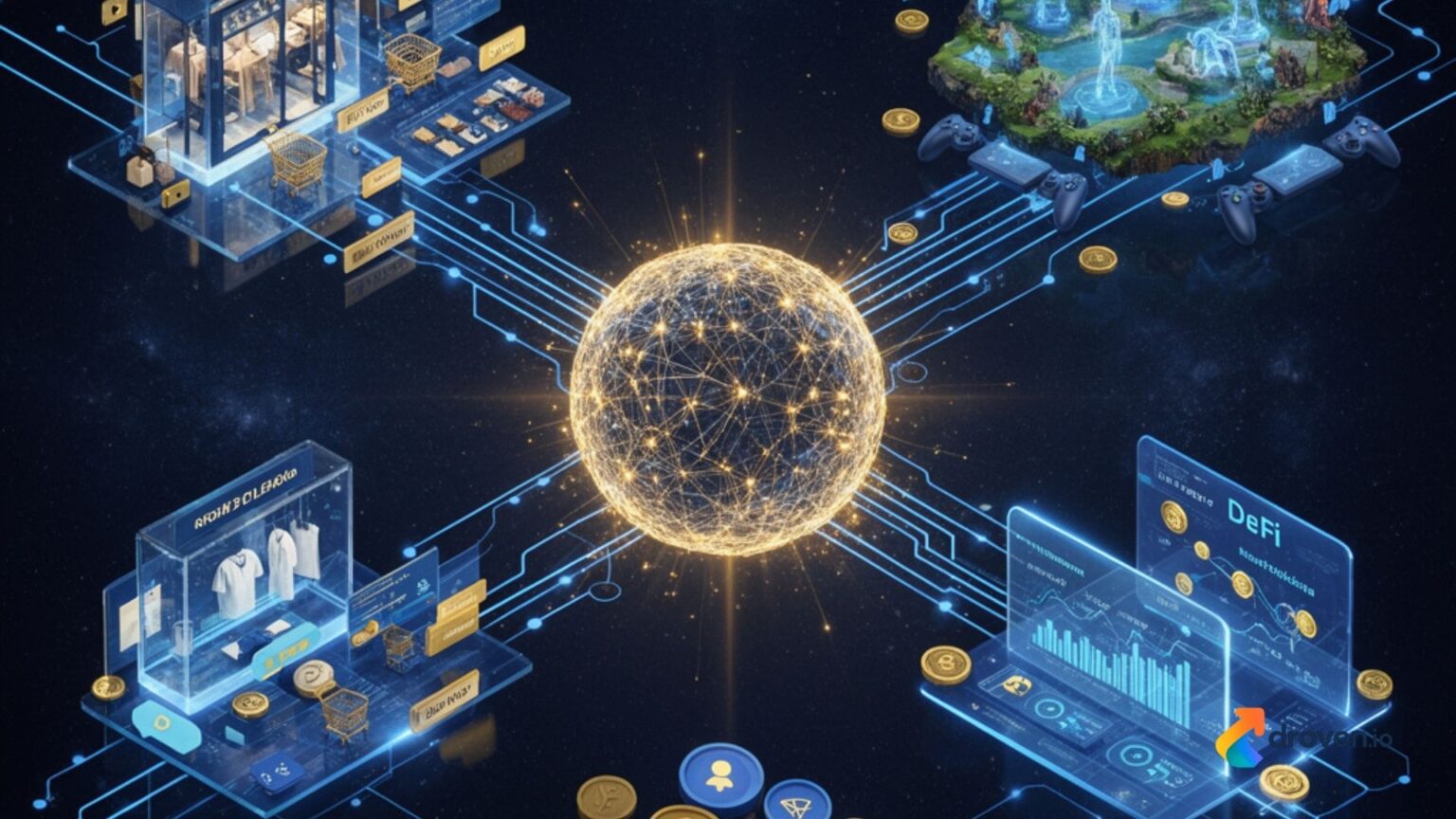
The internet is undergoing a structural transformation as decentralized networks replace legacy centralized intermediaries. Across the online landscape, digital assets have evolved from experimental financial instruments into foundational infrastructure powering web applications, gaming ecosystems, and cross-border commerce. Historically, online platforms operated as walled gardens where corporate entities controlled user data, digital inventories, and payment processing rails. Today, cryptographic tokens and blockchain protocols decentralize ownership, enabling peer-to-peer value transfer across digital borders without intermediaries.
As decentralized finance, tokenized infrastructure, and virtual economies mature, cryptocurrency is systematically taking over critical areas of the internet. This comprehensive analysis evaluates how programmable tokens transform online commerce, virtual gaming, cloud infrastructure, creator monetization, and digital governance.
How Digital Assets Are Reshaping the Global Online Ecosystem
To understand why cryptocurrency is dominating modern web environments, one must analyze the architectural shift from traditional client-server networks to decentralized blockchain infrastructure. Traditional online platforms rely on centralized databases where operators retain unilateral control over account access, transaction records, digital assets, and platform monetization.
| Architectural Dimension | Legacy Web2 Online Infrastructure | Decentralized Web3 Digital Assets Architecture |
|---|---|---|
| Data Ownership | Centralized corporations control user profiles | Users retain self-sovereign control via private keys |
| Payment Settlement | Intermediary banks and card networks (T+2 days) | Instant peer-to-peer cryptographic settlement |
| Platform Interoperability | Siloed ecosystems with closed proprietary APIs | Open-source smart contracts and universal standards |
| Monetization Rights | Platform takes 30% to 50% revenue commissions | Creators receive direct peer-to-peer micro-payments |
| Governance Structure | Corporate executives make unilateral decisions | Community-led voting through token-based DAOs |
When evaluating this architectural evolution, digital assets provide a trustless layer of economic exchange directly inside internet protocols. Consequently, developers build applications where users own their data, carry their digital reputations across platforms, and transact without seeking permission from financial institutions.
7 Epic Online Sectors Taken Over by Digital Assets
Cryptographic tokens are disrupting established online industries by eliminating administrative friction, lowering transaction fees, and returning property rights to end users. Below are seven major online sectors being transformed by decentralized technology.
1. E-Commerce and Cross-Border Merchant Payments
Online retail trade has long suffered from expensive payment processing fees, foreign exchange markups, and chargeback fraud. Today, global e-commerce merchants integrate cryptocurrency payment gateways to process transactions using dollar-backed stablecoins and native blockchain tokens.
| Payment Metric | Standard Credit Card Processing | Decentralized Stablecoin Payment Rails |
|---|---|---|
| Merchant Discount Rate | 2.5% to 4.5% per transaction | 0.1% to 0.5% network transaction fee |
| Settlement Velocity | 2 to 5 business days | 3 to 30 seconds finality |
| Chargeback Fraud Risk | High exposure to fraudulent chargebacks | Zero chargeback risk due to immutability |
| International Coverage | Restricted by geographic banking sanctions | Universal global access via internet wallets |
By adopting digital assets for online payments, e-commerce merchants eliminate expensive processing intermediaries, expand into unbanked international markets, and protect corporate revenue from fraudulent chargebacks.
2. Gaming, Virtual Worlds, and Metaverse Economies
Traditional video games operate as closed economies where players spend billions of dollars on in-game items that remain locked inside proprietary servers. The integration of digital assets into gaming introduces verifiable digital scarcity and true player ownership.
- Play-to-Own Mechanics: Players earn non-fungible tokens and tokenized rewards that hold real-world market value.
- Cross-Game Interoperability: In-game skins, weapons, and avatars function as portable assets usable across multiple virtual worlds.
- Secondary Marketplaces: Gamers trade, lease, and sell their earned virtual inventory freely on decentralized exchanges without publisher restrictions.
Consequently, gaming studios are shifting away from predatory micro-transaction models toward open player-owned economies.
3. Decentralized Finance (DeFi) and Online Lending
Decentralized finance protocols represent the most mature area of online takeover, systematically replacing traditional banking infrastructure with automated smart contracts.
- Automated Market Makers (AMMs): Decentralized exchanges allow users to trade token pairs instantly without relying on centralized order books or brokers.
- Algorithmic Money Markets: Online lending protocols enable individuals to lend and borrow global capital instantly without credit checks or bank loan officers.
- Liquid Staking and Yield: Users generate passive yield on their crypto holdings by securing public blockchain networks and providing liquidity to decentralized protocols.
By removing financial intermediaries, decentralized finance protocols deliver higher savings yields and lower borrowing costs to global online users.
4. Decentralized Physical Infrastructure Networks (DePIN)
The online takeover extends into physical computing infrastructure through Decentralized Physical Infrastructure Networks (DePIN). Instead of relying exclusively on centralized cloud providers like Amazon Web Services or Google Cloud, developers build distributed computing networks powered by token incentives.
| Infrastructure Domain | Centralized Cloud Provider Model | Decentralized DePIN Network Model |
|---|---|---|
| Cloud File Storage | Amazon S3 / Google Cloud Storage | Filecoin, Arweave (Distributed Storage) |
| GPU Compute Power | AWS EC2 / NVIDIA Enterprise Clusters | Render Network, Akash (Decentralized Compute) |
| Wireless Bandwidth | Traditional Telecommunication Carriers | Helium Network (Community-Owned IoT/Mobile) |
| Web Data Indexing | Proprietary Search Engine Web Crawlers | The Graph (Decentralized Blockchain Indexing) |
Participants contribute spare hard drive space, idle GPU processing power, and wireless bandwidth to public networks, earning digital assets as compensation. Consequently, DePIN infrastructure reduces cloud computing costs significantly while eliminating single points of network failure.
5. Digital Media, Content Creator Economy, and NFTs
Traditional social media and streaming platforms monetize user-generated content through advertising, distributing only a fraction of advertising revenues to creators. Cryptographic tokens and non-fungible tokens (NFTs) restructure the online creator economy by enabling direct fan-to-creator monetization.
| Media Monetization Model | Legacy Web2 Streaming / Social Media | Web3 NFT and Creator Token Economy |
|---|---|---|
| Platform Revenue Split | Creator receives 45% to 55% of net ad revenue | Creator receives 95% to 97% of primary sales |
| Secondary Resale Rights | Zero revenue from secondary content sharing | Automated 5% to 10% on-chain resale royalties |
| Audience Relationship | Algorithm-controlled audience reach | Direct, uncensored peer-to-peer fan connection |
| Content Preservation | Subject to arbitrary platform de-platforming | Permanent decentralized storage on Arweave/IPFS |
Through token-based memberships and collectible digital artwork, content creators build independent online businesses that cannot be de-monetized by corporate executives.
6. Decentralized Autonomous Organizations (DAOs) and Online Governance
Online communities historically lacked legal and financial structures to coordinate capital across international borders. Decentralized Autonomous Organizations (DAOs) solve this challenge by utilizing digital assets as governance tokens within smart contract treasuries.
- Transparent Treasury Management: Every incoming and outgoing treasury transaction is publicly verifiable on the blockchain ledger.
- Proposal Voting Systems: Governance token holders vote directly on protocol upgrades, grant allocations, and capital deployments.
- Borderless Collective Action: Contributors from dozens of countries collaborate seamlessly without establishing traditional corporate subsidiaries.
Consequently, DAOs are replacing traditional corporate structures for open-source software development, online investment clubs, and digital cooperatives.
7. Digital Identity and Web3 Domain Services
Online identity verification has traditionally relied on centralized authentication providers like Google, Apple, or Facebook. However, relying on corporate logins exposes users to surveillance and de-activation risks.
- Self-Sovereign Identity: Users authenticate across web applications using cryptographic wallet addresses rather than passwords.
- Web3 Domain Names: Services like Ethereum Name Service (ENS) replace complex hexadecimal wallet addresses with readable domains that act as portable web identities.
- Verifiable On-Chain Reputations: On-chain activity logs create immutable resumes showing a user’s transaction history, governance participation, and skill badges.
This identity takeover ensures that individuals retain absolute ownership over their online reputations across every web application they visit.
Technological Infrastructure Driving Digital Assets Expansion
The rapid takeover of online industries relies on advanced cryptographic engineering and high-throughput blockchain architectures. Understanding the underlying technology clarifies how decentralized networks achieve consumer-grade performance.
| Technology Component | Engineering Specification | Impact on Online Takeover |
|---|---|---|
| Layer-2 Scaling Rollups | Optimistic and Zero-Knowledge (ZK) rollups | Compresses transactions to reduce gas fees by 98% |
| Account Abstraction | ERC-4337 smart contract wallet accounts | Enables social login and gasless transactions |
| Cross-Chain Bridges | Interoperable messaging protocols | Allows tokens to flow seamlessly across blockchains |
| Zero-Knowledge Proofs | Cryptographic privacy verification | Verifies user credentials without exposing private data |
These technological advancements remove historical usability barriers. By abstracting away complex seed phrases and network gas fees, modern decentralized applications deliver intuitive user experiences that rival traditional web platforms.
Comparative Breakdown: Legacy Web Channels vs. Digital Assets
Comparing traditional internet business models against decentralized alternatives highlights why developers and consumers migrate toward crypto-powered networks.
| Online Service Sector | Traditional Web2 Market Leader | Decentralized Web3 Challenger Protocol | Primary Advantage of Decentralized Protocol |
|---|---|---|---|
| Financial Exchange | New York Stock Exchange / NASDAQ | Uniswap / dYdX (DEX) | 24/7 global access without broker intermediation |
| Video Streaming | YouTube / Twitch | Livepeer / Theta Network | Lower video transcoding costs via shared bandwidth |
| Freelance Marketplace | Upwork / Fiverr | Braintrust / Web3 Job Portals | Zero commission fees taken from freelancer wages |
| Domain Registration | GoDaddy / Verisign | Ethereum Name Service (ENS) | True domain ownership without recurring renewal fees |
| Social Networking | X (Twitter) / Instagram | Farcaster / Lens Protocol | Uncensored social graphs owned by individual users |
As demonstrated in this comparative breakdown, decentralized alternatives systematically offer lower fees, stronger privacy protections, and superior user ownership rights across every online sector.
Pipeline for Integrating Digital Assets into Web Enterprises
For traditional online businesses seeking to adopt cryptocurrency functionality, engineering teams follow a structured implementation pipeline.
| Integration Phase | Technical Execution Task | Operational System Outcome |
|---|---|---|
| Phase 1: Payment Gateways | Integrate non-custodial stablecoin checkout APIs | Enables instant global crypto payments at checkout |
| Phase 2: Wallet Authentication | Add Web3 wallet connection alongside email login | Allows self-sovereign user authentication |
| Phase 3: Tokenized Rewards | Launch loyalty reward programs using native tokens | Increases user retention through real asset ownership |
| Phase 4: On-Chain Governance | Introduce voting modules for product roadmaps | Transforms passive consumers into active stakeholders |
Following this integration pipeline allows established web enterprises to transition smoothly into the Web3 economy without disrupting their existing operational revenue streams.
Security and Regulatory Governance in Digital Assets Adoption
While the online takeover of decentralized technology accelerates, maintaining rigorous security standards and regulatory compliance remains essential for enterprise adoption.
| Governance Challenge | Operational Risk Factor | Industry Best Practice Solution |
|---|---|---|
| Smart Contract Vulnerabilities | Exploits in code draining protocol treasuries | Multiple independent bytecode audits & bug bounties |
| Regulatory Compliance (AML) | Anti-money laundering enforcement by authorities | Implementing non-invasive on-chain risk scoring APIs |
| Private Key Custody | Loss of access to organizational treasury funds | Multi-party computation (MPC) and hardware vaults |
| Phishing and Front-End Hacks | Malicious actors intercepting user wallet approvals | Automated transaction simulation & clear signing UI |
By deploying multi-party computation vaults, executing continuous smart contract audits, and applying automated transaction screening tools, online platforms secure their digital asset infrastructure against evolving cyber threats.
Frequently Asked Questions (FAQs)
What are digital assets in the context of the online space?
They are programmable cryptographic tokens, stablecoins, non-fungible tokens, and cryptocurrencies that represent verifiable ownership and value on a blockchain network.
How are digital assets changing e-commerce payments?
They allow merchants to accept borderless payments with near-instant settlement, zero chargeback fraud risk, and processing fees under one percent.
Why do gamers prefer digital assets over traditional in-game items?
Cryptographic tokens give gamers true ownership of virtual items, allowing them to trade, sell, or transfer skins and weapons across different games freely.
What is a Decentralized Physical Infrastructure Network (DePIN)?
DePIN is an online framework where individuals share physical resources like cloud storage, GPU compute, and wireless bandwidth in exchange for token rewards.
How do digital assets protect content creator revenues?
They allow creators to sell digital content directly to fans without platform intermediaries, while automating perpetual resale royalties through smart contracts.
What makes Web3 domain names different from traditional DNS domains?
Web3 domains function as self-sovereign identity tokens stored in a user’s wallet, requiring no recurring annual renewal fees to centralized domain registrars.
Conclusion
The ongoing takeover of the online space by digital assets marks a permanent evolution in how the internet structures ownership, commerce, and governance. As analyzed throughout this review, cryptographic tokens are dismantling the walled gardens of traditional web platforms across e-commerce, gaming, cloud computing, decentralized finance, and social media. By replacing centralized corporate gatekeepers with automated smart contracts, blockchain protocols deliver lower transaction fees, instant global settlement, and true self-sovereign ownership to internet users worldwide.
Furthermore, advancements in layer-2 scaling, account abstraction, and zero-knowledge cryptography continue to remove technical barriers, making decentralized applications accessible to mainstream consumers. As regulatory clarity improves and enterprise adoption expands, programmable tokens will serve as the default infrastructure for the next generation of online digital commerce.
