
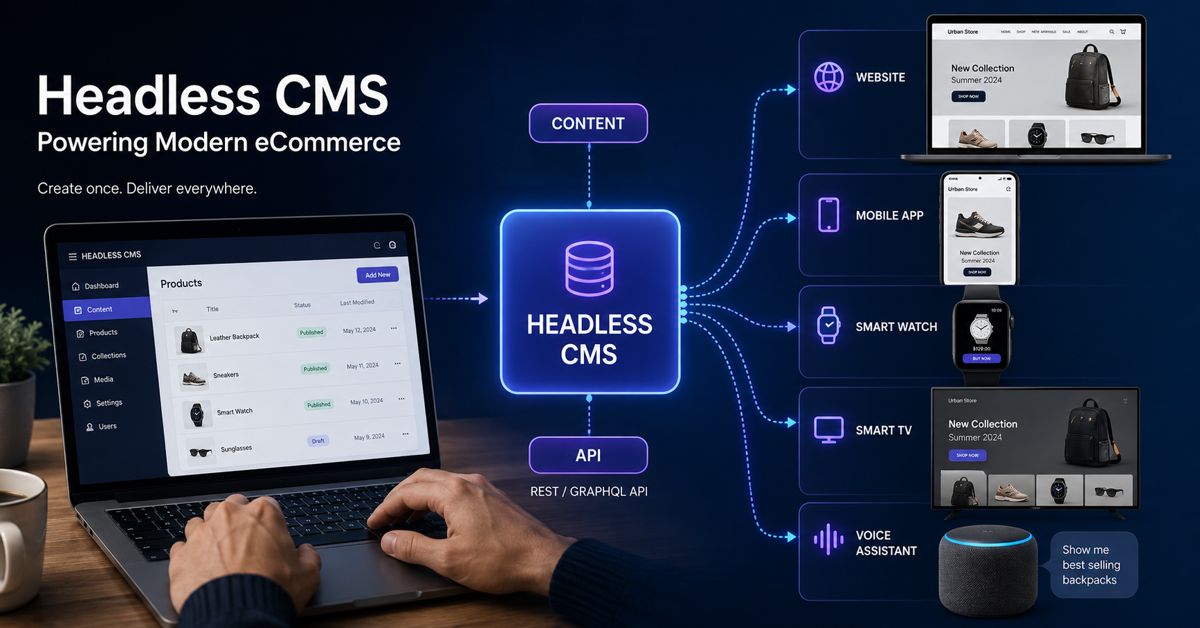
Shopping online has evolved significantly over the past few years. Today, customers are shopping on phones, tablets, smart TVs and – even – voice assistants. They want a seamless and quick experience whatever device they are using. The old-school content management systems were not created for this type of requirement.
Businesses investing in custom CMS development services are increasingly choosing headless architecture because it gives them the control and flexibility that traditional platforms cannot offer.
In this article you will learn what headless CMS is and why it is relevant for eCommerce and how it’s transforming the way online stores are developed.
What Headless CMS Actually Means
The word “headless” sounds more complicated than it is. A traditional CMS is separate from the content, always paired with the design. Imagine a house with a single room for the living room and the kitchen. Now, imagine everything being connected, and that if the kitchen was to change, the living room will too.
A headless CMS is one that resolves those two things. The content is stored and managed in the back end of the system, but the customer can see only the front end. Both sides can talk to one another by using an API, which is in essence a messenger that carries messages from the backend to whatever frontend it’s connected to.
How It Fits Into Modern eCommerce
● The Shopping Experience Has Changed
Customers today do not follow a straight path from ad to purchase. They see a product on Instagram, read about it on their cell phone, and purchase it on their laptop. All touchpoints should be uniform. That’s easier with a headless CMS, since content stays where it belongs and provides it wherever it’s needed. Traditional platforms were designed to work for websites, not for a network of sales channels.
● Speed Becomes a Real Advantage
Speeds are one of the key things that can be gained by doing it headless. It adds load time to the overall process when using traditional CMS, as the pages get generated on the server before being sent to the browser. A headless setup delivers the pre-built pages directly to the end-user, which is quicker. For an eCommerce business, speed is a crucial component since it is directly near the customer whether they remain or depart.
● Developers Can Work Without Limits
In a traditional CMS, developers have to create within the platform’s limitations. Certain layouts are possible. Others are not. Most of those restrictions are lifted with Headless. The front could be created with any tech that the developers prefer, such as, React, Next.js, Vue. A dev that’s not hacking against the platform makes better things and makes them quicker.
The Content Management Side
● Marketers and Content Teams Stay in Control
The biggest fear business owners have when they first hear about a headless CMS is that it seems too complicated. When the front-end development is custom-made with the back end being outside your control, does this eliminate the marketing team’s ability to control their content? Not at all. Content Management should be easy for non-technical users—this is exactly why the whole back end exists. It is easy for non-technical users.
Marketers can continue to log in and update banners, add blog posts, and manage promotions. They are not expected to be aware of what has been done on the frontend. Their content is added there, and the developers have control over how it will be displayed.
● One Source for All Channels
It’s completely a nightmare where brands are selling across various mediums on their website, mobile apps, Amazon, social media storefronts etc. Things get out of sync. Product description is different on one platform and differs on another. Prices are updated on one side of the programme but not the other.
One way this can be overcome is by using a headless CMS, which serves as the single source of truth. Everything is centrally managed and pushed to all channels via APIs. If there is a price increase or the product is updated, then it is updated everywhere. That kind of consistency saves time and prevents mistakes.
Why eCommerce Businesses Are Making the Switch
● Scaling Gets Easier
A traditional CMS handles a small store well enough. But as the business grows, performance drops and the system gets harder to manage. This is where many businesses turn to expert ecommerce web development services to rebuild on a headless foundation. Because the frontend and backend are independent, each can be upgraded without disrupting the other.
● Integration With Other Tools Is Simpler
A lot of tools are used by modern eCommerce stores — payment processors, inventory systems, platforms for email marketing, and loyalty programs. However, when trying to combine them all into a traditional CMS, you typically find slow plugins and brittle custom code. Headless integrations are handled by APIs, they are cleaner and easier to take care of. If any one tool in the chain is replaced the rest of the tools remain unaffected.
● Personalization Becomes Possible at Scale
Consumers want an experience that makes them feel special, including recommendations based on previous purchases, location-based content and offers based on their browsing and shopping habits. A traditional CMS can pretty much do some of this, but it quickly becomes chaotic. A headless setup can seamlessly integrate with personalization features and provide appropriate experiences without the constant battle.
Where This Is All Heading
Headless CMS is not a trend that is going to fade. This is now a standard to how much eCommerce development is taken seriously. The tools that are used to support it are improving year by year, and usability is improving even further. Platforms supporting headless are increasing, and the number of real experts is increasing.
For businesses thinking about their next platform decision, headless architecture is no longer only for large enterprises. It’s a smart option for any expanding retail shop seeking to stay competitive, provide uniform experiences throughout all channels and launch on a basis that grows with the small.
