
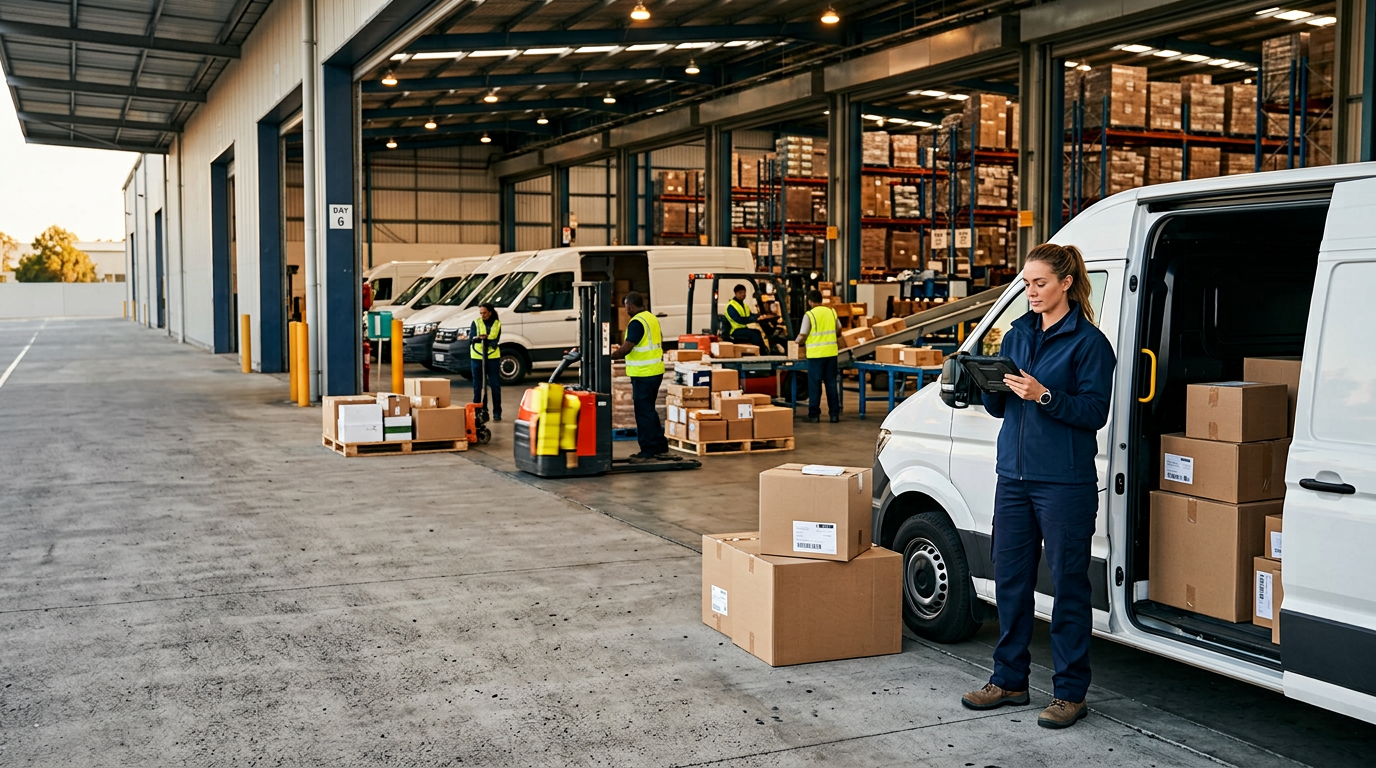
Most people do not spend much time thinking about freight terminals, distribution centers, warehouse management systems, or the people coordinating truck routes across several states.
Then a shipment is late.
A store runs out of a popular product. A contractor discovers that a critical component will not arrive until next week. A restaurant cannot get a particular ingredient. A hospital waits on supplies it expected that morning. Suddenly, an industry that usually operates quietly in the background becomes very visible.
Modern life depends on thousands of businesses whose work is largely invisible when everything goes according to plan. Transportation companies, warehouse operators, freight brokers, third-party logistics providers, inventory specialists, and distribution teams are among them. Their work connects manufacturers with retailers, suppliers with businesses, and businesses with customers.
The remarkable part is not that deliveries are occasionally delayed. It is how often extraordinarily complicated supply chains work without consumers ever having to think about them.
The Hidden Infrastructure Behind Everyday Purchases
A product sitting on a store shelf may have traveled farther than the person buying it realizes.
Its raw materials might originate in several countries. Manufacturing could take place hundreds or thousands of miles from the eventual customer. Packaging may come from another supplier. Finished goods might move through ports, rail terminals, regional warehouses, and local distribution centers before reaching a retailer.
Online shopping adds another layer.
Customers increasingly expect to see whether something is in stock, receive an estimated delivery date, follow the package in real time, and sometimes receive it within a day or two. Meeting those expectations requires coordination far beyond simply putting a box on a truck.
Warehouses must know what inventory they have and where it is located. Transportation planners must organize efficient routes. Businesses must anticipate demand, maintain enough stock without overfilling their facilities, and react quickly when something changes.
When every link in that system works properly, the complexity is almost invisible.
That invisibility is one of logistics’ greatest achievements.
What Happens When One Part of the Chain Breaks
Supply chains are interconnected, which means a relatively small disruption can travel surprisingly far.
Imagine a manufacturer waiting for one specialized part before finishing a product. If that component arrives several days late, production may slow or stop. The finished product then reaches the warehouse late, which affects retailer deliveries and ultimately customers.
A delay that initially involved one supplier can quickly involve dozens of businesses.
Weather events, port congestion, equipment failures, staffing shortages, road closures, sudden demand increases, and manufacturing problems can all affect transportation schedules. Even administrative issues such as inaccurate shipping documents or inventory records can create significant delays.
Companies therefore spend considerable effort identifying potential bottlenecks before they become serious problems.
This is why supply chain management is not simply about moving goods quickly. It is about creating enough visibility and flexibility to respond when the original plan stops working.
Why Businesses Rely on Logistics Partners
For smaller organizations in particular, building an entire transportation and warehousing operation internally may be impractical.
Warehouses require space, equipment, technology, staffing, safety procedures, inventory systems, and management. Transportation adds another set of challenges involving routing, carriers, schedules, costs, and delivery performance.
Third-party logistics companies allow businesses to outsource some or all of those responsibilities.
A growing company serving customers in Florida, for example, might work with a Tampa third party logistics provider to handle services such as warehousing, distribution, fulfillment, or transportation coordination rather than attempting to build the same infrastructure independently.
The value is not simply convenience.
Experienced logistics providers can give companies access to established transportation networks, operational expertise, storage capacity, and systems that might otherwise require significant investment. They may also help businesses respond more quickly when demand changes.
That flexibility becomes especially important during growth periods, seasonal spikes, promotions, or unexpected disruptions.
Retailers Feel Supply Chain Problems Almost Immediately
Retail may be the easiest place to observe logistics in action because inventory problems become visible to customers.
A missing product creates more than an empty shelf. Customers may purchase an alternative, visit another retailer, or postpone the purchase altogether.
For ecommerce companies, the effects can be even more immediate.
Shoppers have become accustomed to seeing delivery estimates before completing a purchase. If shipping takes significantly longer than expected, some customers will simply choose another seller.
Retailers therefore need accurate information about what is available, what is arriving, and how quickly orders can leave the warehouse.
This has made logistics technology increasingly important. Inventory systems, barcode tracking, warehouse software, transportation platforms, and predictive analytics all help businesses understand what is happening throughout their operations.
Technology cannot prevent every disruption, but it can make disruptions easier to identify and manage.
Manufacturers Depend on Timing More Than Most Consumers Realize
Manufacturing illustrates how tightly connected modern supply chains have become.
Factories often rely on components arriving according to carefully planned schedules. Holding enormous amounts of extra inventory can be expensive, so many businesses try to balance having enough material available without unnecessarily tying up capital or warehouse space.
That approach works well when supply chains are predictable.
Problems emerge when a critical shipment is delayed, and there is no readily available substitute.
Production may slow, workers may have to change schedules, customer orders may be postponed, and transportation arrangements for finished products may need to be reorganized.
For this reason, manufacturers increasingly focus on supply chain resilience rather than efficiency alone.
The fastest or cheapest system is not always the strongest. Businesses also need contingency plans, alternative suppliers, transportation options, inventory visibility, and realistic expectations about where disruptions could occur.
Healthcare Shows Why Logistics Can Be More Than a Convenience
Some industries can tolerate a delayed shipment more easily than others.
Healthcare is one of the clearest examples.
Hospitals, clinics, pharmacies, laboratories, and treatment facilities depend on consistent access to medical supplies, equipment, medications, food, sanitation products, and countless ordinary operational materials.
A healthcare facility cannot simply assume that important supplies will somehow be available when needed.
Behind patient-facing services is an extensive network of purchasing teams, distributors, warehouse operators, transportation providers, and inventory specialists working to keep essential goods moving.
Healthcare also demonstrates that supply chains ultimately affect people, not just balance sheets.
When organizations support individuals during particularly difficult periods, dependable operations matter. Someone entering a drug and alcohol detox program, for instance, primarily sees clinicians, support staff, and the treatment environment. Behind those visible services are less noticeable operational systems ensuring that facilities have the resources necessary to function day after day.
Logistics may rarely be considered part of care, but dependable supply networks help make many forms of care possible.
Hospitality Runs on Deliveries Too
Hotels, restaurants, resorts, and event venues face a different type of supply chain pressure.
Their customers expect experiences to feel effortless.
Guests generally do not want to know that a hotel had difficulty receiving linens, cleaning products, toiletries, food, beverages, replacement equipment, or maintenance materials. They simply expect those things to be available.
Restaurants face particularly tight timelines because many ingredients are perishable.
Receiving too much creates waste. Receiving too little can leave popular menu items unavailable. Receiving food late may be nearly as problematic as not receiving it at all.
That makes forecasting and supplier coordination critical.
The same principle applies to event venues. Weddings, conferences, and large gatherings cannot always be postponed because a shipment failed to arrive. Businesses must anticipate demand and create backup plans before problems occur.
Consumers Now Expect Supply Chains to Be Visible
For much of history, customers had very little information about what happened between placing an order and receiving it.
That has changed dramatically.
Tracking numbers, delivery notifications, estimated arrival times, warehouse updates, and live maps have made logistics part of the customer experience.
Consumers may never meet anyone involved in transporting their purchase, but they increasingly expect to know where that purchase is.
This visibility creates pressure as well as opportunity.
A delayed order can be frustrating, but uncertainty often makes the experience worse. Businesses that communicate clearly about delays may preserve customer trust even when circumstances are imperfect.
That means logistics has become closely connected with customer service.
The delivery itself matters, but so does the information surrounding it.
Supply Chain Stress Eventually Reaches People
Discussions about supply chains often focus on products, trucks, warehouses, software, and costs. The human side receives less attention.
Yet disruptions frequently create intense pressure for the people responsible for solving them.
Drivers work within demanding schedules. Warehouse employees manage changing order volumes. Procurement teams search for alternative suppliers. Customer service representatives respond to frustrated buyers. Managers make rapid decisions while trying to control rising costs.
Most people handle occasional periods of pressure without serious consequences, but prolonged stress can affect sleep, mood, relationships, and coping habits.
Organizations cannot eliminate every demanding period, but healthier workplaces recognize that employee wellbeing is part of operational resilience. When anxiety, substance use, or other concerns become persistent, access to appropriate professional resources matters. Information about co-occurring anxiety and addiction treatment may be useful for individuals or families trying to understand situations where these challenges overlap.
The broader lesson is that resilient systems depend on resilient people as well as reliable technology.
The Best Logistics Is Often the Logistics Nobody Notices
There is a strange paradox at the center of the logistics industry.
Success frequently means becoming invisible.
When goods arrive exactly where they should, when inventory is available, when restaurants have ingredients, when factories have components, and when online orders appear on doorsteps on schedule, few people stop to ask how any of it happened.
They simply continue with their day.
That quiet reliability supports much of the modern economy.
Transportation networks connect businesses that may never interact directly. Warehouses allow companies to position products closer to customers. Technology gives organizations visibility into inventory and shipments. Logistics professionals troubleshoot thousands of small problems before they grow large enough for consumers to notice.
Only when something goes wrong does the machinery behind modern commerce suddenly become obvious.
Perhaps that is the best way to understand the industry: logistics is one of those essential systems that earns attention precisely when it stops being invisible.
The next time a package arrives on time, a favorite product is waiting on the shelf, or a business has exactly what it needs when it needs it, there is a good chance an entire network of people, technology, transportation, and planning worked behind the scenes to make that ordinary moment possible.
