
Launching a SaaS product is not simply about making the product available.
You need to explain what the product does, why it matters, and why someone should pay attention to it at the right stage of the buying journey. Video can help with all three, but a single video rarely needs to do everything.
A more useful approach is to build a video campaign around the launch itself.
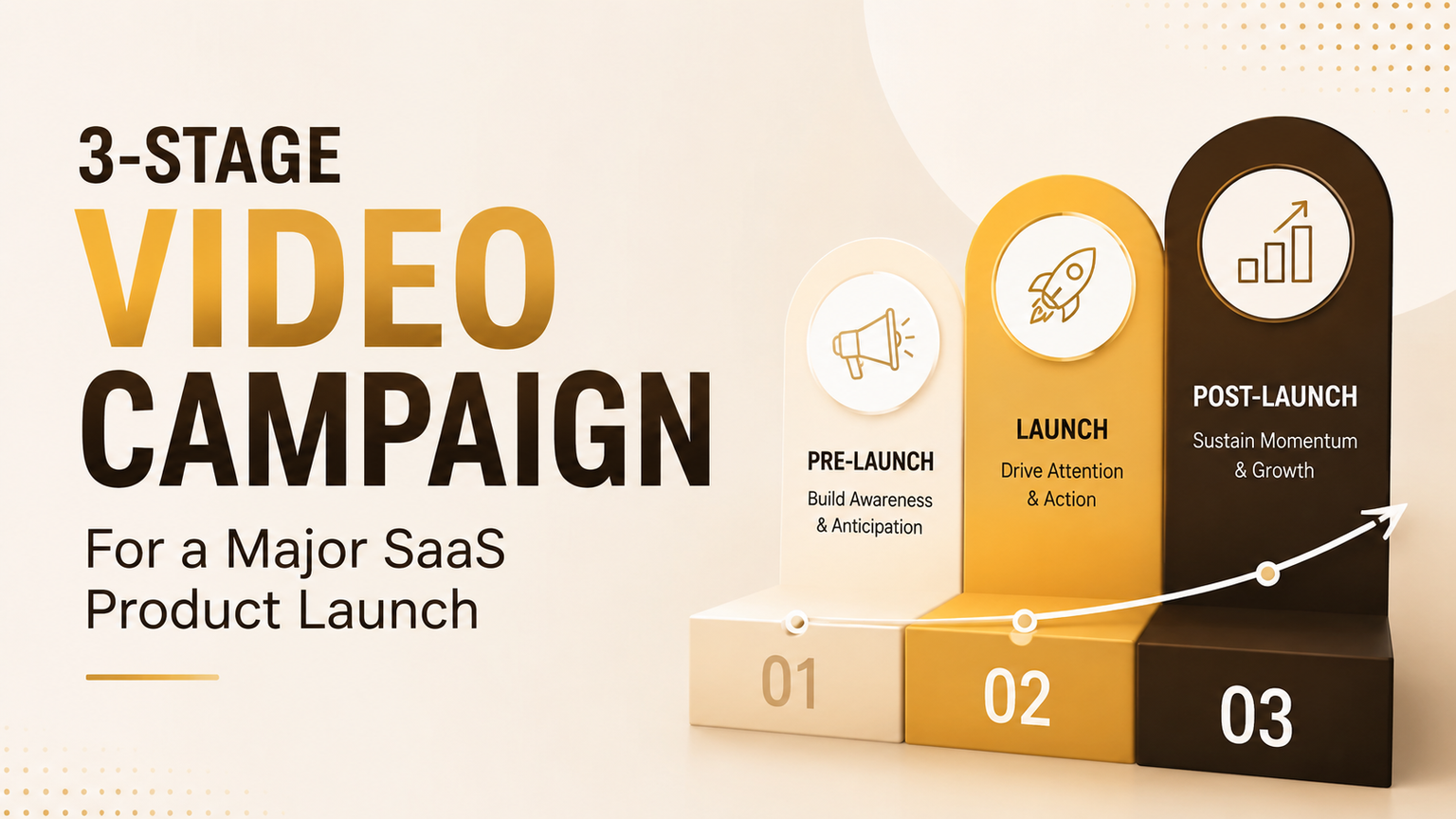
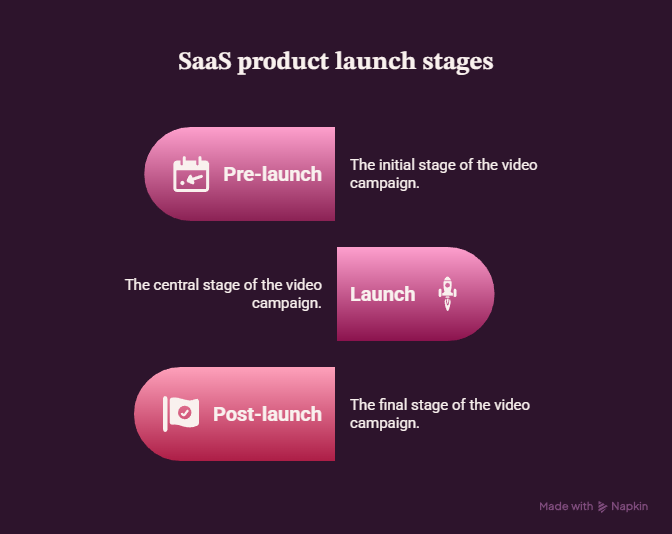
Pre-launch → Launch → Post-launch
Each stage has a different purpose. The videos you create, the message you use, and the metrics you track should reflect that purpose.
Understanding the SaaS Product Launch
Before planning the video campaign, it helps to understand what makes a SaaS launch different from a traditional product launch.
SaaS products are often complex. They may involve multiple features, workflows, integrations, pricing plans, and use cases. A launch therefore needs to communicate more than the existence of a new product.
It needs to help potential customers understand how the product fits into a problem they already have.
What Is a SaaS Product?
Software-as-a-Service (SaaS) is software that customers access over the internet, usually through a subscription rather than a one-time purchase.
Instead of installing and owning a fixed version of the software, customers typically use a centrally hosted product that is continuously updated.
For the company launching it, that changes the role of the launch.
You are not simply introducing software to the market. You are introducing an ongoing service that needs to demonstrate value over time.
That makes clarity particularly important. Potential customers need to understand what the product does, what problem it solves, and whether it is relevant to their situation.
Why Product Launches Matter
A product launch creates an early opportunity to test how the market responds to the product.
It can help a SaaS company attract its first users, generate customer feedback, test its positioning, and identify whether the value proposition is clear enough.
A strong launch can also reveal problems that were difficult to see before the product reached real customers.
For example, prospects may understand the product but not the pricing. They may like the feature set but not see how it fits into their existing workflow. Or they may understand what the product does but not why they need it.
These signals can influence everything from messaging and sales enablement to future product development.
What Makes a SaaS Launch Successful?
A successful launch is not simply one that generates a large number of views, clicks, or sign-ups.
The more useful question is whether the launch attracts the right audience and creates meaningful movement toward adoption.
Depending on the product and launch strategy, that could include:
- Early adopters
- Product sign-ups
- Qualified leads
- Customer feedback
- Product engagement
- Sales opportunities
- Initial customers
The exact targets will vary, but the principle is the same: the launch should create evidence that the product is solving a real problem for the right audience.
Video should support that process rather than operate as a separate marketing activity.
Stage 1) Pre-launch Phase
The pre-launch stage is about creating context before asking people to take action.
Potential customers may not know the product exists yet. They may also not understand the problem it solves or why the new product is different from existing alternatives.
This is where research, validation, and planning become important.
Conducting Market Research
Before deciding what the videos should say, understand what the target audience already knows and cares about.
Look at the problems customers are trying to solve, how competitors position their products, what language prospects use, and where existing solutions fall short.
This information can help shape the video’s message.
For example, if customers consistently describe a problem using a particular phrase, that language may be more effective than internal product terminology.
Market research can also help answer a more important question:
What does the audience need to understand before they will care about the product?
That answer should influence the campaign’s messaging from the beginning.
Validating Your Ideas
Once the market and customer problem are clearer, the next step is to test whether the product and its value proposition make sense to the intended audience.
A minimum viable product (MVP) can help companies collect early feedback before investing heavily in a full launch.
The same principle applies to the video campaign.
Early messaging, scripts, concepts, or short videos can be tested with prospects or existing customers to identify what is clear and what is confusing.
If people understand the feature but cannot explain why it matters, the problem may not be the video. The positioning may need more work.
The goal is not to make the launch video sound impressive.
It is to make sure the product makes sense to the people who are most likely to use it.
Developing a Launch Plan
Once the positioning and product have been validated, the campaign needs a clear launch plan.
This should define:
- What videos will be created
- Who each video is for
- When each video will be released
- Where each video will be distributed
- What action viewers should take
- Which teams will use the videos
- How performance will be measured
The launch plan should also align marketing, product, and sales.
A product launch becomes harder to manage when the marketing team is communicating one message, the website communicates another, and the sales team is using a different explanation.
The video campaign should reinforce the same core value proposition across these touchpoints.
Stage 2) Launch Phase
The launch stage is where the product is introduced directly to the market.
At this point, the audience needs more than awareness. They need enough information to understand the product and decide whether it is worth exploring.
That usually requires more specific and product-focused video content.
Creating the Right Video Content
Not every launch needs one large product video.
Different videos can answer different questions.
Product demos can show how the product works.
Explainer videos can simplify a complex product, workflow, or technical concept.
Customer testimonials can provide evidence that the product delivers value in a real situation.
The important part is to give each video a clear job.
A product demo might focus on the workflow.
A launch video might explain what is new.
A testimonial might answer the question, “Why should I trust this product?”
Trying to make one video answer all of these questions can make the message harder to follow.
Implementing the Go-to-Market Strategy
The video campaign also needs to be connected to the broader go-to-market strategy.
The same video may appear on different channels, but its role can change depending on where it is used.
For example:
- A short version may introduce the product on social media.
- A longer demo may sit on the product landing page.
- A sales-focused version may be used during outreach.
- An explainer may be included in an email campaign.
- A customer story may support the sales process.
Distribution should therefore be planned alongside production.
The question is not simply, “Where can we publish this video?”
It is:
“Where will this video help the audience take the next useful step?”
Launch Day Checklist
Launch day involves more than publishing the video.
Before the campaign goes live, check that the supporting experience works as expected.
At a minimum, review:
- Landing pages
- Forms
- Product links
- CTAs
- Pricing information
- Tracking and analytics
- Video embeds
- Sales materials
- Customer support channels
The videos should also be checked against the final product.
If a feature, interface, price, or workflow shown in the video has changed, the video can create confusion rather than clarity.
Launch day is therefore a useful point to verify the entire customer journey, not just the video itself.
Post-launch Strategies
Publishing the campaign is not the end of the launch.
Once real users and prospects start interacting with the product, the company has new information that can be used to improve both the product and the marketing.
The post-launch stage is where that information becomes useful.
Analyzing Performance Metrics
Start by looking at how people interacted with the videos.
Depending on the campaign, useful metrics may include:
- Video views
- Watch time
- Engagement
- CTA clicks
- Sign-ups
- Conversion rates
- Customer acquisition cost
- Product engagement
For a more detailed look at how video contributes to sign-ups, demo requests, and other conversion actions, see our guide to SaaS video conversion rate.
But these numbers should be interpreted in context.
A video with a high view count may generate little business value if the audience is not relevant.
A video with fewer views may perform better if it reaches qualified prospects and contributes to product sign-ups or sales opportunities.
The goal is not simply to find the video with the most views.
It is to understand which videos are helping the launch move forward.
Gathering Customer Feedback
Analytics can show what people did.
Customer feedback can help explain why they did it.
Early users and prospects can reveal where the product is difficult to understand, which features are valuable, and which parts of the messaging are unclear.
Feedback can come from:
- Customer interviews
- Surveys
- In-product feedback
- Sales conversations
- Support conversations
- Social media discussions
For example, if prospects repeatedly ask the same question during sales calls, that question may deserve a clearer explanation in the product video or on the landing page.
This makes customer feedback useful not only for product development, but also for improving the launch content.
Iterating on the Product
The information collected after launch should feed into the next iteration.
That may mean improving an existing feature, changing a workflow, adjusting pricing, refining the positioning, or creating new content around a common customer question.
The same applies to the videos.
If viewers consistently leave before the product demonstration begins, the introduction may be too long.
If qualified prospects watch the video but do not move forward, the video may not be addressing the questions or objections that matter at that stage.
If a particular use case consistently generates better engagement or conversion, future content can focus more heavily on that use case.
The launch should therefore be treated as a learning cycle rather than a single event.
How the 3-Stage Video Campaign Fits Together
The three stages have different objectives, but they should work as one system.
Pre-launch → Create context and validate the message
Launch → Explain the product and encourage action
Post-launch → Measure, learn, and improve
This structure also helps prevent a common problem with product launch campaigns: trying to make every video do everything.
A pre-launch video does not necessarily need to generate a sale.
A launch video does not necessarily need to explain every feature.
A post-launch video does not necessarily need to attract a new audience.
Each piece should have a clear role.
What Should You Measure?
The metrics should follow the objective of each stage.
During pre-launch, you may be more interested in engagement, audience response, and message validation.
During launch, sign-ups, CTA actions, product interest, and qualified leads may become more important.
After launch, you can look further down the funnel at customer acquisition, product engagement, retention, and feedback.
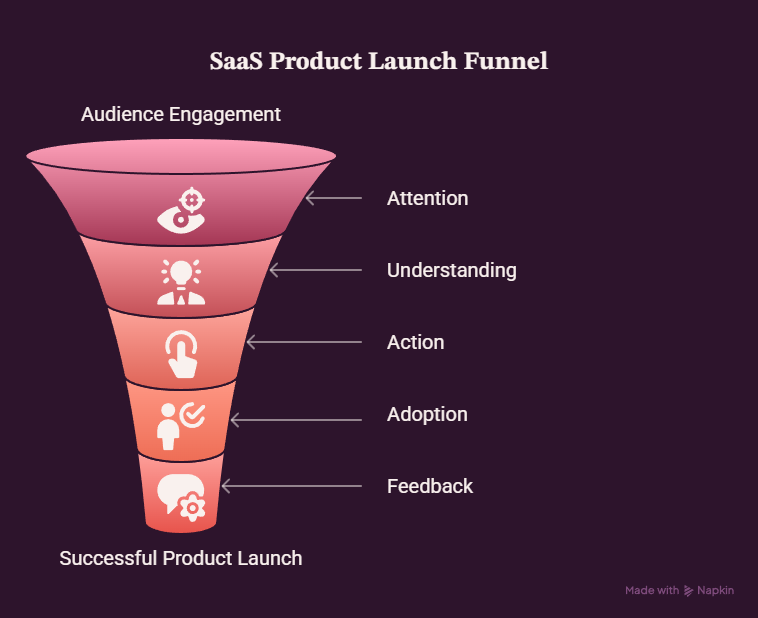
A simple way to think about the campaign is:
Audience → Attention → Understanding → Action → Adoption → Feedback
The exact metrics will vary by company, but connecting these stages gives you a clearer picture of whether the campaign is actually helping the product launch.
The Real Role of Video in a SaaS Product Launch
A video campaign should not be treated as a collection of videos published around launch day.
Its purpose is to help potential customers understand the product at different points in their decision-making process.
Before launch, video can help create context and test the message.
During launch, it can demonstrate the product and make the value proposition easier to understand.
After launch, performance data and customer feedback can show what needs to be improved.
That is what makes a 3-stage video campaign useful.
The goal is not to create more videos. It is to create the right video for the question the buyer is asking at each stage of the launch.
