
Introduction: The Real Cost of Choosing the Wrong Platform
Every growing business eventually hits the same wall. The digital product that worked well for the first thousand users starts to struggle at fifty thousand. New features take months instead of weeks. Integrations break. Customers notice, and some of them leave.
Very often, the root cause traces back to an early platform decision made under time pressure. One of the most common forks in that road is the choice between a Progressive Web App (PWA) and a native mobile app. It looks like a technical question, but it is really a business strategy question with lasting consequences for cost, reach, and customer experience.
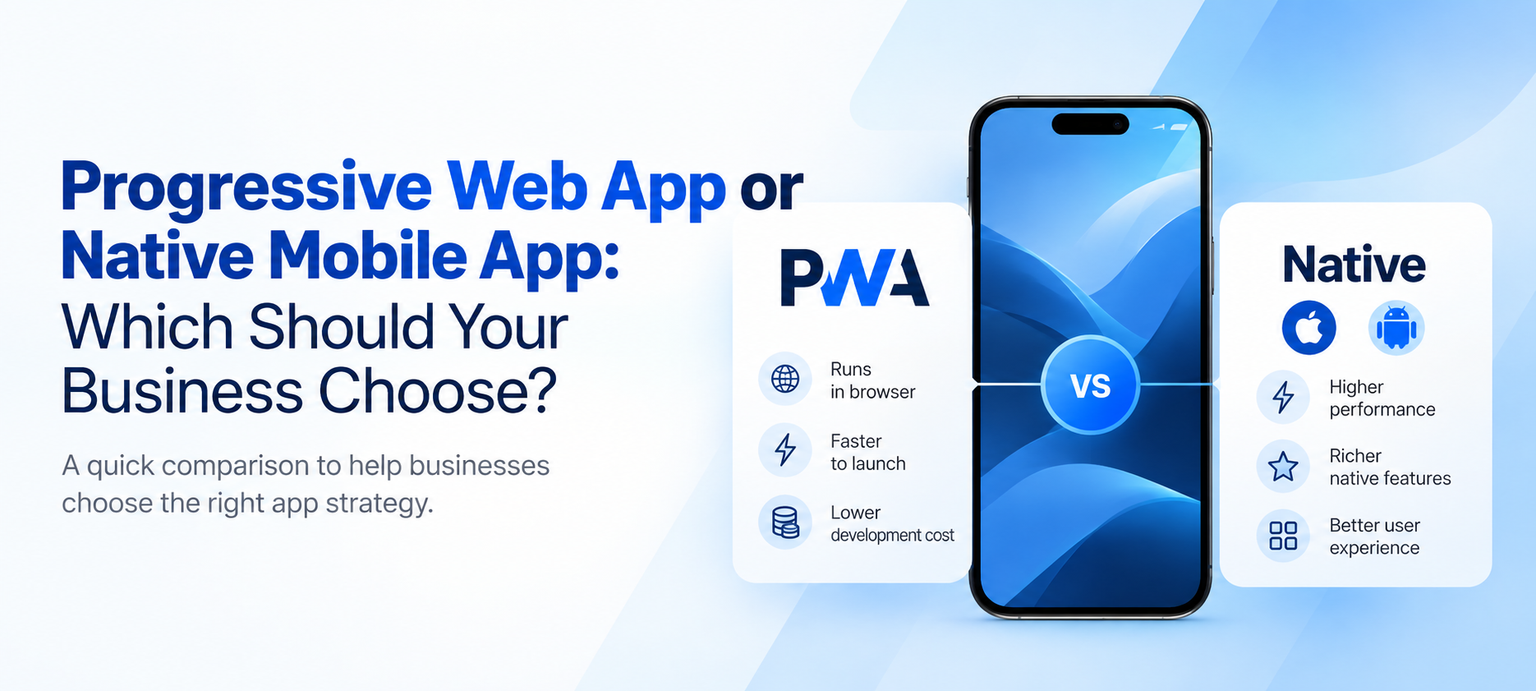
A PWA runs in the browser but behaves much like an installed app. It can work offline, send push notifications, and sit on a user’s home screen without a trip to the app store. For many companies, it grows naturally out of an existing investment in custom web application development services, since a single codebase can serve desktop, tablet, and mobile users alike.
Why This Decision Shapes Long-Term Growth
A native app, on the other hand, is built specifically for iOS or Android. It taps directly into device hardware such as cameras, biometrics, GPS, and Bluetooth, and it typically delivers the smoothest, most responsive experience. Businesses that need deep device access or highly interactive features often look to custom mobile application development services for exactly this reason.
Neither option is universally better. The right answer depends on who your users are, what they need to accomplish, and how your business plans to grow. Choosing poorly leads to predictable bottlenecks: duplicated development effort, fragile integrations, rising maintenance bills, and an app that cannot keep pace with demand.
The smarter approach is to evaluate both options against the standards that separate a short-term app from an enterprise-grade product.
What Defines an Enterprise-Grade Application
Whether you build a PWA or a native app, the same five qualities determine whether it will support your business for years or become a liability within months.
Scalability
An enterprise-grade application handles growth without a rebuild. PWAs scale easily on the distribution side, because anyone with a browser can access them instantly. Native apps scale well in performance but require separate releases and approvals for each platform. Either way, true scalability lives in the backend, not the front end.
Security
Native apps benefit from platform-level protections such as secure device storage and biometric authentication. PWAs rely on HTTPS and browser security, which is strong but gives you less control over the device. If you handle sensitive financial or health data, this difference deserves serious attention.
Performance
Native apps generally win on speed, animation, and heavy processing. Modern PWAs have closed much of the gap for content-driven and transactional experiences, but graphics-intensive or real-time applications still favor native.
Reliability
Users expect apps to work on weak connections and to recover gracefully from errors. Both approaches support offline functionality, though native apps offer more robust background syncing.
Integration Capabilities
Your app rarely lives alone. It needs to connect with your CRM, ERP, payment systems, and analytics tools. The good news is that both PWAs and native apps can consume the same APIs, which means a well-designed backend protects you regardless of the front-end choice.
Key Pillars for Long-Term Growth
Platform choice matters, but the architecture beneath it matters more. These four pillars determine how far your application can go.
Modular Architecture: Microservices vs Monolith
A monolith bundles every function into one large system. It is faster to launch but harder to change, because a small update can ripple across the entire product. Microservices break the system into independent services, such as payments, user accounts, and notifications, that can be updated and scaled separately.
For businesses expecting to support a PWA today and a native app tomorrow, a modular backend is essential. It lets both front ends share the same core services instead of duplicating logic.
Cloud-Native Development
Cloud-native applications are built to run on platforms like AWS, Azure, or Google Cloud from day one. They scale automatically during traffic spikes and scale down during quiet periods, so you pay for what you use. This flexibility supports both PWAs and native apps equally well.
Data-Driven Decision Making
Your app should tell you how it is being used. Built-in analytics reveal which features drive revenue, where users drop off, and which devices dominate your audience. That data often settles the PWA versus native debate for your next phase of growth.
Automation and AI Readiness
AI features such as personalized recommendations, chat assistants, and predictive insights are quickly becoming standard expectations. Applications built on clean data pipelines and flexible APIs can add these capabilities without major rework. Native apps can also use on-device AI for faster, more private processing.
Common Mistakes Businesses Make
A Short-Term Development Mindset
Many businesses choose the cheapest, fastest path to launch and plan to fix things later. Later rarely comes cheaply. A rushed build frequently needs to be rewritten within two years, costing far more than doing it right the first time.
Ignoring Scalability Early
It is tempting to design only for today’s user count. But retrofitting scalability into a system that was never built for it is like adding floors to a house with a foundation meant for one story.
Choosing the Wrong Tech Stack
Some companies build native apps when a PWA would serve their customers perfectly, doubling costs for little benefit. Others force a PWA into a role that demands hardware access or peak performance, frustrating users. The stack should follow the business need, not the latest trend.
Best Practices for Building Future-Ready Applications
Plan Strategically Before Development
Before writing a single line of code, answer a few practical questions:
- Do your users need to find you in an app store, or do they arrive through search and links?
- Does your product depend on device features like cameras, sensors, or background location?
- How often will you release updates, and how quickly must they reach users?
- What is your realistic budget for maintaining one codebase versus two?
As a general guide, PWAs suit content platforms, e-commerce, booking systems, and internal business tools. Native apps suit fintech, healthcare, logistics, gaming, and any experience that relies on hardware or intensive performance. Many mature businesses eventually run both on a shared backend.
Choose the Right Development Partner
The team you work with shapes the outcome as much as the technology. Look for a partner who asks about your business goals before recommending a platform and who can build across web, mobile, and cloud. NewAgeSysIT is a New Jersey-based custom software engineering company that works with businesses across the United States on web, mobile, cloud, and AI initiatives. Its approach reflects a broader industry shift toward platform-neutral advice, where the recommendation depends on user behavior and growth plans rather than a preferred technology.
Commit to Continuous Optimization and Iteration
Launch is the starting line, not the finish. Monitor performance, gather user feedback, and release improvements regularly. PWAs make this easier because updates go live instantly, while native apps require store review cycles that should be built into your roadmap.
Real-World Example: Growing Without a Rebuild
Consider a mid-sized regional retailer that launched a basic native iOS app a few years ago. Android users were left out, updates were slow, and the app’s logic was tangled into a single monolithic system that made every change risky.
Rather than build a second native app, the retailer restructured its backend into modular, cloud-hosted services and launched a PWA for its broad customer base. The PWA reached every device through a simple link, loaded quickly on mobile networks, and supported offline browsing of the product catalog. The existing iOS app was kept and connected to the same services for loyal, high-frequency shoppers.
The results followed a pattern seen across many similar projects: faster feature releases, lower maintenance costs, and higher mobile conversion rates. Most importantly, the business gained an architecture that could absorb future growth, including AI-driven product recommendations, without starting over.
Conclusion: Build for the Business You Are Becoming
The PWA versus native app question does not have a single right answer. It has a right answer for your business, your users, and your growth plans.
PWAs offer broad reach, faster updates, and lower costs. Native apps offer peak performance, deeper device access, and stronger platform security. What truly determines long-term success, though, is the foundation underneath: modular architecture, cloud-native infrastructure, clean data, and readiness for AI.
Businesses that treat this decision as a strategic investment rather than a quick fix avoid costly rebuilds and position themselves to scale with confidence. Before committing to either path, it is worth taking the time to map your user needs and growth goals, ideally with experienced technical advisors who can weigh both options objectively. The right choice today will save years of rework tomorrow.
