
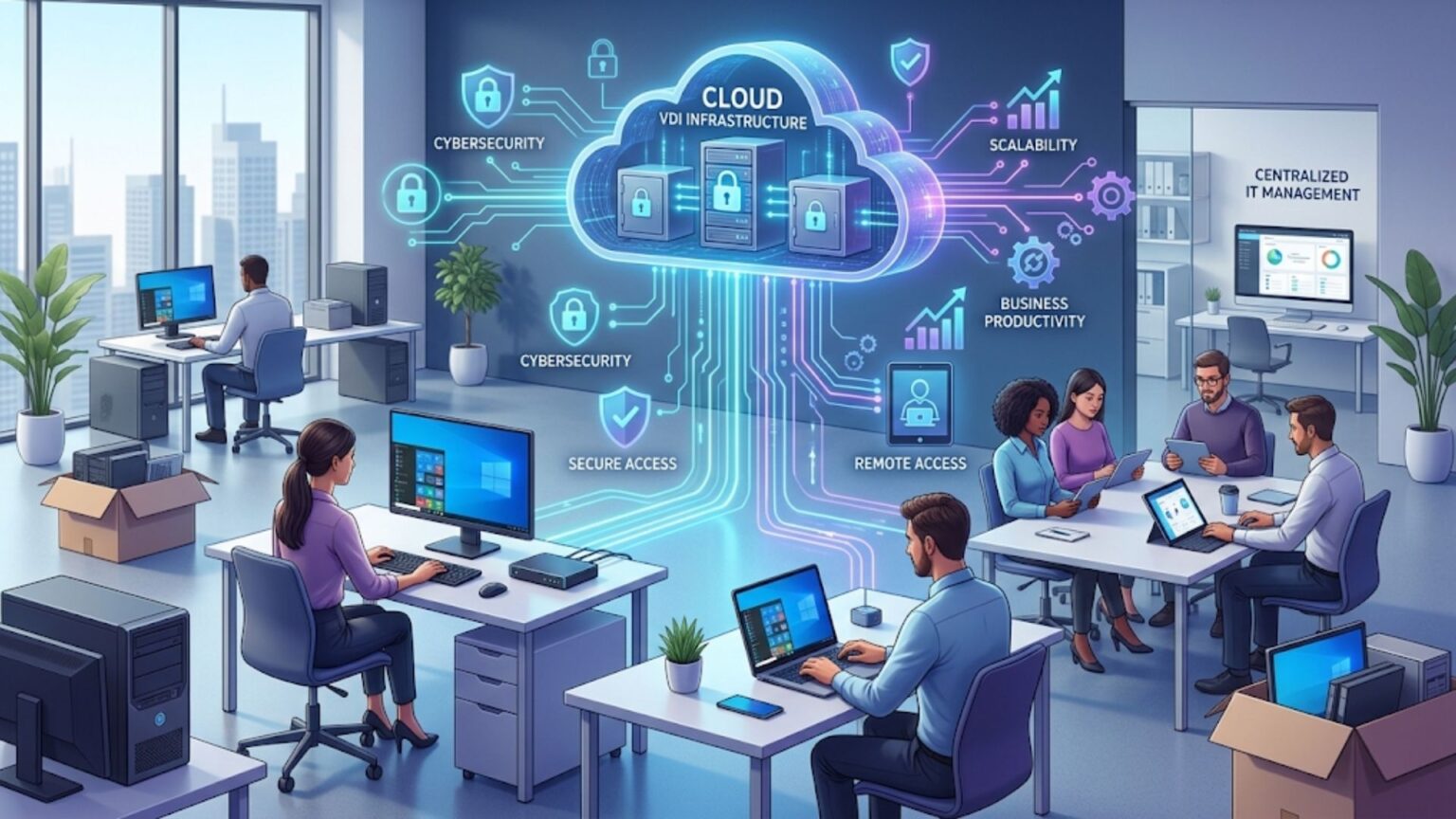
Picture the IT closet at a mid-sized company five years ago. Rows of identical desktop towers in order, each one to be unboxed, imaged, patched, and delivered to a desk. A spreadsheet tracking which machine went to whom. A technician spent Friday afternoon rebuilding a laptop that someone spilled coffee on, while three new hires waited for hardware that hadn’t arrived. Every desktop was an island, and keeping the islands in sync was a full-time job.
Now picture the same company today. A new employee logs in from a thin client, a personal laptop, or a tablet at their kitchen table, and their full work environment appears in seconds, exactly as it would in the office. The coffee spill is a shrug rather than a crisis, because nothing important lived on that laptop anyway. That shift is what virtual desktop infrastructure has made possible, and it’s why so many businesses are quietly retiring their fleets of traditional desktops. Here’s what’s driving the move.
The Way We Work Changed for Good
The biggest push came from where people actually work now. According to the U.S. Bureau of Labor Statistics, 35 percent of employed people did some or all of their work at home on days they worked in 2025, based on the American Time Use Survey released in June 2026.
More than a third of the workforce regularly working outside the office means the old model, where a desktop sat under a desk and the data sat on the desktop, simply doesn’t fit. Businesses need every employee to have the same secure, consistent environment whether they’re at headquarters, at home, or in a client’s conference room. VDI delivers that by moving the desktop itself into the data center or cloud and streaming it to whatever screen the user happens to be in front of.
What VDI Actually Changes
With a traditional setup, the operating system, applications, and files live on each physical machine. With virtual desktop infrastructure, all of that runs on centralized servers, and users connect to their personal desktop session from any device. In practical terms, that means:
- Devices become interchangeable. A thin client, an old laptop, or a home PC all deliver the same experience.
- Data never leaves the data center. What appears on the user’s screen is a display stream, not a local copy.
- Updates happen once. Patching a single master image updates every desktop built from it.
- Recovery is nearly instant. A failed device is replaced, the user logs in, and everything is exactly where they left it.
The desktop stops being a physical object to manage and becomes a service to deliver.
Security Is Often the Deciding Factor
Ask most IT leaders why they made the switch, and security comes up first. Traditional desktops scatter sensitive data across hundreds of endpoints, each one a potential loss, theft, or breach. Centralizing desktops changes the risk profile completely:
- Lost or stolen devices contain no company data
- Access can be revoked centrally in seconds when someone leaves
- Security policies, encryption, and monitoring apply uniformly to every session
- Compliance audits become simpler because data lives in a known, controlled location
- Contractors and temporary staff can be given access without shipping them hardware
For businesses in regulated industries, this alone can justify the move.
Making the Transition Without the Headaches
VDI has been around for years, but early deployments had a reputation for being complex to build, expensive to size correctly, and frustrating when performance lagged. That reputation is what modern VDI solutions have been designed to overcome. Rather than asking a business to assemble servers, storage, networking, and virtualization software from scratch and hope the pieces perform well together, current offerings package the full stack as a pre-validated, ready-to-run platform with predictable performance per user and a clear path to scale.
That matters because the hardest part of VDI historically wasn’t the concept but the engineering: getting storage fast enough for hundreds of simultaneous logins, sizing GPUs for graphics-heavy users, and ensuring the experience felt as responsive as a local machine. Buying that as a proven, integrated system rather than a science project shortens deployment from months to weeks and removes most of the risk that used to make IT teams hesitate.
The Cost Picture Over Time
Upfront, VDI isn’t always cheaper than buying desktops. The savings show up over the lifecycle:
- Longer device life. Thin clients and repurposed older PCs last years longer than full desktops because the heavy lifting happens on the server.
- Lower support costs. Fewer site visits, fewer rebuilds, faster onboarding.
- Reduced downtime. Problems are fixed centrally, often before users notice.
- Energy savings. Thin clients draw a fraction of the power of a desktop tower.
- Simpler licensing and asset tracking. Everything is visible from one console.
When businesses account for the full cost of managing a physical fleet, the comparison usually tips in VDI’s favor within a couple of years.
Who Benefits Most
Not every organization needs VDI, but certain profiles see outsized gains:
- Companies with hybrid or distributed teams
- Firms handling sensitive client or patient data
- Businesses with high staff turnover or seasonal workers
- Organizations running legacy applications that are hard to install locally
- Teams using graphics-intensive software who want to work from anywhere
If two or more of those describe your business, the case for moving is probably already there.
Conclusion
Businesses are moving from traditional desktops to VDI because the world those desktops were designed for no longer exists. With more than a third of employees working from home on any given day, data scattered across physical machines has become a liability, and the cost of managing hundreds of individual devices keeps rising.
Virtual desktop infrastructure turns the desktop into a centrally managed, securely delivered service that follows people to whatever device and location they’re working from. Modern, pre-integrated platforms have removed most of the complexity that once held adoption back, which is why the row of desktop towers in the IT closet is increasingly a memory rather than a plan.
