
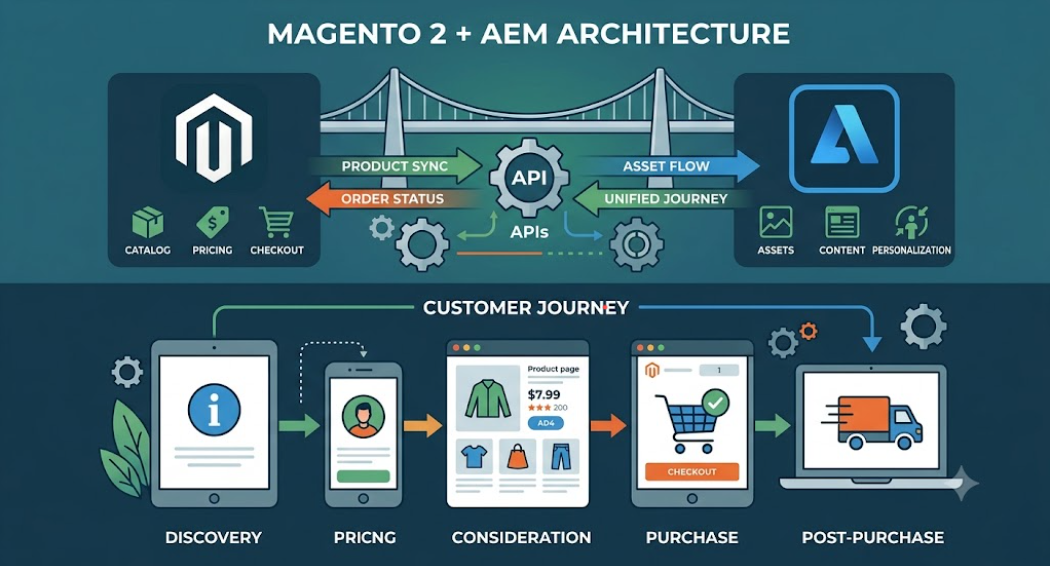
Modern ecommerce experiences are no longer built around product catalogs alone. Customers increasingly expect useful content, product education, personalized recommendations, rich media, and consistent experiences across multiple digital channels.
Magento 2 and Adobe Experience Manager can work together as complementary platforms, with Magento managing commerce functionality and AEM supporting content, digital assets, and experience management. For businesses planning this type of connected architecture, an experienced magento website development company can help align the commerce platform, content layer, integrations, and customer experience.
Why Content and Commerce Need to Work Together
Consider a customer researching a technical product. They may need product specifications, comparison information, buying guides, instructional videos, product images, FAQs, and customer support content before making a purchase.
A traditional ecommerce catalog may provide the transactional information but not the complete experience. This is where content-driven commerce becomes important. A well-structured Magento website development approach can help businesses create a stronger foundation for connecting product experiences with content, while AEM can help manage structured and unstructured content, digital assets, publishing workflows, and personalized experiences. Magento 2 continues to manage the transactional side of the journey.
Understanding the Role of Each Platform
Before starting an integration, businesses should establish clear responsibilities.
Magento 2 / Adobe Commerce
The commerce platform can manage:
- Product catalogs
- Pricing
- Customer accounts
- Shopping carts
- Checkout
- Orders
- Promotions
- Inventory-related integrations
- Commerce APIs
Adobe Experience Manager
AEM can manage:
- Web content
- Digital assets
- Landing pages
- Editorial workflows
- Brand content
- Experience fragments
- Content personalization
- Cross-channel content delivery
The integration connects these capabilities so customers experience them as one journey rather than two separate systems.
Creating a Unified Product Experience
One of the most important integration goals is creating a consistent product experience.
A product page might combine transactional information from Magento with editorial content managed through AEM.
For example, a furniture retailer could use Magento for price, inventory, variants, and checkout while AEM manages buying guides, room inspiration, lifestyle imagery, videos, and promotional assets.
Instead of forcing the commerce platform to manage every type of content, each system can focus on the capabilities it handles best.
Building the Integration Layer
The integration architecture needs to define how information moves between the platforms.
APIs provide an important foundation for this process. Rather than tightly coupling every component, businesses can establish structured communication between commerce and content systems.
A typical architecture may include:
Magento 2 / Adobe Commerce: Product and transactional data.
AEM: Content, digital assets, and experience management.
Integration layer: APIs, middleware, or integration services responsible for data exchange.
External systems: ERP, PIM, CRM, analytics, search, and marketing platforms.
The exact architecture will depend on business requirements, existing systems, data ownership, and performance expectations.
Establishing Clear Data Ownership
Integration projects can become difficult when multiple platforms attempt to become the source of truth for the same information.
A better approach is to define ownership before development begins.
For example, the organization might determine that:
- Product master data comes from a PIM or commerce platform.
- Pricing is controlled by Adobe Commerce.
- Editorial content is managed through AEM.
- Digital assets are maintained through AEM Assets.
- Customer information is managed through CRM or commerce systems.
- Analytics data is consolidated within the organization’s analytics ecosystem.
These rules reduce duplication and make the architecture easier to maintain.
Connecting Product Data With Content
The real value of integration appears when product and content data can work together.
Imagine a customer browsing an outdoor equipment category.
The commerce system provides products, prices, availability, and variants. AEM can provide buying guides, seasonal content, instructional videos, and campaign assets.
Together, these elements can support the entire decision-making process.
This becomes especially useful for businesses with complex products where customers need education before purchasing.
Personalization Across the Journey
Another important consideration is personalization. Customers can receive different experiences depending on factors such as location, browsing behavior, customer segment, product interest, or campaign context. An experienced adobe commerce development partner can help businesses connect personalization strategies with their broader commerce and content ecosystem.
Adobe’s ecosystem provides technologies that support analytics, personalization, and experience management alongside commerce. However, personalization should be designed around useful customer experiences rather than simply adding more dynamic content.
Performance and Governance Matter
Adding another enterprise platform can introduce complexity if performance and governance are ignored.
Teams should consider:
- API response times
- Caching strategies
- Content delivery
- Image and asset optimization
- Authentication
- Deployment processes
- Content approval workflows
- Security
- Monitoring
- Failure handling
The integration should also be designed so that a temporary issue in one system does not unnecessarily disrupt the complete shopping journey.
Choosing the Right Development Approach
The technical implementation depends heavily on the existing Magento architecture and business requirements.
Organizations may need custom APIs, middleware, headless components, or integration services to connect the systems effectively.
A well-planned implementation should consider how product data, content, assets, and customer interactions move between platforms while keeping the architecture maintainable.
A Practical Integration Roadmap
A structured project can follow several stages:
1. Discovery: Document business requirements, systems, data sources, and customer journeys.
2. Architecture planning: Define responsibilities, data ownership, APIs, integrations, and security requirements.
3. Content and product modeling: Establish how commerce information and content will be structured.
4. Integration development: Build and test APIs or middleware connections.
5. Experience development: Create templates, components, product experiences, and responsive interfaces.
6. Testing: Validate functionality, performance, security, content workflows, and failure scenarios.
7. Deployment and optimization: Launch gradually, monitor performance, and refine the experience based on real user behavior.
Businesses looking to build or modernize this type of ecosystem can also evaluate adobe commerce development solutions based on their integration requirements, content architecture, scalability needs, and long-term commerce roadmap.
Final Thoughts
Magento 2 and Adobe Experience Manager can address different but complementary parts of digital commerce.
Magento provides the transactional foundation, while AEM can help businesses create, manage, and deliver richer content experiences.
The strongest integrations do not simply connect two platforms. They create a clear architecture where commerce data, content, digital assets, and customer experiences work together.
For businesses operating complex digital ecosystems, that approach can turn an ecommerce website from a simple product catalog into a connected, content-driven commerce experience.
Author Bio
Ronak Meghani
Ronak Meghani is the CEO & Co-Founder of Magneto IT Solutions, where he partners with medium and enterprise brands to design, build, and scale next-generation digital commerce ecosystems. With experience across 200+ B2B, D2C, and B2C engagements, he specializes in creating customer-centric, AI-enabled, and conversion-driven commerce experiences.
Ronak works closely with organizations to move beyond traditional eCommerce by aligning strategy, technology, and customer experience. He focuses on transforming commerce platforms into continuously evolving, revenue-generating engines through AI-driven optimization and scalable growth strategies.
