
Ask an AI assistant to recommend a project management tool or a payroll provider and it will name a few brands, often with links. To the person asking, that list feels like an opinion. Behind it is a fairly mechanical process: the assistant searches, retrieves a handful of pages, and writes an answer from what those pages say. Generative engine optimization (GEO) is the practice of making your pages easy to retrieve and easy to quote in that process.
Two ways an assistant “knows” about you
An AI assistant can draw on two very different sources.
The first is its training data: the large body of text the model learned from before release. This shapes general knowledge, but it is fixed at a point in time and you cannot update it on demand.
The second is live retrieval. When an assistant runs a web search, it queries an index, pulls back current pages and uses them to ground its answer. The links you see in ChatGPT search, Google’s AI Overviews and Perplexity come from this step.
For most businesses, retrieval is where GEO work pays off. It responds to changes on your site and across the web without waiting for a new model release.
How the main systems find their sources
ChatGPT search
OpenAI runs several crawlers, each with a separate job. OAI-SearchBot crawls pages so they can appear in ChatGPT search results. GPTBot collects content that may be used to train models. ChatGPT-User fetches a page when a user’s request needs it. A fourth agent, OAI-AdsBot, is listed as well. The full list and the robots.txt tokens are in OpenAI’s crawler documentation.
The detail many site owners miss: blocking GPTBot does not block OAI-SearchBot. You can opt out of training while still being eligible for search citations. The reverse also applies. If a security plugin or CDN rule blocks OAI-SearchBot, your pages may never be considered, however good they are.
Google AI Overviews, AI Mode and Gemini
Google’s AI Overviews and AI Mode draw on Google’s own search index. If a page is not crawled and indexed for regular Search, it will not be used there either. Google-Extended is a separate control: it governs whether your content is used to train Gemini models, and it does not affect inclusion in Search. Google’s guidance on AI features is clear that the usual SEO foundations apply.
Perplexity
Perplexity searches the web for each question and shows numbered citations next to its answer. It publishes its own crawler user agents, so check its documentation and your firewall rules in the same way you would for OpenAI.
| System | Where sources come from | Control that matters most |
| ChatGPT search | OpenAI’s search crawling plus user-triggered fetches | Allow OAI-SearchBot and ChatGPT-User |
| Google AI Overviews and AI Mode | Google’s search index | Normal Googlebot crawling and indexing |
| Gemini model training | Content used to train models | Google-Extended (training only) |
| Perplexity | Its own web retrieval | Allow its published crawlers |
Why this is getting attention now
Interest in the topic has grown quickly. In the US, “generative engine optimization” averaged about 4,400 searches a month between September 2025 and August 2026, with a keyword difficulty of 54. “Answer engine optimization” averaged about 2,400, “AI SEO” about 6,600 and “LLM SEO” about 720.
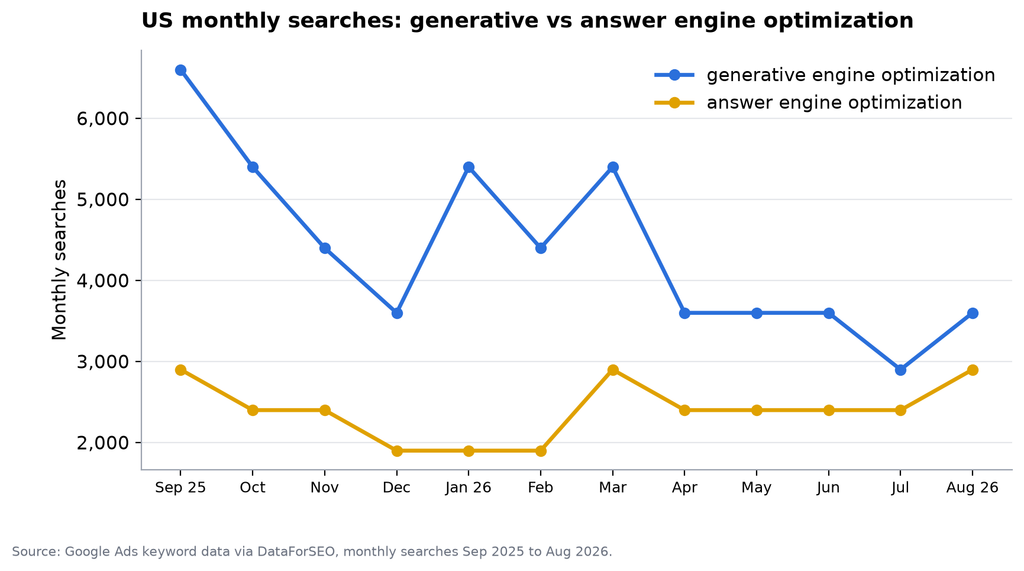
Figure 1: US monthly searches for “generative engine optimization” and “answer engine optimization”, September 2025 to August 2026 (Google Ads data via DataForSEO).
The vocabulary varies, but the questions behind these searches are the same: why does an assistant mention a competitor and not us, and what can we change?
What makes a page citable
Assistants pull short passages, not whole pages. A page gets quoted when one clear passage answers the question being asked. That points to a handful of practical habits.
Let crawlers in. Check robots.txt, CDN bot rules and security plugins for each crawler in the table above. This is the most common silent failure, and the cheapest to fix.
Define the thing early. If a page is about a service or a product category, say what it is in the first two sentences, in plain words. “X is a Y that does Z for W” is easy to lift into an answer. A clever opening paragraph is not.
Use specific, attributable data. A page that states a number, a date and where it came from gives the assistant something concrete to cite. Vague claims such as “industry-leading results” give it nothing. Your own data, with its source and date, is the strongest version of this.
Keep your entity information consistent. Assistants describe a business from what many sources say about it. If your website, Google Business Profile, directory listings and social profiles disagree on your name, category, location or what you do, the description an assistant produces will be blurred. Pick one wording and use it everywhere.
Structure for questions. Headings phrased the way people ask, short answers directly under them, and tables for comparisons all make passages easier to extract.
None of this is exotic. If you are comparing outside help, reading how providers of AI SEO and GEO services describe their process is a fast way to see whether they start with these basics or skip straight to promises.
How to check whether you are being cited
There is no single dashboard that covers every assistant, so combine a few signals.
- Run a fixed prompt set. Write a fixed list of the questions your buyers actually ask. Run them in ChatGPT search, Google AI Mode and Perplexity each month, and log which brands and URLs appear. Answers vary between sessions, so look at trends rather than single results.
- Read your server logs. Look for OAI-SearchBot, ChatGPT-User and other assistant crawlers. If they never request your key pages, citations are unlikely.
- Check referral traffic. In your analytics, filter for referrals from chatgpt.com and perplexity.ai and look at which landing pages receive them.
- Use the search engines’ own reports. Bing Webmaster Tools added an AI Performance report in public preview in February 2026, showing how often your pages are cited in Copilot and Bing AI answers. Google Search Console announced Search Generative AI performance reports in June 2026, showing impressions for AI features but not clicks or queries.
What not to believe
Guaranteed citations. No one controls what an assistant says. Anyone promising that your brand will appear in ChatGPT or AI Overviews for a given question is promising something they cannot deliver.
Secret formats. There is no hidden markup that forces a citation. Crawl access, clear content and consistent information do the heavy lifting.
“Block AI bots to protect your content.” Blocking training crawlers is a reasonable choice. Blocking search crawlers by accident removes you from the answers your buyers read.
Single-screenshot proof. One answer on one day is an anecdote. Track the same questions over months before drawing conclusions.
A one-week starting plan
On day one, audit robots.txt and firewall rules against the crawler table. On day two, rewrite the opening of your five most important pages so each starts with a plain definition. Over the next few days, align your business name, category and description across your site, Google Business Profile and main directory listings. Then write your prompt set, run it once to set a baseline, and repeat it monthly. That baseline is what turns GEO from guesswork into something you can measure.
