
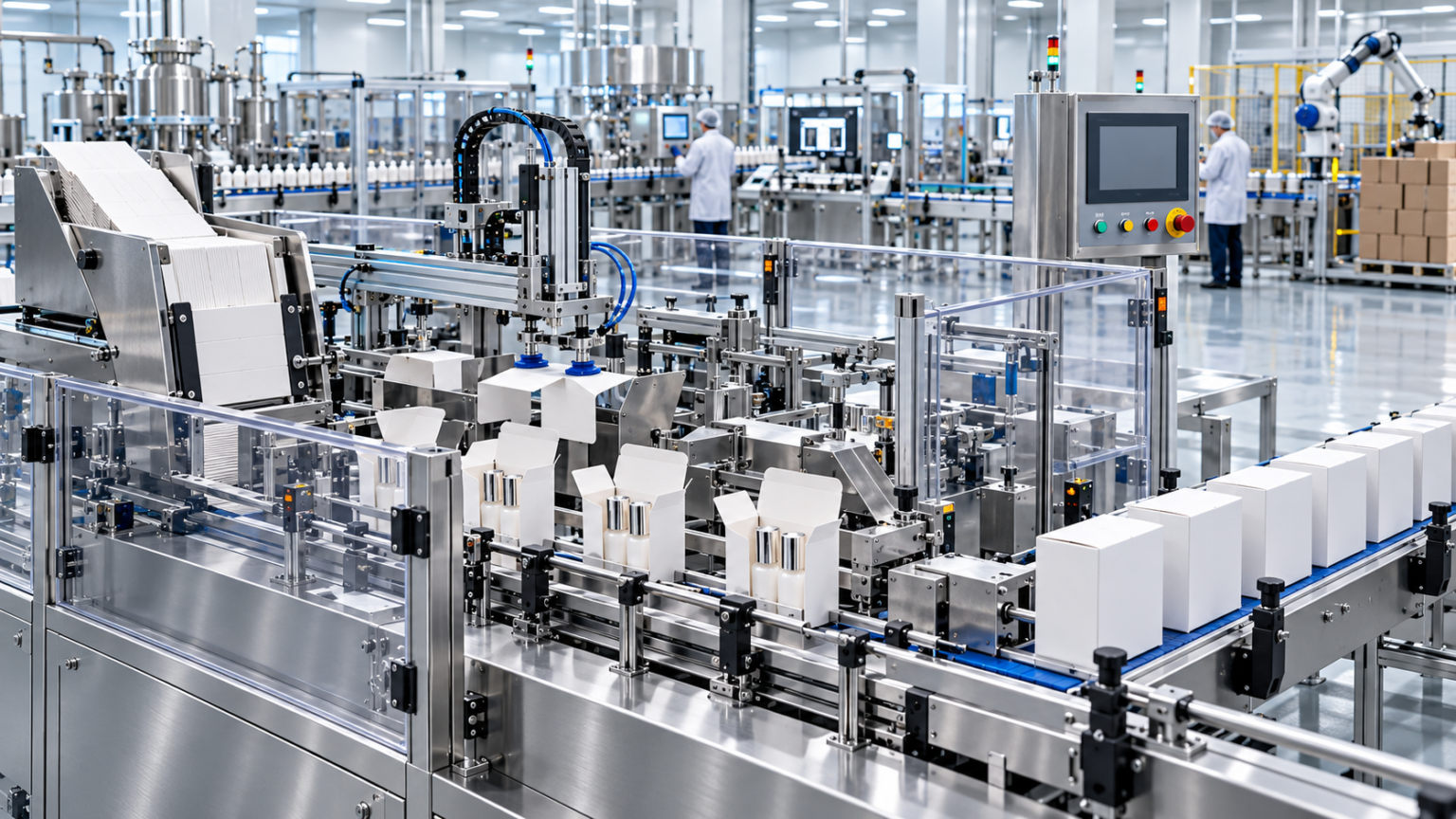
Modern manufacturing depends on more than producing high-quality products. Every item must also be packaged accurately, protected during handling, and prepared for distribution. Whether a factory produces pharmaceuticals, cosmetics, food products, household goods, or consumer electronics, consistent carton packaging is an essential part of the production process. A professional Cartoning Machine helps manufacturers automate carton forming, product insertion, flap folding, and carton sealing while improving production consistency and reducing repetitive manual operations.
Packaging requirements have become increasingly complex as manufacturers introduce new products, smaller production batches, and different carton designs. Companies must maintain attractive packaging while managing production costs, operational downtime, and quality requirements.
Manual cartoning can work for small production quantities, but it becomes challenging when thousands of products must be packed into accurately formed cartons every day.
Automatic cartoning equipment offers a structured solution by combining mechanical handling, sensors, programmable controllers, and suitable closing mechanisms.
However, investing in packaging automation requires careful planning. Manufacturers must evaluate product dimensions, carton construction, operating speed, available factory space, safety, and maintenance.
This guide examines seven important benefits of automatic cartoning technology, explains the different types of cartoning machines, and outlines the practical considerations involved in choosing the right equipment.
What Is a Cartoning Machine?
A Cartoning Machine is industrial packaging equipment that forms folding cartons, inserts products into them, and closes the cartons according to the selected packaging design.
The equipment may be semi-automatic or fully automatic.
A typical machine uses a carton magazine to store flat cardboard blanks. A mechanical or vacuum-assisted system separates and opens each blank, positioning it for product insertion.
The product is transferred into the carton through a controlled loading mechanism.
The machine then closes the flaps using a tuck-in arrangement, adhesive system, or another suitable closure method.
Depending on the equipment, additional functions may include leaflet insertion, batch coding, barcode inspection, and defective-package rejection.
How Automatic Cartoning Works
The process generally begins with cartons loaded into a magazine.
A suction or mechanical opening system selects a carton blank and forms it into the required shape.
An infeed mechanism positions the product for insertion.
The product is placed inside the carton, either horizontally or vertically, depending on the machine design.
Once the product is correctly inserted, the machine folds and secures the carton flaps.
Finished cartons move towards inspection, case packing, or another downstream operation.
Although the process appears simple, reliable operation requires close coordination between several mechanical and electronic components.
Cartoning Versus Case Packing
Cartoning and case packing serve different packaging functions.
A cartoning machine generally places individual products or small product groups into folding cartons, frequently intended for retail sale.
A case packing machine places finished products or retail cartons into larger shipping cases.
For example, a skincare bottle may first enter an attractive printed retail carton. Multiple finished cartons can then be packed into a corrugated shipping case.
Both processes can be automated, but they require different equipment configurations.
1. A Cartoning Machine Improves Packaging Speed and Production Efficiency
Production capacity is one of the main reasons manufacturers adopt automatic cartoning technology.
Manual carton opening, product insertion, and flap closing involve repeated movements that become increasingly time-consuming as output grows.
Automation coordinates these tasks into a defined mechanical sequence.
Reducing Manual Packaging Bottlenecks
A manufacturing facility may use high-speed filling, sealing, or wrapping equipment but still rely on workers to assemble cartons manually.
This creates a potential bottleneck.
Products may accumulate while employees attempt to keep pace with the upstream machinery.
An automatic cartoner can help align carton packaging capacity with the preceding operations.
The benefit depends on selecting equipment that matches the production requirements.
Understanding Cartons Per Minute
Machine performance is commonly expressed in cartons or boxes per minute.
A model rated at 60 cartons per minute has a theoretical capacity of 3,600 cartons during an uninterrupted hour.
However, actual factory output will differ because of product feeding, carton replenishment, quality checks, changeovers, and downtime.
Advertised maximum speed should therefore be used as a reference rather than a guaranteed production figure.
Continuous and Intermittent Motion
Cartoning machines use different movement arrangements.
Intermittent-motion equipment pauses at particular stages to complete operations such as product insertion or carton closing.
Continuous-motion machines maintain coordinated movement while carrying out these processes.
Continuous operation may support higher throughput in suitable applications, while intermittent equipment can provide practical flexibility for particular product and carton configurations.
The correct choice depends on production requirements and mechanical design.
Improving Production Planning
A stable cartoning process helps manufacturers estimate the time required to complete an order.
This supports planning for staffing, packaging materials, finished goods inventory, and delivery schedules.
Reliable production information can also help identify where additional capacity is needed.
2. Automatic Cartoning Machines Improve Packaging Accuracy
Accurate carton assembly is essential for protecting products and maintaining a professional appearance.
Incorrectly formed cartons, missing products, or damaged flaps can create quality problems.
Automatic equipment uses controlled mechanisms to make these operations more repeatable.
Consistent Carton Formation
A flat carton blank must be opened into the intended shape before loading.
If the carton does not open correctly, the product may become damaged or the machine may jam.
Vacuum suction systems, carton guides, and mechanical supports help position the carton.
The blank’s dimensions and stiffness must remain within the machine’s approved specifications.
Accurate Product Insertion
The insertion mechanism places the intended product into the carton.
Some machines use mechanical pushers, while others employ specialised feeding or robotic equipment.
Correct positioning is important for products with limited clearance inside the package.
A carton that is too tight may cause repeated jams, while an excessively large carton may fail to support the product appropriately.
Detecting Missing Products
Certain automatic cartoners include sensors designed to detect missing products or incorrect feeding conditions.
Depending on the configuration, the machine may stop, reject a carton, or prevent an incomplete packaging cycle.
Manufacturers should verify which inspection features are included in the selected model.
Supporting Leaflet Insertion
Pharmaceutical and other regulated packaging operations may require instruction leaflets or additional inserts.
Some cartoning machines can integrate leaflet-folding and insertion equipment.
The system should confirm that the correct leaflet is supplied with the appropriate product.
A missing or incorrect leaflet may create a significant quality issue even when the carton itself is properly closed.
Better Quality Control
Consistent mechanical movement can reduce certain variations associated with manual packaging.
However, automated equipment does not eliminate inspection requirements.
Finished cartons should still be checked according to a documented quality procedure.
3. A Cartoning Machine Supports Different Product and Carton Formats
Manufacturers often handle several product types within the same facility.
A cosmetic producer may package creams in jars, lotions in bottles, and skincare treatments in tubes.
A food company may pack biscuits, snack products, or individually wrapped items into different cartons.
Flexible cartoning equipment helps businesses manage these variations.
Horizontal Cartoning Machines
Horizontal cartoners insert products through the side opening of a carton.
This arrangement is commonly used for regularly shaped products, retail boxes, tubes, blister packs, and similar items.
A properly configured horizontal machine can coordinate carton opening, product insertion, and flap closing in one process.
Vertical Cartoning Machines
Vertical machines generally position cartons upright and load products from above.
This arrangement may be useful for loose components, small hardware items, wrapped food products, or other materials suited to top loading.
Some machines use manual product placement, while others incorporate automatic feeding.
The correct configuration depends on the intended product.
Semi-Automatic Cartoning Systems
Semi-automatic equipment combines certain automated movements with manual product handling.
These machines may be appropriate for businesses with relatively low production volumes or frequently changing products.
They can provide an intermediate option between fully manual packaging and complete automation.
High-Speed Cartoning Equipment
High-speed machines are designed for sustained production where carton supply, product feeding, and downstream capacity can support their operation.
These systems may use continuous-motion mechanisms and advanced controls.
However, higher speed can involve additional investment and more demanding integration requirements.
Robotic Cartoning
Robotic systems can use programmable movements to identify, position, and insert products.
Their capabilities depend on the robot, gripping system, sensors, and carton configuration.
Robotic equipment may be useful for applications requiring flexible handling or complex product orientation.
Managing Different Carton Sizes
Some cartoners include adjustable guides, handwheels, and replaceable forming components.
These features allow supported carton sizes to be processed using different settings.
However, not every machine accommodates every size.
Manufacturers should confirm the actual operating range before purchase.
4. Automatic Cartoning Improves Product Protection and Packaging Presentation
Cartons do more than create a visually attractive package.
They may help protect products from routine handling, provide additional information, and organise items for distribution.
Correct assembly contributes to these functions.
Supporting Consistent Retail Presentation
Consumers often evaluate packaging before purchasing a product.
A well-formed carton with aligned flaps and an undamaged surface creates a more professional appearance.
Automatic cartoning can help maintain this consistency across a production run.
The final result also depends on the quality of the printed blanks and carton design.
Reducing Handling Damage
Repeated manual handling can create opportunities for dropped products, scratched packaging, or crushed carton edges.
A suitable automated process may reduce some of these risks.
However, incorrect machine settings can also damage products.
The loading mechanism must be matched to the product’s dimensions and durability.
Protecting Fragile Products
Glass vials, cosmetic jars, and other delicate products may require protective inserts or carefully controlled placement.
A cartoning machine should be compatible with these additional packaging requirements.
Mechanical speed should not take priority over product protection.
Maintaining Carton Closure Quality
Cartons may use tuck-in flaps, adhesive closures, or other designs.
The closing process must match the carton structure.
Poor alignment or unsuitable adhesive application can result in packaging defects.
Manufacturers should establish clear acceptance criteria for completed cartons.
Supporting Distribution Quality
After cartoning, products may pass through case packing, palletising, storage, and transport.
The retail carton is one component of the complete protective packaging system.
Appropriate carton materials and distribution testing may be necessary to confirm overall performance.
5. A Cartoning Machine Reduces Repetitive Manual Packaging Work
Carton assembly involves repeated hand movements, reaching, and product positioning.
Workers performing these tasks continuously may face ergonomic demands.
Automatic machinery can reduce the need to repeat certain operations.
Automating Carton Opening
Manual carton erection requires employees to pick up flat blanks and shape them before product insertion.
An automatic cartoner performs this operation mechanically.
This helps reduce one of the repeated handling steps.
Reducing Manual Product Insertion
Fully automatic models can insert products through controlled feeding mechanisms.
Workers no longer need to place every individual item into a carton.
However, employees may still handle materials and monitor production.
Supporting More Organised Workstations
Automation creates a defined material flow through the packaging station.
Carton blanks enter through a magazine, products arrive through a feeding system, and completed cartons leave through a conveyor.
This can simplify some aspects of workstation organisation.
Improving Employee Responsibilities
Automation changes the skills needed at the packaging line.
Operators may spend more time checking package quality, replenishing materials, and monitoring machine status.
Maintenance personnel may require knowledge of mechanical drives, sensors, programmable controls, and pneumatic components.
Evaluating Workplace Ergonomics
An automatic Cartoning Machine may reduce certain repetitive tasks, but it does not remove every manual handling hazard.
Carton magazines still need replenishment, rejected products may require investigation, and replacement components must be handled safely.
An ergonomic assessment should consider the complete operation.
6. Automatic Cartoning Machines Integrate With Modern Production Lines
A cartoning machine frequently operates as one stage within a larger packaging process.
Its performance depends on effective coordination with the machinery before and after it.
Integration With Filling Equipment
Cosmetic, pharmaceutical, and food production lines may include machines that fill containers before cartoning.
The cartoner must receive finished products in a suitable orientation and at a compatible rate.
Unstable product feeding can reduce cartoning efficiency.
Connecting Flow Wrapping Machines
Many food and consumer products are individually wrapped before entering retail cartons.
A flow wrapper may supply these items directly to an automatic cartoner.
The two machines must coordinate product spacing and transfer timing.
Leaflet Folding and Insertion
Some packaging applications require folded instructions or information leaflets.
An automatic leaflet feeder can be integrated where the cartoner supports it.
The system should include appropriate controls for ensuring the intended inserts are supplied.
Batch Coding and Printing
Cartons may require product codes, lot information, dates, or other identification.
Coding equipment can be integrated into the packaging line.
The required information depends on the product category and destination market.
Inspection and Rejection Systems
Vision equipment, barcode readers, checkweighers, and presence sensors may be used to inspect finished cartons.
The exact requirements depend on the quality system.
These inspection devices must be configured and validated for their intended purpose.
Connection With Case Packers
Completed retail cartons may be grouped into corrugated shipping cases.
A downstream case packer performs this operation.
The cartoning and case packing systems should be balanced to avoid product accumulation.
Preparing for Palletising
After secondary packaging, shipping cases may move towards palletising.
Consistent carton and case dimensions help maintain a predictable downstream process.
The entire line should be assessed as an integrated system rather than separate machines.
7. A Cartoning Machine Can Improve Long-Term Manufacturing Economics
Industrial machinery is a significant capital investment.
The financial value of automation depends on production demand, machine utilisation, labour requirements, operating costs, and maintenance.
Reducing Packaging Cost Per Unit
When the equipment is used efficiently, automatic cartoning may reduce the amount of manual work required per finished carton.
This can contribute to a lower packaging cost per unit.
However, the actual savings depend on production volume and existing operating arrangements.
Managing Material Waste
Incorrectly formed or damaged cartons can create avoidable material losses.
A stable packaging process may help reduce these defects.
The benefit should be measured using actual production and rejection records.
Improving Capacity Utilisation
A properly selected cartoner can help the end-of-line operation keep pace with upstream equipment.
This may allow a factory to make better use of its existing production capacity.
Understanding Maintenance Expenses
Automatic machinery requires regular servicing.
Vacuum systems, carton guides, drive components, sensors, belts, and other parts may need attention.
The cost and availability of replacement components should be considered before purchase.
Evaluating Total Cost of Ownership
A realistic cost assessment should include purchase price, shipping, installation, electricity, compressed air, labour, maintenance, and downtime.
Businesses should also consider the cost of changing carton sizes or product formats.
Calculating Return on Investment
Return on investment depends on measurable improvements compared with the previous packaging process.
Useful measures include effective carton output, labour hours, product damage, carton waste, and machine availability.
The strongest purchasing decision is based on production evidence rather than advertised benefits alone.
JOCHAMP Cartoning Machine Range: Available Types and Features
JOCHAMP is a China-based packaging machinery manufacturer offering multiple cartoning technologies for different industries and production requirements.
According to its published equipment catalogue, the company offers horizontal, vertical, high-speed, semi-automatic, wraparound, and robotic cartoning solutions.
JOCHAMP states that it began developing cartoning equipment in 2005 and provides customised machinery for different carton structures and product formats.
Horizontal Cartoning Equipment
JOCHAMP identifies horizontal cartoners as suitable for many regularly shaped products.
The equipment inserts products from the side, generally after a folding carton has been erected.
Applications can include packaged foods, pharmaceutical products, cosmetics, stationery, and other compatible goods.
Vertical Cartoning Equipment
The manufacturer’s vertical range is intended for products suited to loading from above.
Potential applications include loose items, small hardware, confectionery, and selected powdered-product packaging formats.
The precise machine must be selected according to the material and carton arrangement.
High-Speed Cartoning Equipment
JOCHAMP describes continuous-motion cartoning machines intended for medium- and large-scale production.
These models are designed to coordinate product insertion and carton movement at elevated operating speeds.
Actual throughput should be established for the selected product and carton.
Wraparound Cartoning Equipment
Wraparound systems form packaging around products or product groups.
JOCHAMP identifies potential applications involving multipacks and other grouped products.
This technology differs from inserting a product into a previously erected folding carton.
Semi-Automatic Cartoners
Semi-automatic equipment combines mechanical carton handling with manual operations.
Such systems may suit laboratories, small factories, and businesses with lower output requirements.
Robotic Cartoning Systems
JOCHAMP also describes robotic cartoning equipment with programmable product handling and optional inspection capabilities.
Buyers should confirm the exact functions and supported product configurations.
JOCHAMP JCZ-100: Entry-Level Automatic Cartoner
One of the company’s published models is the JCZ-100 automatic cartoning machine.
According to its model-specific technical page, the following specifications apply to the listed configuration:
- Advertised cartoning speed: 40–60 boxes per minute
- Supported carton dimensions: Approximately 65–180 mm × 65–80 mm × 30–80 mm
- Required compressed-air pressure: At least 0.6 MPa
- Advertised compressed-air consumption: 20 m³/hour
- Electrical supply options: 220V or 380V, 50Hz
The JCZ-100 is presented as an entry-level option with a compact design and relatively straightforward operating arrangement.
Its published information identifies applications across food, pharmaceutical, cosmetics, hardware, and stationery packaging.
These figures are manufacturer specifications and should be verified for the machine configuration offered.
JOCHAMP JCZ-120H: Hot-Melt Glue Cartoning
JOCHAMP also offers the JCZ-120H automatic cartoner with a hot-melt glue option.
Its published specifications include an advertised output of 30–70 cartons per minute, depending on application conditions.
The manufacturer describes automatic carton opening, leaflet handling, product insertion, batch printing, and closing functions.
Buyers should confirm which features are standard and which require additional equipment.
Customisation and Support
JOCHAMP advertises equipment customisation for carton dimensions, product feeding, coding, labelling, and production line integration.
Its website also describes technical support and after-sales services.
Specific support arrangements, warranty coverage, and replacement-part availability should be agreed upon in writing.
Industries That Use Automatic Cartoning Machines
Cartoning machinery serves a wide range of manufacturing industries.
The correct equipment depends on product shape, packaging design, production conditions, and regulatory requirements.
Pharmaceutical Manufacturing
Pharmaceutical producers use cartoning equipment for suitable bottles, blister packs, tubes, and other finished products.
Packaging may require patient information leaflets, batch identification, and other regulated details.
In the United States, certain prescription drug products are subject to Drug Supply Chain Security Act product identification requirements.
A cartoner can support the packaging process, but pharmaceutical compliance depends on appropriate controls, validation, and inspection.
Food Manufacturing
Food companies use folding cartons for biscuits, confectionery, wrapped snacks, and other products.
Equipment should be appropriate for the production environment.
Where components contact food, suitable materials and hygienic procedures may be required.
Cosmetics and Personal Care
Cosmetic products are frequently packed into printed retail cartons.
Automatic cartoners can support consistent packaging for creams, lotions, beauty products, and other suitable items.
Correct package presentation is especially important for products sold through retail channels.
Household Products
Manufacturers of cleaning supplies and other household goods may use cartoning equipment to prepare retail packages.
Machinery must be compatible with the actual product and any relevant handling hazards.
Electronics and Small Consumer Products
Accessories, small electronic components, and related products are often sold in folding cartons.
Product orientation, inserts, and protective materials may influence the selected cartoning process.
Hardware and Industrial Components
Fasteners, small tools, and other hardware products may be suitable for particular vertical or horizontal cartoning arrangements.
The machine must handle the product weight, shape, and required quantity reliably.
How to Choose the Right Cartoning Machine
Selecting industrial equipment begins with detailed information about the products and cartons.
Define Product Dimensions
Record the dimensions, weight, shape, and handling limitations of the item being packed.
Consider whether the product is rigid, flexible, fragile, or irregularly shaped.
Confirm Carton Specifications
Provide accurate carton dimensions and the intended board material.
Carton stiffness, folding design, and printing can affect the machine’s operation.
Determine Production Capacity
Calculate the required number of finished cartons per minute and per shift.
Include realistic allowances for downtime, material replenishment, and quality checks.
Choose Horizontal or Vertical Loading
The product’s shape and packaging requirements should guide the loading method.
A supplier should explain why the selected configuration is suitable.
Review Closure Requirements
Determine whether the carton uses tuck-in flaps, adhesive, or another closing arrangement.
The machinery must support the approved carton structure.
Consider Leaflets and Coding
Some products require instructions, batch numbers, or other information.
Confirm whether the selected machine can incorporate these features.
Evaluate Factory Space and Utilities
Check equipment dimensions, electrical requirements, compressed air, and required maintenance access.
Request Sample Testing
Ask the supplier to demonstrate the machinery using representative products and approved carton blanks.
This helps reveal practical problems before purchase.
Machinery Safety and Regulatory Considerations
Automatic cartoners contain moving mechanical components that require appropriate safeguards.
Machine Guarding
Carton opening mechanisms, pushers, conveyors, and closing systems can create pinch and crushing hazards.
In the United States, OSHA standard 29 CFR 1910.212 addresses general machine guarding requirements.
The appropriate guarding arrangement depends on the machine and associated risks.
Hazardous Energy Control
Maintenance activities can expose personnel to unexpected movement or stored energy.
OSHA standard 29 CFR 1910.147 addresses hazardous-energy control during covered servicing and maintenance activities.
Employees should follow appropriate isolation procedures before entering hazardous machine areas.
Risk Assessment
ISO 12100:2010 provides general principles for identifying machinery hazards and reducing risks.
Manufacturers and equipment owners should evaluate the complete installation.
Evaluating Certification Claims
JOCHAMP advertises CE-related conformity and ISO 9001 quality management credentials.
Buyers should request relevant, current documents for the exact model and destination market.
An ISO 9001 certificate does not independently establish the safety compliance of every product.
Industry-Specific Compliance
Food, pharmaceutical, and other regulated sectors may require additional product-specific controls.
A Cartoning Machine should be integrated into the manufacturer’s applicable quality and compliance system.
Installation and Commissioning of Cartoning Equipment
Proper commissioning helps verify that the equipment can operate safely and consistently.
Prepare the Factory Layout
Provide adequate space for carton replenishment, product feeding, inspection, maintenance, and access.
Connect Utilities
Electrical and pneumatic services should match the manufacturer’s requirements.
Qualified personnel should complete the relevant installation.
Adjust Carton Guides
The carton magazine and forming mechanisms must be configured for the approved carton dimensions.
Incorrect settings can cause jams or damaged blanks.
Configure Product Feeding
The product infeed should deliver items in the correct orientation and spacing.
Test Carton Closing
Verify flap folding, adhesive application where relevant, and finished carton appearance.
Conduct Production Trials
Assess output, product insertion, reject rates, and machine behaviour using representative materials.
Approve the Operating Process
Record the approved settings and train employees before routine production begins.
Maintenance Tips for Long-Term Cartoning Performance
Routine maintenance supports production consistency and helps reduce unexpected downtime.
Inspect Vacuum Suction Components
Suction cups and vacuum systems are commonly used in carton opening.
Damage or loss of vacuum can affect blank pickup.
Maintain Conveyor and Drive Components
Check moving parts according to manufacturer instructions.
Unusual vibration or noise should be investigated.
Clean Sensors
Dust and cardboard particles may accumulate around detection equipment.
Sensors should remain clean and correctly aligned.
Check Carton Guides
Worn or incorrectly positioned guides can create folding and insertion problems.
Inspect Closing Mechanisms
Tuck-in components and adhesive systems should be examined for wear and correct operation.
Verify Safety Devices
Guards, interlocks, and emergency stop arrangements must remain functional.
Maintain Service Records
Document inspections, faults, repairs, and replacement components.
These records support preventive maintenance planning.
Common Problems With Automatic Cartoning Machines
Cartons Fail to Open
Possible causes include damaged carton blanks, incorrect magazine settings, or suction problems.
The carton material and forming mechanism should be inspected.
Products Do Not Enter Correctly
Poor positioning, incompatible product dimensions, or incorrect timing can interfere with insertion.
Carton Flaps Do Not Close Properly
Incorrect folding settings, damaged blanks, or adhesive problems may cause closure defects.
Repeated Machine Jams
Jams may result from carton variation, misaligned guides, or incorrect product feeding.
The underlying cause should be identified rather than repeatedly restarting the machine.
Missing Leaflets
Problems with leaflet feeding may cause incomplete packages.
The system should provide suitable detection and rejection according to the quality requirements.
Lower-Than-Expected Production Speed
Actual output may be limited by carton supply, product feeding, inspection requirements, or downstream equipment.
The complete production line should be evaluated.
The Future of Cartoning Machine Technology
Industrial packaging continues to evolve as manufacturers seek greater flexibility and more reliable production.
Advanced Servo Control
Servo-driven mechanisms can support precise movement and programmable operation.
The value depends on the complete machine design and intended application.
Robotic Product Handling
Robotic technology may support different product orientations and specialised feeding arrangements.
Vision-Based Inspection
Machine vision can help identify missing products, incorrect cartons, or other visible defects.
Faster Changeovers
Adjustable components and stored machine settings may reduce time spent changing between approved carton formats.
Production Monitoring
Modern control systems may collect data on machine speed, fault conditions, and rejected products.
This information can support operational improvement.
Packaging Material Efficiency
Manufacturers may explore carton designs that reduce unnecessary board use while maintaining suitable protection.
Integrated End-of-Line Automation
Future systems may coordinate product wrapping, cartoning, case packing, and palletising within a connected process.
The most valuable improvements will combine reliable performance, safety, and practical maintainability.
Frequently Asked Questions
1. What is a Cartoning Machine used for?
A Cartoning Machine forms folding cartons, inserts suitable products, and closes the cartons automatically or semi-automatically, depending on the machine configuration.
2. What is the difference between horizontal and vertical cartoning machines?
Horizontal cartoners insert products from the side, while vertical cartoners generally load products from above. The best option depends on product characteristics.
3. Can a cartoning machine handle different carton sizes?
Yes. Many models support multiple approved carton dimensions through adjustments or changeable components, but their exact operating ranges vary.
4. How fast can an automatic cartoning machine operate?
Production speed depends on the model and application. JOCHAMP lists approximately 40–60 boxes per minute for its JCZ-100 model-specific configuration.
5. Can cartoning machines be integrated with existing packaging lines?
Yes. Compatible machines can connect with filling, wrapping, leaflet insertion, coding, inspection, and case packing equipment.
6. How do I choose the best Cartoning Machine?
Evaluate product dimensions, carton construction, required output, loading direction, closure method, factory space, machinery safety, customisation, and supplier support.
Conclusion
A Cartoning Machine is an essential investment for manufacturers seeking more consistent, efficient, and organised retail packaging. Automatic systems can improve carton formation, product insertion, packaging appearance, and integration with modern production lines. Selecting suitable equipment requires careful attention to realistic capacity, product compatibility, operator safety, and maintenance. With proper installation and quality control, automated cartoning can support dependable manufacturing and long-term business growth.
