
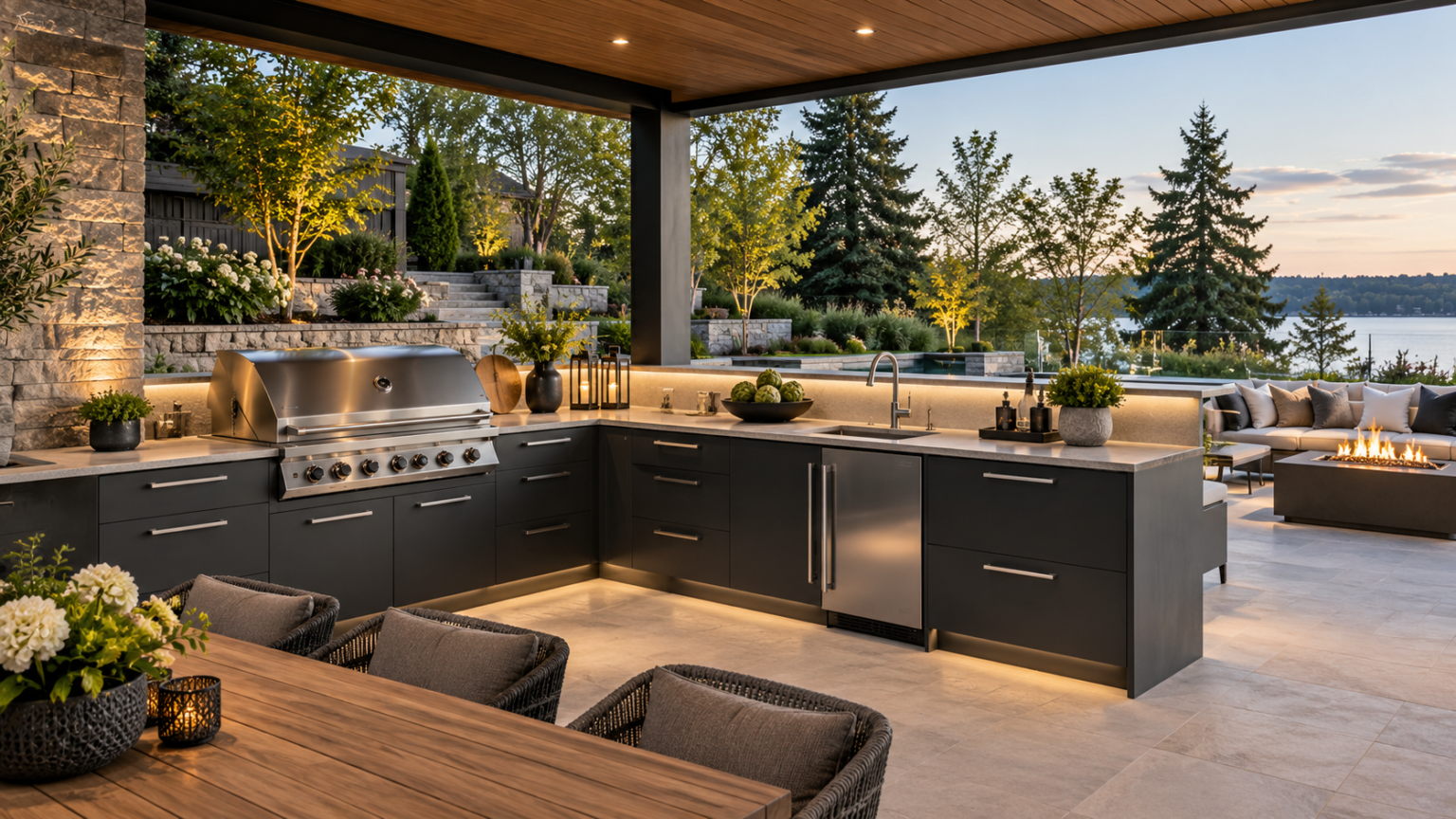
Outdoor living has become an important part of residential design across Canada and the United States. Homeowners increasingly want their backyards to function as comfortable extensions of their indoor living spaces, with dedicated areas for cooking, dining, entertaining and relaxing. A well-designed outdoor kitchen can bring these activities together while creating an attractive architectural feature. Station Grill is a Canadian outdoor-kitchen brand that specialises in custom cabinetry, weather-resistant materials and thoughtfully planned cooking spaces for different homes and lifestyles.
An outdoor kitchen is more than a barbecue placed on a patio. A complete installation can include preparation counters, enclosed storage, a built-in grill, refrigeration, a sink, additional cooking appliances and practical areas for serving food.
However, creating a dependable outdoor kitchen requires careful decisions about cabinet materials, layout, ventilation, appliance compatibility and ongoing maintenance.
Ordinary indoor cabinetry may not perform well when exposed to rain, snow, humidity,, or temperature changes. Outdoor installations therefore need materials and construction methods suited to their environment.
Station Grill approaches this challenge through a selection of modular and custom cabinetry systems designed for outdoor applications.
Its product range includes contemporary and classic finishes, custom cabinet configurations,ns and ready-made kitchen kits.
Understanding how these systems work can help homeowners make informed choices before starting an outdoor kitchen project.
This guide explores seven major benefits of a thoughtfully designed outdoor kitchen, the features available from Station Grill,and the practical considerations involved in planning a durable and functional backyard cooking area.
What Is Station Grill?
Station Grill is a Quebec-based outdoor kitchen design and cabinetry company serving residential and professional markets in North America.
According to the company, it was founded in February 2013 by brothers Luc and Marc Lacroix.
The business focuses on outdoor kitchen cabinetry, custom layouts, weather-resistant construction, and integration with suitable cooking appliances.
Its offerings extend beyond individual grill cabinets.
Homeowners can explore complete outdoor kitchen arrangements with storage, countertops, refrigeration, sinks, and various cooking stations.
What Makes an Outdoor Kitchen Different From an Indoor Kitchen?
An indoor kitchen operates within a building where its materials are generally protected from direct weather exposure.
An outdoor kitchen must cope with moisture, sunlight, seasonal temperature changes,, and potentially freezing conditions.
These differences influence the selection of cabinets, countertops, hardware and appliances.
An outdoor installation also needs appropriate drainage, ventilation and safe integration of fuel-burning equipment.
The correct construction details depend on the climate and the location of the kitchen.
Custom Outdoor Kitchens Versus Standard Barbecue Stations
A simple barbecue station may provide enough space for a grill and a small preparation surface.
A custom outdoor kitchen offers a more complete arrangement, with dedicated storage and equipment positioned according to how the homeowner plans to use the space.
For example, someone who regularly entertains large groups may want generous preparation space and easy access to refrigerated drinks.
A homeowner who primarily cooks family meals may prioritise a practical grill, storage drawers,and a durable countertop.
The right design is based on everyday use rather than the number of appliances installed.
1. Station Grill Supports Custom Outdoor Kitchen Design
One of the most valuable advantages of custom outdoor cabinetry is the ability to create a layout that suits the available space.
Backyards vary considerably in size, shape,, nd architectural character.
A long, narrow terrace requires a different arrangement from a spacious patio surrounding a swimming pool.
Understanding Custom Kitchen Layouts
An outdoor kitchen can be arranged in several familiar configurations.
A straight-line design positions cabinets and appliances along one continuous section.
An L-shaped layout creates two connected work areas and can provide a useful balance between cooking and preparation space.
A U-shaped arrangement offers additional counters and storage but requires sufficient room for circulation.
An island-style installation may create a focal point for entertaining when the site allows appropriate access and clearances.
The most suitable configuration depends on site conditions and appliance requirements.
Flexible Cabinet Configurations
Station Grill describes a catalogue containing more than 150 cabinet models and sizes.
This selection allows designers to combine different cabinet types to accommodate the intended layout.
Options can include drawers, doors, storage compartmen,,ts and cabinets designed for specific cooking appliances.
The actual arrangement still needs to be checked against the dimensions of the proposed equipment.
Designing Around Existing Architecture
A successful outdoor kitchen should complement the home rather than appear disconnected from it.
Materials, colours and proportions can help create a consistent visual style.
For a modern home, streamlined cabinetry and neutral surfaces may be appropriate.
A traditional property may suit cabinetry with more detailed door profiles and softer colours.
The objective is to connect the outdoor living area with the surrounding architecture.
Prioritising Practical Movement
An attractive layout can become frustrating if the cooking area is difficult to use.
Homeowners should consider the relationship between food preparation, grilling, refrigeration, washing and serving.
These areas should be close enough for convenient use without creating unnecessary crowding.
There must also be sufficient room for cabinet doors, appliance access,, and safe movement around hot equipment.
Planning for Future Changes
Outdoor living needs may change over time.
A household may eventually want an additional side burner, more preparation spac,,e or alternative storage.
Modular cabinetry can offer design flexibility, although modifications depend on the original installation and the available space.
It is usually more economical to anticipate likely needs during initial planning than to make major changes later.
2. Weather-Resistant Cabinetry Supports Long-Term Durability
Outdoor cabinetry is exposed to environmental conditions that ordinary interior furniture is not designed to withstand.
Selecting appropriate materials is therefore essential.
Understanding Moisture Exposure
Rainwater, humidity, sno,,w and condensation can affect outdoor structures.
Poorly selected cabinetry may swell, deteriorate,, or develop problems after repeated moisture exposure.
The cabinet body, door panels, hardware and installation details all contribute to weather performance.
Station Grill states that its cabinet structures use a proprietary 3/4-inch black PVC material formulated for outdoor use.
The company describes this material as waterproof and resistant to mould.
These are manufacturer claims that should be evaluated alongside the complete installation design.
Why Cabinet Construction Matters
The visible cabinet door is only one part of the structure.
The internal framework supports the countertop, drawers, applianc,,es and stored items.
A durable outer finish cannot compensate for an unsuitable structural core.
For this reason, buyers should investigate how the cabinets are built rather than comparing appearance alone.
Managing Water Around Cabinets
Water can enter outdoor kitchen installations through poorly detailed joints, openings and service connections.
Suitable drainage, sealing and weather-conscious construction help manage this exposure.
Station Grill describes integrated drainage and weather-resistant cabinet arrangements within its product range.
However, the effectiveness of the completed installation depends on correct assembly and site conditions.
Choosing Suitable Hardware
Outdoor cabinetry relies on hinges, drawer mechanisms, handles,, and other hardware.
These components need to operate consistently despite changes in temperature and exposure to moisture.
Station Grill advertises Blum soft-close hardware in its cabinetry.
Soft-close mechanisms can provide controlled door and drawer movement, while suitable hardware contributes to everyday usability.
Understanding Weather Resistance Limitations
Weather-resistant does not mean indestructible.
Even materials designed for outdoor use can be affected by improper cleaning, unsuitable heat exposure, installation defects,, or physical damage.
Homeowners should follow the manufacturer’s maintenance and care instructions.
Any warranty should also be reviewed for relevant exclusions and conditions.
3. Station Grill Offers Multiple Outdoor Kitchen Collections
Material and finish selection have a major influence on the appearance and maintenance needs of an outdoor kitchen.
Station Grill offers several collections with different design characteristics.
PUR Collection
The PUR collection uses marine-quality high-density polyethylene, commonly called HDPE, for its doors and drawer fronts.
HDPE is a polymer material often selected for applications where moisture resistance is important.
Station Grill presents this collection as a modern, practical option with a lightly textured finish.
Its relatively simple visual design may suit contemporary patios and everyday outdoor cooking areas.
CLASSIC Collection
The CLASSIC collection also uses marine-quality HDPE.
However, its door and drawer fronts feature a shaker-inspired design with grooved detailing.
This creates a more traditional appearance.
The collection can suit homes where the owner wants a less minimalist outdoor kitchen.
EVO Collection
EVO uses aluminium composite panels marketed by Station Grill under the NEXBOND name.
The collection focuses on streamlined surfaces and contemporary styling.
The company describes the material as engineered for outdoor durability and relatively straightforward maintenance.
LUX Collection
LUX uses aluminium panels within an anodised aluminium framing arrangement.
This creates a refined architectural appearance intended for modern outdoor spaces.
The collection is designed to complement stainless steel appliances, stone surfaces and contemporary residential finishes.
Comparing the Collections
PUR and CLASSIC primarily differ in their visual profiles while sharing HDPE-based façade construction.
EVO and LUX focus on aluminium-based finishes with different design treatments.
The best choice depends on architectural style, maintenance preferences, project budget,, and the intended appearance.
Buyers should request current material samples and confirm product-specific details before selecting a collection.
Understanding NEXBOND Panels
Station Grill describes NEXBOND as an aluminium composite panel product with an architectural-grade PVDF paint system and an additional surface treatment intended to improve resistance to dirt and stains.
These descriptions come from the manufacturer.
Surface durability should be considered alongside cleaning instructions, installation conditions,, and warranty coverage.
4. Outdoor Kitchen Cabinets Improve Storage and Everyday Functionality
A well-designed outdoor kitchen should make cooking convenient.
Without enough storage, homeowners may need to repeatedly carry equipment, utensi,,ls and serving items between their indoor and outdoor kitchens.
Keeping Cooking Tools Nearby
Dedicated drawers can provide space for grilling utensils, preparation tools,, and suitable accessories.
This helps keep frequently used items within reach.
Storage locations should be chosen according to the way the kitchen will be used.
Creating Dedicated Cabinet Zones
A practical layout might include separate areas for cooking equipment, utensils, cleaning supplies,, and serving accessories.
Heavy items should be stored in suitable cabinets designed to support their weight.
Chemicals and other potentially hazardous products should be handled according to their safety instructions.
Adding Waste and Recycling Storage
Built-in waste and recycling compartments can improve convenience during meal preparation.
Station Grill includes pull-out waste and recycling arrangements in certain kitchen configurations.
An accessible waste area can help keep preparation surfaces free of clutter.
Incorporating Drawers and Shelves
Different cabinet types serve different needs.
Drawers may suit smaller utensils and tools.
Shelves can accommodate larger items.
Cabinets with full doors can help conceal equipment and maintain a neat appearance.
The combination should be planned around actual storage requirements.
Using Soft-Close Hardware
Soft-close mechanisms prevent cabinet doors and drawers from closing abruptly during normal use.
They can contribute to a more comfortable experience in frequently used outdoor kitchens.
However, hinges and slides still need suitable adjustment and maintenance.
Why Storage Should Be Planned Early
Storage is often treated as a secondary concern after choosing the grill.
In practice, insufficient storage can make an attractive outdoor kitchen less convenient.
Homeowners should identify the tools and accessories they need before finalising cabinet dimensions.
5. Station Grill Supports Different Outdoor Cooking Appliances
A custom outdoor kitchen can accommodate more than a built-in barbecue.
Some homeowners enjoy preparing food using several cooking techniques.
Others prefer a simpler installation with one main cooking appliance.
Built-In Gas Grills
A built-in grill often forms the central cooking station.
Its dimensions, ventilation needs, fuel supply,, and required clearances affect the surrounding cabinetry.
Station Grill offers grill cabinets designed around compatible appliance dimensions.
The manufacturer specifies a standard grill cabinet depth of 30 inches and indicates that cabinet width is generally 12 inches greater than the associated grill model’s width.
These are product-design details, not universal rules for all outdoor kitchen cabinets.
Side Burners
A side burner can provide an additional cooking area for suitable pots and pans.
It may be useful when preparing sauces or accompaniments while the main grill is operating.
The appliance must be installed according to its approved requirements.
Flat-Top Griddles and Planchas
Flat cooking surfaces can support meals that are less convenient to prepare on an open grill.
A suitable outdoor kitchen design may include a dedicated cabinet for this equipment.
The selected cabinet must account for the appliance’s dimensions, heat exposure,, and service requirements.
Pizza Ovens
Pizza ovens are increasingly incorporated into outdoor cooking spaces.
Their heat output and installation requirements vary.
They may require a dedicated support structure and additional clearance from combustible materials.
Designers should follow the oven manufacturer’s installation instructions rather than assuming ordinary countertop spacing is sufficient.
Refrigeration and Sinks
Outdoor-rated refrigeration can keep suitable ingredients and beverages conveniently accessible.
A sink may provide a dedicated washing or preparation point, where permitted and properly connected.
Electrical, plumbi,,ng and drainage requirements must be considered during the design stage.
Appliance Compatibility
Station Grill states that its cabinetry can accommodate equipment from a range of major outdoor cooking brands.
However, individual appliances have different dimensions and installation instructions.
Compatibility should always be confirmed for the exact appliance model.
6. A Station Grill Outdoor Kitchen Can Create a Better Entertaining Space
Outdoor kitchens are often designed as gathering spaces.
They allow cooking to take place near family and guests rather than in a separate indoor room.
Connecting Cooking and Dining
An outdoor kitchen can be positioned near a dining table or seating area.
This allows food preparation and serving to take place within the same general space.
However, seating should remain clear of hot surfaces and required appliance clearances.
Designing a Comfortable Seating Area
Some outdoor kitchen layouts include a raised bar or adjacent counter suitable for serving food.
The design should provide enough circulation space for people to move safely.
Seating should not block access to storage, equipment controls or emergency shutoffs.
Creating an Architectural Focal Point
A built-in kitchen can become a central feature of the backyard.
Cabinet finishes, countertops, landscaping and lighting contribute to the overall design.
A cohesive installation can create the appearance of an intentional outdoor living room rather than a collection of separate appliances.
Incorporating Lighting
Outdoor lighting can improve visibility during evening cooking.
Task lighting may be particularly useful around preparation counters.
Additional lighting can support pathways, dining spaces and landscaping.
Electrical fixtures must be suitable for outdoor installation and installed in accordance with applicable requirements.
Planning for Different Seasons
In many parts of Canada and the northern United States, outdoor kitchens experience substantial seasonal changes.
A covered outdoor area may improve comfort during rain or strong sunlight.
However, roofs, pergolas and other overhead structures must be evaluated for safe clearance and ventilation around cooking equipment.
A shelter should never turn an outdoor-only gas appliance into an enclosed or inadequately ventilated installation.
Considering Household Lifestyle
Not every home needs a large entertaining kitchen.
A compact installation may be sufficient for a family that enjoys occasional outdoor meals.
A larger space may make sense for people who frequently host gatherings.
Designing around actual use can help avoid unnecessary equipment and expense.
7. Station Grill Offers Both Custom Kitchens and Ready-Made Kits
Homeowners have different requirements when planning an outdoor kitchen.
Some prefer a fully customised installation, while others want a more straightforward preconfigured arrangement.
Station Grill offers both approaches.
Custom Outdoor Kitchens
A custom project allows the layout, cabinet selection, materials and appliance arrangement to be planned around the property.
This approach may be useful for unusual patios, larger outdoor living projects or detailed architectural designs.
It also involves more decisions and may require coordination between several professionals.
Ready-Made Outdoor Kitchen Kits
Station Grill also advertises preconfigured kitchen kits.
These products are intended to simplify the selection process by combining an established cabinet arrangement with specified materials and dimensions.
According to its published information, selected kits include a 20 mm Dekton countertop, Blum hardware and predefined cabinet configurations.
Understanding Kit Compatibility
The manufacturer states that its ready-made kits are designed for selected Twin Eagles and Delta Heat grill models.
The grill and its required insulated jacket are sold separately.
This is an important distinction when estimating the total project cost.
Buyers should confirm the exact compatible appliance before ordering.
Advertised Turnaround
Station Grill publishes a production and shipping turnaround of ten business days for its ready-made kits.
This is a manufacturer-advertised timeframe.
Actual delivery and installation schedules may differ according to location, product availability and project requirements.
Choosing Between Custom and Ready-Made
A ready-made kit may suit a property where the available space and preferred appliance match one of the standard configurations.
A custom kitchen may be more appropriate when the project requires unusual dimensions, multiple cooking stations or specific architectural features.
Neither option is automatically superior.
The decision should reflect space, budget, project complexity and long-term needs.
Important Station Grill Product Features to Know
Understanding the manufacturer’s published details helps buyers compare product configurations more effectively.
PVC Cabinet Structure
Station Grill states that its cabinet bodies use 3/4-inch black PVC designed for outdoor applications.
The company presents this construction as a durable alternative to conventional materials that may require greater protection from moisture.
Cabinet Door and Drawer Materials
The available collections incorporate HDPE or aluminium-based door and drawer finishes.
The selected collection affects appearance, texture and material characteristics.
Blum Hardware
The manufacturer identifies Blum hinges and soft-close hardware as features of its cabinetry.
Exact hardware specifications should be confirmed for the selected configuration.
Grill Cabinet Dimensions
Station Grill’s standard grill cabinetry is described as 30 inches deep, with width calculated according to the associated grill.
Custom dimensions may be required for certain appliances.
Insulated Jackets
Station Grill states that an insulated jacket is required for its grill cabinet installations.
The exact appliance and cabinet construction must be evaluated according to relevant safety instructions.
An insulated jacket is not a substitute for ventilation, required clearances or safe gas installation.
NEXBOND Finishing Panels
The manufacturer offers NEXBOND panels for selected finishing applications.
These can help create a visually coordinated installation while accommodating planned service arrangements.
Warranty
Station Grill advertises a 15-year warranty for its outdoor kitchen cabinetry.
Buyers should obtain the current written warranty to confirm its scope, exclusions, eligible components and applicable conditions.
The warranty should not be assumed to cover every installed appliance, countertop, or accessory.
How to Plan a Station Grill Outdoor Kitchen
A successful outdoor kitchen project begins with preparation.
Homeowners should establish the practical requirements before finalising finishes or purchasing appliances.
Step 1: Measure the Available Space
Record the dimensions of the intended location.
Consider slopes, existing structures, access routes, doors,windows,ss and other site features.
Ensure there is sufficient room for safe cooking and movement.
Step 2: Define the Cooking Requirements
List the appliances that will actually be used.
A built-in grill may be essential, while a pizza oven or additional burner may be optional.
Choose equipment based on cooking habits rather than appearance alone.
Step 3: Choose the Preferred Layout
Compare straight-line, L-shaped, U-shaped, and island arrangements.
The layout should support preparation, cooking, cleaning, and serving.
Step 4: Select Appropriate Materials
Consider local weather conditions and maintenance preferences.
Review the PUR, CLASSICand ,and E d LUX collection options and request material information.
Step 5: Plan Utilities
Identify any required natural gas, propane, electricity, water, and drainage connections.
Professional installation may be necessary.
The site should be assessed against local permit and building requirements.
Step 6: Confirm Appliance Clearances
Built-in grills and other heat-producing appliances require careful installation.
Follow the appliance manufacturer’s specified clearances, ventilation requirements, and approved enclosure details.
Do not rely on a generic measurement taken from another grill model.
Step 7: Confirm the Total Budget
A realistic budget should include more than cabinetry.
Countertops, appliances, utilities, site preparation, installation nd accessories can create substantial additional costs.
Step 8: Review Drawings Before Ordering
Confirm cabinet dimensions, appliance locations, door clearances, and service access.
The final design should be approved before manufacturing begins.
Outdoor Kitchen Safety: What Homeowners Must Consider
Outdoor cooking equipment can create fire and carbon monoxide hazards.
Safe design and operation are essential regardless of the cabinet brand.
Gas Grill Ventilation
Gas grills must be used in locations that provide the ventilation required by the appliance manufacturer and applicable codes.
Health Canada advises that barbecues should be used outdoors in well-ventilated areas.
Fuel-burning cooking appliances should not be used indoors or in enclosed spaces where dangerous combustion gases may accumulate.
Heat Protection Around Cabinets
Built-in appliances may require insulating jackets, non-combustibleconstruction,, or specific clearances.
The correct details depend on the approved appliance.
Station Grill requires insulated jackets for its grill cabinet arrangements.
Qualified installers should confirm the complete installation.
Gas Connections
Natural gas and propane installations should follow local requirements.
Fuel lines, regulators and shutoff arrangements must be suitable for the appliance.
Gas work should be performed by authorised professionals where required.
Electrical Safety
Outdoor refrigeration, lighting and electrical outlets require appropriate wiring and protection.
Electrical equipment should be rated for its intended environment.
Keeping Combustibles Away
Outdoor cooking areas should not place combustible items too close to heated surfaces.
Follow the appliance manufacturer’s specified clearances.
Safe Cooking Practices
Never leave an operating grill unattended.
Regular cleaning helps limit grease accumulation.
Homeowners should also inspect hoses and fittings according to the manufacturer’s instructions.
How Much Does a Station Grill Outdoor Kitchen Cost?
The price of an outdoor kitchen depends on the selected collection, number of cabinets, countertop material, appliances, installation and other project requirements.
Cabinet Collection Pricing
Station Grill publishes indicative prices per linear foot in US dollars on its collection comparison page.
The displayed ranges are:
- PUR: $990–$1,639 per linear foot
- CLASSIC: $990–$1,639 per linear foot
- EVO: $1,040–$1,749 per linear foot
- LUX: $1,210–$2,189 per linear foot
These are manufacturer-published reference ranges, not complete installed project quotations.
Additional Project Expenses
A finished kitchen may require a grill, an insulated jacket, refrigeration, countertops, plumbing, electrical work and site preparation.
The price of cabinetry alone does not establish the total project cost.
Custom Design Costs
Complex layouts and specialised appliance arrangements may involve additional design and fabrication requirements.
Homeowners should request an itemised quotation.
Installation Expenses
Installation requirements vary depending on the site.
Existing patios, service connections and structural conditions can influence the project cost.
Comparing Long-Term Value
The least expensive initial option is not always the most economical over time.
Materials, maintenance needs, replacement parts,, and warranty coverage should also be considered.
Maintenance Tips for Outdoor Kitchen Cabinets
Outdoor kitchens benefit from routine care, even when their materials are designed for weather exposure.
Clean Cabinet Surfaces
Use cleaning products and methods approved by the manufacturer.
Avoid abrasive techniques that could damage protective finishes.
Inspect Hinges and Drawers
Check that doors and drawers open and close correctly.
Adjustments should follow the hardware manufacturer’s instructions.
Keep Drainage Paths Clear
Outdoor kitchens should allow rainwater and condensation to drain as designed.
Remove debris from accessible drainage areas.
Maintain Appliances Separately
Cooking appliances have their own maintenance requirements.
Follow the appliance manufacturer’s instructions for burners, grease trays, refrigeration and other components.
Inspect Gas Equipment
Health Canada recommends checking barbecue hoses, fittings and burners before use, particularly after extended storage.
Potential gas leaks should be handled according to appropriate safety procedures.
Prepare for Winter
In freezing climates, plumbing may need to be drained or winterised.
Outdoor refrigeration and other equipment should be handled according to their operating and storage instructions.
Review the Warranty
Maintenance practices may affect warranty coverage.
Keep installation records, invoices and relevant product documentation.
Common Outdoor Kitchen Design Mistakes
Some problems arise not from the cabinet material but from decisions made during planning.
Choosing Appliances Before Measuring
A grill may not fit the intended cabinet or available space.
Always confirm dimensions before ordering.
Ignoring Preparation Space
An outdoor kitchen with several appliances but little countertop area can be inconvenient.
Preparation surfaces should be included from the beginning.
Overlooking Ventilation
Built-in cooking equipment requires appropriate ventilation and clearance.
These requirements must be resolved before cabinetry is finalised.
Providing Too Little Storage
Without suitable cabinets and drawers, utensils and accessories may clutter the preparation area.
Underestimating Installation Costs
Gas, electrical, plumbing and site work can add substantially to the budget.
Selecting Unsuitable Materials
Outdoor cabinetry should be designed for environmental exposure.
Interior-only materials may require additional protection or be inappropriate for the application.
Forgetting Maintenance Access
Appliances and service connections may need inspection or repair.
The design must provide access consistent with the equipment requirements.
Station Grill for Architects, Designers and Builders
Outdoor kitchens are also relevant to professionals designing residential properties.
Residential Architects
An outdoor kitchen can be planned as part of a broader home design.
Considering its location early helps coordinate services, circulation and architectural appearance.
Landscape Designers
Landscape professionals can integrate cabinetry with paving, planting, dining areas and outdoor lighting.
The result should balance usability with visual consistency.
Custom Home Builders
Builders may incorporate outdoor kitchens into new residential projects.
Early coordination allows utility routes, structural details and appliance locations to be established before construction progresses.
Property Developers
Outdoor kitchens may form part of premium residential amenity packages.
Their value depends on buyer preferences, location, project budget and quality of installation.
A particular increase in property value should not be assumed without market evidence.
Professional Design Tools
Station Grill offers professional resources, including a SketchUp catalogue and dealer-oriented design tools.
These resources may help relevant professionals develop layouts and equipment specifications.
Availability and access should be confirmed directly with the manufacturer.
The Future of Luxury Outdoor Kitchen Design
Outdoor living continues to influence residential architecture.
Several design approaches are becoming increasingly visible in contemporary projects.
Integrated Indoor-Outdoor Spaces
Homeowners may choose outdoor cabinetry and countertops that complement the interior kitchen.
This creates a more connected architectural appearance.
Durable Low-Maintenance Materials
Materials that require less routine finishing may appeal to homeowners with busy lifestyles.
Actual maintenance still depends on the product and environment.
Modular Kitchen Layouts
Configurable cabinetry allows designers to adapt arrangements to different sites.
Integrated Refrigeration
Outdoor-rated refrigeration can reduce the need to move between indoor and outdoor preparation areas.
Flexible Cooking Stations
Some homeowners prefer several smaller cooking appliances rather than a single large grill.
These arrangements require careful consideration of space and ventilation.
Coordinated Lighting
Task and ambient lighting can make an outdoor kitchen easier to use in the evening.
Practical Designs Over Excessive Features
A successful kitchen does not need every available appliance.
The best installations balance the homeowner’s habits, available space, safe operation and budget.
Frequently Asked Questions
1. What is Station Grill known for?
Station Grill is a Canadian outdoor-kitchen company known for custom cabinetry, weather-resistant materials, modular layouts and outdoor cooking installations.
2. What outdoor kitchen collections does Station Grill offer?
Its main collections include PUR, CLASSIC, EVO and LUX, offering different HDPE and aluminium-based finishes for various architectural styles.
3. Are Station Grill outdoor kitchen cabinets weather-resistant?
The manufacturer describes its cabinets as designed for outdoor conditions, with 3/4-inch PVC structures and weather-resistant finishes. Correct installation and maintenance remain important.
4. Can Station Grill cabinets accommodate different grill brands?
Yes. The company advertises compatibility with numerous outdoor cooking brands, although fit, insulation and installation requirements must be checked for each appliance model.
5. Does Station Grill offer ready-made outdoor kitchen kits?
Yes. Its published range includes preconfigured kits for selected Twin Eagles and Delta Heat grills, with specific countertops and cabinet arrangements.
6. How much does a Station Grill outdoor kitchen cost?
Costs vary by collection, layout, appliances and installation. The company publishes indicative cabinet pricing per linear foot, but a complete project requires an individual quotation.
Conclusion
Station Grill offers homeowners and design professionals a range of outdoor kitchen solutions built around custom layouts, weather-resistant cabinetry and compatible cooking equipment. Its PUR, CLASSIC, EVO and LUX collections provide different styles for contemporary and traditional outdoor spaces. A successful installation requires careful planning of materials, storage, appliance safety, utilities and long-term maintenance. By combining practical design with appropriate professional installation, homeowners can create an outdoor cooking area that complements their property and everyday lifestyle.
