
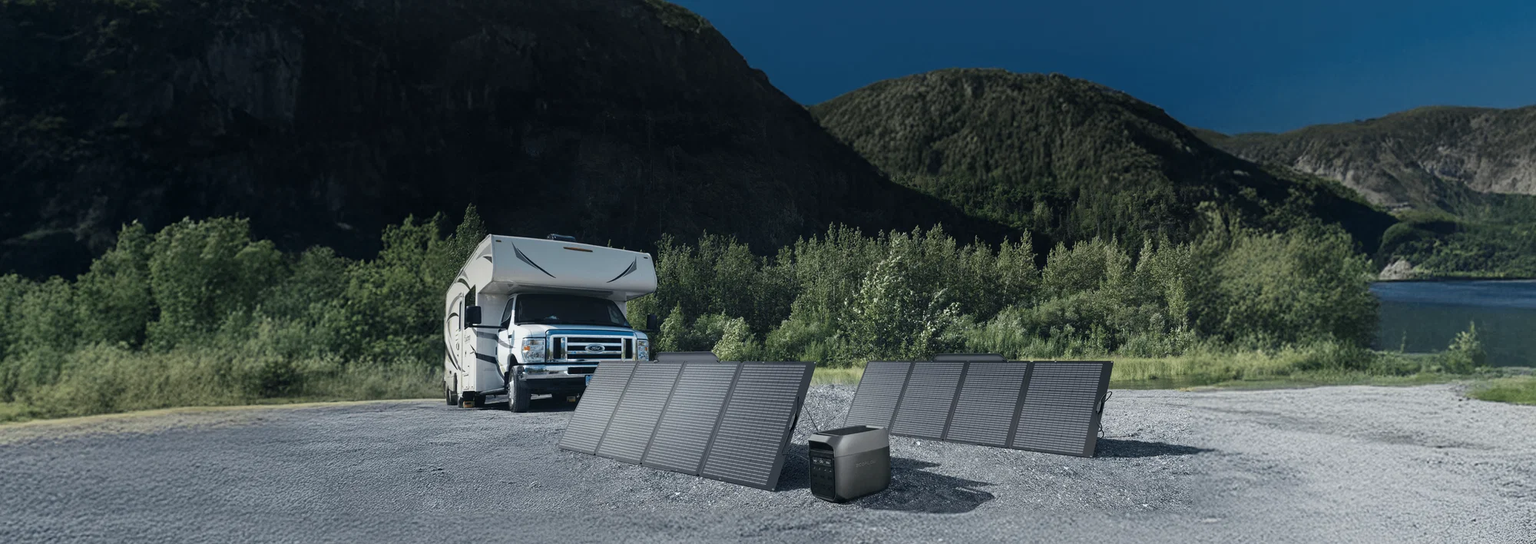
Yes, a solar generator can run an RV air conditioner if it provides the correct electrical output, handles compressor startup, and stores enough energy for the cooling time you want. Brief afternoon cooling and running an air conditioner through a hot night are very different requirements.
For a traditional 120V rooftop unit, the inverter supplies the air conditioner while the battery and solar input support that demand. Buying enough output to start the compressor is only the first part of making the setup useful.
Check the Exact Air Conditioner, Not Just Its BTU Rating
BTUs describe cooling capacity. They do not tell you the exact running power or startup demand of a particular unit.
Check the model’s specifications for operating voltage, running requirements, and compressor startup. Include the other equipment that will be powered at the same time.
For example, suppose an air conditioner draws 1,500W while running and requires a brief 3,500W startup demand. If other RV equipment is using 200W, the source needs to accommodate:
- Approximately 1,700W during normal operation.
- Approximately 3,700W during compressor startup.
Those are hypothetical figures. Actual startup behavior depends on the air conditioner and the source’s ability to support the required surge for long enough.
A compatible soft-start device can reduce compressor starting demand. It does not substantially reduce the electricity needed for normal cooling, so it should not be treated as a way to turn a short battery runtime into all-night operation. Confirm compatibility and installation requirements with the air-conditioner and soft-start manufacturers.
Estimate Runtime From Average Consumption
Battery capacity becomes the main constraint once startup and running requirements are satisfied.
A useful estimate is:
Runtime ≈ Usable battery energy ÷ Average air-conditioner power draw
For illustration, suppose a station with 3,000Wh nominal capacity has 2,400Wh budgeted for usable AC output under the planned conditions. That allowance is an assumption, not a universal efficiency rule.
With no solar charging or other RV loads, the estimate becomes:
| Average air-conditioner power draw | Estimated runtime from 2,400Wh |
| 600W | About 4 hours |
| 900W | About 2.7 hours |
| 1,500W | About 1.6 hours |
Average consumption matters because the compressor may cycle or change speed. A unit pulling 1,500W while actively cooling may average less after reaching the thermostat setting. In severe heat, however, it may run much more continuously.
Do not assume a favorable cycling pattern when planning for a hot campsite. Measure energy use over a representative period, including compressor cycles and fan operation.
The scale of overnight cooling is worth checking early. A continuous 1,500W load for eight hours requires 12,000Wh before losses and other equipment. That explains why a system that easily starts the air conditioner may still be unsuitable for the whole night.
Solar Panels May Extend Runtime Without Maintaining the Battery
Panels can replace some of the energy being consumed, but a modest array may not keep pace with an operating rooftop air conditioner.
Suppose solar input is actually averaging 450W while the air conditioner draws 1,500W. Even before other loads and conversion losses, there is a difference of roughly 1,050W. The battery must supply the balance.
Charging and consumption occur through different parts of the system, so this subtraction is only a simplified energy comparison. It nevertheless shows why a charging indicator does not mean the battery is holding its charge.
Also distinguish panel rating from actual input. A 600W array does not continuously provide 600W throughout the day. Roof orientation, shade, weather, heat, and the station’s input limits affect production.
An RV parked in shade may need less cooling but produce less electricity from roof-mounted panels. Portable panels can offer more positioning freedom where the site and approved cable arrangement allow it.
Include the Rest of the RV in the Load
Connecting through the RV’s shore-power inlet may supply more equipment than the air conditioner.
The converter may begin charging the house battery. A refrigerator or water heater may be operating electrically. Those loads reduce runtime and can push the source beyond its output limit when the compressor restarts.
Check the operating modes and consumption of the equipment connected to that circuit. Testing the air conditioner alone does not establish that the full RV arrangement will behave the same way.
An RV-style outlet or adapter also does not increase a power station’s available output. Confirm voltage, outlet limits, total inverter capacity, and compatibility with the RV’s electrical protection. Have an RV technician verify the connection if you are unsure.
For an RV solar generator, a suitable connection, adequate startup capability, and enough battery energy need to work together. None of those specifications can substitute for the others.
Match the Setup to a Specific Cooling Goal
A useful goal might be cooling the RV during a lunch stop, reducing interior temperature before bed, or supporting several hours of evening use.
Each allows a different balance of battery capacity, solar equipment, weight, and recharging. If the goal is reliable cooling throughout a very hot night, assess that full energy requirement before committing to a portable system.
Run a representative test before relying on the arrangement at a remote campsite. Include the other intended loads, observe several compressor restarts, and record energy use over the cooling period you expect.
A short demonstration proves that the unit can operate. A longer test tells you whether it can deliver the cooling time you are buying it for.
Conclusion
Choose around the hours of cooling you need. Battery-based solar power can be useful for defined cooling periods, but prolonged summer air conditioning requires substantial storage and replenishment. Establish the energy requirement first, then confirm that the inverter and RV connection can support it.
