
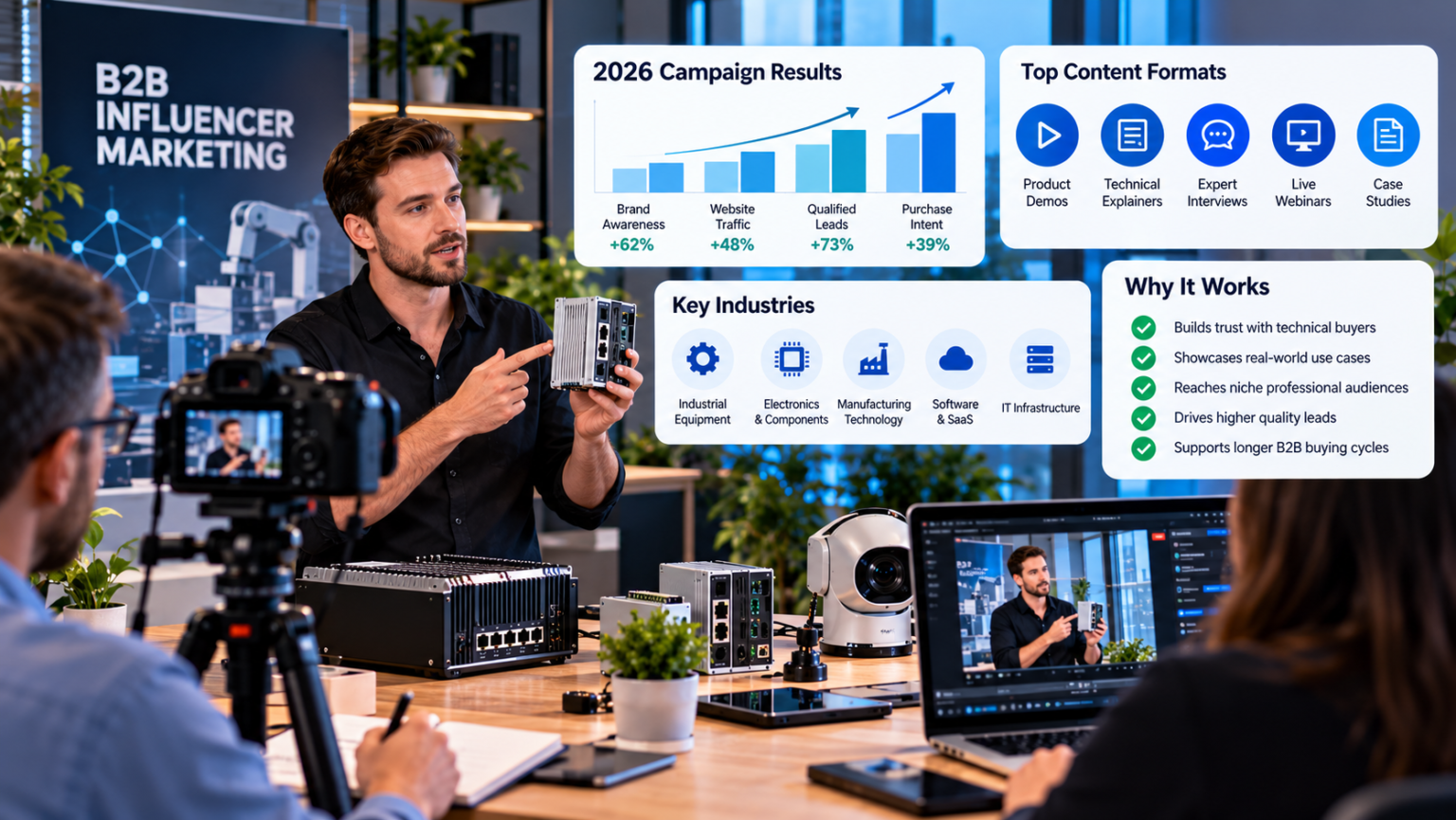
B2B influencer marketing works for technical products when a brand pays a practitioner to show the product in real work, picks that creator for audience fit over follower count, and judges results over 90 days. Clerk, the authentication platform, learned this after three dedicated “here is our product” YouTube videos barely moved signups. Once creators built whole apps with Clerk as one layer, the program grew to 20 partners and a 30% rise in YouTube-attributed signups, according to a published teardown of the program.
Most advice on the topic still comes from consumer marketing, where reach and a discount code do the work. Technical buyers behave differently. They evaluate a tool for weeks, ask colleagues, read the docs and only then sign. This guide covers what changes when the buyer is an engineer, a platform lead or a CTO.
What B2B influencer marketing means for a technical buyer
B2B influencer marketing is paying or partnering with people who hold the trust of a business audience, so they show your product to that audience. For technical products, those people are engineers who teach on YouTube, developer advocates, founders who post build logs on X, and newsletter writers whose readers run infrastructure.
Three things set it apart from consumer influencer work:
- The viewer is an evaluator, not always the signer. A Bain & Company survey of 279 US B2B buyers, run with Twitter, found that more than half of buyers say manager-level colleagues have a large say in technology purchases. The creator reaches the engineer who shortlists the tool.
- The cycle is long. A developer may watch a video in March, try the free tier in April and bring it to a team decision in June. Any measurement window shorter than a quarter undercounts.
- The audience checks claims. Engineers test what a creator says. A benchmark they cannot reproduce costs the creator and the brand more trust than no post at all.
Why technical buyers trust practitioners over vendor content
Technical buyers lean on people who have done the work. In the Bain and Twitter study, buyers trusted community sources twice as much as advertisements. The study dates from 2020 and Twitter co-ran it, so read it as a direction.
Newer surveys point the same way:
- In LinkedIn’s 2026 B2B marketing survey of 1,299 marketers, 70% said buyers rely more on peer voices and experts than on brand-produced content.
- The 2025 Edelman and LinkedIn B2B Thought Leadership report found that 64% of buyers trust thought leadership more than product sheets when they assess a vendor.
Alana Joseph, who runs creator partnerships at HubSpot, put the trade simply in a HubSpot Live session: a brand that sponsors a creator is buying the trust that creator has built. For a technical audience, that trust comes from one source. The creator has shipped real things in public, and their audience has watched them do it.
Where B2B creator budgets are going in 2026
A tally of sponsor slots shows how crowded some categories have become. We read the descriptions of the 103 most recent long-form videos across 11 programming YouTube channels, including Fireship, Theo, The PrimeTime, Traversy Media and Web Dev Simplified, and counted every sponsor read in 2025 and 2026.
The 103 videos carried 73 sponsor slots. AI-era devtools took 31 of them, or 42%:
- AI code review: 16 slots, split between three competing products.
- AI agent infrastructure: 13 slots, from browser automation to scraping APIs.
- CI and build speed: 9 slots.
- Hosting, databases, observability and auth: most of the rest.
Two channels, Theo’s and Ben Davis’s, ran a sponsor on every video checked. One code review tool appeared on five of the eight channels that ran sponsors at all.
Three lessons follow for a technical brand:
- Crowded categories need exclusivity. A viewer who sees three code review sponsors in a month starts comparing them. Paying a creator to keep rivals off their channel for 60 to 90 days costs less than losing that comparison.
- Quiet categories are open. Auth, database and hosting sponsors that filled these channels in 2023 barely appeared in this window, so a well-placed integration can stand out.
- Small channels sell out too. Ben Davis had under 46,000 subscribers and sold every slot, so a small channel in a hot category can still be fully booked.
How to choose creators by audience fit
Follower count is the weakest signal in B2B creator selection. In one agency’s analysis of YouTube creator rates, subscriber count explained almost none of the variation in price, with an r² of 0.001, and cost per thousand subscribers ranged from $2.57 to $233.
Score each creator on six checks instead:
- Audience match. “Developer” covers many audiences. A frontend creator’s viewers judge tools differently from SRE or data engineers, so match the creator’s niche to the engineers who would adopt your product. PostHog’s public handbook, for example, avoids channels about interview prep and career growth.
- Stack overlap. The best partners already use tools that sit beside yours, so your product slots into a workflow they show anyway.
- Engagement quality. PostHog’s handbook sets a written bar: 0.002 to 0.005 comments per view counts as good, and anything under 5,000 views per video is not worth a sponsorship.
- Median reach. Use the median of the last 10 posts or videos. One viral upload hides a channel that usually gets a third of it.
- Platform-specific activity. Audience on one platform does not transfer to another. A benchmark post for a CI product by a creator best known on YouTube reached 1,478 views on X, where his account had about 2,800 followers and had been quiet for months.
- Sponsor history. Look for past sponsored posts with clear disclosure, a working demo and no direct rival booked in the same quarter.
Ask your own engineers before you search. Neill Gernon, who has run creator programs for devtools such as Clerk and Snyk, notes that founders and dev teams usually already know one or two creators they trust, and that list makes the best starting shortlist.
Which platforms carry B2B influence for technical products
Each platform reaches a different slice of the technical buyer, so the platform choice comes from the buyer before the creator. In the 2025 Stack Overflow Developer Survey, developers named YouTube (60.5%), Reddit (53.7%), LinkedIn (37.2%) and X (17.1%) among the community platforms they use regularly.
- YouTube carries the deepest evaluation. PostHog’s handbook calls long-form YouTube its strongest acquisition channel, after its own brand channel failed to move signups in 2022 and 2023.
- X carries fast, opinionated discussion in AI tooling and infrastructure. Its published ranking code, synced in October 2026, gives a reply 7.6 times the weight of a like, so posts that invite technical argument travel further than posts built for likes.
- LinkedIn reaches the director and VP who approve budgets, which suits thought leadership from practitioners rather than demos.
- Newsletters reach a self-selected technical reader with no feed algorithm in between, and they work well for launch weeks.
Most technical brands should start on one platform where their buyers already argue, then add a second once the first produces signups.
How to brief a creator for a technical product
The brief decides whether the content reads as a recommendation or an ad. Clerk’s switch from dedicated videos to integrations is the clearest example: creators built full apps, Clerk handled authentication inside them, and signups followed.
HubSpot’s creator team moved the same way. Alana Joseph describes replacing fixed scripts with a “mad lib” brief that holds the key messages and must-say facts, with gaps the creator fills from their own experience. A good brief for a technical product carries:
- One problem, in the words the buyer uses.
- One proof point the creator can produce themselves, such as a build time, a latency number or a working repository.
- Product access: a sandbox, credits and an engineer the creator can message for help.
- Format and placement: where the product must appear, such as the first post of a thread or the first two minutes of a video.
- A tracked link unique to that creator, plus an instruction to mention the creator at signup.
- Disclosure: “Ad” at the start of the post, plus the platform’s paid partnership label. The FTC says a platform’s tool alone may not be enough, and the UK’s ASA advises against “sponsored” as the only label.
Leave out the script, the adjectives and the feature list. Phil Agnew, host of the Nudge podcast, makes the point that audiences notice the moment a creator switches to someone else’s voice, and they stop trusting what follows.
What B2B creator partnerships cost
No public rate card exists for technical creators, and prices spread widely. Third-party estimates from the sponsorship tracker SponsorRadar put PostHog’s recent YouTube deals at $1,100 to $2,200 per video across 22 creators. Clerk’s tests with performance-based deals used CPMs of $20 to $55.
The price of a placement moves with:
- Effort: a recorded build or benchmark costs more than a mention, because the creator has to do the work.
- Audience depth: a niche channel followed by platform engineers can charge more than a larger general tech channel.
- Usage rights: reusing the content in ads, docs or email adds to the fee.
- Exclusivity: keeping rivals off the channel for a set period is a separate line item.
Budget for a first campaign of three months rather than a single video. Neill Gernon puts the floor for a YouTube program at about $30,000, because large creators use up budget fast and a smaller sample tells you little. Plan repeat bookings from the start: in one 90-placement campaign for an AI app builder, second placements with the same creator averaged 1.41 times the views of first placements.
How to measure B2B influencer marketing over a long sales cycle
Measurement fails when a team expects one video to show up as revenue in the same month. Developers watch on a phone, try the product on a laptop days later, and bring it to a team decision weeks after that.
Stack several signals:
- One link per creator. PostHog gives each creator a vanity URL such as its domain plus the creator’s name, with utm_source set to the creator, and keeps the link in the top three lines of the video description.
- Signup attribution. PostHog found that only about 10% of signups filled in an optional “where did you hear about us” field, so make it required and list creator names.
- Branded search. Record four weeks of searches for your product name before launch, then compare the weeks after each video.
- Saves. On X, posts people save for later point to evaluation intent. In a sample of five sponsored devtool posts, a code tutorial earned 545 saves against 496 likes.
- A 90-day review. Join signups to your CRM and judge each creator on active users and opportunities.
For the full model, including how to price attribution gaps, see this guide on measuring influencer marketing ROI for B2B teams.
When to bring in a B2B influencer marketing agency
Running creators in-house works when one person already knows the category’s creators, can answer technical questions within a day and has budget authority. PostHog chose this route and hired a full-time influencer lead, listed at $100,000 to $190,000.
A specialist B2B influencer marketing agency fits when the team lacks that person or that network. Before signing, ask three questions:
- How do you score creators, and where does follower count sit in that score?
- Can you show post-level analytics and signups per creator from a past technical campaign?
- Who supports creators when they hit a technical problem with the product?
FAQs
Does B2B influencer marketing work for developer tools?
It works when the creator’s audience matches the engineers who adopt the tool and the content shows the product in real use. Clerk’s program, for example, produced a 30% rise in YouTube-attributed signups after it moved from dedicated videos to integrations.
How many creators should a B2B brand start with?
Start with three to five creators over a three-month campaign. Keep the three or four whose content keeps bringing signups as long-term partners, and use the rest for launch amplification.
How do you disclose a sponsored post to a technical audience?
Start the post with “Ad” and switch on the platform’s paid partnership label. Technical audiences tend to respect clear disclosure, and regulators in the US and UK both expect it at the start of the pos
