
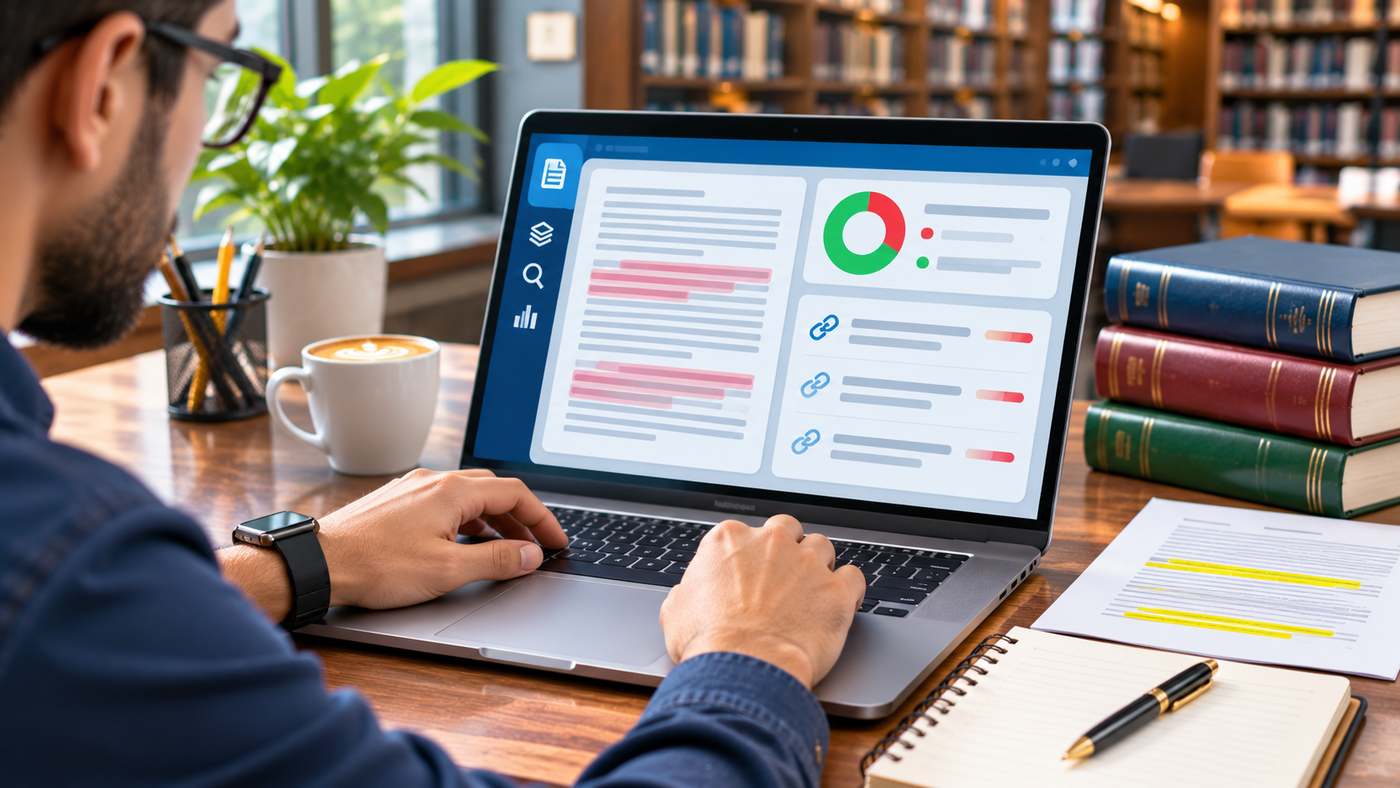
Original content plays an important role in academic writing, digital publishing, professional communication, and online business. Whether someone is preparing a university assignment, writing an SEO article, publishing a research paper, or reviewing business documents, checking for similarities with existing material can help maintain credibility and responsible writing practices.
A plagiarism checker is a digital tool designed to identify text that matches or closely resembles content available in its reference database. By highlighting potentially duplicated passages and identifying matching sources, it helps writers understand which parts of their documents require further review.
However, detecting similar text is not the same as proving plagiarism. Legitimate quotations, technical terminology, properly cited research, and common expressions can also appear in similarity reports.
Modern originality checking tools simplify document review by using automated comparisons, source identification, and reporting features. Platforms such as ZeroGPT provide web-based plagiarism detection alongside other writing assistance tools.
Understanding how these systems work and how to interpret their results is essential for making responsible decisions about originality.
This guide explains plagiarism detection technology, important features, practical benefits, common limitations, and seven effective ways to improve content quality while maintaining academic and professional integrity.
What Is a Plagiarism Checker?
A plagiarism checker is a software application that compares submitted writing against text available in its searchable sources.
The system identifies exact matches or certain types of similar wording and presents the results for review.
Depending on the tool, the comparison may involve publicly accessible websites, academic publications, previously indexed documents, or proprietary content databases.
Different platforms maintain different collections of material, which means the same document may receive different results depending on the service used.
How Does Plagiarism Detection Work?
Most modern plagiarism detection systems follow a structured process.
First, the user submits a document or copies text into an online interface.
The software processes the content and compares relevant passages with accessible sources.
When potential matches are identified, the tool highlights the corresponding text.
A report may then display source references, similarity percentages, and other information intended to help users examine the results.
Some platforms use additional text analysis methods to identify passages that may have been modified from previously published content.
However, detection capabilities vary, and no tool can guarantee that every instance of unattributed copying will be discovered.
Understanding Text Similarity
Text similarity describes how closely a passage resembles material from another source.
For example, two articles may contain an identical definition of a technical term.
A similarity checker might flag that definition even if it is properly quoted and referenced.
Likewise, a student may include a correctly cited quotation from an academic publication.
The quotation can appear in the similarity report because the wording matches the original source.
This does not automatically mean the student committed plagiarism.
The important distinction is between identifying matching language and evaluating whether that language has been used appropriately.
Why Is Plagiarism Checking Important?
Originality checking has several practical applications across education, publishing, and business communication.
Its value comes from helping people identify possible issues before distributing or submitting their work.
Supporting Academic Integrity
Students are expected to acknowledge the sources used in assignments, essays, dissertations, and research projects.
A similarity report can help identify passages that need quotation marks, citations, or clearer attribution.
However, institutional rules determine what constitutes acceptable academic practice.
Students should follow their university’s policies rather than relying solely on a software percentage.
Protecting Professional Credibility
Businesses regularly publish reports, website content, product descriptions, and promotional materials.
Unattributed copying can damage credibility and create disputes.
Reviewing material before publication helps editorial teams identify potential concerns.
This is particularly useful when content is prepared by freelancers, external agencies, or multiple contributors.
Improving Research Practices
Research-based writing often involves consulting numerous sources.
During drafting, writers can unintentionally reproduce language from reference material.
A similarity check helps identify passages that may need stronger attribution or more independent analysis.
Supporting Editorial Quality Control
Publishers may use automated content checks as one part of their editorial workflow.
The results can help editors investigate unusually similar passages.
Nevertheless, the final decision should involve human judgment and examination of the relevant sources.
7 Smart Ways to Use a Plagiarism Checker Effectively
Plagiarism detection software is most useful when it supports a broader writing and editing process.
The following seven approaches can help users interpret results responsibly and improve their content.
1. Check Content Before Final Submission or Publication
Reviewing originality before submitting a document gives writers an opportunity to identify potential problems.
For students, this may involve checking an assignment before the final deadline, where institutional policy permits the use of external tools.
For businesses, the check may occur during the editorial review stage.
Review Completed Drafts
A complete draft provides more meaningful context than a short fragment.
Checking individual sentences can sometimes produce misleading results because common expressions appear in many sources.
A complete document allows the reviewer to examine how matched passages are distributed throughout the text.
Preserve Earlier Versions
Keeping earlier drafts can help writers explain how a document developed.
Version histories may also provide useful evidence of original work.
This is especially relevant when academic or professional authorship is questioned.
Allow Time for Corrections
Originality review should not be the final action immediately before a deadline.
Writers may need time to locate sources, correct citations, or revise sections that rely too heavily on borrowed language.
Planning an appropriate review stage can improve final quality.
2. Understand Similarity Scores Correctly
Many plagiarism detection tools produce a percentage indicating how much submitted text matches sources in their databases.
This percentage is commonly called a similarity score.
It should not automatically be interpreted as the percentage of a document that has been plagiarized.
Why High Similarity Does Not Always Mean Plagiarism
A research paper may contain correctly formatted quotations, technical definitions, references, or standard terminology.
These elements can contribute to a higher similarity score.
An academic document with properly attributed quotations may therefore contain more matching text than a short opinion piece.
The context matters.
Why Low Similarity Does Not Guarantee Originality
A document can receive a low score while still containing unattributed ideas or copied material that the tool cannot access.
Some sources may not be included in the database.
A plagiarism checker may also fail to identify heavily modified copying.
Consequently, a low score should not be treated as definitive proof of ethical authorship.
Is There an Acceptable Similarity Percentage?
There is no universal percentage that applies to every assignment or publication.
A university may establish particular requirements for certain types of submissions.
A publisher may use different editorial standards.
Turnitin explicitly advises that similarity scores require contextual evaluation and should not independently determine whether plagiarism occurred.
The responsible approach is to examine the actual matches rather than attempt to achieve an arbitrary number.
3. Review Highlighted Passages and Original Sources
A useful similarity report should provide more than a single numerical result.
Source-level analysis helps writers understand why particular passages have been flagged.
Examine Each Significant Match
Start with longer or more distinctive matching passages.
Review whether the wording comes from a quotation, a standard definition, or material that may need better attribution.
Short matches involving ordinary expressions may have limited significance.
Compare Context
A matching sentence may have a different meaning when removed from its original context.
When possible, examine the original source to understand how the material was used.
This can help distinguish legitimate quotation from inappropriate copying.
Identify Missing Attribution
If a statement contains someone else’s original research, argument, or distinctive interpretation, attribution may be required even when the wording has been changed.
A text comparison tool cannot reliably evaluate every instance of uncredited ideas.
Writers should review sources based on meaning as well as language.
4. Improve Citations and Referencing Practices
Correct citation is fundamental to academic and professional writing.
A source should be acknowledged according to the relevant style guide or publication standard.
Understand Common Citation Styles
Different institutions and disciplines use different referencing formats.
Common examples include APA, MLA, Chicago, and Harvard.
Each has specific requirements for in-text citations, quotations, and reference lists.
Writers should follow the instructions established by their institution or publisher.
Use Quotation Marks Appropriately
When reproducing another author’s exact wording, use the required quotation format and citation.
Changing a few words while retaining the original sentence structure may not constitute adequate independent paraphrasing.
Paraphrase With Understanding
Effective paraphrasing involves understanding the source and explaining its meaning in genuinely new wording and structure.
A proper citation is still necessary when the underlying idea comes from another author.
Simply replacing words with synonyms does not eliminate the need for attribution.
Keep Research Notes Organized
Recording source details while researching can prevent problems during final editing.
Useful information includes the author, publication title, date, relevant page numbers, and source location.
Reference management software may help organize this information for larger projects.
5. Use a Plagiarism Checker to Improve SEO Content
Website owners and content marketers often publish substantial amounts of written material.
Blogs, category descriptions, service pages, and guest posts can unintentionally resemble content from competing websites.
Originality checking can help identify repeated wording before publication.
Review Blog Articles
When researching a topic, writers may consult competitor articles or industry publications.
It is important to transform that research into genuinely useful original content rather than simply reproducing another page.
A plagiarism checker can highlight some wording similarities that deserve review.
Evaluate Product Descriptions
E-commerce businesses sometimes use manufacturer-provided descriptions across many product listings.
Such descriptions may legitimately appear on multiple websites.
However, a business may benefit from writing additional original information that explains product characteristics, comparisons, and practical uses.
The goal is to provide useful value for shoppers rather than merely alter wording to achieve a different similarity score.
Understand Google’s Position on Originality
Google Search Central recommends helpful, reliable, people-first content that provides original information, analysis, or substantial value.
However, Google does not use a third-party plagiarism checker score as a universal ranking factor.
Passing an originality scan does not guarantee better rankings.
Likewise, all text similarity should not be treated as a search engine penalty.
SEO success depends on the usefulness, relevance, technical accessibility, and overall quality of a page.
Avoid Mechanical Rewriting
Replacing words solely to avoid detection can make content unnatural and less accurate.
A stronger approach involves adding original explanations, reliable examples, expert perspectives, and genuinely useful detail.
6. Protect Confidential Content Before Uploading
Online plagiarism detection requires submitting information to a service provider.
This creates privacy considerations, particularly for unpublished or confidential material.
Review Data Handling Policies
Before uploading a document, examine how the service processes submitted content.
Important questions include whether documents are retained, whether information is shared with service providers, and what deletion options are available.
Be Careful With Sensitive Documents
Legal agreements, confidential business records, unpublished research, and customer information may contain details that should not be shared with an unapproved platform.
Organizations should establish suitable policies for external document-processing tools.
Follow Institutional Requirements
Some universities prohibit uploading assignments or research material to certain third-party services.
Students should check their institution’s rules before using an external originality tool.
Understand ZeroGPT’s Privacy Information
ZeroGPT publishes a privacy policy explaining how user-submitted text and files are processed through its services, including plagiarism checking.
The policy describes processing user content to provide requested services and certain operational functions.
Users should examine the current privacy policy rather than assuming a document is never retained or processed beyond the visible scan.
7. Combine Automated Results With Human Editing
Plagiarism detection is useful, but it should not replace careful writing and editorial judgment.
A software tool can highlight matching text without fully understanding the author’s intentions or the complete research context.
Evaluate Writing Quality
Review whether the document explains concepts clearly and logically.
Originality is only one component of quality.
A document can contain no identified matches while still being inaccurate, repetitive, poorly organized, or unhelpful.
Confirm Factual Accuracy
Plagiarism checking does not verify whether statements are true.
A text can be original and still contain incorrect statistics, unsupported claims, or outdated information.
Fact-check important statements using reliable sources.
Review References Manually
A plagiarism checker may identify matching language, but it cannot guarantee that every citation is complete or accurate.
Authors should verify source details directly.
Make the Final Decision Carefully
A highlighted passage is an indication for review, not an automatic finding of misconduct.
Human evaluation helps distinguish acceptable source use from problems requiring correction.
How to Use ZeroGPT’s Plagiarism Checker
ZeroGPT offers a web-based originality checking tool that supports text submission and document comparison.
Its product page describes similarity reports, highlighted matches, multilingual capabilities, and downloadable PDF results.
Users seeking a plagiarism checker can examine ZeroGPT’s service to understand its available features and determine whether it suits their writing workflow.
Step 1: Open the Official Tool
Visit ZeroGPT’s plagiarism checker webpage.
The current page directs users toward account registration before accessing its scanning workflow.
Feature availability may depend on account status.
Step 2: Enter Text or Upload a Document
According to ZeroGPT’s FAQ, users can paste text or submit a supported file.
The exact upload limits and supported file formats should be confirmed through the current interface.
Clean, readable text generally provides a more dependable starting point for matching than poorly extracted document content.
Step 3: Start the Plagiarism Scan
Submit the document using the available scanning option.
ZeroGPT states that its system compares writing against online sources and its internal reference database.
The company advertises broad coverage, although its database size and detection accuracy have not been independently verified here.
Step 4: Examine the Similarity Report
Review highlighted passages and any available matching source information.
Identify sections that may require clarification, quotation marks, citation corrections, or more independent analysis.
Do not assume that every highlighted sentence represents misconduct.
Step 5: Download or Save Results
ZeroGPT advertises downloadable reports, including PDF output.
These can be useful for internal editorial records or documenting the review process.
However, a downloadable report is not a formal academic certification of originality.
Step 6: Revise and Review
Address genuine problems by improving attribution, correcting citations, and rewriting passages based on your own understanding.
After making changes, review the final document for accuracy and clarity.
Important Features of ZeroGPT’s Plagiarism Detection Tool
Different plagiarism detection platforms offer different capabilities.
ZeroGPT’s published information highlights several features intended for students, writers, and organizations.
Document Upload Support
Uploading a document can simplify checking longer assignments or articles.
Users should verify the allowed file formats and account restrictions.
Deep Search
ZeroGPT advertises a deep-search function intended to provide additional similarity analysis.
Its product description does not establish that this feature can access every private academic database.
Source Identification
Matching source information helps users investigate flagged passages.
The value of this feature depends on whether the relevant sources are accessible and correctly identified.
Similarity Percentage
The platform presents similarity percentages intended to summarize matched text.
These figures require interpretation.
A numerical score should not be treated as a legal or academic conclusion.
Multilingual Analysis
ZeroGPT advertises support for more than 190 languages.
Actual detection quality may differ between languages, writing styles, and document types.
Organizations working with multilingual content should test representative examples.
Downloadable Reports
PDF reporting may be useful for editorial quality control, internal audits, and communication between reviewers.
The report should be accompanied by appropriate human evaluation.
Plagiarism Checker vs. AI Content Detector
Plagiarism detection and AI-generated text detection are different processes.
Although some software providers offer both, the results answer different questions.
Plagiarism Detection
A plagiarism checker identifies text that matches or resembles material from accessible reference sources.
Its primary purpose is to support originality review and source attribution.
AI Content Detection
An AI content detector estimates whether text exhibits patterns associated with machine-generated writing.
These estimates are probabilistic and can produce false positives and false negatives.
A human-written passage may be classified incorrectly, and AI-generated text may not always be identified.
Can AI-Generated Writing Be Original?
AI-generated text can contain wording that does not match previously published content.
A plagiarism scan may therefore show limited similarity.
However, that does not establish factual accuracy, proper authorship disclosure, or compliance with academic and professional policies.
Can Human Writing Receive an AI Detection Flag?
Yes.
Automated AI detection is imperfect.
A detector’s assessment should not independently determine whether a student or employee used unauthorized tools.
Any significant decision requires a fair review of the available evidence and applicable rules.
Free vs. Paid Plagiarism Checking
Cost is an important factor when choosing writing software.
Some platforms provide limited free access, while others charge for higher usage, advanced analysis, or additional features.
Free Tools
Free access can be helpful for occasional content checks.
However, users should examine possible restrictions involving document length, scanning frequency, reports, and database coverage.
A service being free does not necessarily mean every capability is available without payment.
Paid Platforms
Paid plans may offer greater capacity, integrations, additional reporting, or team features.
ZeroGPT advertises free registration alongside paid personal, business, educational, and API-related plans.
Users should check the current pricing page to confirm which plagiarism checking functions and allowances are included.
What Matters More Than Price?
A useful plagiarism checker should provide reliable source references, understandable reports, and appropriate data protection.
The cheapest tool is not automatically the best choice.
Likewise, a high subscription price does not guarantee that every possible source can be detected.
How Students Can Avoid Accidental Plagiarism
Unintentional plagiarism may occur when students misunderstand citation rules or lose track of research sources.
Developing good writing habits can reduce these problems.
Take Notes in Your Own Words
When researching, record the meaning of a source rather than copying entire paragraphs without clear labels.
Separate direct quotations from personal notes.
Cite Sources While Drafting
Adding citations during the writing process reduces the risk of forgetting where information originated.
Distinguish Facts From Original Arguments
Some widely known facts may not require citation, depending on the context.
However, original research, distinctive interpretations, and specialized claims generally need appropriate attribution.
Use Quotations Selectively
Quotations are useful when an author’s exact words matter.
Excessive quotation can make an assignment less analytical.
Students should combine appropriately cited evidence with their own explanation.
Follow Academic Policies
Different institutions have different expectations for quotations, paraphrasing, collaboration, and AI assistance.
Understanding those rules is essential.
Plagiarism Checking for Businesses and Content Agencies
Businesses that publish large volumes of content often involve several writers and editors.
A structured originality workflow can help maintain quality.
Review Freelance Submissions
Content agencies may check submitted articles before publication.
A similarity report can help identify passages that require investigation.
Editors should consider the topic, citations, and source context before rejecting work.
Maintain Editorial Guidelines
Clear instructions can explain expectations for original research, quotation, attribution, and acceptable source use.
Writers should understand these standards before beginning an assignment.
Protect Brand Reputation
Publishing unattributed material can weaken trust.
Responsible quality control helps businesses maintain professional standards.
Create an Efficient Workflow
A practical review process may include initial drafting, factual verification, similarity checking, editorial revisions, and final approval.
Each stage addresses a different aspect of content quality.
Common Plagiarism Checking Mistakes to Avoid
Even experienced writers can misuse similarity detection tools.
Treating Every Match as Plagiarism
Common expressions and correctly cited quotations may appear as matches.
Review the surrounding context.
Trying to Achieve a Zero Similarity Score
A zero score is not required for every form of legitimate writing.
Academic research frequently contains properly attributed source material.
Rewriting Only to Reduce the Percentage
Changing words mechanically can damage accuracy and readability.
Improve the actual writing and citation practices instead.
Checking Only Short Fragments
Short passages may provide insufficient context.
Reviewing the complete document can produce more useful information.
Ignoring Source Attribution
Original wording does not eliminate the need to credit borrowed research or ideas.
Uploading Confidential Material Without Permission
Sensitive documents require appropriate privacy safeguards.
Assuming Detection Is Perfect
No plagiarism checker has access to every document ever written.
A clear report does not guarantee complete originality.
How to Choose the Best Plagiarism Checker for Your Needs
Different users have different priorities.
Students may need compatibility with institutional rules, while content teams may focus on convenient editorial workflows.
Consider Database Coverage
Ask which types of sources the tool can compare.
Public websites, academic journals, and private repositories are not necessarily covered equally.
Examine Report Quality
Useful reports should help reviewers locate and understand matches.
A single numerical score provides limited information.
Evaluate Privacy
Check how documents are processed, stored, and deleted.
This is particularly important for unpublished or confidential material.
Review Supported Languages
Multilingual writers should confirm that the service performs appropriately for their languages.
Compare Pricing and Limits
Review document length allowances, scanning frequency, reporting features, and any subscription requirements.
Test With Representative Documents
Where permitted, evaluate the tool using material similar to your normal work.
Compare the usefulness of its source identification and reporting rather than relying exclusively on promotional accuracy claims.
The Future of Plagiarism Detection Technology
Originality checking technology continues to evolve alongside digital publishing and artificial intelligence.
Future systems may improve the identification of paraphrased passages, multilingual similarities, and more complex forms of content reuse.
However, several challenges will remain.
Better Contextual Analysis
Newer systems may become more capable of distinguishing common language from potentially significant source similarities.
Human interpretation will still be necessary.
Multilingual Detection
Cross-language matching is an important research area because ideas can be copied or translated between languages.
Such detection is more complicated than identifying identical English sentences.
Integrated Writing Workflows
Originality checking may increasingly operate alongside citation tools, grammar review, and editorial software.
Integration can improve convenience, but each feature still requires appropriate verification.
Greater Focus on Data Protection
Users are becoming more conscious of how online services handle submitted documents.
Clear privacy practices and suitable institutional controls will remain important.
Continued Importance of Human Judgment
Technology can identify potential similarities, but deciding whether content has been used ethically requires an understanding of context, attribution, and relevant standards.
The strongest future systems will support responsible review rather than replace it.
Frequently Asked Questions
1. What does a plagiarism checker do?
A plagiarism checker compares submitted writing with accessible sources and highlights matching or similar text. The results help users review originality and citation practices.
2. Is ZeroGPT’s plagiarism checker free?
ZeroGPT advertises free account access and paid plans. The available plagiarism scanning features, document limits, and reporting allowances should be checked on its current website.
3. Does a 20% similarity score mean plagiarism?
Not necessarily. A similarity percentage indicates matching text, not confirmed plagiarism. Proper quotations, references, technical terms, and common phrases may contribute to the score.
4. Can a plagiarism checker detect all copied content?
No. Detection depends on the tool’s databases, matching technology, supported languages, and document quality. Human review and proper source attribution remain necessary.
Conclusion
A plagiarism checker is a valuable tool for students, researchers, content creators, and businesses that want to evaluate text similarity and improve writing integrity. It can highlight potentially duplicated passages, support citation review, and make editorial quality control more efficient.
However, originality cannot be determined by a percentage alone. By combining reliable detection tools with proper citations, independent research, factual verification, and thoughtful editing, writers can produce more trustworthy and useful content.
