
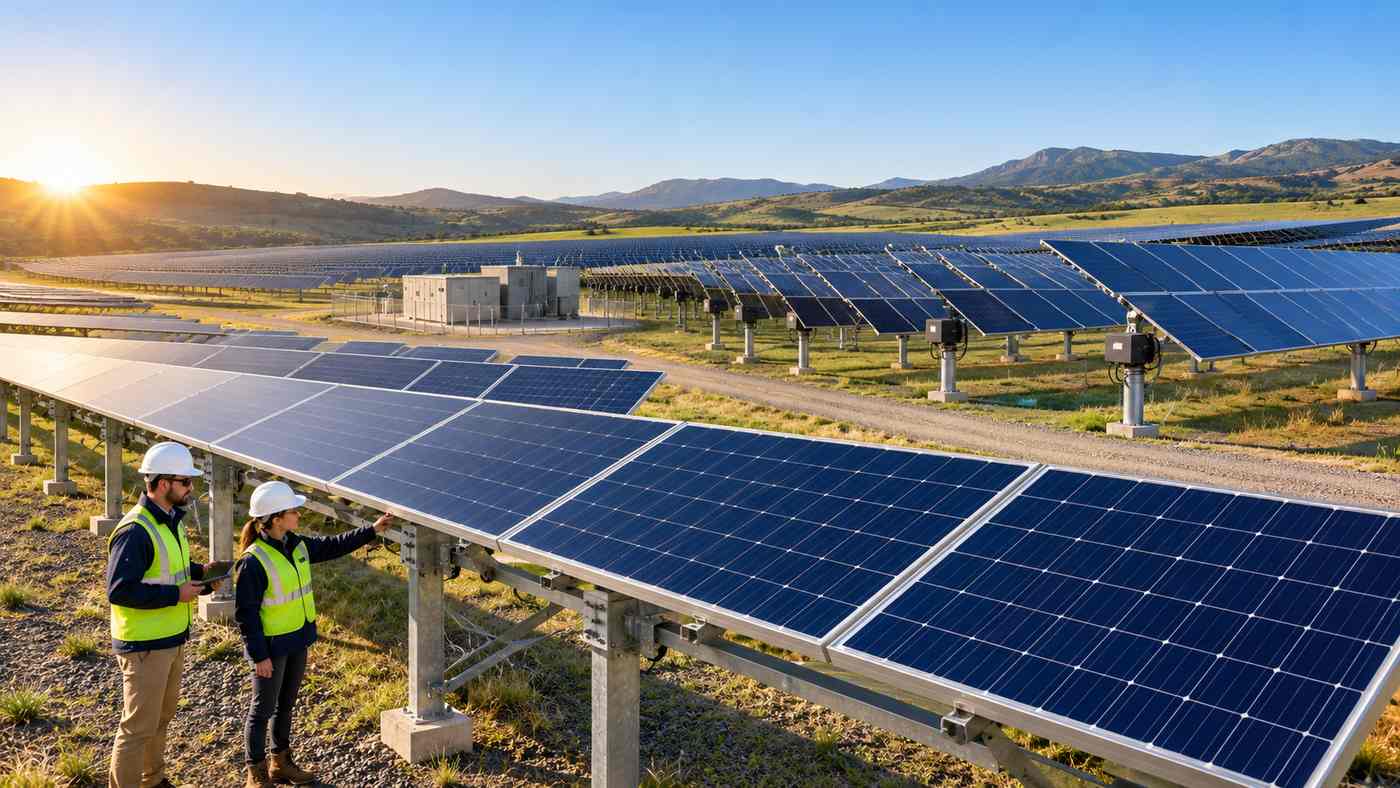
Solar energy has become an important part of global electricity infrastructure as governments, energy companies, and private investors expand renewable power generation. Large photovoltaic installations can produce electricity for thousands of homes and businesses, support energy diversification, and contribute to long-term sustainability objectives. As solar technology advances, the design and operation of these projects are becoming increasingly sophisticated.
Utility-scale solar refers to large photovoltaic power plants that generate electricity primarily for delivery into the electrical grid. These installations typically use extensive ground-mounted solar arrays, sophisticated electrical infrastructure, and engineered mounting systems designed for long-term operation.
Unlike residential rooftop installations, large solar farms require substantial site planning, structural engineering, electrical design, environmental assessment, and ongoing maintenance.
The selection of solar mounting structures is especially important because they influence installation costs, energy generation, system durability, and maintenance requirements.
Developers can choose between fixed-tilt mounting structures and solar tracking systems, each offering different advantages depending on location, terrain, climate, and financial objectives.
This guide explores the essential components of utility solar farms, seven important project planning strategies, Clenergy’s mounting technologies, and practical approaches to improving long-term solar investment performance.
What Is Utility-Scale Solar?
Utility-scale solar is the development of large photovoltaic installations designed to generate electricity at a scale suitable for utility networks or other major electricity users.
These projects typically occupy extensive areas of land and use thousands of interconnected photovoltaic modules.
The US Department of Energy generally describes large-scale solar projects as installations greater than 1 megawatt in capacity.
However, definitions can vary between jurisdictions, electricity markets, and reporting organisations.
How Utility Solar Farms Generate Electricity
Solar photovoltaic modules convert sunlight into direct-current electricity.
This electricity travels through cables and associated electrical equipment before reaching inverters.
Inverters convert direct current into alternating current suitable for integration with the electricity network.
Transformers and substations then help manage the voltage required for transmission or distribution.
The complete system must be designed to operate safely within applicable grid requirements.
Understanding Solar Farm Capacity
Solar plant capacity is commonly measured in megawatts.
One megawatt equals one million watts.
However, developers should distinguish between direct-current module capacity and alternating-current output capacity.
A project may be described using MWdc or MWac, depending on the context.
These measurements are not interchangeable.
For example, a solar farm containing 100 MWdc of photovoltaic modules may have a lower rated AC output because of inverter sizing and other design considerations.
Global Solar Market Growth in 2026
According to the International Energy Agency Photovoltaic Power Systems Programme’s September 2026 report, global cumulative photovoltaic capacity reached approximately 2.96 terawatts by the end of 2025.
Around 690 gigawatts of new PV capacity were installed during 2025, representing approximately 15% growth compared with the previous year.
China remained the largest market, followed by substantial additions in India, the United States, Germany, and other countries.
These figures demonstrate the significant role photovoltaic technology now plays in electricity infrastructure development.
Main Components of a Utility-Scale Solar Power Plant
A solar farm contains several interconnected systems that must operate together.
Photovoltaic Modules
Solar modules convert sunlight into electricity.
Modern projects commonly use high-efficiency crystalline silicon modules.
Bifacial modules have become increasingly important because they can capture additional light reaching the rear side of the module.
However, actual bifacial gains depend on ground reflectivity, mounting height, spacing, and environmental conditions.
Solar Mounting Structures
Mounting systems hold photovoltaic modules in the correct position.
They must withstand relevant environmental loads throughout the intended operating life.
Depending on the project, structures may use steel, aluminium, or other suitable materials.
Inverters and Electrical Equipment
Inverters convert DC electricity into AC electricity.
Additional equipment includes transformers, switchgear, cables, monitoring systems, and grid connection infrastructure.
The electrical design must satisfy applicable safety and interconnection requirements.
Monitoring and Control Systems
Large solar plants need reliable operational monitoring.
Supervisory Control and Data Acquisition, commonly called SCADA, can provide information about equipment performance, alarms, environmental conditions, and other operating parameters.
Energy Storage
Some utility solar projects include battery energy storage systems.
Storage can help shift electricity delivery to different periods, depending on the project’s configuration and market arrangements.
However, adding batteries increases capital requirements and creates additional operational responsibilities.
7 Smart Strategies for Designing Successful Utility-Scale Solar Projects
The long-term performance of a solar farm depends on multiple technical and commercial decisions.
The following seven strategies can help developers establish more reliable and financially sustainable projects.
1. Choose the Right Solar Farm Location
Site selection is one of the earliest and most important project decisions.
A location with strong sunlight may appear attractive, but solar resource alone does not determine whether a project is feasible.
Evaluate Solar Irradiance
Solar irradiance describes the amount of solar power reaching a surface.
Developers use historical weather information and solar resource models to estimate expected energy production.
Actual electricity generation depends on solar conditions, system design, temperature, shading, and equipment performance.
Examine Land Characteristics
Land slope, drainage, soil conditions, and existing land use can influence construction requirements.
A level site may simplify some installation activities.
However, appropriately engineered mounting structures can also accommodate more complex terrain.
Consider Grid Accessibility
A site located far from suitable transmission or distribution infrastructure may require substantial interconnection investment.
Developers should investigate network capacity, connection requirements, and potential upgrade costs early.
Review Environmental Constraints
Projects may need assessments covering biodiversity, water management, heritage considerations, agricultural use, and nearby communities.
Environmental requirements vary by jurisdiction.
Early engagement with relevant authorities and stakeholders can help identify potential constraints.
2. Select Between Fixed-Tilt and Solar Tracking Systems
The mounting system influences construction complexity, power generation, operating requirements, and long-term project economics.
Two common options are fixed-tilt structures and single-axis trackers.
Fixed-Tilt Solar Mounting
Fixed-tilt systems hold photovoltaic modules at a predetermined angle.
They have no routine motorised movement to follow the sun.
This can simplify mechanical design and reduce certain maintenance requirements.
Fixed-tilt systems may suit locations where straightforward construction and lower mechanical complexity are priorities.
However, their annual energy generation may be lower than a suitably designed tracking system under comparable conditions.
Single-Axis Solar Trackers
Single-axis trackers rotate photovoltaic modules along one axis to follow the sun’s movement during the day.
This can improve the amount of solar radiation collected throughout different periods.
Tracking systems may increase annual energy production, but their performance depends on project location, equipment design, weather, and operating conditions.
They also introduce motors, controllers, moving components, and maintenance requirements.
Understanding Tracker Energy Gains
Clenergy advertises potential generation improvements of up to 25% for its ezTracker D1P120 compared with a standard fixed-tilt arrangement.
This is a manufacturer-stated potential benefit rather than a guaranteed result for every installation.
Project-specific energy modelling should determine whether the additional electricity production justifies the associated costs.
Compare Lifetime Economics
The lowest initial equipment cost does not always provide the best long-term outcome.
Developers should examine projected production, capital expenditure, maintenance, reliability, and operating expenses.
The appropriate choice depends on the complete financial model.
3. Invest in Strong Structural Engineering
Solar mounting systems must remain stable under relevant environmental conditions.
A failure affecting thousands of modules can create significant repair costs and operational disruption.
Structural reliability should therefore be considered from the beginning.
Wind Load Assessment
Wind can create substantial pressure and uplift forces on photovoltaic arrays.
The effects depend on terrain, panel geometry, row positioning, and local weather conditions.
Wind tunnel testing can provide information about how particular structures behave under simulated wind conditions.
However, product testing must be evaluated against the actual project design and local standards.
Snow and Hail Protection
Some solar farms experience heavy snowfall, hail, or freezing conditions.
Appropriate structural and operational measures may be necessary.
Certain tracking systems provide protective operating positions during severe weather.
These features should be configured according to the manufacturer’s guidance and site-specific engineering assessments.
Soil and Foundation Design
The mounting structure transfers loads into the ground through foundations.
Foundation options may include driven piles, concrete foundations, or other engineered arrangements.
Geotechnical investigations help determine soil bearing capacity, corrosion exposure, and suitable installation methods.
Corrosion Resistance
Solar farms are intended to operate for extended periods.
Protective coatings and suitable materials help manage corrosion risks.
Material selection should consider environmental exposure, maintenance requirements, and relevant durability standards.
4. Optimise Panel Layout and Land Utilisation
The arrangement of modules affects the amount of electricity a solar farm can produce.
Developers must balance installed capacity, shading, access, maintenance, and site constraints.
Row Spacing
Solar panel rows require appropriate spacing to manage shading.
Rows placed too close together may shade neighbouring modules during certain periods.
However, excessive spacing can reduce the amount of capacity installed within the available land.
Engineering models help identify suitable compromises.
Ground Coverage Ratio
Ground Coverage Ratio describes the relationship between the photovoltaic array footprint and the land area occupied by the system.
It is an important design parameter for solar farms.
The optimal ratio depends on module dimensions, mounting configuration, tracking behaviour, and the site’s characteristics.
Bifacial Module Considerations
Bifacial modules can collect light reflected from the ground and surrounding surfaces.
Mounting height, surface reflectivity, row spacing, and structural shadows can influence the additional energy collected.
Bifacial gains should be estimated using suitable modelling assumptions.
Access and Maintenance Routes
Large solar farms need space for maintenance vehicles, electrical equipment, inspections, and emergency access.
These requirements should be considered during layout planning.
An arrangement that maximises panel density but restricts essential maintenance may create long-term operational problems.
5. Improve Installation Efficiency Through Mounting Design
Utility-scale construction involves extensive repetitive work.
A project may require thousands of foundations, support beams, fasteners, and photovoltaic modules.
Small improvements in installation processes can therefore have meaningful effects on labour requirements and construction schedules.
Prefabricated Components
Pre-assembled structures can reduce certain onsite assembly activities.
This may support more predictable installation processes.
However, benefits depend on transportation arrangements, equipment dimensions, and project conditions.
Simplified Fastening Systems
Mounting systems with appropriate positioning features and efficient clamps can reduce repetitive installation tasks.
Clenergy’s SolarTerrace Ikon product, for example, uses module positioning features, integrated earthing arrangements, and a simplified fastening approach.
These are manufacturer-described design features.
The actual installation benefit should be evaluated through project planning and qualified installation procedures.
Construction Quality Control
Efficient installation should never compromise structural or electrical safety.
Appropriate quality checks may include foundation inspections, fastener verification, alignment assessments, and electrical continuity testing.
Logistics and Material Availability
Large projects need coordinated deliveries and storage.
Poor logistics can delay construction even when the selected mounting system is technically suitable.
Developers should confirm manufacturing capacity, delivery schedules, packaging, and availability of replacement components.
6. Use Intelligent Monitoring and Control Systems
Monitoring is important because solar farms operate across large areas with numerous electrical and mechanical components.
Without appropriate visibility, faults may remain undetected and reduce production.
Real-Time Performance Monitoring
SCADA systems can collect relevant operating information from connected devices.
This may include tracker positions, weather conditions, alarms, and equipment status.
Operators can use this information to identify unusual activity.
Solar Tracker Control
Tracking systems use control algorithms to determine suitable module angles.
Some also use backtracking to reduce shading between rows.
Backtracking can improve performance where ordinary sun-following positions would create unwanted row-to-row shading.
Severe Weather Operating Modes
Modern tracker systems may include wind stow, snow stow, hail protection, or other predefined operating modes.
These functions move arrays into selected positions intended to reduce exposure to certain conditions.
However, effectiveness depends on accurate configuration and the equipment’s design limits.
Predictive Maintenance
Historical operating information can help identify recurring faults and equipment deterioration.
Maintenance teams may use trends to prioritize inspections.
However, predictive analytics should support rather than replace physical inspections and manufacturer-recommended maintenance.
7. Evaluate Long-Term Project Economics
A successful solar farm needs to perform reliably over its intended operating life.
Developers should evaluate more than initial installation expenses.
Levelised Cost of Electricity
Levelised Cost of Electricity, or LCOE, is a measure commonly used to compare electricity generation costs.
It considers relevant costs and expected electricity production over the project’s operating life.
A simplified expression is:
LCOE = Present Value of Lifetime Costs ÷ Present Value of Lifetime Electricity Generation.
The underlying model should account for suitable assumptions about financing, construction, operations, maintenance, and energy production.
Capital Expenditure
Capital costs may include modules, mounting systems, inverters, foundations, electrical equipment, land-related expenses, engineering, and construction.
The actual scope depends on the project.
Operating Expenditure
Operating expenses may include inspections, vegetation management, equipment maintenance, monitoring, insurance, and replacement activities.
Tracking systems may introduce additional mechanical maintenance requirements.
Financial Sensitivity Analysis
Solar projects are affected by uncertain variables.
Useful sensitivity analysis can examine changes in construction costs, energy yield, equipment availability, financing costs, and electricity revenue.
This helps investors understand potential risks rather than relying on a single optimistic forecast.
How Clenergy Supports Utility-Scale Solar Development
Clenergy is an international solar technology company founded in Melbourne, Australia, in 2007.
The company manufactures and supplies solar mounting products and related energy technologies.
Its utility-scale portfolio includes fixed-tilt ground structures, single-axis tracking systems, and monitoring technology.
Developers evaluating utility-scale solar infrastructure can explore Clenergy’s engineering, mounting, tracker, and project support solutions.
SolarTerrace Fixed-Tilt Systems
Clenergy’s SolarTerrace product family includes ground-mounted structures for different commercial and utility applications.
SolarTerrace Ikon incorporates features intended to simplify module positioning and installation.
The manufacturer also advertises compatibility with bifacial modules.
SolarTerrace 2 uses pre-assembled structural components and includes adjustment features intended to support installation in different conditions.
Product suitability should be established through current technical documentation and site-specific engineering.
ezTracker D1P120
The ezTracker D1P120 is a single-axis tracking system using a one-portrait module arrangement.
Clenergy describes features involving multiple coordinated drives, terrain adaptability, and intelligent control.
Its published specifications identify support for up to 120 modules per tracking row in suitable configurations.
Actual capacity depends on module selection and detailed design.
ezTracker D2P120
The ezTracker D2P120 uses a two-portrait configuration.
The manufacturer describes structural features including an octagonal torque tube, multi-drive design, and controls intended to support long-term operation.
It also advertises bifacial compatibility and potential applications involving agricultural land use.
The correct tracker selection should reflect project-specific engineering and operational requirements.
ezSCADA Monitoring Platform
Clenergy’s ezSCADA system is designed for monitoring solar tracking installations.
The platform offers map-based plant visualisation, equipment status monitoring, operational alarms, and historical data analysis.
According to the manufacturer, the system includes several operating modes for weather protection and other conditions.
These capabilities can help operators coordinate the management of large tracking installations.
Engineering and Delivery Support
Clenergy advertises assistance involving early project design, structural calculations, proposals, production documentation, logistics coordination, and onsite installation guidance.
The company also describes local support teams across several international markets.
Prospective customers should confirm the scope of services, product certifications, warranties, and commercial terms for their projects.
Examples of Clenergy Utility Solar Projects
The company’s published project portfolio includes installations across Asia and Europe.
Hungary – 20.1 MW Solar Project
Clenergy reports supplying its D1P tracking system for a 20.1 MW project in Gyöngyöshalász, Hungary, in 2025.
According to its case study, the project involved different wind exposure conditions and snow-load requirements.
The design incorporated site-specific structural considerations and tracking controls.
China – 430 MW Solar Project
Clenergy lists a 430 MW project in Weifang, Shandong, China, using its ezTracker D2P120 technology.
The installation demonstrates the application of its tracker product family to a large photovoltaic development.
Vietnam – 50 MW Solar Project
The company’s project portfolio also identifies a 50 MW installation in Hue, Vietnam, using D2P120 tracking technology.
These are manufacturer-published examples and should not be interpreted as independent guarantees of future performance.
Fixed-Tilt vs. Solar Tracking: Which Is Better?
Neither mounting approach is universally superior.
A fixed-tilt structure may offer advantages when developers prioritize mechanical simplicity.
Tracking systems may provide higher modeled annual energy production under suitable conditions.
However, tracker economics depend on installation costs, operating requirements, climate, solar resource, and expected electricity revenue.
A developer should compare alternatives using a consistent financial and engineering model.
Relevant considerations include expected output, structural requirements, maintenance complexity, land utilization, and project risk.
For some sites, the increased energy production from tracking may justify the additional investment.
For others, fixed-tilt structures may provide a more practical solution.
Environmental Considerations for Utility Solar Farms
Large photovoltaic developments can affect land use and local ecosystems.
Responsible planning should consider environmental conditions throughout the project lifecycle.
Land Use and Biodiversity
Developers may need to evaluate existing vegetation, wildlife habitats, drainage, and agricultural activity.
The appropriate response depends on local environmental requirements.
Agrivoltaics
Agrivoltaics involves combining agricultural activities with solar electricity generation.
Possible arrangements include certain crops, grazing, or other suitable land uses.
However, compatibility depends on mounting height, panel spacing, machinery access, and agricultural requirements.
Water Management
Construction and long-term operations can influence surface drainage and soil erosion.
Suitable planning can reduce these risks.
Equipment Recycling
Solar modules, inverters, and mounting structures have finite operating lives.
Project planning should consider future replacement, dismantling, and responsible material management.
The appropriate recycling process depends on local facilities and applicable regulations.
Common Mistakes to Avoid in Solar Farm Development
Even technically promising projects can experience difficulties when important issues are overlooked.
Choosing Land Without Assessing Grid Access
Strong sunlight does not guarantee affordable interconnection.
Transmission and connection constraints should be investigated early.
Selecting Mounting Systems Based Only on Price
A low initial purchase price may not reflect structural durability or long-term maintenance costs.
Underestimating Soil Conditions
Unsuitable foundation assumptions can create delays and additional engineering requirements.
Overestimating Tracker Yield
Advertised performance improvements should not replace project-specific energy simulation.
Ignoring Extreme Weather
Wind, snow, hail, flooding, and other hazards require appropriate design consideration.
Neglecting Operations and Maintenance
Long-term plant performance depends on inspections, monitoring, repairs, and equipment management.
Using Unrealistic Financial Assumptions
A project should account for uncertainty involving costs, electricity production, financing, and market conditions.
The Future of Utility-Scale Solar in 2026 and Beyond
Solar electricity infrastructure continues to evolve.
Advances in photovoltaic modules, mounting systems, operational controls, and storage technologies are changing how large projects are designed.
Growing Adoption of Bifacial Modules
Bifacial technology can increase energy capture by using light reaching both module surfaces.
The benefit depends on project design and environmental conditions.
Smarter Tracking Technology
New tracker systems incorporate advanced control algorithms and monitoring capabilities.
These may help operators manage energy production and respond to weather conditions.
Integration With Battery Storage
Storage can create additional operational flexibility by shifting electricity delivery between periods.
Its value depends on electricity markets, system costs, and project requirements.
More Attention to Structural Resilience
Solar developers are placing greater emphasis on engineering for severe weather and long-term equipment durability.
Improved Monitoring and Analytics
Data-driven operations can help maintenance teams identify faults and evaluate performance.
However, the effectiveness of monitoring depends on reliable sensors, accurate information, and appropriate operational procedures.
Frequently Asked Questions
1. What is utility-scale solar?
Utility-scale solar refers to large photovoltaic power plants that generate electricity primarily for the grid. Projects generally involve extensive solar arrays, mounting structures, inverters, and grid connection equipment.
2. Are solar trackers better than fixed-tilt systems?
Solar trackers can increase energy generation in suitable conditions, but they also involve additional equipment and maintenance. The best option depends on the site’s design, climate, and financial model.
3. What mounting systems does Clenergy offer for solar farms?
Clenergy offers fixed-tilt ground-mount solutions such as SolarTerrace and tracking systems including ezTracker D1P120 and D2P120, alongside its ezSCADA monitoring platform.
4. What affects the cost of a utility-scale solar project?
Project costs depend on land conditions, solar modules, mounting systems, foundations, electrical infrastructure, grid connections, construction, financing, and long-term maintenance requirements.
Conclusion
Utility-scale solar is playing an increasingly important role in expanding renewable electricity generation worldwide. Successful projects require careful coordination of site selection, mounting technology, structural design, electrical infrastructure, and long-term operations.
Fixed-tilt structures and intelligent tracking systems offer different advantages, making project-specific engineering and financial analysis essential. By prioritizing reliability, energy yield, efficient installation, and realistic lifecycle costs, developers can build solar farms that support sustainable energy production and long-term investment performance.
