
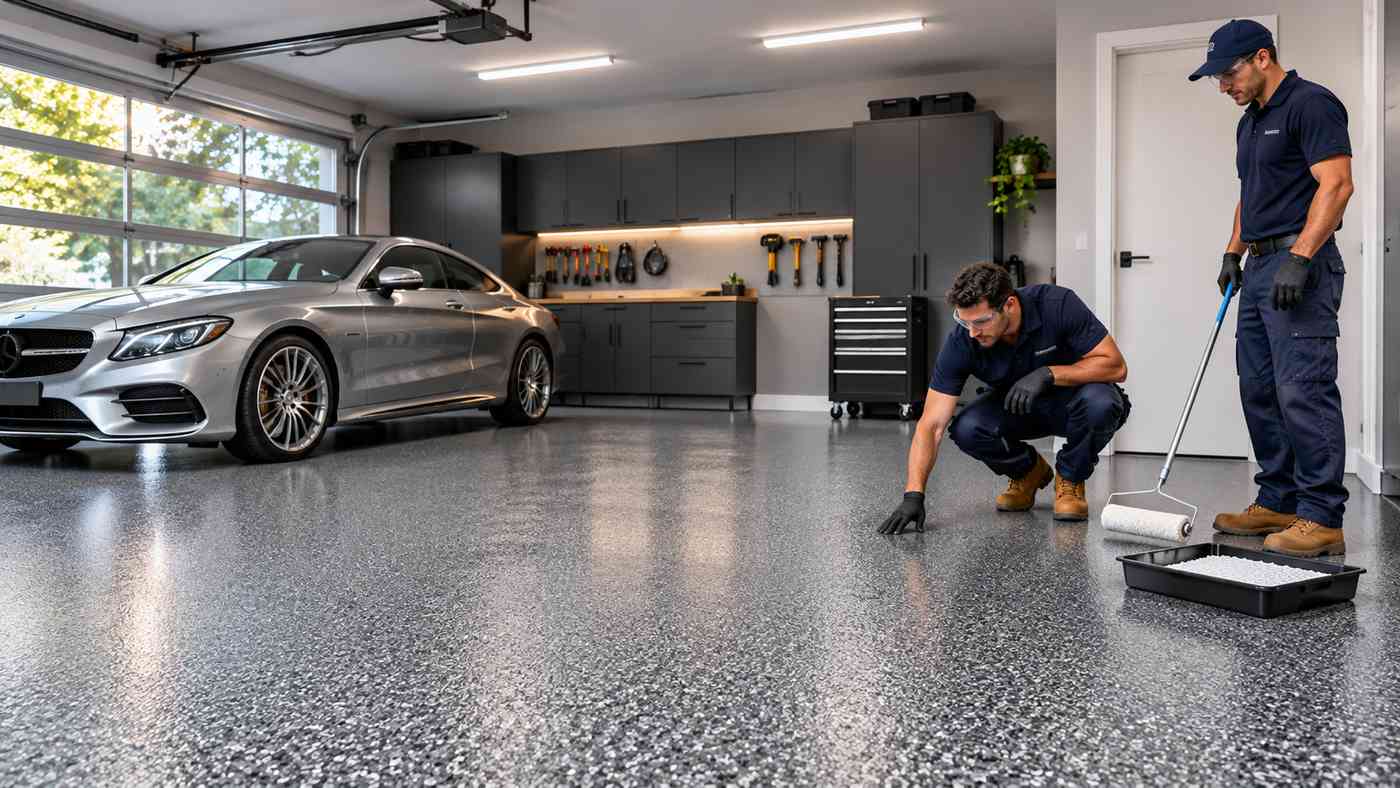
A garage is no longer just a place to park vehicles or store household equipment. Many homeowners now use their garages as workshops, home gyms, hobby areas, and practical extensions of their living spaces. However, an unfinished concrete floor can make even a well-organized garage feel dusty, outdated, and difficult to maintain.
A professionally installed epoxy garage floor coating can transform ordinary concrete into an attractive, durable, and easier-to-clean surface. With the right preparation and coating system, homeowners can improve the appearance of their garages while providing additional protection against everyday wear, oil spills, moisture exposure, and vehicle traffic.
Modern garage flooring systems offer a wide selection of colors, textures, decorative flakes, and finishing options. Some designs create a smooth, contemporary appearance, while others use multicolored flakes to add visual depth and help conceal minor dirt.
However, selecting a coating involves more than choosing an attractive finish. Concrete condition, surface moisture, preparation techniques, coating chemistry, curing requirements, and installation quality all influence long-term performance.
A coating that looks excellent immediately after installation may experience peeling, discoloration, or premature wear if the underlying concrete was not prepared correctly.
This guide explains how epoxy garage flooring works, seven important factors to consider, common installation methods, differences between epoxy and polyaspartic coatings, maintenance requirements, and practical ways to choose a reliable flooring contractor.
What Is Epoxy Garage Floor Coating?
Epoxy garage floor coating is a protective flooring system created by applying an epoxy-based resin to a properly prepared concrete surface.
Many professional epoxy systems contain two components: a resin and a hardener.
When mixed according to the manufacturer’s instructions, these materials undergo a chemical reaction that forms a hardened coating.
The finished surface can provide additional resistance to abrasion, certain chemicals, and everyday garage activities.
However, actual performance depends on the formulation, coating thickness, concrete preparation, and intended use.
How Does Epoxy Flooring Work?
A typical installation begins with cleaning and preparing the concrete.
The surface must be suitable for adhesion.
After preparation, the installer applies the selected coating system.
Depending on the design, the process may involve a primer, epoxy base coat, decorative flakes, and a protective topcoat.
Some systems combine epoxy with polyurethane or polyaspartic finishing products.
These additional layers can influence appearance, weathering resistance, chemical resistance, and maintenance requirements.
Is Epoxy Flooring the Same as Garage Floor Paint?
No.
Ordinary concrete floor paint generally forms a relatively thin decorative film.
A two-component epoxy flooring system undergoes a chemical curing process that creates a different type of protective coating.
However, not every product marketed as epoxy flooring has identical performance characteristics.
Some consumer products contain epoxy-modified paint formulations rather than the same chemistry used in professional resin flooring systems.
Check the technical data sheet before comparing products.
Where Can Epoxy Coatings Be Used?
Suitable systems can be used in residential garages, workshops, storage spaces, showrooms, and selected commercial environments.
Some specialist coatings are designed for more demanding industrial conditions.
The appropriate product depends on exposure to traffic, chemicals, temperature changes, moisture, and other operating requirements.
Benefits of Epoxy Garage Flooring
Garage floor coatings offer practical and aesthetic advantages when the materials and installation methods are appropriate.
Improved Floor Appearance
An unfinished concrete slab may contain stains, discoloration, minor surface imperfections, and uneven color.
A decorative coating can create a more consistent appearance.
Homeowners can choose from different colors and selected surface textures.
Easier Routine Cleaning
A properly installed, relatively seamless coating can reduce the number of surface pores and crevices where dirt accumulates.
Dust, ordinary debris, and many spills may be easier to remove than from untreated porous concrete.
However, cleaning procedures must remain compatible with the coating.
Resistance to Everyday Garage Wear
Appropriate resin systems can withstand routine vehicle traffic and other expected activities.
Actual resistance to scratching, impact, and chemicals depends on the selected system.
Heavy equipment or sharp objects can still damage the finish.
Decorative Flexibility
Epoxy coatings are available in various solid colors and decorative systems.
Flake finishes can create a visually textured appearance that complements modern garage interiors.
Additional Concrete Protection
A suitable coating can reduce direct exposure of the concrete surface to some common contaminants.
However, epoxy is not a substitute for repairing structural concrete damage or correcting significant moisture problems.
Customizable Slip Resistance
Certain systems incorporate decorative aggregates or other texture-producing materials.
These can improve traction under specified conditions.
Nevertheless, no coating should be assumed to be slip-proof, particularly when wet or contaminated with oil.
7 Proven Tips for Choosing and Installing Epoxy Garage Floor Coating
The long-term success of a garage flooring project depends on thoughtful product selection and installation.
These seven factors should be evaluated before beginning work.
1. Inspect the Existing Concrete Before Choosing a Coating
The condition of the concrete determines whether a coating can be installed successfully.
Even a premium resin system may fail if applied over an unsuitable substrate.
Look for Cracks and Surface Damage
Inspect the floor for visible cracks, spalling, loose concrete, and damaged areas.
Some minor defects can be repaired with suitable materials before coating.
However, cracks caused by continuing structural movement may require specialist assessment.
Simply covering a moving crack with rigid epoxy does not eliminate the underlying problem.
Check for Oil and Chemical Contamination
Garage floors often contain oil, grease, automotive fluids, and other contaminants.
These materials may interfere with adhesion.
The surface must be cleaned using suitable methods and products.
Severe contamination may require additional preparation or localized concrete treatment.
Evaluate Concrete Moisture
Moisture is one of the most important considerations.
Water vapor moving through a concrete slab can affect coating adhesion and contribute to blistering or delamination.
A contractor may use appropriate moisture assessment methods based on the proposed system.
ASTM F2170 addresses in-situ relative humidity testing of concrete slabs, while other methods may be suitable for particular applications.
The acceptance criteria should come from the coating manufacturer’s specifications.
Consider Previous Coatings
An existing painted or coated floor requires additional evaluation.
Loose or incompatible coatings may need removal.
Applying a new product over an unknown surface without appropriate testing can cause adhesion problems.
Understand New Concrete Requirements
New concrete needs suitable curing and moisture evaluation before coating.
Many products specify minimum curing periods and acceptable substrate conditions.
Do not assume that every slab is ready exactly 28 or 30 days after placement.
Actual readiness depends on the concrete, environment, and chosen coating system.
2. Choose the Right Epoxy Flooring System
Different garage coating technologies offer different advantages.
Understanding the options helps homeowners select a finish that matches their expectations.
Solid-Color Epoxy
Solid-color coatings create a relatively uniform appearance.
They may be suitable for homeowners seeking a clean, contemporary design.
However, a plain glossy floor can make dust, scratches, and imperfections more visible.
Decorative Flake Epoxy Flooring
Flake flooring uses colored decorative chips broadcast into a resin base coat.
A protective topcoat then seals the finish.
Flakes can provide visual variation and help disguise minor debris.
The selected texture and coating formulation determine how the finished surface performs.
Metallic Epoxy
Metallic epoxy systems create decorative patterns using specialized pigments.
They can produce dramatic visual effects.
However, the final pattern is influenced by application techniques and cannot always be reproduced exactly.
Metallic finishes may be better suited to decorative interiors than to garages where traction and heavy-duty utility are the main priorities.
Epoxy With a Polyaspartic Topcoat
Some premium garage flooring systems combine epoxy with a polyaspartic protective layer.
The epoxy provides the underlying coating, while the topcoat contributes its own performance characteristics.
Depending on formulation, polyaspartic products can offer improved ultraviolet resistance and relatively fast curing.
However, product selection and installation must follow the manufacturer’s technical requirements.
Polyurethane Finishes
Selected polyurethane coatings may also be used in flooring systems.
Different polyurethane products offer different flexibility, chemical resistance, and weathering characteristics.
The correct option depends on the exposure conditions.
Compare the Complete System
A product should not be judged solely by its label.
Ask what is included in the complete flooring system, including surface preparation, base coat, decorative materials, topcoat, and any moisture mitigation treatment.
3. Prioritize Professional Concrete Surface Preparation
Surface preparation is one of the most important stages of an epoxy installation.
Sherwin-Williams emphasizes that a concrete substrate should be sound, clean, suitably dry, and free of contaminants before receiving a bonded coating.
Diamond Grinding
Professional installers often use diamond grinding equipment to prepare concrete.
Grinding can remove surface contaminants and create a profile suitable for the selected coating.
The required profile depends on coating thickness and manufacturer specifications.
Mechanical Surface Preparation
Other projects may require shot blasting or specialized mechanical preparation.
The correct method depends on substrate condition and the coating system.
Repair Cracks and Holes
Appropriate repair products may be used to address localized defects.
Repairs should be compatible with the coating and its expected movement.
Movement joints should be handled according to the flooring design rather than indiscriminately filled with rigid resin.
Remove Dust Thoroughly
Grinding and other preparation methods can produce significant dust.
Before coating, the floor must be cleaned properly.
Residual dust can interfere with adhesion.
Control Silica Exposure
Concrete grinding can generate hazardous respirable crystalline silica.
OSHA identifies wet methods and suitable vacuum dust collection systems as important exposure controls.
Professional contractors should use appropriate equipment, training, and required protective measures.
Homeowners should not attempt extensive dry concrete grinding without understanding these serious health risks.
Why Surface Preparation Affects Durability
A coating depends on the bond between the resin and concrete.
When the substrate is contaminated, weak, or unsuitable, the entire flooring system may experience problems.
Good preparation is therefore more valuable than applying an expensive coating over a poorly prepared surface.
4. Select an Appropriate Texture and Decorative Finish
The appearance of garage flooring should complement its practical function.
A surface that looks beautiful in photographs may be unsuitable when it becomes wet or is used for mechanical work.
Consider Slip Resistance
Highly polished surfaces can become slippery under certain conditions.
Installers may add compatible texture-forming aggregates or select decorative systems that provide appropriate traction.
However, increasing surface texture can make cleaning more demanding.
The ideal balance depends on the garage’s use.
Choose Practical Colors
Light colors can make a garage feel brighter.
Dark colors may complement modern cabinetry and automotive displays.
Gray and blended flake systems are popular options because they provide a versatile appearance.
The best choice depends on lighting, vehicle colors, furniture, and personal preference.
Understand Decorative Flake Coverage
Some flooring systems use lightly scattered flakes.
Others apply a full broadcast that covers the visible base coat.
The appearance and material requirements can differ substantially.
Choose a Suitable Sheen
Glossy finishes can reflect light and create a polished appearance.
Matte or satin systems may provide a more understated look.
The available sheen depends on the coating chemistry and product range.
Request Physical Samples
Computer screens do not always represent coating colors accurately.
Viewing physical samples under relevant lighting can help establish realistic expectations.
5. Plan Installation and Curing Conditions Carefully
A garage floor coating project involves chemical application and curing.
Temperature, humidity, substrate condition, and ventilation influence the process.
Understand Pot Life
Two-component coatings have a limited usable time after mixing.
This is commonly called pot life.
Once the chemical reaction begins, the installer must work within the product’s specified application window.
Check Temperature Requirements
Many coating products have minimum and maximum application temperatures.
Applying a material outside those conditions can affect curing and appearance.
Consider Humidity and Condensation
Moisture in the air can influence certain coating systems.
Surface temperature relative to the dew point may also matter.
Professional installers should review the conditions specified in the technical data sheet.
Allow Adequate Curing Time
Curing time varies by formulation.
Some products permit foot traffic relatively quickly, while other systems require several days before exposure to vehicle traffic or chemicals.
A floor being dry to the touch does not necessarily mean it has achieved full mechanical or chemical resistance.
Follow Reopening Instructions
Homeowners should not park vehicles on the floor until the installer confirms it is ready.
Premature traffic can damage the coating.
Maintain Safe Ventilation
Certain products contain substances that can irritate the skin, eyes, or respiratory system before curing.
The Safety Data Sheet should guide ventilation, handling, and protective equipment.
Never assume that a low-odor product is automatically harmless.
6. Compare Long-Term Durability and Maintenance Requirements
A garage floor should be evaluated according to its expected service conditions.
A lightly used residential garage has different requirements from a commercial workshop.
Vehicle Traffic
Ordinary passenger vehicles create different wear conditions from heavier equipment.
The coating must be specified for the expected traffic.
Hot-Tire Performance
Tires can become warm during driving and place stress on certain coatings.
Improper preparation or unsuitable coating systems may contribute to peeling or tire-related marks.
Some professional flooring products are formulated for improved resistance.
However, resistance is not a promise that damage can never occur.
Chemical Exposure
Garage floors may encounter engine oil, gasoline, brake fluid, cleaning products, and other materials.
Chemical resistance varies by formulation and exposure duration.
Always check the manufacturer’s resistance information.
Spills should be cleaned promptly.
Ultraviolet Exposure
Traditional epoxy coatings can discolor or turn amber after prolonged ultraviolet exposure.
This is particularly relevant near open garage doors or areas exposed to strong sunlight.
Suitable UV-resistant topcoats may help manage this concern.
Scratching and Impact
Sharp tools, dragged metal objects, heavy equipment, and dropped components may damage the surface.
Protective pads or suitable work areas can reduce unnecessary wear.
Cleaning Requirements
Routine cleaning may include sweeping, vacuuming, and mopping with compatible products.
Avoid assuming that every industrial cleaner is suitable.
7. Choose a Qualified Garage Flooring Contractor
Professional installation can be valuable because preparation and material handling require specialized knowledge.
However, contractor quality varies.
Review Relevant Project Experience
Ask to see completed garage flooring projects.
Look for examples involving similar concrete conditions and the type of finish you want.
Understand the Proposed System
A contractor should explain the preparation methods and products to be used.
Ask whether the proposed finish includes epoxy, polyaspartic, polyurethane, decorative flakes, or a combination.
Discuss Moisture Testing
A reliable proposal should address the condition of the slab.
Ask how moisture will be assessed and what happens if the floor does not meet the coating requirements.
Review Safety Procedures
The installation may involve concrete grinding, chemical mixing, and ventilation requirements.
Contractors should use appropriate safety equipment and follow relevant regulations.
Request a Detailed Quotation
The quotation should clearly describe preparation, repairs, coating layers, finish, schedule, and exclusions.
Understand Warranty Coverage
Some providers advertise multi-year warranties.
However, warranty terms may exclude certain forms of misuse, structural movement, moisture-related problems, or other circumstances.
Read the actual conditions before making a decision.
Compare Value Rather Than Price Alone
A cheaper installation may exclude important preparation work.
Comparing complete systems provides a more useful assessment than comparing headline prices.
How Urban Concrete Floors Approaches Garage Coating Systems
Homeowners researching professional epoxy garage floor coating options can explore the finishes offered by Urban Concrete Floors, a concrete flooring specialist based in Melbourne, Australia.
The company offers decorative concrete finishes for residential, commercial, and industrial environments.
Its catalog includes polished concrete, decorative overlays, industrial coatings, and an epoxy-flake flooring system known as Urban Stone.
Urban Stone Decorative Flake Flooring
Urban Stone combines an epoxy resin base coat with decorative flakes and a polyaspartic finishing layer.
The company’s published technical material describes a multistep installation process intended to create a durable, easy-to-maintain surface.
The decorative flakes provide color variation and help conceal minor surface debris.
Polyaspartic Protective Finish
Urban Concrete Floors describes using a polyaspartic topcoat for improved weathering performance and protection.
The company advertises resistance to common garage contaminants, including oil and petrol.
These properties depend on the installed system and operating conditions.
Concrete Preparation
The company emphasizes surface preparation, including diamond grinding and relevant repairs.
This is consistent with broader industry guidance that emphasizes concrete condition before coating application.
Available Applications
The company’s finishes are promoted for garages, workshops, home gyms, selected commercial environments, and other suitable areas.
Warranty Information
Urban Concrete Floors advertises a 12-year warranty for its qualifying garage flooring system.
However, prospective customers should obtain the written warranty and understand its conditions.
Choosing the Right Finish
Urban Concrete Floors is an Australian contractor, but the broader principles behind its resin flooring systems are relevant to homeowners internationally.
Those outside its service area should seek appropriately qualified local installers using suitable materials.
Epoxy vs. Polyaspartic Garage Floor Coating
Epoxy and polyaspartic products are both used in resin flooring systems.
However, their chemistry and operating characteristics differ.
Epoxy Coatings
Epoxy systems can provide a strong bonded surface when correctly installed.
They are used across residential, commercial, and industrial environments.
Depending on the formulation, curing may require substantial time.
Traditional epoxies can also discolor under ultraviolet light.
Polyaspartic Coatings
Some polyaspartic systems cure relatively quickly and offer improved UV and weathering performance.
They may be used as stand-alone coating systems or as part of a multilayer installation.
However, their application windows can be short, and some products require experienced installers.
Which Should You Choose?
A garage used mainly for parking may have different requirements from a workshop where chemicals and heavy equipment are common.
The best system depends on the concrete condition, environmental exposure, desired appearance, and maintenance expectations.
In many cases, a hybrid system combines the advantages of different coating technologies.
How Much Does Epoxy Garage Floor Coating Cost?
Garage flooring costs vary according to location, garage size, concrete condition, selected materials, and installation complexity.
There is no universal price per square foot that accurately represents every project.
Garage Size
Larger floors require more materials and installation work.
However, the price per square foot may change with the total project size.
Surface Preparation
A relatively sound concrete floor may require less repair work than a damaged slab.
Grinding, coating removal, crack repair, and moisture mitigation can affect the quotation.
Coating Type
Basic single-color systems may have different material and labor requirements from full-flake multilayer coatings.
Polyaspartic topcoats and specialized finishes may affect the cost.
Decorative Options
Custom colors, additional texture, and specialty finishes can increase material or labor requirements.
Labor and Location
Contractor pricing varies by region.
A realistic estimate should reflect the local market and actual project conditions.
Sample Budget Comparison
Consider a hypothetical two-car garage measuring approximately 400 square feet.
A contractor would inspect the slab, determine the preparation required, select the coating system, and calculate labor and materials.
A basic coating and a professionally installed multilayer flake system would typically involve different scopes of work.
Rather than relying on a generic price estimate, request at least two or three quotations based on the same specifications.
This provides a more meaningful comparison.
DIY vs. Professional Epoxy Garage Flooring
Some homeowners choose to apply epoxy using consumer flooring kits.
Others prefer professional installation.
Both approaches have advantages and limitations.
DIY Installation
A DIY project may reduce labor expenses.
However, homeowners need to understand cleaning, substrate preparation, moisture testing, mixing ratios, application timing, and safety precautions.
Mistakes can be costly to correct.
Concrete grinding and chemical handling may also create significant hazards.
Professional Installation
Professional contractors generally have access to specialized equipment and experience.
They may be better equipped to assess difficult substrates and install more complex coating systems.
However, results still depend on the contractor and the agreed scope.
When Professional Help Is Especially Important
Consider professional assessment when the garage has persistent moisture, substantial cracking, a failing previous coating, or unusual chemical and traffic requirements.
These conditions can make installation more complicated.
How to Maintain an Epoxy Garage Floor
Appropriate maintenance helps preserve the appearance and functionality of a coated floor.
Sweep Regularly
Remove loose dirt and abrasive debris.
This can reduce unnecessary scratching.
Clean Spills Promptly
Oil, fuel, and other automotive fluids should be cleaned according to the coating manufacturer’s guidance.
Do not assume that chemical resistance means spills can remain indefinitely.
Use Compatible Cleaning Products
A mild, suitable cleaning solution may be sufficient for routine maintenance.
Avoid harsh chemicals unless specifically approved.
Protect Against Mechanical Damage
Use suitable protection when moving heavy objects or equipment.
Avoid dragging sharp metal across the surface.
Inspect Periodically
Check for unusual peeling, cracks, or damaged areas.
Early inspection may help identify a localized problem before it becomes more extensive.
Follow the Installer’s Care Instructions
Different products require different cleaning methods.
The technical documentation for the actual coating should take priority over generic advice.
Common Epoxy Garage Floor Problems and How to Avoid Them
Even well-designed systems can experience problems.
Understanding the possible causes helps homeowners ask better questions.
Peeling or Delamination
Poor surface preparation, contamination, moisture, or incompatible materials can contribute to adhesion failure.
A professional assessment should identify the cause before repairs are attempted.
Bubbles or Blisters
Moisture, trapped air, application conditions, and product-related factors may contribute to bubbling.
The correct solution depends on the cause.
Yellowing
Traditional epoxy can yellow when exposed to sunlight.
Selecting appropriate UV-resistant materials can help reduce this issue.
Scratches
Sharp objects and abrasive debris may damage the coating.
Routine cleaning and careful handling can reduce unnecessary wear.
Slippery Surfaces
Smooth coatings can become slippery when wet or contaminated.
A suitable texture should be considered during product selection.
Uneven Appearance
Incorrect mixing, application inconsistencies, or substrate problems may affect the finish.
Experienced installation and controlled working conditions can reduce these risks.
How Long Does Epoxy Garage Flooring Last?
There is no guaranteed lifespan applicable to every epoxy coating.
Service life depends on the complete system, installation quality, concrete condition, traffic, chemical exposure, and maintenance.
A lightly used residential garage may experience different wear from a busy workshop.
Some professional contractors offer warranties lasting several years, but warranty duration should not be confused with guaranteed service life.
Homeowners should focus on the actual system specifications and realistic operating conditions.
Garage Flooring Trends to Consider in 2026
Several design and technical approaches continue to influence modern garage flooring.
Decorative Flake Finishes
Multicolored flake systems remain a practical option for homeowners seeking visual texture and an easy-to-maintain appearance.
Satin and Matte Looks
Not every homeowner wants a highly reflective floor.
Subtle sheen levels can complement contemporary garage design.
Hybrid Resin Systems
Combining epoxy base layers with compatible protective topcoats allows contractors to tailor systems to different requirements.
Improved Surface Texture
Slip resistance is increasingly considered alongside appearance.
The selected texture should reflect how the garage will be used.
Integrated Garage Design
Flooring is often selected together with cabinetry, wall storage, lighting, and workshop equipment.
Coordinated materials can make the garage feel more organized and functional.
Frequently Asked Questions
1. Is epoxy garage floor coating worth it?
Epoxy garage floor coating can be worthwhile for homeowners who want a more attractive, easier-to-clean and potentially more durable concrete surface. Results depend on installation quality and the selected system.
2. How long does epoxy garage floor coating take to cure?
Curing times vary by product, temperature, humidity, and coating thickness. Some systems allow light traffic relatively quickly, while others require several days before vehicle use.
3. Is epoxy flooring slippery when wet?
A smooth epoxy floor can become slippery when wet. Suitable textures or compatible anti-slip aggregates can improve traction, but no flooring system is completely slip-proof.
4. Is epoxy or polyaspartic better for garage floors?
Both can be suitable. Epoxy provides useful coating properties, while selected polyaspartic products offer faster curing and better UV resistance. The ideal choice depends on the full flooring system and garage conditions.
Conclusion
Epoxy garage floor coating can transform an unfinished concrete garage into a cleaner, more attractive, and practical space. However, durability depends on the concrete condition, correct preparation, suitable materials, and careful installation.
Decorative flake systems, UV-resistant topcoats, and appropriate surface textures provide options for different design and performance requirements.
By understanding the available finishes and choosing a qualified contractor, homeowners can make informed decisions and enjoy a garage floor designed for long-term use.
