
Most UK universities allow AI tools like ChatGPT only if your assessment guide clearly gives permission. If you use AI without permission or do not tell your university, it can be treated as academic dishonesty (cheating). To know if you can use AI for your essay or dissertation, you must check your university’s AI policy and ask your module instructor.
Introduction
Whether ChatGPT is allowed at UK universities depends on your specific school and course. There is no single rule across the UK Higher Education sector. Instead, each university creates its own guidelines, and your specific module brief explains if you can use AI tools for an assignment. To be safe, always assume that the official generative AI university policy in the UK does not allow creating text without permission. Using AI without permission—like writing text, rewriting work automatically, or making up fake references—can lead to disciplinary action for ChatGPT academic misconduct. To follow the rules, you should understand key guidelines like the Russell Group AI principles, common policy categories (like those from UCL, Bath, and Oxford), and how to submit a university AI declaration.
Imagine you need to summarise a long paper quickly with ChatGPT for your academic writing or dissertation writing. Do you know your university’s rules before you start? Here is a simple guide by The Academic Papers UK to AI policies across UK universities.
The Russell Group AI Principles Explained
In July 2023, the Russell Group AI principles (24 leading UK research universities) released five principles for the ethical use of AI in higher education (Milani, 2026).
- Supporting AI Literacy: Universities will provide support for students and staff to develop AI Literacy, thereby understanding the potential, limitations and ethical considerations of generative tools.
- Resources for Academic Staff: Institutions will provide staff with resources to support students with their use of generative AI tools in their specific academic disciplines.
- Adapting Teaching and Assessment: Universities will adapt their methods of teaching and assessment with the ethical use of AI and ensure equal opportunity for all students.
- Ensuring Academic Rigour and Standards of Integrity: Institutions will ensure academic rigour and maintain high standards of integrity, with clear guidance on academic integrity with respect to the use of AI.
- Collaborating and Sharing Best Practice: Universities will make available best practices, as technology and learning applications mature.
Key Takeaway: The principles on AI outlined in the Russell Group are broad educational guidelines for institutions. They are not permissions for students as such. The principles are used by individual universities and departments to develop their own operating assessment systems.
How UK Universities Categorise AI Use in Assessments
Instead of blanket bans, large universities in the UK now have a defined assessment banding. If you wish to steer clear of ChatGPT academic misconduct, it is crucial to comprehend these categories.
| University / Institution | Framework / Rule Structure | Core Policy Rule |
| UCL (University College London) | 3 Categories (Category 1, 2, 3) | Ranges from zero AI permitted to integral usage. Unfair academic advantage is strictly prohibited under all circumstances. |
| University of Bath | 3 Types (Type A, B, C) | Defines whether AI is prohibited, allowed as assistive support, or compulsory for the assessment task. |
| University of Oxford | Written-Permission Default | AI use is unauthorised by default unless explicit written permission is provided in advance in course handbooks. |
| Imperial College London | Departmental Guidance | High-level principles set centrally; specific permissions are decided at the individual module level. |
UCL’s Three Categories
UCL has implemented a clear categorisation system that defines rules for submission of assessments:
- Category 1 (AI Not Permitted): Generative AI cannot be used in any part of the process of preparing, researching, or writing the assignment.
- Category 2 (AI in an Assistive Role): Text submitted should be original work with AI assistance for some secondary tasks (ideation, outlining, basic grammar checking) (University College London, 2026). It is mandatory to be transparent and declare to UCL under generative AI category 2.
- Category 3 (AI as an Integral Component): is explicitly required to perform the task (evaluating AI output, prompt engineering, algorithmic comparisons, etc.).
Bath’s Types A, B, and C
For academic modules, the University of Bath has a three-tier system in place:
- Type A: Generative AI is not allowed in any fashion.
- Type B: The use of AI to assist students with clearly defined tasks (such as structuring, proofreading) is allowed as long as the final product is the student’s independent critical analysis (University of Bath, 2025).
- Type C: Generative AI is incorporated throughout the assessment design, or it is required.
Oxford’s ‘Written Permission’ Default
The Oxford University ChatGPT policy is one of the most stringent policies in the UK. The principle of the default setting for Oxford is that students must assume AI is unauthorised and have been given explicit written permission to use it in advance, as outlined in either the module handbook or assessment brief. Any unauthorised use will be investigated and may lead to a zero mark, failure of the module or expulsion from the Higher School.
Imperial and Other Russell Group Approaches
Central ethical principles are stressed, with individual departmental and module leaders having permissions delegated to them. This can mean that in one term, the same student has no restrictions when using AI to optimise code, but has strict Category 1 restrictions on an ethics essay in the same term.
What’s usually allowed and what usually isn’t: task matrix
The matrix below outlines common student questions:
- Can I use AI for proofreading at university?
- Is using ChatGPT for ideas cheating, associating it with the standard UK assessment categories?
| Academic Task / Activity | Category 1 / Type A (Prohibited) | Category 2 / Type B (Assistive Support) | Category 3 / Type C (Integral / Compulsory) | Oxford Default Rule (Written Permission) |
| Brainstorming essay topics & outlines | ❌ Prohibited | ✔ Allowed (must declare scope in front matter) | ✔ Allowed | ⚠️ Unauthorised unless stated in course handbook |
| Summarising dense papers for comprehension | ❌ Prohibited | ✔ Allowed (personal study aid; do not quote summary as fact) | ✔ Allowed | ✔ Allowed as private study aid (text must not enter paper) |
| Basic spelling & punctuation checking | ⚠️ Check Brief (standard spellcheckers usually fine) | ✔ Allowed | ✔ Allowed | ✔ Allowed (must adhere to University Proofreading Policy) |
| Rephrasing sentences & structural rewriting | ❌ Strictly Prohibited (contract cheating / collusion risk) | ❌ Prohibited (infringes on authentic student voice) | ⚠️ Only if explicitly instructed | ❌ Strictly Prohibited |
| Generating boiler-plate code snippets | ❌ Prohibited | ⚠️ Module-Dependent (must document prompts and outputs) | ✔ Allowed / Expected | ⚠️ Unauthorised unless explicitly permitted in brief |
| Drafting main body paragraphs or conclusions | ❌ Strictly Prohibited (ChatGPT academic misconduct) | ❌ Strictly Prohibited | ⚠️ Only if critically evaluating AI output | ❌ Strictly Prohibited (can trigger failure or rustication) |
| Synthesising literature & finding research gaps | ❌ Prohibited | ❌ Prohibited (must represent independent student critique) | ⚠️ Module-Dependent | ❌ Strictly Prohibited |
| Sourcing references & DOI lookup | ❌ Prohibited | ❌ Unsafe / Prohibited (high hallucination risk) | ⚠️ Only for hallucination testing | ❌ Prohibited |
| Translating foreign-language secondary sources | ⚠️ Check Brief | ⚠️ Permitted with disclosure (must cite original text) | ✔ Allowed | ⚠️ Must confirm with module convenor |
The Grey Area: Proofreading and Translation
The most frequent source of accidental academic misconduct investigations at UK universities involves the boundary between legitimate proofreading and automated rewriting.
- Permissible Proofreading: Identifying typos, comma splices, mechanical misspellings, or formatting errors. Tools running standard algorithmic checks (like Microsoft Word Editor) operate safely within university proofreading policies. There are reliable editing and proofreading services such as The Academic Papers UK that offer human-assisted proofreading, forgoing the need to use AI and protect your academic voice.
- Prohibited Intervention: Using generative platforms (such as ChatGPT, Claude, or advanced Grammarly rewrite features) to “improve academic tone,” alter vocabulary, or restructure passive arguments into academic prose. UK academic integrity boards routinely classify automated stylistic rewriting as a loss of the student’s authentic critical voice, treating it as unauthorised third-party assistance.
Can I Use ChatGPT for My Dissertation?
One of the frequently asked questions by final-year undergraduate students and postgraduates is that, can I use ChatGPT for my dissertation literature review? As dissertations are a significant portion of credit and are an examination of independent research skills, policy is more rigorous than that for regular coursework. When it comes to using ChatGPT for a literature review in a dissertation, there are key dangers to be aware of:
- Fabricated Citations (Hallucinations): ChatGPT often creates believable journal articles, authors and DOIs. One of the main disadvantages of using ChatGPT is that relying on these false citations leads to plagiarism from imaginary sources, triggering severe academic misconduct investigations. You should seek help to better understand how to use AI tools for research responsibly.
- Uploading primary research data, survey responses or interview transcriptions into an AI platform visible to the public is a breach of the GDPR laws of the United Kingdom and university research ethics approvals.
- A literature review, critical synthesis and evaluation of methodology, as well as identification of research gaps, are a part of the process of Loss of Critical Voice. Generic summaries produced by generative AI lack in-depth analysis and critical thinking.
When it comes to secondary uses of AI (like formatting support or exploratory searches), talk with your supervisor before using it, and get permission in writing.
How to Acknowledge or Declare AI Use
When assistive AI is allowed for your assignment, using it is required for you to acknowledge it in your assignment. If you do not acknowledge the use of AI that is allowed, the situation can still be considered academic dishonesty.
Steps for Declaring AI
- Decide on the type of Framework: If your department needs an AI declaration university form, you must do that; if your department does not need an AI declaration university form, you must do a statement in the appendix or an inline note.
- Log Your Process: Record details of the AI product, model version, date of access, exact prompts put into the AI, and output generated.
- Explain Your Modifications: Describe in detail how you validated, edited, or further developed the output from the AI in your own work.
AI-Use Declaration Template Samples
Most UK universities do not provide a standalone, one-click PDF called an “AI Declaration Form.” Instead, AI disclosures are handled in three primary ways:
- Embedded in the Thesis Submission / Front-Matter Form: Built into the university’s electronic submission portal (e.g., eVision, Moodle, or Turnitin submission checkpoints) alongside standard declarations of originality and copyright.
- Postgraduate Research (PGR) / Dissertation Handbooks: Outlined in the guidance documents hosted on your university’s Teaching & Learning Hub or Graduate School Portal (e.g., UCL Teaching & Learning Hub, King’s College London Student Guidance, or Bath Learning & Teaching Hub).
- Front-Matter / Preliminary Pages in the Thesis: Placed directly after the Title Page, Abstract, and Table of Contents (often titled “Declaration of Generative AI Use”).
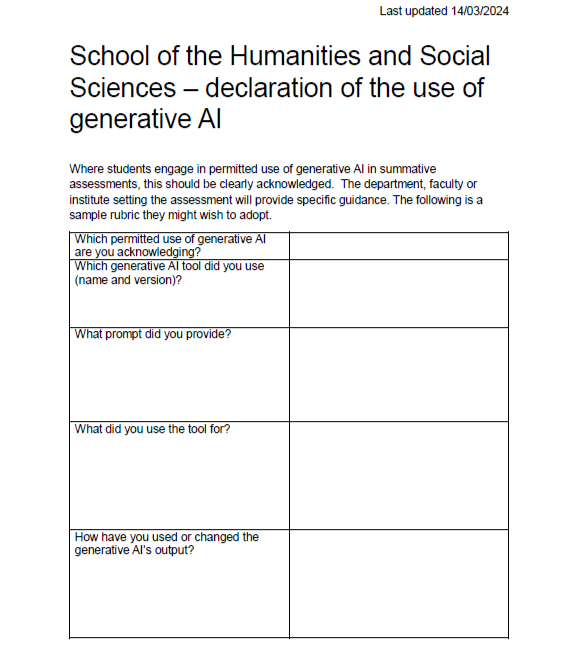
If your department requires an explicit disclosure, the template below matches current UK institutional standards and is obtained from the University of Cambridge, School of the Humanities and Social Sciences.
Copy-Paste Adapted Template
| University Assessment AI Declaration (Adapted from University of Cambridge Guidance)Assessment DetailsStudent ID / Candidate Number: [Insert ID]Module Code & Title: [Insert Code & Title]Permitted AI Assessment Category: [e.g., UCL Category 2 / Bath Type B]___________________________________________________________________________________Declarative Statement of AuthorshipI declare that the work submitted for this assessment is entirely my own original scholarship, except where explicit assistive use of generative artificial intelligence has been permitted by the module convenor and disclosed in the rubric below. I understand that presenting machine-generated text, unverified AI summaries, or automated paraphrasing as my own authentic critical analysis constitutes academic misconduct. A complete audit trail (prompt history and version-controlled draft snapshots) has been retained.___________________________________________________________________________________Assistive Use Disclosure Rubric1. Permitted Use Acknowledged:[e.g., Preliminary topic ideation, Boolean search syntax design, and exploratory reading summaries.]2. Generative AI Tool & Model Version: [e.g., ChatGPT (OpenAI GPT-4o, accessed 18 October 2026).]3. Prompts Submitted to the System:[e.g., “Suggest five potential research gaps regarding the impact of renewable energy subsidies on UK grid stability between 2020 and 2025.”]4. Primary Purpose of the Query:[e.g., Broadening search terms for academic database queries on Scopus and Web of Science.]5. Student Synthesis & Changes Applied:[e.g., The generated points were used only to identify secondary literature themes. All citations were located independently through peer-reviewed journals, and none of the AI-generated prose was included in the submitted text.]___________________________________________________________________________________ Student Signature: _______________________ Date: [DD/MM/YYYY] |
Referencing ChatGPT in Harvard Style
When learning how to acknowledge ChatGPT in an essay or PhD thesis, or how to reference ChatGPT following a standard Harvard referencing guide (such as Cite Them Right):
In-text Citation: (OpenAI, 2026)
- Reference List Entry:
- OpenAI (2026) ChatGPT (28th September 2026 version) [Large language model]. Available at: https://openai.com/(Accessed: 28th September 2026).
What Happens If You Break Your University’s AI Rules?
When it comes to academic integrity and whether or not to use ChatGPT at university without permission, there are procedures in place.
How do universities investigate AI use?
Students often enquire: Can my university tell if I used ChatGPT? Or can universities tell if you use ChatGPT? But UK universities do not depend only on automated detection software, as it could produce false positive results. Rather, markers and academic integrity panels rely on a combination of evidence:
- Turnitin AI Detection Scores: As a preliminary indicator – not definitive evidence.
- Vocabulary, tone or level of writing changes abruptly from one submission to the next.
- Monitor the history of word processor edits, time typing, etc., and keep a document’s history in a log.
- Oral Examination (Viva Voce): Conducting an interview with the student to discuss their arguments, research options, and sources.
Potential penalties
The consequences of plagiarism and unauthorised AI usage can impact your overall UK degree classification. Penalties are determined by the severity of the offence and previous misconduct:
- Formal warning and work re-marking to a maximum grade.
- Giving a mark of zero for the individual component of assessment.
- Giving a score of 0 for a whole module.
- Temporary rustication, or permanent expulsion as highlighted under Oxford policy where appropriate.
What UK Students Are Actually Doing: HEPI 2026 Data
The Higher Education Policy Institute (HEPI) Student Generative AI Survey shows that AI technology has spread across the UK campus:
- According to 95% of UK Undergraduates, they have used generative AI in some form at least once while studying (Stephenson, 2026).
- 94% of Students use AI to enhance and support their assessed work, mainly for brainstorming, explaining tricky concepts, or proofreading.
- 12% of Students have reported directly copying AI-created text in final work (up from previous years).
Although the statistics indicate high adoption, they also make a strong statement of the danger: “direct text generation without explicit authorisation” is the number one trigger for academic misconduct investigations.
A Safe-Use Checklist for 2026–27
Before submission of your dissertation, follow this step-by-step verification process to ensure that your dissertation meets the full academic integrity standards of the institution:
- Confirm Your Assessment Category: Confirm the category for your assessment in your module handbook or assessment brief (e.g. UCL Category 1, 2 or 3). The extent of your permitted use of tools, and how much disclosure you need, will depend entirely on this classification.
- Get Written Confirmation: If your assessment brief or departmental guidelines are unclear as to what tools of AI are allowed, please email your module leader/dissertation supervisor before you start writing.
- Audit Permissible Assistance (Category 2): If you are using generative AI, use it only for a secondary task (e.g., generating outlines, proofreading papers, editing search queries, etc.) and be sure that any primary text, critical analysis, and synthesis is your own work.
- Fill out an AI Declaration: Fill out a formal declaration statement in your front matter (or your university’s specific declaration form for AI) indicating what tools were used, what prompt strategies were used, and if there was a section where it was used for assistance, what it was assisting with.
- Keep a log of your own conversational prompts, and the outputs generated, as well as a version-controlled history of your draft (such as tracked changes in Microsoft Word or Google Doc) that documents the changes you make to your work, to provide verification evidence if your work is reviewed for academic dishonesty.
Conclusion
Understanding is the key to navigating the landscape of AI policies at UK universities, not speculation. Getting to grips with the policies of UK universities on AI is no reason for speculation. Academic integrity frameworks differ in different contexts; it is important to establish what is academic integrity and what is not in the context of your assignment. If an assistive tool is allowed, it must be transparent. Students are required to submit formal AI declarations which explain the software, prompts and specific scope of the assistance. Keep full version history and prompt logs, as this will help to prevent software flags from detecting it. Finally, critical literature synthesis and clinical judgment are all personal. There is no general prohibition, but local and assignment-specific permission only. If you have any questions, read your assessment brief; take extensive notes; fill out an AI declaration university statement; and always use your own critical voice and scholarship in all final submissions.
Frequently Asked Questions
Is ChatGPT banned at UK universities?
No, ChatGPT is not banned across the UK, but every university has its own rules. Most universities only allow you to use it for simple help with essay writing, like planning or brainstorming, and you must declare it. You cannot use it to write your essay or make up references, because that is considered cheating. Always check your assignment brief first.
Is using ChatGPT for ideas considered cheating?
It depends on the assignment type. Brainstorming is allowed in Category 2 (Assistive Use), but must be announced. In Category 1 (AI Not Permitted), the use of AI for ideation is not permitted.
Can I use Grammarly or ChatGPT to proofread my essay?
You can usually use them for basic spelling and punctuation, but not for rewriting. Asking AI to restructure paragraphs, rephrase sentences, or alter vocabulary violates most UK university proofreading policies and can be treated as academic misconduct. Always check your department’s policy before using automated editing features.
Do I need to reference ChatGPT?
Yes. When using AI-generated content in a permitted context, if it has been cited, it must be done in a standard referencing style, for example, Harvard (Cite Them Right).
Can my university tell if I used ChatGPT?
Yes. Universities have put together a variety of checks, including document version information, stylistic analysis, and oral examinations, along with AI detection flags.
Can I use ChatGPT for my dissertation literature review?
Yes, only when specific dissertation guidelines are given for your programme. Take great care with fabricated citations, omission of critical analysis, and data protection infringements.
What are the Russell Group’s five AI principles?
The focus of the Russell Group principles on AI is on promoting student and staff AI literacy, supporting academics in adapting to AI, maintaining academic integrity, and disseminating institutional best practices.
