
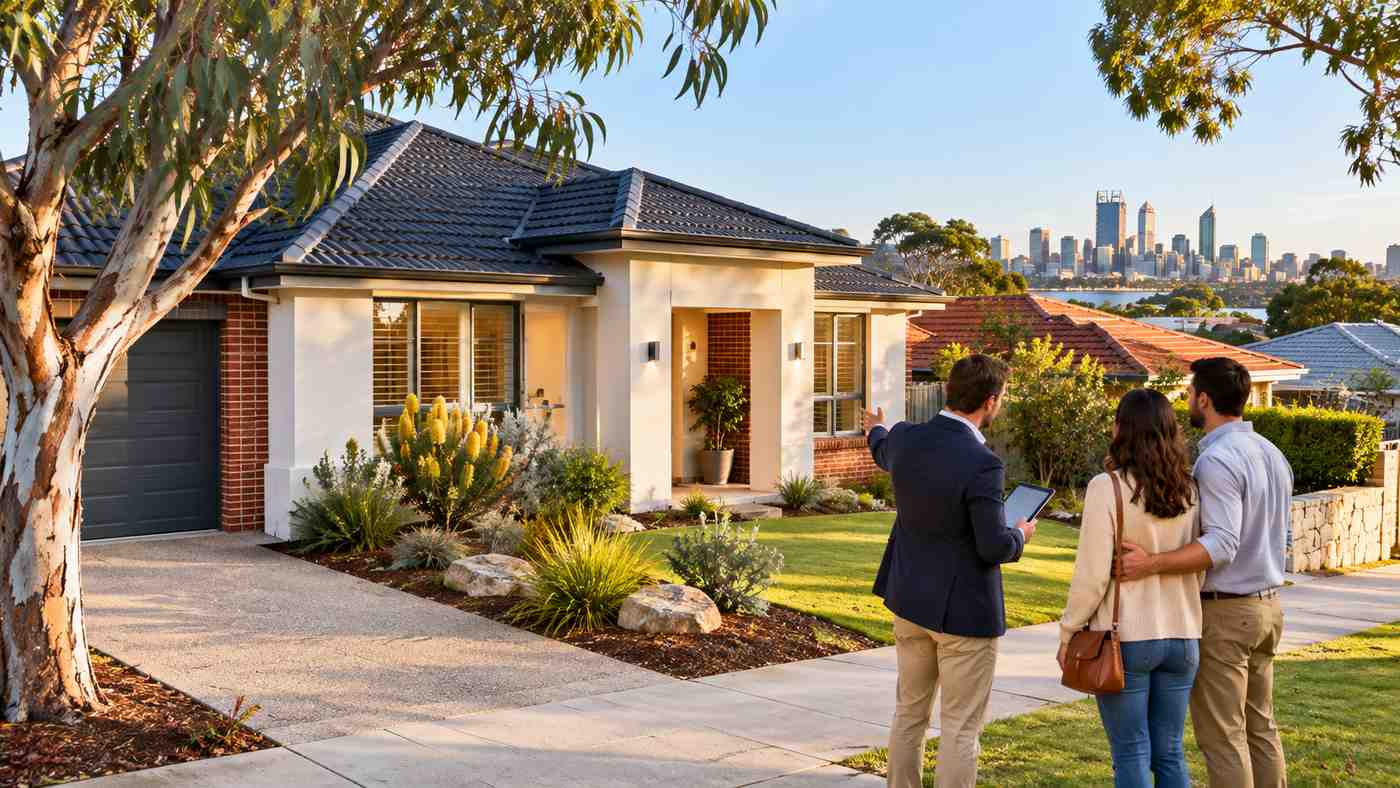
Perth’s property market has experienced one of the most significant transformations in Australian real estate over recent years. Once widely regarded as a comparatively affordable capital city, Perth has seen substantial increases in house prices, driven by population growth, housing demand, economic activity, and changing supply conditions.
The Perth median house price became a major national headline in January 2026 when new Domain research confirmed that the city had crossed the A$1 million milestone.
For homeowners, this milestone highlighted the considerable increase in residential property values. For first-home buyers, it raised difficult questions about affordability, deposits, mortgage repayments, and the availability of suitable homes.
However, Perth’s property market has not continued rising without interruption.
By the September 2026 quarter, Domain was reporting falling house prices, while separate data from the Real Estate Institute of Western Australia (REIWA) showed a different median figure because of its reporting methodology.
Understanding these developments is important for anyone considering buying, selling, or investing in Perth property.
This guide explores the million-dollar milestone, the factors behind Perth’s long-term growth, recent market changes, and seven practical lessons for navigating the housing market.
Perth Median House Price: How the City Crossed $1 Million
In January 2026, a significant development attracted attention across the Australian property industry.
According to Domain’s December 2025 quarter research, Perth’s median house price reached A$1,087,762.
The figure represented a 9.9% quarterly increase and made Perth the sixth Australian capital city to record a median house price above A$1 million.
The milestone was covered by Elite Agent, which explained how the median house price climbed above the $1 million mark following years of strong residential property growth.
The report highlighted the influence of population expansion, Western Australia’s economic conditions, and sustained housing demand.
It also demonstrated how quickly Perth’s relative affordability had changed.
The Long-Term Transformation of Perth Property Prices
Domain’s research illustrated the scale of the shift.
In 1994, Perth’s reported median house price was A$143,394.
By 2019, it had reached A$528,779.
The January 2026 report then placed the December 2025 quarter median above A$1.08 million.
These historical figures show a major increase in nominal house prices over more than three decades.
However, nominal prices do not account for inflation, changes in borrowing costs, or differences in the types of properties sold.
A more complete assessment of affordability also considers household income, interest rates, and housing expenses.
What Is Perth’s Median House Price in Late 2026?
The million-dollar milestone remains important, but it should not be presented as the only current market figure.
Different research providers calculate their statistics using different reporting periods and datasets.
Latest Reported Perth House Price Figures
| Source and reporting period | Median house price | Additional context |
|---|---|---|
| Domain, December 2025 quarter | A$1,087,762 | Up 9.9% over the quarter |
| Domain, September 2026 quarter | A$1,115,227 | Down 7.4% over the quarter |
| REIWA, 12 months ending October 2026 | A$970,000 | Annual-period median, updated November 7 |
These figures are not directly interchangeable.
Domain’s quarterly report measures its published median for the relevant quarter.
REIWA’s market snapshot presents a median calculated over the preceding 12 months, using its transaction-based data and reporting process.
The difference does not necessarily indicate that one source is incorrect.
Instead, it demonstrates why property statistics should always be accompanied by the reporting period and methodology.
Perth’s Market Has Recently Cooled
Domain’s September 2026 report showed a substantial change in conditions.
Perth house prices fell by 7.4% during the quarter, while unit prices declined by 6.5%.
Despite this quarterly downturn, Domain still recorded annual house price growth of 6.8%.
These figures show that a property market can decline over a short period while remaining above its level from a year earlier.
The September quarter results also suggest that buyers should be cautious about assuming the exceptionally strong growth of previous years will continue.
7 Important Facts About Perth’s Changing Property Market
1. Population Growth Has Supported Housing Demand
Population growth has been a major factor in Western Australia’s housing market.
When more people move into a region, additional demand may develop for rental properties, established houses, apartments, and newly built homes.
The Australian Bureau of Statistics reported that Western Australia’s population increased by 2.1% during the year ending March 2026.
That was the fastest annual population growth rate among Australian states and territories.
An expanding population can support housing demand, particularly when new construction does not increase at the same pace.
However, population growth alone does not guarantee rising property prices.
Interest rates, wages, housing availability, migration patterns, and economic confidence also influence buying decisions.
Why Population Growth Matters for Perth
An increase in residents creates demand for housing near employment centers, schools, transport connections, and established services.
This can place pressure on available properties in desirable locations.
However, the effect varies between suburbs.
Areas with significant new housing construction may experience different conditions from established neighborhoods where available land is limited.
2. Affordability Has Become a Major Challenge
Perth’s historical reputation for affordability has weakened as property prices have increased.
Elite Agent’s January 2026 article highlighted that entry-level house prices had risen by 74.3% since 2019, according to Domain’s analysis.
The same report stated that the share of household income required to service a median mortgage had increased from 22.3% to 39.5%.
Those figures illustrate how rising house prices can influence household budgets.
A buyer may need a larger deposit while also committing a greater proportion of income to repayments.
The Impact on First-Home Buyers
Higher prices can make it harder to save a sufficient deposit.
A person saving for a home may find that their target purchase price increases before they have accumulated the required funds.
Borrowing capacity also depends on interest rates, existing financial obligations, and lender assessments.
The Australian government’s Moneysmart guidance recommends planning for the deposit and additional purchase expenses, including transfer duty, legal fees, and inspections.
It also advises checking affordability against the possibility of higher interest rates.
3. Perth Has Experienced Strong Suburban Price Growth
Perth’s price increases have not been limited to expensive inner-city neighborhoods.
The original Domain research highlighted substantial growth in traditionally more affordable suburbs.
More than 50 Perth suburbs reportedly experienced house price doubling over a five-year period.
Examples mentioned in the January coverage included Orelia, Parmelia, Coolungup, Armadale, and Merriwa.
This illustrates how significant price changes can occur outside established premium locations.
However, historical growth does not establish that the same suburbs will deliver future returns.
Why Suburb-Level Research Matters
A citywide median cannot describe every local property market.
One suburb may have substantial demand for established family houses, while another may experience increased competition from new developments.
Buyers should examine recent comparable sales, available listings, local amenities, and the condition of individual properties.
Median figures are useful for understanding broad trends, but they cannot determine the fair price of a particular house.
4. The Number of Million-Dollar Suburbs Has Increased
REIWA reported in July 2026 that 167 Perth suburbs had median house sale prices of at least A$1 million at the end of June.
That represented approximately 41.4% of the suburbs included in its analysis.
Five years earlier, only 42 suburbs were in the same category.
This change demonstrates the geographic spread of long-term price increases.
It also explains why the meaning of a million-dollar property has changed in Perth.
In some neighborhoods, that price may be associated with a relatively ordinary family home rather than a luxury residence.
Nevertheless, individual property values continue to depend on land size, location, condition, and local demand.
5. Property Listings and Buyer Conditions Are Changing
Strong property markets often feature intense competition and limited listings.
However, Perth’s market conditions have changed during 2026.
REIWA’s market snapshot for the week ending November 1 recorded 9,217 properties listed for sale across houses, units, and land.
The comparable figure for the same week in the previous year was 2,870.
The increase indicates that buyers had substantially more advertised stock available than a year earlier.
Greater choice can reduce some of the pressure associated with competitive property searches.
However, listing counts alone do not establish that every suburb has become a buyer’s market.
Demand, property quality, pricing, and local inventory still matter.
Why Buyers Should Monitor Local Supply
A larger number of available properties can create opportunities to compare alternatives.
Buyers may have more time to review building conditions, negotiate contract terms, or obtain professional advice.
Sellers may need to adjust expectations when competing with similar homes.
However, well-presented properties in desirable locations can still attract considerable interest.
6. Units and Townhouses May Offer Alternative Entry Points
Not every buyer needs a detached house.
Apartments, villas, and townhouses may provide alternative ways to enter the property market.
According to REIWA’s November 2026 market snapshot, the annual-period median unit price was approximately A$700,000.
That was below the corresponding A$970,000 house median.
Domain’s September quarter report also showed a price difference between houses and units, although its calculation produced different figures.
What Buyers Should Consider
An apartment may have a lower purchase price but involve ongoing strata levies.
Townhouses can offer additional space compared with some apartments, but the ownership structure and maintenance responsibilities vary.
Before deciding, review:
- Interior floor space and layout
- Strata fees and special levies
- Building condition and maintenance
- Parking and storage
- Transport access and nearby facilities
- Restrictions associated with the property
The most suitable property depends on lifestyle needs and total ownership costs, not simply the advertised price.
7. Short-Term Corrections Do Not Erase Long-Term Risks
Perth’s recent decline illustrates that property values do not move upward in a straight line.
Markets respond to changes in borrowing costs, economic confidence, supply, and demand.
A property purchased during a period of rapid growth may experience a decline before its owner is ready to sell.
For investors, this can affect expected returns and borrowing arrangements.
For owner-occupiers, short-term market movements may be less important than affordability, location, and the ability to maintain mortgage repayments.
The key lesson is to avoid making buying decisions based on an assumption of guaranteed capital growth.
What Is a Median House Price?
The median is the middle value when property sales are arranged from lowest to highest.
For example, imagine five homes selling for:
A$650,000, A$750,000, A$900,000, A$1,100,000, and A$1,500,000.
The median sale price is A$900,000 because it is the middle result.
This is different from the average, which adds all five prices and divides the total by five.
The median can be useful because it is less affected by unusually high or low transactions.
However, it remains sensitive to the mix of properties sold during the reporting period.
If a greater proportion of expensive houses sell in one quarter, the median may increase even without equivalent price growth for every individual home.
This is one reason buyers should compare median statistics with local comparable sales and other market indicators.
What a $1 Million Perth Home Could Cost to Finance
Purchase prices are only one element of affordability.
Mortgage repayments depend on the amount borrowed, interest rate, repayment term, and loan structure.
Consider a hypothetical A$1 million property purchase.
Illustrative Mortgage Example
<escape>| Item | Amount |
|—|—:|
| Purchase price | A$1,000,000 |
| Deposit at 20% | A$200,000 |
| Loan amount | A$800,000 |
| Loan term | 30 years |
| Monthly repayment at 6% | Approximately A$4,796 |
| Monthly repayment at 8% | Approximately A$5,870 |</escape>
These are hypothetical principal-and-interest calculations, not current lender offers.
They exclude transfer duty, conveyancing, insurance, maintenance, council rates, and other expenses.
The difference between the two illustrative interest rates demonstrates why borrowers should consider how repayments could change.
Moneysmart recommends evaluating affordability under a scenario where interest rates increase by two percentage points.
Other Costs Buyers Should Budget For
Additional expenses may include building and pest inspections, conveyancing, transfer duty, lender charges, insurance, and relocation.
Some buyers may also need lenders mortgage insurance, depending on their deposit and eligibility for particular loan arrangements.
A property purchase should be based on the complete financial commitment rather than the monthly mortgage repayment alone.
First-Home Buyer Assistance in Western Australia
Western Australia provides certain transfer duty concessions for qualifying first-home buyers.
According to RevenueWA’s transfer duty guidance, the first-home owner rate applying from May 7, 2026 includes:
- No transfer duty on eligible homes valued at A$600,000 or less.
- A concessional calculation for eligible homes between A$600,001 and A$800,000.
- The general transfer duty rate for properties valued above A$800,000.
Eligibility requirements apply.
First-home buyer transfer duty concessions are distinct from other grants and government home-buying programs.
Purchasers should confirm current thresholds and their eligibility directly with RevenueWA before relying on any proposed saving.
Should Buyers Enter the Perth Property Market in 2026?
There is no universally correct time to purchase a home.
The appropriate decision depends on financial circumstances, employment stability, intended ownership period, and the specific property.
A buyer planning to live in a home for many years may prioritize suitability and repayment affordability over short-term price changes.
An investor may need to consider rental income, ongoing expenses, vacancies, financing costs, and potential resale risks.
Questions to Ask Before Buying
Consider whether you have sufficient savings for the deposit and upfront expenses.
Check whether mortgage repayments remain manageable under less favorable financial conditions.
Research recent sales of comparable homes rather than relying on the metropolitan median.
Understand the property’s legal and physical condition.
Finally, decide whether the home meets your needs independently of expectations about future price increases.
What Could Influence Perth House Prices Next?
Perth’s future housing conditions will depend on several interacting factors.
Population and Migration
Continued population growth may support demand for housing.
However, the scale and location of new demand can change over time.
Construction and Housing Supply
New developments, building completion rates, and access to established housing can influence available supply.
Construction delays and infrastructure limitations may affect how quickly new homes become available.
Interest Rates and Borrowing Capacity
Changes in financing costs can influence what buyers can afford.
Higher rates may reduce borrowing capacity, while lower rates may improve affordability for some purchasers.
However, interest rates alone do not determine property prices.
Economic Conditions
Western Australia’s employment market, business activity, and resource-sector performance can influence household confidence and housing demand.
A change in economic conditions may affect property markets differently across suburbs and property categories.
Buyer Confidence
Consumer sentiment, transaction activity, and expectations can affect how quickly properties sell.
The market’s September 2026 correction demonstrates the importance of monitoring current conditions rather than relying entirely on historical trends.
Common Mistakes to Avoid in Perth Property Research
One mistake is assuming that a median house price above A$1 million means every home costs at least that amount.
Another is comparing statistics from different providers without understanding their reporting periods.
Buyers should also avoid treating previous suburb growth rates as predictions of future performance.
A further mistake is overlooking purchase costs and ongoing ownership expenses.
Finally, do not base a purchase solely on an optimistic forecast.
The strongest decisions combine financial planning, independent inspections, local research, and an understanding of the property’s actual value.
Frequently Asked Questions
1. Did Perth’s median house price exceed A$1 million in 2026?
Yes. Domain reported a median house price of A$1,087,762 for the December 2025 quarter, with the milestone announced in January 2026. Its September 2026 figure was A$1,115,227.
2. Why does REIWA report a Perth house median below A$1 million?
REIWA’s November 2026 snapshot reported A$970,000 for the 12 months ending October 2026. Its reporting period and transaction methodology differ from Domain’s quarterly statistics.
3. Are Perth house prices still rising rapidly?
Not consistently. Domain reported a 7.4% quarterly decline in September 2026, although annual house price growth remained positive at 6.8%.
4. Is Perth still affordable for first-home buyers?
Affordability varies by income, savings, property type, and suburb. Rising prices have created challenges, but eligible buyers may find alternatives in units, townhouses, or lower-priced areas and may qualify for relevant assistance programs.
Conclusion
The Perth median house price crossing A$1 million marked an important stage in the city’s long-term property market transformation.
Strong population growth, housing demand, and economic conditions contributed to substantial earlier gains, while the September 2026 downturn demonstrated that prices can also move lower.
For buyers and investors, understanding different market data sources is just as important as following headline figures.
Careful budgeting, suburb-level research, and realistic expectations provide a stronger foundation for property decisions than assuming that recent growth will continue indefinitely.
