
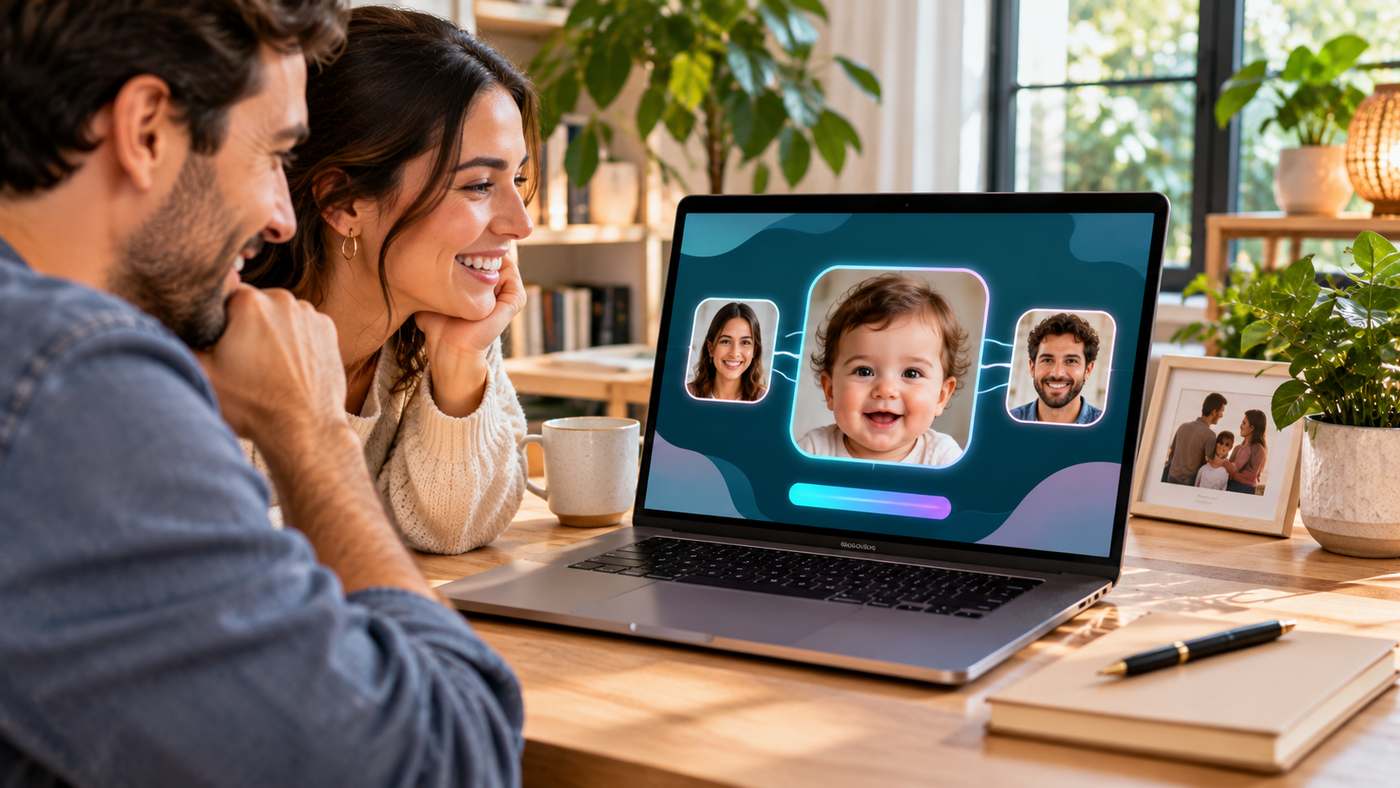
Technology has introduced creative new ways for people to explore personal ideas, celebrate relationships, and visualize imaginary moments. One increasingly popular application is generating a realistic-looking portrait of a possible future child using photographs of two adults.
An ai baby face generator uses artificial intelligence to analyze visible facial characteristics and create a fictional baby portrait inspired by the uploaded images. For couples, expecting parents, and curious users, the results can be a fun way to imagine what a future family might look like.
Modern tools offer more than basic photo blending. Some allow users to select a baby’s apparent age, generate alternative portraits, create family compositions, and even animate the resulting image.
However, these tools have important limitations. A visually convincing generated baby is not a scientific prediction of genetic inheritance. Photo quality, privacy, payment terms, and responsible sharing should also be considered.
This guide explains how AI baby generators work, what the AI Baby Generator platform offers, seven practical ways to improve results, and the precautions users should take before uploading personal photographs.
What Is an AI Baby Face Generator?
An AI baby face generator is an image-generation application that creates a fictional child’s face using photographs of two people.
The tool analyzes visible characteristics such as face shape, eye appearance, skin tone, and other facial details. An AI image model then produces a new portrait that may resemble a combination of the uploaded faces.
The resulting photograph can look realistic, but it represents an artistic interpretation rather than a reliable prediction.
For example, two adults might upload clear photographs of themselves and receive an image showing a smiling baby with facial features reminiscent of both.
A different combination of photographs or generation settings could produce a noticeably different result.
How Does AI Baby Face Generation Work?
The process typically involves three stages.
First, users provide photographs containing clearly visible faces.
Second, the application processes the uploaded images and identifies visual patterns that can guide image generation.
Third, a generative AI model creates a synthetic portrait incorporating selected characteristics from those references.
The final image is produced by software rather than a genetic test.
This is an important distinction because actual human inheritance involves biological information that cannot be determined from two facial photographs alone.
Exploring the AI Baby Generator Online Platform
People interested in an AI baby face generator can explore the online service offered by AI Baby Generator.
The website provides tools for generating fictional baby portraits from two parent photographs.
Its published features include selecting different visual options, choosing age categories, creating family portraits, and producing short animated clips with supported premium access.
The platform’s stated purpose is entertainment and creative visualization.
Uploading Parent Photographs
The generator asks for one photograph of each parent.
According to its website, the system analyzes visible facial characteristics and creates a baby-style portrait.
The platform recommends using well-lit, front-facing photographs with clearly visible faces.
Selecting Visual Preferences
Users can choose from boy, girl, and twins options.
These settings guide the type of image the model attempts to create.
They are not predictions of a future child’s biological sex or whether a pregnancy will involve twins.
Exploring Different Ages
The service also offers baby, child, and teen appearance categories.
These allow users to explore different fictional age representations.
However, selecting a teen portrait should not be interpreted as a scientifically accurate forecast of how a real child will age.
Creating Family Portraits
The platform offers a family-photo option in addition to individual child portraits.
This feature can create imaginative compositions involving the uploaded adults and a generated child.
As with other generated images, the result is synthetic and may alter details of the original reference photographs.
7 Smart Tips for Creating Better AI Baby Face Images
Getting an appealing result depends partly on how the photographs are prepared and which generation options are selected.
1. Choose Clear, High-Quality Photographs
Start with images that clearly show both people’s faces.
Blurred photographs, heavy filters, and poor lighting can make it harder for the AI model to interpret the visual references.
Choose photographs with enough detail around the eyes, nose, mouth, and facial contours.
A recent, natural-looking portrait is generally more useful than a heavily edited social media image.
Avoid using beauty filters that substantially alter facial proportions.
2. Use Front-Facing Photos
The website recommends photographs in which the person faces the camera.
A direct view provides a clearer reference for facial proportions than an extreme side angle.
Try to keep the face unobstructed.
Sunglasses, large shadows, and objects covering important features may affect the generated result.
Both photographs do not need identical backgrounds, but clear facial visibility can help produce more coherent output.
3. Maintain Balanced Lighting
Lighting influences how facial characteristics appear in photographs.
Harsh overhead light may create deep shadows, while excessive exposure can hide details.
Soft natural daylight is often a practical choice.
For example, taking a photograph near a window can provide more even illumination.
Avoid extreme color filters that change the appearance of skin or eyes.
The objective is to give the AI clear visual information rather than create a dramatic portrait.
4. Select the Desired Appearance Settings
Before generating an image, review the available options.
The AI Baby Generator website offers categories for visual gender presentation, apparent age, and portrait type.
Choose settings according to the kind of fictional image you want.
For example, selecting a baby portrait may produce a different composition from selecting a teen image.
These settings are artistic controls, not medical or genetic predictions.
5. Experiment With Different Photo Pairs
If a result does not resemble the uploaded adults as expected, consider trying another suitable photograph.
A different camera angle, expression, or lighting condition may change how the model interprets facial features.
However, additional generations may count toward paid usage limits.
Review the available credits or subscription terms before repeatedly generating images.
Avoid assuming that a result is more scientifically accurate simply because it looks more convincing.
6. Review the Generated Image Carefully
AI-generated portraits sometimes contain small visual inconsistencies.
These may involve eye alignment, ears, hair texture, teeth, lighting, or unusual facial details.
Inspect the image before downloading or sharing it.
The most realistic-looking result is not necessarily the one that best reflects the uploaded references.
Choose an image based on its visual quality and your personal creative preferences.
7. Protect Your Photos and Get Consent
Photographs of real faces can be sensitive personal data.
Before uploading an image of another person, obtain their permission.
Read the service’s privacy policy, understand how information is processed, and check whether third parties receive the uploaded files.
Avoid uploading confidential images or photographs you do not have permission to use.
When sharing the final result, explain that the baby portrait was generated by AI.
Responsible use is especially important because realistic synthetic images can be mistaken for genuine photographs.
How Accurate Is an AI Baby Face Generator?
AI baby portraits can be visually convincing, but their scientific predictive value is limited.
Human appearance is shaped by genetic inheritance and other developmental influences.
Many visible characteristics are influenced by multiple genes rather than a simple combination of the parents’ appearances.
For example, the National Institutes of Health’s MedlinePlus Genetics resource explains that eye color depends on several genes involved in pigmentation.
The National Human Genome Research Institute likewise describes skin color and height as examples of polygenic traits.
These characteristics cannot be reliably determined by blending two photos.
Why a Real Baby May Look Different
A child inherits genetic material from both biological parents through complex processes.
The resulting combination is not equivalent to averaging their visible facial features.
A child may have characteristics resembling grandparents or other relatives.
Certain inherited variations may not be obvious from the parents’ photographs.
Appearance can also change during growth and development.
Consequently, a generated baby image should be treated as an imaginative possibility, not an expected outcome.
Can AI Predict Eye Color or Hair Color?
An image generator may create a portrait with a selected or inferred eye or hair color.
However, the generated appearance is not proof that a real child will inherit those traits.
Even separate trait calculators generally rely on simplified assumptions.
They should not be used as substitutes for professional genetic counseling when someone has a medical or inherited-condition concern.
Main Features of AI Baby Generator
The linked platform offers several capabilities intended for different creative uses.
| Feature | What It Does |
|---|---|
| Parent photo upload | Uses two facial photographs as visual references |
| Baby image generation | Creates a fictional baby portrait |
| Boy or girl selection | Guides the appearance of the generated portrait |
| Twins option | Creates an imaginative twins-themed result |
| Age selection | Offers baby, child, and teen-style images |
| Family portrait | Produces a synthetic family composition |
| AI baby video | Animates supported generated portraits |
| Download options | Allows saving results under applicable plan terms |
The availability of individual features depends on the selected access plan and current website functionality.
Can You Turn an AI Baby Portrait Into a Video?
The AI Baby Generator platform advertises a premium video feature that converts supported generated baby images into short animated clips.
According to its published information, the videos are approximately five seconds long.
The animation may include subtle facial movements such as smiling or blinking.
The service describes a vertical video format suitable for sharing on mobile-oriented platforms.
How the Video Feature Works
Users first create a supported AI-generated baby photograph.
The platform then offers an animation option under the applicable premium plan.
The resulting video can be downloaded in MP4 format.
According to the company’s documentation, its animation function is designed for images generated by its own baby model rather than arbitrary uploaded photographs of real children.
Important Video Limitations
An animated baby portrait is still fictional.
Facial movement does not make the underlying prediction more accurate.
The platform’s homepage and FAQ contain some inconsistent descriptions of trial video access, so users should verify current entitlements before purchasing.
Is AI Baby Generator Free to Use?
The website advertises several free tools, but its main AI baby photo-generation service uses paid access.
According to pricing displayed on November 8, 2026, the site lists the following options.
| Plan | Advertised Price | Main Features |
|---|---|---|
| Free Tools | $0 | Baby name and selected trait-related calculators |
| 3-Day Trial | $2.99 | Trial access to baby image generation |
| Premium | $19.99/month | Up to 100 photos per month and 10 video clips |
The website states that the three-day trial converts to the monthly subscription unless canceled.
The listed prices are in US dollars.
Actual billing conditions, available features, and promotional terms may change.
What Free Tools Are Available?
The website lists several no-sign-up tools, including a baby name generator, child height predictor, eye color calculator, hair color calculator, and twins-related calculator.
These are separate from the paid AI portrait-generation service.
Like the portrait generator, trait calculators should not be treated as reliable medical predictions.
Review the Subscription Before Paying
Check the renewal date, payment amount, cancellation steps, and available generation credits.
A short discounted trial is not necessarily a one-time purchase.
The platform’s refund policy states that digital purchases are generally non-refundable, with limited exceptions involving duplicate charges, missing results, or verified technical failures.
It instructs users to contact support within seven days of purchase for eligible refund requests.
Read the current policy before completing payment.
Are Uploaded Photos Safe and Private?
Privacy is an important consideration when using any service that processes facial images.
The AI Baby Generator privacy policy, last updated September 18, 2026, explains how the company handles uploaded photographs, generated results, and account information.
Photo Retention
The company states that uploaded parent photographs and generated predictions are automatically deleted within 30 days.
It also provides a method for requesting earlier deletion.
These are the provider’s published commitments, not independently audited guarantees.
Third-Party Processing
The platform explains that uploaded photographs are transmitted to a third-party AI model provider for image generation.
This matters because website statements about not publicly sharing photos do not mean the images are processed entirely on the user’s own device.
The service reports that its processors are not permitted to use uploaded information for unrelated marketing purposes.
AI Model Training
The website states that uploaded photographs are not used to train its AI models.
Users should still review the latest privacy policy before uploading images because service terms can change.
Account and Usage Records
The policy also describes collecting account and technical information, including email addresses, device information, IP addresses, and usage records.
It specifies separate retention periods for certain activity records.
Users should understand these practices before creating an account.
Why Facial Image Privacy Matters
A photograph may reveal much more than a person’s appearance.
Images can contain identifying information and, in some circumstances, metadata associated with the device or capture location.
The US Federal Trade Commission has warned that biometric technologies introduce privacy and security risks when personal information is collected or used without appropriate safeguards.
Before uploading a photograph, consider whether the service genuinely needs that information.
Use images you have permission to share, avoid uploading unnecessary identifying details, and review available deletion options.
Users should also avoid sharing synthetic baby portraits in a way that misleads others about whether the child is real.
Creative Ways to Use AI Baby Face Images
AI baby portraits can be used for several lighthearted activities.
Family Conversations
Couples may enjoy comparing different generated portraits and discussing which features appear familiar.
This can be a playful activity without attaching scientific meaning to the results.
Personal Keepsakes
A fictional baby portrait can become a digital keepsake associated with a particular moment or celebration.
If printing or sharing the image, consider whether the people whose photographs were used consent to that use.
Private Celebrations
Some people may include an AI-generated portrait in a private family slideshow or a playful announcement.
Make the fictional nature of the image clear to avoid confusion.
Creative Digital Art
Artists and hobbyists may use imaginary family imagery as inspiration for personal storytelling or design exercises.
Commercial rights depend on the platform’s terms and the materials used.
Do not assume that an AI image automatically carries unrestricted ownership or usage rights.
How to Choose a Reliable AI Baby Generator
Before selecting an AI portrait service, review several factors.
First, check whether the website clearly explains what the tool does and does not predict.
Second, examine its pricing and renewal terms.
Third, read its photo retention and privacy disclosures.
Fourth, consider whether a third-party AI processor receives uploaded images.
Fifth, review the quality of sample outputs without assuming those samples guarantee your own results.
Finally, look for accessible customer support, clear cancellation instructions, and understandable refund terms.
A trustworthy experience depends on transparency as well as attractive generated images.
Common Mistakes When Using AI Baby Generators
One common mistake is treating a realistic portrait as a forecast of a future child’s actual appearance.
Another is uploading low-quality images and expecting the model to recover details that are not visible.
Users may also overlook automatic subscription renewal or assume that every feature advertised on a homepage is free.
Sharing another person’s photograph without permission creates a separate privacy concern.
Finally, avoid using generated results to make decisions about family planning, inherited medical conditions, or other health matters.
The technology is intended for creative entertainment, not diagnosis or genetic assessment.
Frequently Asked Questions
1. What is an AI baby face generator?
An AI baby face generator creates a fictional baby portrait using facial photographs, usually from two adults. It is an image-generation tool rather than a genetic testing service.
2. Can an AI baby face generator accurately predict my future child?
No. It can create a plausible-looking portrait, but it cannot determine the complex genetic combination or developmental factors that shape a real child’s appearance.
3. Is AI Baby Generator free?
The linked website offers free baby-name and trait-related tools. Its AI baby photo service currently advertises a $2.99 three-day trial followed by a $19.99 monthly subscription.
4. Does AI Baby Generator keep uploaded parent photos?
Its privacy policy states that uploaded photos and generated images are automatically deleted within 30 days, with earlier deletion available on request. The images are also sent to a third-party AI provider for processing.
Conclusion
An AI baby face generator offers a creative way for couples and curious users to imagine a fictional future child’s appearance.
The most enjoyable results come from clear photographs, appropriate visual settings, and realistic expectations about what artificial intelligence can accomplish.
Before using a service, review its pricing, privacy policy, and photo-sharing requirements.
Treat the final image as an imaginative portrait to enjoy, not as a prediction of a real baby’s future appearance.
