
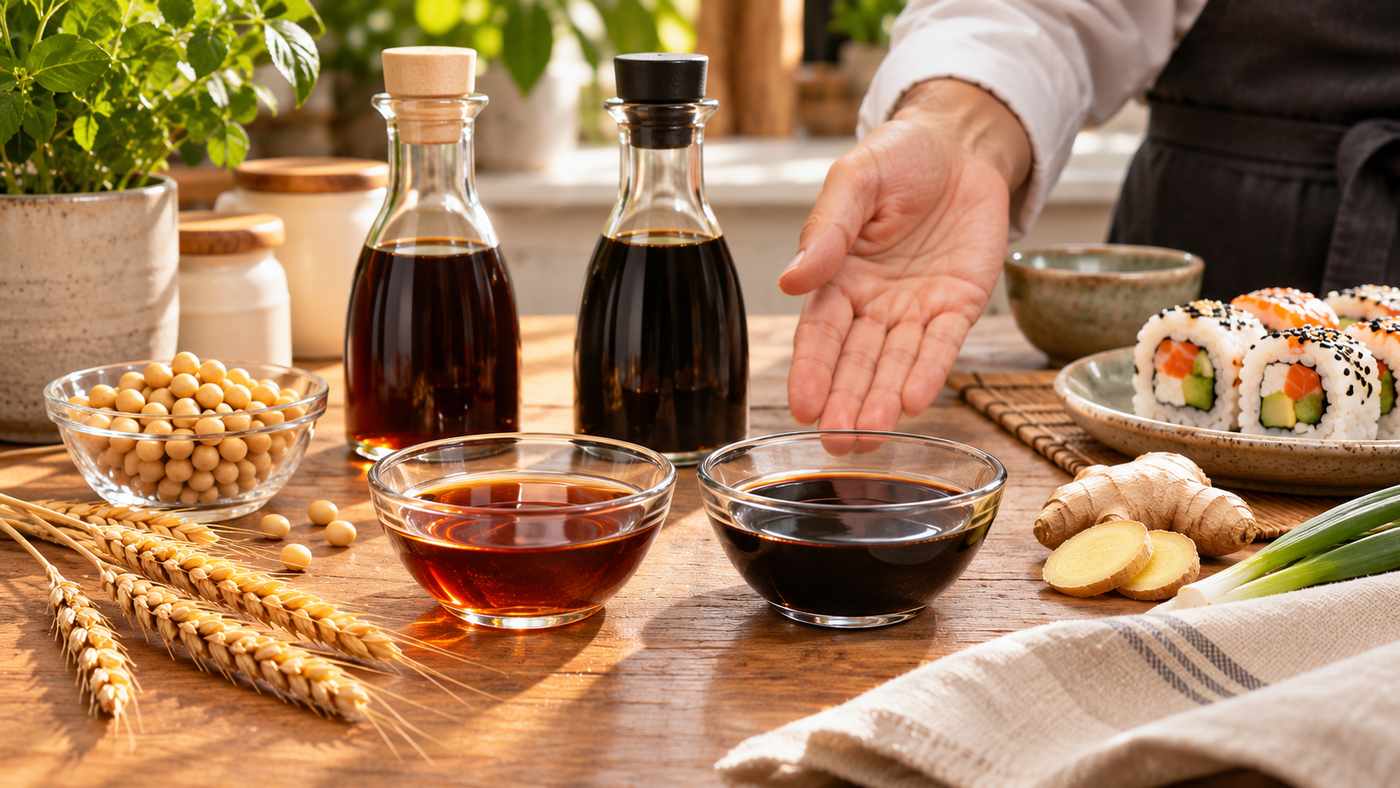
Soy sauce is one of the most popular condiments used in Asian cooking. Its rich umami flavor makes it a familiar ingredient in stir-fries, marinades, dipping sauces, noodle dishes, and restaurant meals. However, people following a gluten-free diet often wonder whether traditional soy sauce is safe to consume.
Understanding how much gluten is in soy sauce is particularly important for individuals with celiac disease, gluten-related dietary restrictions, or concerns about wheat-containing ingredients.
Although soybeans are naturally gluten-free, many traditional soy sauces contain wheat. During fermentation, proteins undergo chemical changes, making the precise amount of remaining gluten difficult to determine through conventional testing.
Some commercially available sauces are specifically manufactured without wheat and labeled gluten-free, providing alternatives for consumers who need to avoid gluten.
This guide explains where gluten in soy sauce comes from, how fermentation affects gluten proteins, what US food-labeling regulations require, and seven practical facts to consider when purchasing soy sauce.
Does Soy Sauce Contain Gluten?
Most traditional soy sauces contain wheat as an ingredient, which means they should not automatically be considered suitable for a gluten-free diet.
The conventional brewing process commonly uses four primary ingredients:
- Soybeans
- Wheat
- Water
- Salt
These ingredients undergo fermentation to develop the characteristic savory flavor, aroma, and color associated with soy sauce.
Wheat contributes to the fermentation process and influences the sauce’s overall taste.
Although the fermentation process changes the structure of wheat proteins, this does not automatically establish that a conventional soy sauce is gluten-free.
For individuals with celiac disease, the practical recommendation is to choose a product specifically labeled gluten-free and verify its ingredients.
Why Is Wheat Added to Soy Sauce?
Wheat contributes carbohydrates and proteins that influence soy sauce fermentation.
During production, microorganisms and enzymes break down various components into smaller compounds.
These transformations help create complex flavors and aromas.
However, the presence of wheat creates an important consideration for people avoiding gluten.
Wheat naturally contains gluten-forming proteins, and their behavior during fermentation complicates conventional gluten measurement.
Are Soybeans Naturally Gluten-Free?
Yes. Plain soybeans naturally do not contain the gluten proteins found in wheat, barley, and rye.
However, products made from soybeans may contain gluten-containing ingredients.
For example, plain tofu is generally gluten-free, while tofu marinated in conventional soy sauce may contain wheat-derived ingredients.
Likewise, soy-based sauces should be evaluated according to their complete ingredient lists rather than the presence of soy alone.
How Much Gluten Is in Soy Sauce?
There is no single reliable gluten concentration that applies to every traditional soy sauce.
The amount potentially present depends on ingredients, manufacturing methods, fermentation, and how gluten is measured.
Jolion Foods discusses how much gluten is in soy sauce in its August 2024 article about conventional and gluten-free soy sauces.
That article provides an estimated range of 0.5% to 3% gluten for traditional products.
However, the article does not provide supporting laboratory reports or a testing methodology for establishing that range across commercial products.
It should therefore not be treated as a scientifically verified universal measurement.
What Does Scientific Research Show?
A 2018 study published in Food Chemistry examined fermented products using liquid chromatography–mass spectrometry.
The researchers did not detect gluten in the soy sauce samples examined, despite wheat being listed as an ingredient.
This finding suggested extensive breakdown of gluten proteins during fermentation.
However, the absence of detectable gluten in particular samples does not demonstrate that every wheat-based soy sauce is safe for people with celiac disease.
Another study published in 2017 investigated gluten detection during soy sauce fermentation.
It found that several conventional testing methods did not detect gluten after specific fermentation stages.
The researchers also identified the need for further research into whether all potentially harmful gluten components are sufficiently broken down.
Why Exact Gluten Measurements Are Difficult
Fermentation can break gluten proteins into smaller peptides.
Some testing methods are designed to recognize relatively intact gluten structures.
When proteins have been extensively broken down, those methods may not reliably detect or quantify all relevant fragments.
The FDA recognizes this limitation and has established additional requirements for gluten-free labeling of fermented and hydrolyzed foods.
Consequently, a laboratory result stating that gluten was not detected in a fermented sauce should not automatically be interpreted as proof that it is suitable for a strict gluten-free diet.
7 Essential Facts About Gluten in Soy Sauce
1. Traditional Soy Sauce Commonly Contains Wheat
Traditional soy sauce is typically brewed using both soybeans and wheat.
This is the most important starting point for understanding its gluten-related risks.
Even when wheat does not appear prominently on the front of the packaging, it may be listed among the ingredients.
Different manufacturers use different formulations.
Some products contain more soybeans, while others have different grain ratios or fermentation processes.
How to Identify Wheat-Based Soy Sauce
Read the complete ingredient list.
Look for wheat and other gluten-containing grains or derivatives.
Do not assume that a premium, naturally brewed, or traditionally fermented product is gluten-free.
Similarly, a sauce’s color, thickness, or flavor cannot establish its gluten content.
For someone who must strictly avoid gluten, a clear gluten-free label provides more useful assurance than general descriptions of the brewing process.
2. Fermentation Does Not Automatically Make Soy Sauce Gluten-Free
Fermentation is central to traditional soy sauce production.
During this process, enzymes and microorganisms change proteins and other components.
This helps create the sauce’s complex taste.
However, fermentation is not considered a gluten-removal process under FDA regulations.
The Difference Between Breakdown and Removal
Breaking proteins into smaller fragments is different from demonstrating that gluten has been removed to a compliant level.
A sauce can undergo extensive fermentation without qualifying for a gluten-free labeling claim.
FDA guidance explains that a soy sauce traditionally made with wheat generally cannot claim to be gluten-free simply because fermentation occurred.
An exception may apply when a gluten-containing ingredient has been processed to remove gluten before fermentation and all applicable requirements are satisfied.
For consumers, this means that traditional wheat-containing soy sauce should not be treated as gluten-free based on fermentation alone.
3. Gluten-Free Soy Sauce Must Meet Specific Labeling Rules
In the United States, the Food and Drug Administration regulates voluntary gluten-free claims on packaged food.
Under FDA rules, foods labeled gluten-free must meet specific ingredient requirements and contain less than 20 parts per million of gluten.
The standard applies to claims including gluten-free, free of gluten, without gluten, and no gluten.
What Does 20 PPM Mean?
Parts per million describes the concentration of a substance.
For gluten:
20 ppm = 20 milligrams of gluten per kilogram of food.
As an illustrative calculation, 15 grams of food containing exactly 20 ppm gluten would contain approximately 0.3 milligrams of gluten.
A qualifying gluten-free product must be below the relevant threshold and satisfy the other applicable rules.
This calculation does not reveal the actual gluten content of a particular bottle.
Does Gluten-Free Mean Absolutely Zero Gluten?
Not necessarily.
The FDA’s gluten-free standard permits an unavoidable trace amount below 20 ppm when the relevant ingredient requirements are satisfied.
This does not mean manufacturers are free to add conventional wheat flour and simply label the resulting fermented food gluten-free.
The ingredient and processing requirements still matter.
For fermented products, manufacturers must maintain appropriate records establishing compliance with the applicable regulations.
4. Light and Dark Soy Sauce Can Both Contain Gluten
Consumers sometimes assume that lighter-colored sauces are safer or contain less gluten.
However, color alone is not a reliable indicator.
Light soy sauce is commonly used for seasoning because of its flavor and consistency.
Dark soy sauce may have a richer color and different texture, depending on the recipe.
Both categories can contain wheat.
Is Light Soy Sauce Gluten-Free?
Not automatically.
Many traditional light soy sauces use wheat.
Check the label for the exact product.
Is Dark Soy Sauce Gluten-Free?
Dark soy sauce also may contain wheat.
Its darker appearance does not establish whether gluten is present.
Some formulations contain additional sweeteners or ingredients that alter their flavor and consistency.
The safest approach is to evaluate each bottle individually.
A sauce labeled low-sodium, organic, premium, or naturally brewed is not necessarily gluten-free.
5. Gluten-Free Tamari Is a Popular Alternative
Tamari is a soy-based seasoning frequently used as an alternative to conventional soy sauce.
Some tamari products are manufactured without wheat, making them suitable options for gluten-free cooking.
However, not every product marketed as tamari is automatically gluten-free.
Ingredient formulations vary between brands.
Look for an explicit gluten-free label.
How Does Tamari Taste?
Tamari generally has a savory, umami-rich flavor.
Depending on the manufacturer, it may taste somewhat different from regular soy sauce.
Its characteristics can vary in saltiness, richness, and sweetness.
Many cooks use gluten-free tamari as a substitute in marinades, dressings, noodle dishes, and stir-fries.
Can You Substitute Tamari for Soy Sauce?
Often, yes.
A common starting point is to replace conventional soy sauce with an equal quantity of gluten-free tamari.
Taste the dish and adjust as needed.
Different products have different sodium concentrations, so nutritional labels should also be reviewed when sodium intake matters.
6. People With Celiac Disease Should Choose Verified Gluten-Free Products
Celiac disease is an autoimmune condition triggered by gluten in genetically susceptible individuals.
For people with celiac disease, following a strict gluten-free diet is the established treatment.
The Celiac Disease Foundation identifies traditional soy sauce as a common source of gluten and recommends suitable gluten-free alternatives.
Why Small Amounts Matter
People with celiac disease need to avoid gluten exposure because it can trigger an immune response and intestinal damage.
The absence of immediate symptoms does not necessarily mean that gluten exposure is harmless.
Consequently, choosing a suitable sauce should not depend on whether a person notices a reaction after eating it.
A gluten-free label, ingredient review, and appropriate manufacturer information are more dependable than informal experiments.
Gluten Sensitivity vs. Wheat Allergy
Celiac disease, non-celiac gluten sensitivity, and wheat allergy are different conditions.
A person with wheat allergy may need to avoid wheat proteins regardless of whether a product meets a gluten-free standard.
Similarly, gluten-free soy sauce may still contain soy, which is a separate major food allergen.
Consumers managing allergies should follow their clinician’s advice and evaluate all relevant allergen statements.
7. Hidden Soy Sauce Ingredients Can Introduce Gluten Into Meals
Soy sauce is often used in prepared foods without being obvious.
It may be present in marinades, dressings, dipping sauces, stir-fry seasonings, and packaged meals.
A dish that otherwise contains naturally gluten-free ingredients may still include wheat-based soy sauce.
Common Foods to Check
Examples include:
- Teriyaki-style sauces
- Fried rice and stir-fried noodles
- Restaurant dipping sauces
- Marinated tofu or meat
- Prepared salad dressings
- Ready-made Asian-inspired meals
- Seasoned rice bowls
A dish described as containing rice, vegetables, or soybeans is not automatically gluten-free.
Cross-Contact During Preparation
Cross-contact can occur when gluten-free food comes into contact with gluten-containing ingredients.
For example, a shared sauce bottle or cooking utensil may introduce unwanted gluten into an otherwise suitable dish.
Restaurants should use appropriate ingredient controls and food preparation procedures.
When dining out, ask whether regular soy sauce is used and whether gluten-free substitutions can be prepared without cross-contact.
Gluten Content Comparison: Different Soy Sauce Types
The following table provides practical guidance.
| Sauce Type | Wheat May Be Present? | Gluten-Free Status |
|---|---|---|
| Traditional soy sauce | Usually | Not assumed gluten-free |
| Light soy sauce | Commonly | Check product label |
| Dark soy sauce | Commonly | Check product label |
| Wheat-free tamari | No wheat in the stated formulation | Prefer gluten-free labeling |
| Labeled gluten-free soy sauce | Subject to compliant formulation | Must meet applicable FDA rules |
| Coconut aminos | Usually made without wheat or soy | Verify ingredients and gluten-free status |
A reliable product-specific gluten concentration cannot be assigned to every category because formulations and processing vary.
Jolion Foods and Gluten-Free Soy Sauce Options
Jolion Foods is a Chinese food manufacturer that supplies soy sauces and other seasoning products.
Its website includes information about light soy sauce, dark soy sauce, mushroom soy sauce, and gluten-free formulations.
The company also offers wholesale and private-label food manufacturing services.
Jolion Foods Gluten-Free Soy Sauce
According to its official product information, Jolion Foods offers gluten-free soy sauce manufactured without wheat.
The company describes a formulation based primarily on water, soybeans, and salt, with fermentation providing the characteristic savory flavor.
Its website lists several packaging options, including smaller retail bottles and larger sizes.
These products are positioned for consumers and food businesses seeking wheat-free soy sauce alternatives.
What Buyers Should Verify
The manufacturer’s website states that its gluten-free products meet relevant quality requirements.
However, buyers should request documentation for the specific formulation and product batch when necessary.
For US distribution, importers should verify applicable FDA labeling requirements and relevant supplier records.
A general manufacturer claim is not a substitute for independently verifying a particular product’s compliance.
Wholesale and Food Manufacturing Considerations
Restaurants, importers, and private-label brands need dependable ingredient information.
A business ordering gluten-free soy sauce in bulk should request an ingredient specification, allergen declaration, and appropriate gluten-control documentation.
It should also review manufacturing practices intended to reduce cross-contact.
Clearly identifying gluten-free products can help businesses communicate accurately with customers who need to avoid gluten.
How to Read Soy Sauce Labels Correctly
Reading the label is one of the most practical ways to evaluate soy sauce.
Step 1: Look for a Gluten-Free Claim
Check whether the packaging explicitly identifies the sauce as gluten-free.
For products sold in the United States, that claim is subject to FDA requirements.
Step 2: Examine the Ingredients
Review the complete ingredient list.
Look for wheat, barley, rye, and relevant derivatives.
Remember that the absence of wheat does not automatically rule out every possible gluten source.
Step 3: Review Allergen Information
Wheat and soy are separate allergens.
A product made without wheat may still contain soybeans.
This distinction is important for people with food allergies.
Step 4: Check for Certification
Some manufacturers use third-party gluten-free certification programs.
These may provide additional assurance under their own certification standards.
However, certification is not required for every compliant gluten-free product.
Step 5: Contact the Manufacturer When Necessary
If the ingredient information is unclear, request clarification.
Ask about the specific product rather than assuming that all sauces from the same brand use identical ingredients.
The National Celiac Association recommends checking current labels because manufacturers may change formulations.
Best Gluten-Free Alternatives to Traditional Soy Sauce
Several ingredients can replace soy sauce in selected recipes.
Gluten-Free Tamari
Gluten-free tamari is a convenient option for people who want a familiar savory flavor.
It can work in stir-fries, marinades, dressings, and dipping sauces.
Coconut Aminos
Coconut aminos are generally made using coconut-derived ingredients rather than soybeans and wheat.
They commonly have a somewhat sweeter and milder flavor.
Choose a product with suitable gluten-free labeling, particularly for a strict gluten-free diet.
Certified Gluten-Free Soy Sauce
Some manufacturers offer soy sauce specifically formulated and labeled gluten-free.
These products may be designed to provide a flavor similar to conventional soy sauce without using standard wheat-containing ingredients.
Homemade Seasoning Blends
Some cooks prepare savory sauces using gluten-free broth, suitable seasonings, vinegar, and other ingredients.
However, homemade mixtures should be evaluated ingredient by ingredient.
They may not reproduce the exact flavor of fermented soy sauce.
Is Gluten-Free Soy Sauce Better for Everyone?
Not necessarily.
A gluten-free diet is medically necessary for people with celiac disease and may be appropriate for certain other diagnosed conditions.
However, avoiding gluten does not automatically provide additional health benefits to everyone.
Gluten-free soy sauce is also not necessarily lower in sodium, calories, or other nutrients than traditional soy sauce.
Nutritional characteristics depend on the specific product.
Consumers should evaluate ingredients, sodium content, serving size, and individual dietary needs.
People with suspected gluten-related symptoms should seek appropriate medical evaluation rather than assume that eliminating gluten establishes a diagnosis.
Can You Use Regular Soy Sauce in Gluten-Free Cooking?
For someone who must strictly avoid gluten, conventional wheat-containing soy sauce is not an appropriate default ingredient.
Even if only a small quantity is added, the finished dish should not automatically be described as gluten-free.
For example, adding regular soy sauce to a vegetable stir-fry can introduce a wheat-derived ingredient into an otherwise gluten-free recipe.
Using labeled gluten-free tamari or another suitable sauce is a more straightforward approach.
The rest of the recipe must also be checked.
Noodles, seasonings, marinades, and shared cooking equipment can introduce additional gluten exposure.
Common Mistakes When Choosing Soy Sauce
One mistake is assuming that soy sauce must be gluten-free because soybeans do not naturally contain gluten.
Another is treating fermentation as proof that all gluten has disappeared.
Consumers may also confuse low-sodium soy sauce with gluten-free soy sauce.
The two claims describe different characteristics.
A further mistake is assuming every tamari product is made without wheat.
Finally, avoid relying on a single online estimate of gluten concentration for all traditional soy sauces.
Manufacturing methods differ, and fermented gluten measurements present recognized scientific challenges.
The safest purchasing approach is to evaluate the exact product, its ingredients, and the appropriate gluten-free labeling.
Frequently Asked Questions
1. How much gluten is in soy sauce?
There is no verified universal amount for traditional soy sauce. Wheat-containing formulations vary, and fermentation complicates testing. In the United States, products labeled gluten-free must meet FDA requirements, including less than 20 ppm gluten.
2. Is soy sauce safe for people with celiac disease?
Traditional wheat-containing soy sauce should be avoided by people with celiac disease. Select an appropriately labeled gluten-free soy sauce or tamari and check for potential cross-contact.
3. Does fermentation remove all gluten from soy sauce?
Not necessarily. Fermentation breaks down proteins, but it does not automatically establish that a sauce is gluten-free. Conventional testing can have limitations when measuring fragmented gluten proteins.
4. What is the best gluten-free substitute for soy sauce?
Gluten-free tamari is a popular substitute because of its savory flavor. Labeled gluten-free soy sauce and suitable coconut aminos are other options, depending on the recipe and dietary requirements.
Conclusion
Understanding how much gluten is in soy sauce requires looking beyond the presence of wheat and considering how fermentation affects gluten detection.
Traditional soy sauce should not be assumed safe for a strict gluten-free diet, and one concentration estimate cannot describe every product.
For people with celiac disease or other gluten-related dietary needs, choosing properly labeled gluten-free soy sauce or tamari is a more dependable approach.
Careful ingredient checks, appropriate food preparation, and reliable manufacturer information help make gluten-free cooking safer and more enjoyable.
