
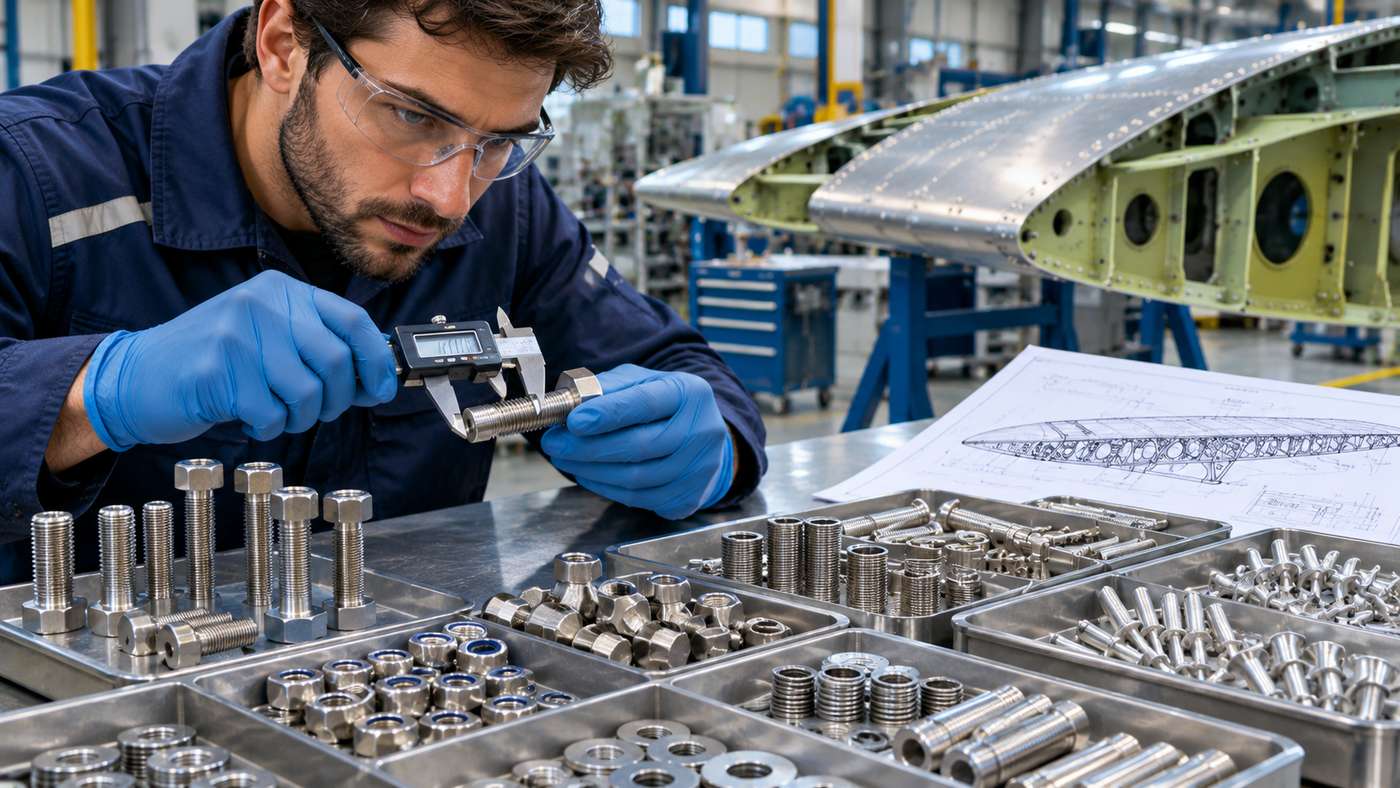
Aircraft and spacecraft depend on thousands of carefully engineered components working together under demanding operating conditions. While engines, wings, structural assemblies, and advanced electronics often receive the most attention, smaller mechanical components are equally important to overall reliability.
Aerospace Fasteners help secure critical assemblies, distribute loads, maintain structural connections, and support the performance of aircraft and space systems. These components may appear simple, but their design, material composition, manufacturing precision, and quality documentation can have major implications for safety.
Unlike ordinary hardware used in general construction, aerospace fastening components often need to satisfy strict engineering specifications. Depending on their application, they may be exposed to high vibration, extreme temperatures, corrosion, repeated loading, and significant mechanical stresses.
Selecting suitable bolts, nuts, screws, rivets, studs, and inserts therefore requires careful technical evaluation.
This guide explores seven essential considerations for aerospace fastener selection, including material properties, recognized specifications, quality assurance, traceability, specialized manufacturing, and procurement practices.
What Are Aerospace Fasteners?
Aerospace fasteners are mechanical components designed or specified for joining, securing, positioning, or retaining parts in aircraft, spacecraft, propulsion systems, and related equipment.
They include familiar hardware types such as bolts and screws, along with specialized components engineered for demanding applications.
Depending on their intended use, aerospace fasteners may be subject to requirements involving dimensional tolerances, tensile strength, fatigue resistance, corrosion protection, and manufacturing traceability.
Why Aerospace Fasteners Matter
A fastening component must perform according to the requirements of the assembly in which it is installed.
For example, a bolt securing part of an aircraft structure may need to withstand repeated loading during operational service.
A fastener used near a jet engine may experience elevated temperatures.
Hardware installed in a satellite may encounter thermal cycling and unusual environmental conditions.
The appropriate fastener depends on the engineering requirements of the specific application.
A component that performs well in one assembly may be unsuitable for another.
Common Types of Aerospace Fasteners
Aerospace applications use a wide range of hardware.
| Fastener type | Typical purpose |
|---|---|
| Bolts | Securing structural or mechanical assemblies |
| Screws | Joining components and attaching removable parts |
| Nuts | Securing compatible threaded fasteners |
| Rivets | Creating permanent mechanical joints |
| Washers | Supporting specified load distribution or spacing |
| Pins | Positioning, retaining, or securing components |
| Studs | Providing threaded connections in assemblies |
| Threaded inserts | Reinforcing or repairing specified threaded connections |
| Locking fasteners | Providing resistance to unintended loosening |
The correct design and application depend on approved engineering requirements rather than general product descriptions.
1. Select the Right Aerospace Fastener Materials
Material selection is among the most important decisions in aerospace fastening.
Aircraft and spacecraft components must often achieve high mechanical performance while controlling weight.
Different alloys offer different combinations of strength, temperature resistance, corrosion behavior, fatigue performance, and manufacturing characteristics.
Titanium Aerospace Fasteners
Titanium alloys are widely recognized for their attractive strength-to-weight ratios and corrosion resistance.
For example, Ti-6Al-4V is a titanium alloy used in various aerospace applications.
Titanium may be advantageous where weight reduction and mechanical performance are important.
However, it is not automatically suitable for every fastener.
Designers must consider compatibility with adjoining materials, fatigue requirements, temperature conditions, and potential galling.
Stainless Steel Fasteners
Stainless steel alloys can provide useful corrosion resistance and mechanical properties.
Different grades offer different strength and temperature capabilities.
The term stainless steel alone is not sufficient to establish suitability for a particular aircraft application.
Engineers must identify the specified grade, condition, and applicable standard.
High-Temperature Alloys
Some aerospace systems require materials capable of operating under elevated temperatures and demanding mechanical loads.
Examples include A286 and nickel-based alloys such as Inconel 718.
These materials may be appropriate for selected applications where strength retention and environmental resistance are essential.
However, suitability depends on actual operating temperatures, stress conditions, processing, and the required material specification.
Specialized High-Strength Alloys
Certain demanding applications use specialized alloys, including MP35N and MP159.
These materials offer distinctive combinations of mechanical and environmental properties.
They may also require specialized manufacturing and inspection processes.
Compare Material Characteristics
| Material family | Potential advantage | Important consideration |
|---|---|---|
| Titanium alloys | High strength-to-weight ratio | Galling and application compatibility |
| Stainless steels | Corrosion resistance | Grade and operating condition |
| A286 | Elevated-temperature strength | Heat treatment and specification |
| Inconel 718 | High-temperature mechanical performance | Processing and cost |
| MP35N / MP159 | Specialized high-strength properties | Material processing requirements |
Material selection should always follow the relevant engineering drawing and approved specification.
2. Understand Aerospace Fastener Standards and Specifications
Aerospace manufacturing relies on controlled specifications to support reliable design and production.
These specifications may define dimensions, materials, manufacturing processes, finishes, and testing requirements.
What Are AN, NAS, and MS Fasteners?
Many aircraft hardware components are identified using established specification systems.
AN: Army-Navy specifications historically associated with standardized aviation hardware.
NAS: National Aerospace Standards covering various aerospace components.
MS: Military Standards identifiers used for certain standardized hardware.
A part number may communicate important characteristics, but the applicable drawing and specification must still be reviewed.
Why Standards Matter
Standardization helps engineers and procurement teams identify components with defined characteristics.
For example, a specification may establish thread dimensions, material requirements, or acceptable manufacturing tolerances.
Using a standardized part can simplify sourcing and inspection when the part is approved for the intended application.
AS9100 Quality Management
AS9100 is a widely recognized aerospace quality management system standard.
It builds on quality management principles while incorporating additional requirements relevant to aviation, space, and defense organizations.
Certification can provide evidence that an organization maintains a quality management system assessed against the standard.
However, AS9100 certification does not automatically certify every individual product for every aerospace installation.
Part conformity, documentation, and applicable approvals must still be established.
Understand Regulatory Requirements
Aircraft manufacturing and maintenance may involve regulatory requirements established by authorities such as the Federal Aviation Administration.
The FAA emphasizes the importance of using appropriately identified, traceable, and approved hardware.
Maintenance personnel should follow applicable approved data and procedures when selecting replacement components.
An apparently similar commercial fastener should never be substituted for approved aircraft hardware without appropriate authorization.
3. Evaluate Mechanical Strength, Fatigue, and Environmental Resistance
Aerospace fasteners may experience several types of mechanical loading throughout their service life.
Their suitability depends on more than nominal tensile strength.
Tensile Strength
Tensile loading attempts to pull a fastener apart along its length.
Aerospace components must satisfy the tensile requirements established for their application.
Testing and material certification may help demonstrate compliance with specified criteria.
Shear Strength
Shear loading occurs when forces act across a fastener rather than along its axis.
Aircraft joints may experience significant shear loads.
The fastener, surrounding structure, and joint geometry must all be considered.
Fatigue Resistance
Repeated loading can produce fatigue damage over time.
A component subjected to many loading cycles may develop cracks even when individual loads remain below its static failure strength.
Fatigue performance can be affected by material condition, manufacturing quality, surface finish, joint design, and installation.
Vibration Resistance
Aircraft engines and other mechanical systems may expose connections to significant vibration.
Appropriate locking features can help control unintended loosening.
These may include specified self-locking nuts, lockwire arrangements, or other approved locking mechanisms.
The correct method depends on the assembly requirements.
Temperature Resistance
Fasteners near propulsion equipment may encounter elevated temperatures.
Other aerospace systems may experience substantial temperature changes during operation.
Temperature affects material properties and thermal expansion.
Engineers must account for these effects when evaluating the complete joint.
Corrosion and Environmental Exposure
Corrosion can reduce mechanical performance and affect long-term reliability.
Protective coatings, compatible materials, and suitable installation methods may help address certain environmental risks.
However, coating selection must also consider the specific operating environment and applicable technical requirements.
4. Prioritize Precision Manufacturing and Quality Control
Small dimensional variations can have significant consequences in aerospace applications.
Thread geometry, fastener length, surface condition, and material properties must align with the specified requirements.
Dimensional Accuracy
Fasteners must fit the intended assembly correctly.
Relevant dimensions may include:
- Thread diameter and pitch
- Grip length
- Head geometry
- Shank diameter
- Overall length
- Hole dimensions
- Surface finish
The allowable variation depends on the applicable drawing and specification.
Precision Machining
Specialized fastening components may require turning, milling, threading, grinding, or other controlled manufacturing operations.
Processes should be selected according to material characteristics and technical requirements.
Heat Treatment
Some alloys require carefully controlled heat treatment to achieve specified mechanical properties.
Improper heat treatment may affect strength, hardness, toughness, or other characteristics.
Manufacturers should maintain suitable process controls and documentation.
Surface Treatments
Coatings and surface treatments may be used to achieve specified corrosion resistance, wear characteristics, or installation properties.
However, not every coating is suitable for every material.
For example, some processing methods can introduce hydrogen embrittlement concerns in susceptible high-strength materials.
Appropriate process specifications and controls are essential.
Inspection and Testing
Quality assurance may include dimensional inspection, material verification, mechanical testing, and process documentation.
Certain applications may also require nondestructive testing.
The inspection plan should reflect component criticality and contractual requirements.
5. Require Complete Aerospace Fastener Traceability
Traceability is essential in aerospace supply chains.
A component should be accompanied by appropriate evidence showing that it meets the specified requirements.
What Is Fastener Traceability?
Traceability allows organizations to connect a finished component to relevant manufacturing and material records.
Depending on the part and specification, these records may include material identification, lot numbers, process certifications, inspection results, and supplier information.
Why Documentation Matters
Incomplete documentation can create uncertainty about a component’s origin or conformity.
This is particularly important when purchasing hardware from multiple suppliers.
The FAA has emphasized that untraceable hardware may be difficult to distinguish from substandard or counterfeit parts.
Common Quality Documents
Documentation may include:
- Certificate of Conformance
- Material test reports
- Heat treatment certifications
- Plating or coating records
- Dimensional inspection reports
- Applicable test results
- Batch and lot identification
- Source traceability information
Not every fastener requires the same documentation package.
Requirements should be defined through purchasing specifications and applicable quality procedures.
Prevent Counterfeit and Substandard Parts
Counterfeit or misrepresented hardware may create serious reliability risks.
Procurement teams should use approved suppliers and verify important documents.
Where appropriate, organizations should implement receiving inspections and supplier risk assessments.
Supplier Example: KJL Fasteners
Companies seeking specialized Aerospace Fasteners can explore KJL Fasteners, a U.S. supplier and manufacturer serving aerospace, rocket, jet engine, and satellite applications.
According to its published information, KJL Fasteners offers specialized bolts, screws, nuts, studs, inserts, pins, washers, and custom hardware.
The company also describes expertise in materials including A286, Inconel 718, Ti-6Al-4V titanium, and MP35/MP159 alloys.
KJL states that it maintains AS9100 certification, follows applicable ITAR requirements, and supplies certification packages that can trace material back to its melt source.
Its services also include modifying commercial-off-the-shelf designs and producing custom fasteners.
These capabilities illustrate the importance of sourcing precision hardware from suppliers that can support project-specific documentation and quality requirements.
Buyers should verify current certifications, applicable scopes, and the exact documentation supplied with an order.
6. Consider Custom Aerospace Fasteners for Specialized Applications
Standard fasteners are suitable for many engineering applications.
However, specialized aerospace systems may require hardware with unusual dimensions, materials, locking features, or surface treatments.
When Custom Fasteners Are Necessary
Custom engineering may be appropriate when an assembly has requirements that cannot be satisfied by an existing approved part.
Examples may include unusual installation constraints, specialized materials, or unique retention features.
Custom design should be supported by appropriate engineering analysis and approval.
Modified Commercial Fasteners
Certain projects can use modified commercial-off-the-shelf components.
Possible modifications include changes to:
- Surface treatments
- Lockwire holes
- Locking features
- Retaining geometry
- Specialized machining surfaces
However, any modification can affect part conformity.
The altered component must be evaluated against the approved design and applicable requirements.
Advantages of Custom Manufacturing
Custom production may help meet application-specific performance or installation needs.
It may also reduce the need for complicated assembly arrangements.
However, custom components can increase engineering effort, qualification requirements, cost, and procurement lead times.
Design for Manufacturability
Engineers should consider manufacturing capabilities during the design stage.
Tolerances, material availability, machining requirements, and inspection accessibility can affect feasibility.
Early cooperation between design and manufacturing teams may help prevent unnecessary revisions.
Verification Before Production Use
Custom components should undergo the necessary design reviews, testing, documentation, and approval processes.
A successfully manufactured prototype does not automatically qualify a component for installation in a flight-critical assembly.
7. Choose a Reliable Aerospace Fastener Manufacturer and Supplier
Supplier selection affects more than purchasing cost.
Manufacturing capabilities, quality management, documentation, inventory access, and communication can influence project success.
Verify Relevant Experience
Look for suppliers familiar with aerospace manufacturing requirements.
Experience with unusual materials and specialized hardware may be valuable for demanding projects.
Review Certifications
Request evidence of relevant quality management certifications.
Check whether the certification is current and whether its scope covers the activities being purchased.
Assess Material Capabilities
If a project requires titanium, nickel alloys, or other specialized materials, confirm the supplier’s capabilities.
Ask whether the required material condition and processing are supported.
Evaluate Inventory and Lead Times
Production schedules may depend on the timely availability of relatively small components.
Suppliers with suitable stock or access to established distribution networks may provide useful procurement flexibility.
Nevertheless, availability and lead times should always be confirmed.
Examine Traceability Practices
Ask what records accompany each shipment.
Purchasing teams should know whether required material certificates, process documentation, and inspection results will be available.
Assess Technical Support
Complex procurement questions may require cooperation between engineers and supplier personnel.
A suitable supplier should be able to discuss drawing requirements, material options, manufacturing constraints, and documentation.
Compare Total Procurement Value
A low unit price may not represent the best overall value.
Consider documentation completeness, nonconformance risk, delivery reliability, inspection requirements, and supplier support.
The objective is to purchase components that meet requirements consistently.
Aerospace Fasteners vs. Commercial Fasteners
Aerospace and ordinary commercial fastening components may look similar.
However, their requirements and acceptance processes can differ substantially.
| Consideration | Aerospace fasteners | General commercial fasteners |
|---|---|---|
| Specifications | Application-specific aerospace requirements | General industrial requirements |
| Materials | May require specialized alloys and conditions | Broad range of common materials |
| Traceability | Often extensive | Depends on product and industry |
| Inspection | Defined by applicable quality requirements | Varies |
| Manufacturing controls | May require qualified processes | Depends on application |
| Regulatory considerations | Can involve aviation-specific approval | Usually different requirements |
| Substitution | Requires approved technical basis | Depends on application |
A commercial fastener should not be used as an aircraft replacement merely because it has a similar shape or nominal strength.
Aerospace Fastener Applications Across Different Systems
Different aerospace environments create distinct fastening challenges.
Aircraft Structures
Structural assemblies may experience repeated flight loads, vibration, and environmental exposure.
Fastener selection must support the approved joint design.
Jet Engines
Engine-related applications can involve high temperatures and demanding mechanical conditions.
Suitable materials and processing are essential.
Spacecraft and Satellites
Space systems may experience vacuum, thermal cycling, launch vibration, and other specialized conditions.
Material selection can also involve concerns about outgassing and compatibility with sensitive equipment.
Rocket Systems
Launch vehicles experience severe dynamic loads and demanding operating environments.
Fastening components must be specified and qualified according to the requirements of the relevant assembly.
Aircraft Interiors
Interior hardware may have different requirements from critical structural components.
However, applicable strength, fire safety, maintenance, and installation requirements must still be satisfied.
Common Aerospace Fastener Selection Mistakes
Choosing a Part Based Only on Appearance
Two fasteners may have similar dimensions but different mechanical properties.
Always verify the complete specification.
Ignoring Material Compatibility
Dissimilar materials can create problems involving galvanic corrosion, thermal expansion, or other interactions.
Material compatibility should be evaluated during design.
Overlooking Installation Requirements
Even a correctly manufactured fastener may perform poorly if installed incorrectly.
Approved installation procedures, inspection requirements, and applicable torque specifications are essential.
Accepting Incomplete Traceability
Missing documentation may prevent a part from meeting purchasing or installation requirements.
Verify documentation before accepting components.
Substituting Without Approval
Unauthorized substitution can compromise engineering conformity.
Follow the relevant approval process before changing a specified fastener.
Treating Certification as a Complete Guarantee
Supplier certification is important but does not eliminate the need to verify individual parts and processes.
Aerospace Fastener Procurement Checklist
| Requirement | Key question |
|---|---|
| Part identification | Is the exact part number specified? |
| Material | Does the alloy meet the required specification? |
| Dimensions | Are tolerances and geometry correct? |
| Mechanical properties | Are strength and fatigue requirements addressed? |
| Surface treatment | Is the approved finish applied? |
| Locking method | Does it meet the assembly requirement? |
| Quality system | Is the relevant supplier certification valid? |
| Traceability | Are required material and lot records available? |
| Testing | Are applicable test results documented? |
| Installation | Are approved procedures available? |
| Lead time | Can the supplier meet the required schedule? |
| Changes | Are deviations and substitutions properly approved? |
The Future of Aerospace Fastener Manufacturing
Aerospace fastener manufacturing continues to benefit from improvements in machining technology, inspection systems, material science, and digital quality management.
Advanced manufacturing equipment can support complex geometries and repeatable dimensional control.
Digital records may also simplify traceability across material suppliers, manufacturers, distributors, and end users.
Meanwhile, research into high-performance alloys and protective treatments continues to expand material options for demanding applications.
However, new technology does not replace qualification requirements.
Any new material, process, or design must demonstrate suitability for the intended application.
The most valuable developments will combine improved manufacturing efficiency with reliable quality assurance and documented compliance.
Frequently Asked Questions
1. What are aerospace fasteners used for?
Aerospace fasteners secure structural and mechanical assemblies in aircraft, spacecraft, engines, satellites, and related equipment. They include bolts, nuts, screws, rivets, pins, studs, and specialized inserts.
2. What materials are commonly used for aerospace fasteners?
Common material families include stainless steels, titanium alloys, and specialized high-strength or high-temperature alloys such as A286 and Inconel 718. Selection depends on the application’s requirements.
3. Why is AS9100 certification important for aerospace fastener suppliers?
AS9100 provides a recognized quality management system framework for aviation, space, and defense organizations. It supports controlled processes but does not automatically approve every individual fastener for a particular installation.
4. How do manufacturers verify aerospace fastener quality?
Verification can involve material traceability, dimensional inspection, process control, mechanical testing, applicable certifications, and documentation demonstrating compliance with the specified requirements.
Conclusion
Reliable Aerospace Fasteners are essential to the integrity and performance of aircraft, spacecraft, and other demanding engineering systems.
Material selection, precise manufacturing, mechanical performance, traceability, and qualified sourcing all contribute to component reliability.
By following applicable specifications and working with capable suppliers, aerospace organizations can support safer, more consistent manufacturing and maintenance practices.
