
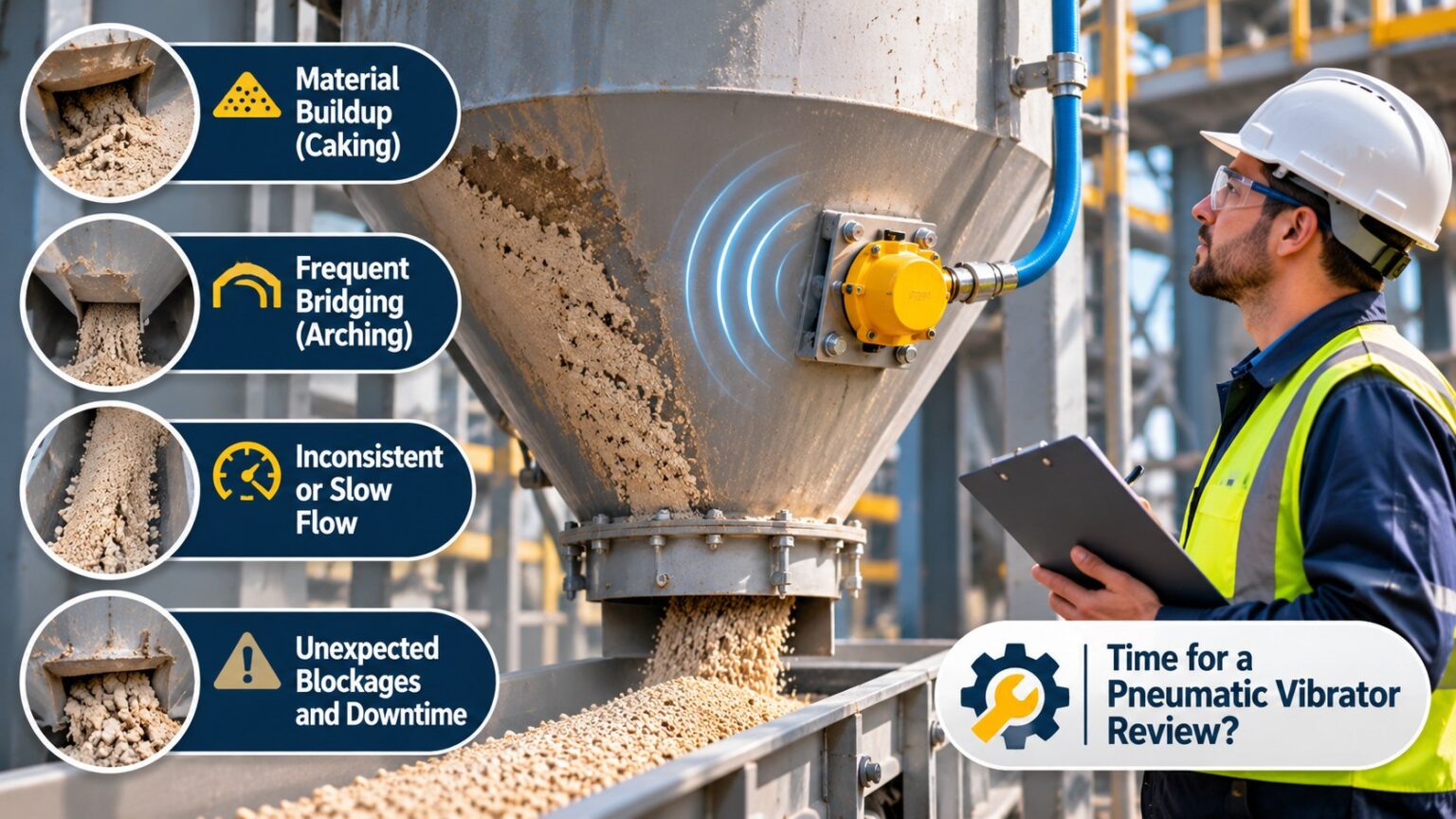
Bulk material that stops moving on time costs money every hour it sits. Throughput drops and maintenance lists grow while crews wait on a hopper that should empty by gravity. Those early misses are often the best time for a pneumatic vibrator review.
Discharge rates stop making sense
Discharge that swings from flood to trickle without a change in gate setting points to trouble inside the vessel. One minute the belt is loaded and the next it runs light. Downstream scales swing with it and batch weights drift. Logs taken from a safe location can show the pattern before crews notice it by eye. That record helps a qualified engineer see if the issue is flow or settings.
Conveyor transfer points often show the fault first. Dust puffs up at the skirts, spillage builds under the tail pulley, and the belt looks starved, then buried. The hopper above may look full and normal through a sight glass. Inside, material can hang on the walls while only a narrow core moves. Inconsistent discharge is an early signal that should trigger checks, not harder hammering.
CEMA guides link hopper wall angle and outlet size to reliable gravity flow. Steep walls and generous outlets suit sticky mixes. Shallow cones and small outlets invite hang-ups. Many older bins were sized for dry and free material. When the mix changes, the same steel does not act the same. A review starts with that mismatch between design intent and present duty.
That pattern is a warning.
Air use can shift at the same time. Solenoids cycle more often and receivers drain faster. Operators report that the plant sounds different near the bin. Don’t ignore that sign. Added air demand with less output means energy is spent without movement. A qualified check of bulk flow and available options is due at that point, and a vibrator is only one of those options.
Manual hits become part of the job
When a bar, mallet, or rod lives next to the hopper, the process has changed. Someone has accepted that flow needs a push. Output may look steady on paper because labor fills the gap. Labor hides downtime that still costs wages and delays. That habit hides the real fault.
Manual poking through an open hatch or hammering on a live vessel is not safe. Stored material can collapse without sign and trap anyone near the outlet, and pressurized air can release from a clogged line with force. Stored energy in gates and springs adds more risk. Only authorized site procedures with isolation and guards in place can control engulfment and pressure hazards, and no article can replace those steps.
A formal review is safer than repeated hits. Note how often help is needed per shift and what method is used. Record the time lost and the tonnage shortfall. Photos taken from guarded positions can show buildup lines and dead zones. Share that file with the maker or a bulk-solids engineer for assessment. The answer may be repair of existing gear, a change in outlet shape or liner, or no new device at all.
Construction sites feel this pressure in a direct way. Cement and aggregates must arrive on schedule to keep crews and mixers moving. If a batch plant hopper stalls, trucks queue and pour windows slip. Precast work faces the same pinch when a cement silo bridges before a morning cast. A bin that needs constant tapping is not fit for tight programs.
Bridging and rat-holing look different on site
Bridging and rat-holing are the two failure modes most crews meet. Both stop steady feed, but they fail in separate ways. A short check helps tell them apart before parts are ordered.
Bridging forms an arch or dome over the outlet. Material locks together and nothing drops, then a slab falls at once. The scale jumps from zero to overload. Flow aids such as air cannons and wall liners are sometimes used for this fault. Vibration is another option that suits some cases, but selection needs test data and maker input rather than habit.
Rat-holing cuts a steep pipe through the center while the rest sits still. Feed looks okay for a while because the core flows. Then the core empties and output falls off a cliff. Old material stays on the walls for days and can cake or spoil. Food plants see this with flour and sugar blends, and mines see it with damp fines. Construction batch plants see it with cement that has picked up moisture.
Particle traits drive both faults. Moisture content and cohesion decide if grains cling. Particle size and shape decide if they lock. Fine and damp mixes pack tight under head load. Coarse and dry mixes tend to arch less, yet they can still jam at a small outlet. There’s no single frequency fix for every bridging event. Model data and duty checks matter more than rules of thumb.
Damp material and new mixes test old settings
A plant that ran well for years can turn sour after a supply change. Quarry moisture rises after rain. A new cement source has finer grind. A food supplier changes starch ratio. The bin stays the same while the load acts new. Flow that was smooth starts to surge.
Sticky buildup narrows the outlet a little each day. Crews open the gate wider to hold rate. Wider gates raise head stress and pack the arch harder. The fix is not always more force on the same spot. In some cases added force packs damp fines tighter. That is why damp and compacted loads should prompt a system check by competent staff, with flow behavior and plant limits weighed before any device change.
Wall angle plays a large role here. A 60-degree cone that passed dry sand may stall on moist manufactured sand. Bin height adds load that squeezes lower layers. Weld seams and patch plates give sticky material a place to key. Specialists may review internal conditions only under an authorized inspection plan that controls stored material, all energy sources, access, and confined-space hazards. Safe remote inspection may show polish lines where flow rubs and dull patches where it never moves. Those marks map the dead area better than guesswork.
There’s no need to blame the crew for the shift. Materials vary by season and source. Screens blind, dryers drift, and stockpiles take on water. When change lines up with flow loss, note dates and test results. Moisture readings and sieve checks help the reviewer link cause and effect. Small data beats loud opinion when downtime is on the line.
Pneumatic and electric drives do not act the same
Electric rotary units spin an eccentric weight to shake the wall. They suit sites with stable power and clean covers. They can struggle where washdown is harsh or heat builds up in motor housings. Wet dust on terminals and seals shortens service life. Temperature extremes add stress that needs close review.
Air piston designs use shop air to drive a piston back and forth in a straight line. They have no windings to burn out and they stop when air stops. That trait draws interest for damp sheds and dusty galleries. Still, a pneumatic drive alone does not grant acceptance for a classified area. Dusty zones need specialist review to current hazardous-area standards, with documents checked for that site and that device. Don’t assume past papers cover new duty.
Air piston designs fall into two broad groups and operators who compare them can review the range of pneumatic linear vibrators available for mining and construction duty, while food plants tend to apply the same sizing checks. One group strikes the wall with each stroke. The other runs smooth without metal-to-metal hit. Choice turns on wall thickness and material response, plus air quality and noise limits on that floor.
Impacting types suit stubborn packs
Impacting units send a sharp pulse into the bin wall through a striker plate. That jolt can break an arch in cohesive powder. Thick plate spreads the hit without oil-canning. Thin sheet can dent or crack if the unit is too large for the panel. Exact force and speed differ by maker and frame size, so catalog data for that model should guide the pick. Field tuning should stay within the maker’s stated range.
Non-impacting types suit light powders and thin walls
Non-impacting units shake with high speed and lower peak force. They keep fine powders in motion without pounding the steel. Screens and small feeders often pair well with this style. Bins with light walls or crack history also lean this way. Again, designs vary a lot between brands and sizes. Noise output and air draw vary as well, so side-by-side data helps more than memory.
Compressed air systems set the ceiling for either style. Pressure and volume must hold during peak demand. Long runs with leaks starve the last leg. Filters and dryers matter because wet air gums pistons and valves. If the compressor hunts when the vibrator fires, capacity is short. A qualified tech should check lines and drains before fault is pinned on the device.
Mounting, air supply and noise point to hidden faults
A good unit on a weak mount wastes motion. Stiffeners should spread load into the cone, not into a lone patch. A plate that flexes and drums eats energy as sound. Bolts that loosen each week point to poor contact or wrong size. Guards should sit firm without rattling against the shell. Only trained staff should inspect or adjust mounts, with energy locked out per site rules.
Noise change is useful data. A unit that turns shrill may run dry or starve for air. A unit that goes dull may have a worn piston or clogged muffler. Crews near food lines or night work in construction zones notice sound fast. Meter readings taken at set spots help track drift. Rising decibels with flat output suggest wear rather than load change.
Air loss tells a similar tale. Hoses that sweat oil, fittings that hiss, and valves that stick all cut stroke power. Moisture in the bowl points to dryer trouble. Rust dust hints at pipe scale moving downstream. Clean, dry air extends seal life and holds timing steady. Capacity checks should cover peak use, not idle, since bins often call for air when dust collectors and air cannons fire too.
Undersize gear breeds false lessons. A small shaker on a large cone moves a hand-sized patch and leaves the arch intact. Staff then say vibration does not work on that material. Oversize gear brings the reverse risk. Heavy hits on thin walls can start fatigue cracks at welds. Strong shake can also sort mixed aggregate by size and hurt blend quality. Fit must match steel gauge and load, with maker sizing charts used as the base.
What a careful review covers before new parts are ordered
A review is diagnostic rather than a sales step. It starts with safe logs of rate, gate position, and stoppages. It adds notes on recent material shifts and weather exposure. It maps where buildup sits and where flow rubs. Photos and trends beat recall when the fault comes and goes.
Next comes hardware state. Mount structure and welds get a close look by competent eyes. Duty air quality and line capacity get measured under load. Noise and guard state get noted. Service age and spares history show if seals and pistons owe replacement. A review is diagnostic, not a sales step that ends with a box on a truck.
Pilot runs should be metered when they happen. Run one change at a time and log rate before and after. Watch for segregation in mixed stone or feed blends. Watch for caking in warm and damp powders. Short trials do not promise plant-wide results. They only show if that setting helped on that day with that load. Repair of mounts or air lines may beat redesign. Redesign of outlet shape or wall angle may beat new force.
End users across mining and food processing face the same choice as construction batch plants. Keep patching a weak bin or fix the cause. Flow aids have a place in that answer. Liners cut friction on some walls. Air cannons break some arches. Vibrators keep some loads in motion. The right mix comes from measured checks and maker advice, not from louder hits or longer rods.
Flow that falters is asking for a closer look. Catch the swing in rate, name the fault, and check mounts and air with skilled help. Order steel and air time before ordering parts. Steady bins pay back that care with full loads and quiet shifts.
