
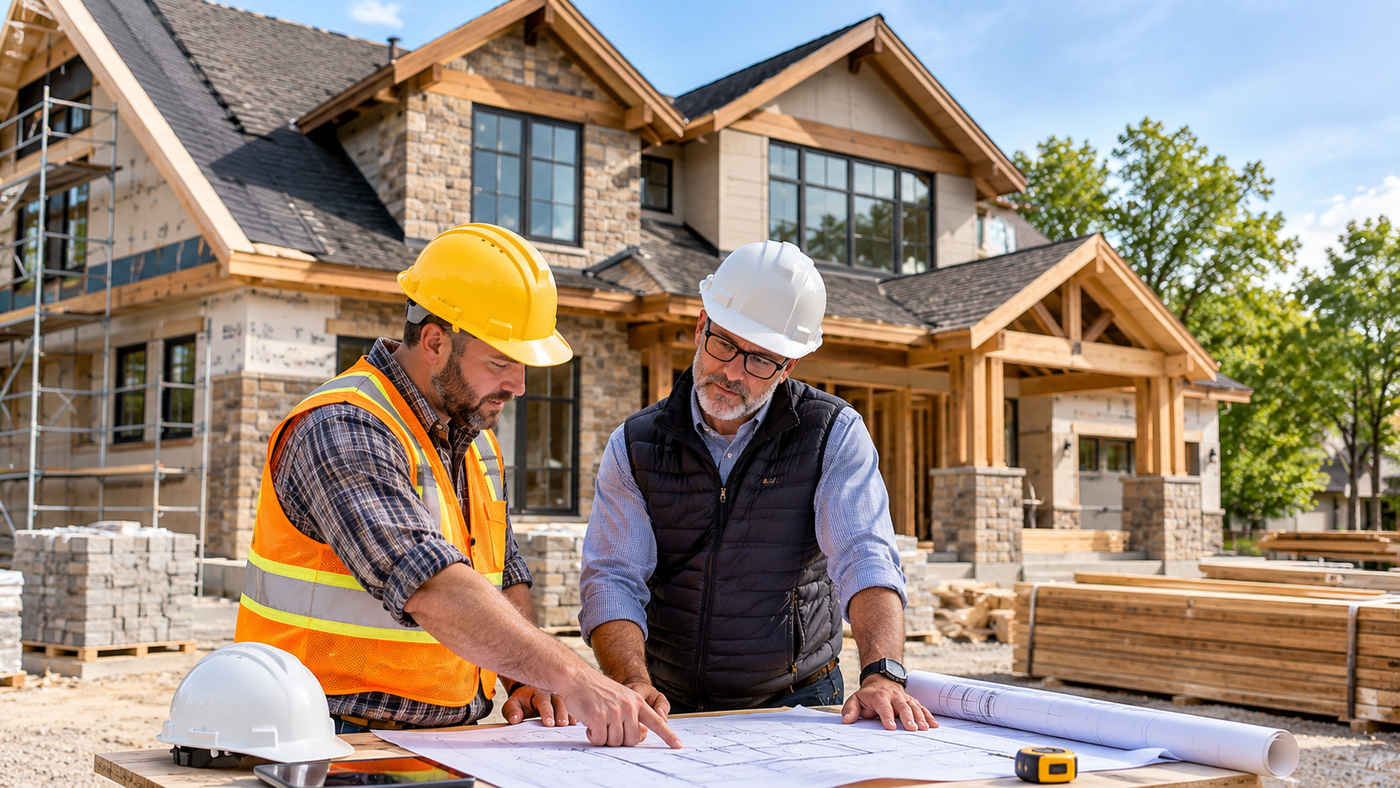
Choosing a custom home builder is one of the most consequential decisions in a new-home project. The builder coordinates the people, materials, schedule, and quality checks that turn architectural drawings into a finished home. A capable professional also helps homeowners understand what their budget can realistically deliver, identify costly site conditions, and make decisions before changes become expensive.
A custom home can provide a layout tailored to your family, work routines, accessibility needs, and preferred materials. But customization also introduces decisions about land, utilities, design fees, construction contracts, permits, financing, and inspections. Attractive renderings alone cannot tell you whether a project has a reliable budget or a practical construction plan.
This guide explains how to evaluate builders, compare quotations, understand common contract structures, manage construction milestones, and verify quality before move-in. The focus is on decisions that homeowners can document and discuss with licensed professionals, rather than promises of a perfect project with no surprises.
What Does a Custom Home Builder Do?
A custom home builder manages residential construction around a specific owner’s approved plans and requirements. Depending on the business model, the company may help identify a suitable lot, coordinate an architect, estimate construction costs, select subcontractors, obtain permits, supervise trades, arrange inspections, and organize final handover.
The exact responsibilities should appear in the written agreement. Some builders provide design-build services under one contract; others build from drawings commissioned independently by the homeowner. Neither approach is inherently superior. The right choice depends on how decisions, design responsibility, cost control, and construction supervision will be managed.
Custom Home vs. Production Home
A production home typically uses established plans and specifications within a particular development, sometimes allowing selected upgrades. A custom home is designed or substantially adapted for one homeowner and site. Customization can offer more flexibility, but it often requires more active decisions and can make prices less predictable until the plans and specifications are complete.
Builder, Architect, and General Contractor: Who Does What?
The architect or designer develops the space planning and technical documents within the scope of their agreement. Engineers address defined structural or building-system questions. A custom home builder commonly oversees construction and coordinates subcontractors. A general contractor may serve that role on a custom project, but the labels alone do not define what each company is responsible for.
Why Written Responsibility Matters
Identify who controls design revisions, coordinates engineering, orders long-lead materials, handles inspections, and communicates cost changes. Ambiguous responsibility can delay decisions when a drawing conflicts with field conditions.
20 Powerful Tips for Choosing the Right Custom Home Builder
1. Define Your Priorities Before Meeting Builders
List the spaces and outcomes that matter most: bedroom count, flexible work areas, accessible entry, storage, outdoor living, low-maintenance finishes, or energy efficiency. Separate essential needs from preferences you would remove if costs rise. An experienced custom home builder can respond more usefully to a prioritized brief than to a collection of inspiration photos without a budget.
2. Set a Realistic Total Project Budget
Consider more than the price to construct the house. Land, surveys, design and engineering fees, soil investigations, permits, impact fees, temporary utilities, landscaping, financing charges, and contingency can all affect total spending. Ask for a preliminary budget that distinguishes estimated costs from confirmed quotations. Do not treat a cost-per-square-foot headline as a comprehensive price.
3. Research Builders With Relevant Experience
Look for completed projects similar in size, architectural complexity, climate, and price range. A company experienced with modest single-story houses may not be the best match for an intricate hillside residence. Ask your local home builders’ association, trusted professionals, and previous clients for leads. Experience should be relevant to your project, not just measured by years in business.
4. Verify Licensing, Insurance, and Business Identity
Licensing and registration requirements vary by state and local jurisdiction. Check the contractor’s legal business name and credentials with the relevant authority. Request current general liability coverage and appropriate workers’ compensation information, then confirm details where necessary. A polished website is not proof that a custom home builder meets local requirements.
5. Speak With Recent Homeowners, Not Only Sales Staff
Ask for references from completed homes and, where practical, projects still underway. Find out how the builder communicated budget changes, corrected defects, handled weather delays, and followed up after move-in. A useful question is whether the owner would choose the same company again. Treat anonymous ratings as a starting point rather than a complete quality check.
6. Visit a Finished Home and an Active Site
A completed home shows finish quality; an active site reveals organization, material protection, and supervision. Look at trim alignment, doors, cabinetry, drainage details, and visible workmanship without entering restricted areas. Ask how the company documents work that will be hidden behind drywall. Site visits should be arranged and supervised, with appropriate safety precautions.
7. Investigate the Lot Before Finalizing Design
A beautiful property may have steep grades, difficult access, poor soils, drainage concerns, or expensive utility connections. Before committing to the full design, investigate zoning, setbacks, easements, survey boundaries, flood exposure, septic suitability where applicable, and utility availability. The custom home builder should coordinate with suitable surveyors and engineers rather than assume all sites support the same floor plan.
8. Decide Who Will Lead the Design Process
Some homeowners hire an independent architect first; others prefer a design-build team. Ask who owns and can use the drawings, how design revisions are approved, and whether the architect’s contract includes site visits during construction. Select a process that provides clear accountability and enough design detail to price the home accurately.
9. Request a Transparent Specification Package
The phrase “high-end finishes” means little without product details. Ask for documented assumptions covering foundations, framing, roofing, windows, insulation, HVAC, plumbing fixtures, cabinets, countertops, flooring, lighting, and landscaping. A custom home builder should identify which selections are fixed, which are allowances, and which remain undecided.
10. Compare Fixed-Price and Cost-Plus Agreements
A fixed-price contract establishes an agreed price for a defined scope, subject to specified changes and conditions. Cost-plus typically charges eligible construction costs plus a stated fee or markup. Both approaches are used in custom construction. Compare what is included, how invoices are reviewed, whether there is a cap, and who carries the risk of cost changes. Have a qualified construction attorney review significant commitments.
11. Understand Allowances and Selection Deadlines
An allowance is a budget placeholder for an item not yet selected, such as tiles or appliances. If the actual choice costs more, the difference may increase the final bill and sometimes the builder’s fee. Request realistic allowances and a selection schedule. Choosing major items early helps the custom home builder obtain more accurate pricing and avoid rushed decisions during construction.
12. Review the Payment Schedule and Draw Process
Construction payments are commonly linked to agreed milestones and lender inspections. Avoid paying substantially ahead of work completed without appropriate protections. Ask how each draw is supported, what documentation is provided, and whether applicable lien waivers or releases will be collected. Local law and lender rules affect the correct approach, so confirm these details with your lender and attorney.
13. Agree on Change-Order Rules in Advance
Changing a window size, moving plumbing, or switching finishes after construction begins can affect materials, labor, permits, and schedule. The contract should require written approval of the price and time impact before non-emergency changes proceed. A clear change-order process protects both homeowner and custom home builder from misunderstandings.
14. Evaluate Energy Performance as a Whole System
Better insulation, continuous air sealing, suitable windows, planned ventilation, and properly sized heating and cooling equipment work together. Ask about the home’s proposed energy-code compliance method, blower-door testing where applicable, and relevant independent certification options. Solar panels do not compensate for poor moisture protection or leaky building details. Discuss performance before the plans are finalized.
15. Ask How Moisture and Drainage Are Managed
A reliable house must control rainwater, ground moisture, and indoor condensation. Review roof drainage, flashing, site grading, foundation waterproofing or dampproofing, and the drying potential of wall assemblies. A custom home builder should explain how materials are protected during construction and how wet products are handled before interior finishes cover them.
16. Clarify Permits, Inspections, and Code Responsibility
Permits and inspections depend on local rules and the work proposed. Confirm who applies for permits, schedules required inspections, handles corrections, and obtains the certificate of occupancy or equivalent approval when required. Building-code compliance is a baseline requirement, not evidence that every custom finish or design choice meets your personal expectations.
17. Review the Schedule and Long-Lead Purchases
Custom windows, specialty doors, cabinets, electrical equipment, and selected finishes can affect the construction sequence. Ask for a realistic milestone schedule showing decision deadlines, ordering, rough-in, inspections, finishing, and handover. Weather and unforeseen conditions may create delays; the agreement should describe how updates and schedule revisions are communicated.
18. Build Independent Quality Checks Into the Plan
Municipal inspectors focus on defined code requirements, not every workmanship issue. Consider qualified third-party inspections at appropriate stages, such as foundation, framing, insulation or pre-drywall, and completion. Ask the custom home builder how deficiencies will be documented and corrected. The ability to inspect concealed systems before they are covered can be especially valuable.
19. Study Warranties and Aftercare Before Signing
Clarify which obligations come from the builder, subcontractors, and product manufacturers. Ask about exclusions, reporting deadlines, emergency contact procedures, and whether the warranty transfers if the home is sold. A warranty is useful only if the company remains reachable and the homeowner understands the process for requesting corrective work.
20. Choose Clear Communication Over Big Promises
Building a one-off home requires many decisions. Establish who is the day-to-day contact, how often written updates arrive, and where plans, selections, invoices, and changes are stored. The best custom home builder for your project is one whose process you can understand and whose claims can be checked, not necessarily the one offering the lowest preliminary number or fastest verbal completion date.
How Much Does a Custom Home Builder Cost?
Costs vary substantially by market, home size, site conditions, design complexity, labour availability, finishes, and the type of construction contract. A custom home builder may quote a fixed price for an adequately defined scope or use a cost-plus arrangement with specified fees. No nationwide price per square foot can accurately cover every lot, foundation, utility connection, and level of customization.
Hard Costs and Soft Costs
Hard costs generally refer to physical construction, including materials, subcontracted labor, and site work. Soft costs may include design fees, permits, surveys, engineering, financing, legal review, and certain insurance expenses. Ask for both categories so the total investment is visible.
Site Work and Utilities Can Change the Budget
Excavation, retaining walls, grading, drainage, driveway access, utility extensions, wells, and septic systems can add substantial expense depending on the lot. Get site-specific information early. A bargain-priced parcel may cost more to prepare than a more expensive lot with suitable services already available.
Plan for Contingency Without Giving Unlimited Approval
A contingency can help absorb reasonable unknowns, but it should not replace proper design or responsible estimating. Decide who controls the contingency and what documentation is needed before it is spent. Under a cost-plus agreement, ask whether the builder’s fee applies to contingency-funded work.
Comparing Two Proposals Fairly
Put each proposal against the same plans, specifications, allowances, and site assumptions. A low bid with excluded landscaping, utility fees, or basic fixtures may exceed a higher but more complete quotation once everything is included. Compare scope and risk, not merely the final number on page one.
The Custom Home Building Process From Land to Move-In
The overall journey often follows a sequence, although design-build teams may overlap some stages. A capable custom home builder should provide a project-specific process rather than promising that every home can be completed in the same number of months.
Feasibility, Land Review, and Preliminary Design
The team investigates site limitations, establishes a budget range, and turns the homeowner’s priorities into conceptual plans. Early consultation with zoning officials, lenders, surveyors, and engineers can reveal problems before detailed drawings are purchased.
Construction Documents and Approvals
Architectural plans, structural requirements, and mechanical or electrical design information are developed as needed. Major materials and allowances become more specific. Required permits are submitted and any requested revisions are addressed before work begins.
Site Preparation, Structure, and Building Envelope
Construction progresses through clearing and grading where approved, foundations, framing, roofing, windows, exterior weather barriers, and related components. Proper sequencing protects work from rain and reduces the risk of closing damp assemblies. Inspections should occur at the stages required by local authorities and the contract.
Systems, Insulation, and Interior Finishes
Plumbing, electrical, and HVAC trades complete rough-in work followed by inspections where applicable. Insulation and air-sealing details are checked before walls are closed. Drywall, interior trim, cabinets, flooring, fixtures, and final finishes follow according to the project schedule.
Commissioning, Punch List, and Handover
The builder tests relevant systems, resolves outstanding deficiencies, supplies manuals and warranties, and completes the required approvals. Before closing, conduct a documented walkthrough and consider an independent home inspection. Understand what remains on the punch list and when each item will be corrected.
How to Evaluate Construction Quality Beyond Appearance
A handsome kitchen and a clean paint finish are appealing, but they do not reveal how the home manages water, energy, or structural loads. When evaluating a custom home builder, ask about quality-control inspections for foundations, wall bracing, flashing, air barriers, ventilation, and plumbing before those elements are concealed.
Building Envelope Performance
A continuous air barrier and suitable insulation can improve comfort and help control unwanted heat loss or gain. Windows and doors require compatible flashing and drainage details. The appropriate assemblies depend on climate, code, and the home’s design; do not assume one wall system is ideal everywhere.
HVAC, Ventilation, and Indoor Comfort
Equipment should be selected using a building-specific load calculation rather than a simple floor-area rule. Ventilation should suit the home’s intended occupancy and airtightness, while moisture-producing rooms need appropriate exhaust. Document balancing, commissioning, filter requirements, and controls so occupants know how to operate the systems.
Evidence of Workmanship
Request dated progress photos, inspection records, product details, and documented corrections. A custom home builder who maintains organized records makes it easier to resolve warranty questions and future maintenance issues. Independent inspectors can provide another perspective, though their work does not guarantee the absence of every defect.
Common Mistakes When Hiring a Custom Home Builder
A common mistake is choosing a company solely because its early estimate is far lower than competing offers. Another is beginning construction while major selections remain undefined. Both can produce expensive change orders and delays. Homeowners should also avoid accepting ambiguous promises about completion dates, upgrades, or warranties instead of clear written terms.
Overlooking the Cost of the Land
Buying a lot before checking access, utilities, setbacks, soil conditions, and drainage may constrain the design or increase construction spending. Ask relevant professionals to evaluate the site before treating the purchase as final, where contract conditions permit.
Rushing Design Decisions
Moving walls or changing mechanical systems after framing has begun can create cascading work. A carefully planned design phase is not wasted time. It often offers the best opportunity to control later changes.
Treating Permits as the Entire Quality Program
Code inspections verify particular requirements at particular stages. They do not replace contractual quality standards, good supervision, or an owner walkthrough. Put both compliance responsibilities and finish-quality expectations into the project documents.
Questions to Ask Before Signing a Custom Home Contract
A custom home builder interview should cover practical processes, not just photographs and references. Request sample scopes, schedules, warranty documents, and the method for explaining cost changes. Ask who supervises the site daily, which trades are subcontracted, how design discrepancies are resolved, and how often the owner receives budget updates.
Also ask whether the quoted price includes site development, design revisions, appliance installation, landscaping, driveway work, utility connections, and required inspections. If anything is excluded, identify who is responsible and how it will be funded. A qualified construction attorney can help interpret the proposed contract before you commit significant money.
Frequently Asked Questions
1. What does a custom home builder do?
A custom home builder typically coordinates construction, subcontractors, materials, schedules, permits, inspections, and handover for a house designed around a specific client’s needs.
2. Is a custom home more expensive than a production home?
It can be, because one-off design, site work, and personalized finishes may cost more. Actual value depends on location, scope, materials, and what each price includes.
3. How long does it take to build a custom home?
Timing varies with design approvals, permits, weather, builder capacity, material lead times, and project complexity. Request a milestone schedule instead of relying on a universal estimate.
4. Should I hire an architect or a builder first?
Either approach can work. An independent architect offers one model; design-build integrates design and construction. Compare responsibilities, fees, and how design decisions affect pricing.
5. What is better: fixed-price or cost-plus construction?
Neither is automatically best. Fixed-price contracts define a price for a stated scope, while cost-plus contracts reimburse eligible costs plus an agreed fee. Review exclusions and risk allocation.
6. How can I verify a custom home builder is reliable?
Check relevant licensing, insurance, recent references, completed work, clear written contracts, inspection practices, communication, and warranty support before hiring.
Conclusion
The right custom home builder brings disciplined planning, transparent pricing, and dependable construction oversight to a highly personal project. Start with the lot and total budget, review detailed specifications and contract terms, and verify quality throughout construction rather than waiting for move-in. Independent advice and documented inspections can reduce avoidable risk, while clear communication keeps decisions manageable. A well-planned custom home should suit the people who live in it as well as the site and climate around it.
