
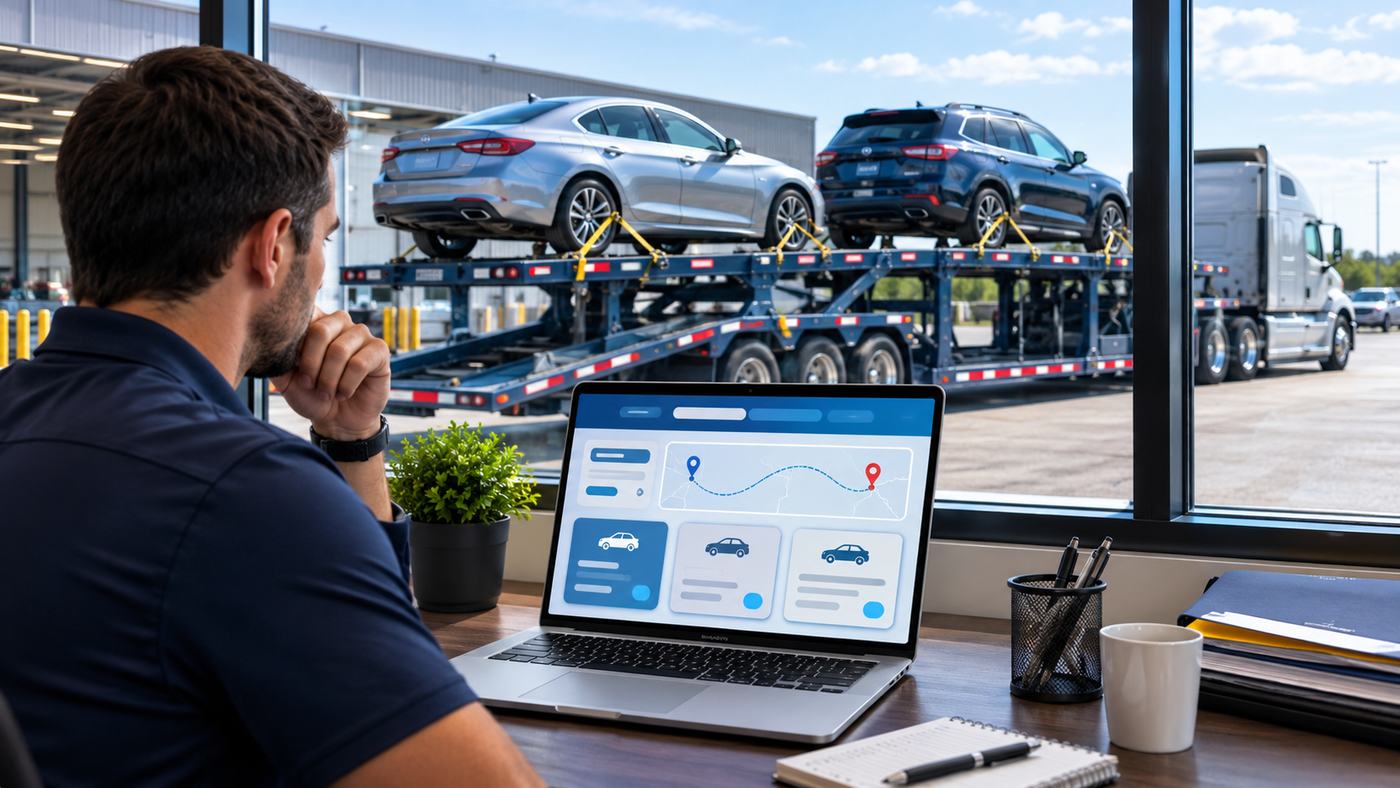
Moving a car to another city can be harder to budget than the rest of a move. The final price is not based on mileage alone: it depends on where the vehicle starts and ends, its size and condition, the trailer used, pickup flexibility, and the number of transporters serving the route. A car shipping calculator gives drivers a starting estimate before they talk to an auto transport broker or carrier. Used correctly, it can help compare options and highlight details that might otherwise increase the eventual bill.
The key word is estimate. An online result is not automatically an available truck, a guaranteed pickup date, or a binding transportation contract. Some tools use historical shipments, current carrier data, and route assumptions; others simply apply a price-per-mile formula. Either approach can be useful if the buyer understands what is included and verifies the terms before booking.
This guide explains how car shipping estimates are calculated, the difference between open and enclosed transport, what current U.S. pricing research suggests, and nine practical strategies for avoiding unnecessary costs. It also covers federal registration checks, inspection paperwork, cargo coverage questions, and what to do if a quote changes. The focus is domestic U.S. auto transport; Alaska, Hawaii, international shipping, and specialty vehicle movements may require substantially different arrangements.
What Is a Car Shipping Calculator?
A car shipping calculator is an online estimation tool that uses shipment details to predict the likely cost of transporting a vehicle. Most ask for a pickup and destination city or ZIP code, the car’s year, make and model, whether it runs, the preferred shipping method, and an approximate ready date. Some tools provide a planning range immediately, while others request contact details and return a quote from a broker or transport company.
A well-designed car shipping calculator makes its assumptions clear. For example, a base estimate may assume a standard-size, operational sedan on an open multi-vehicle trailer, with flexible pickup dates and accessible locations. A lifted truck, non-running vehicle, or enclosed transport request needs different pricing.
Calculator Estimate vs. Confirmed Quote
An estimate predicts a likely cost. A quote communicates what a particular business proposes to charge. A booking creates a contractual arrangement subject to agreed terms. These are distinct stages, and a displayed number should not be treated as guaranteed unless the provider expressly commits to it in the final agreement.
Montway’s published explanation of its car shipping calculator, for example, states that its instant prices are not final until booking is completed. Industry comparisons likewise warn that quotes can change when shipment information or carrier availability changes. Ask the provider what must happen before the total is locked and under what circumstances it may be revised.
Who Benefits From Using One?
A car shipping calculator can help people relocating for work, buying an out-of-state car, moving for college, arranging seasonal travel, or transferring a vehicle to a family member. Dealers and fleet administrators may use similar tools, although their commercial rates and shipping processes can differ from one-vehicle consumer bookings.
How Does a Car Shipping Calculator Work?
Auto transport pricing reflects both the cost of the route and the capacity of available trailers. A carrier needs to cover fuel, driver time, equipment, loading, and operations while filling enough trailer space to make a trip viable. A broker may use historical rates or available carrier offers when preparing an estimate.
| Calculator input | Why it matters | Detail to check |
|---|---|---|
| Pickup and delivery ZIP codes | Establish route and access conditions | Exact cities and whether a large truck can stop nearby |
| Distance | Usually increases total transport cost | Road route, not straight-line map distance |
| Year, make, model | Determines typical size and loading fit | Modifications, height, ground clearance |
| Operating condition | A non-running car needs special handling | Whether it can roll, steer, and brake |
| Open or enclosed trailer | Affects availability and protection | Confirm the actual equipment requested |
| First available pickup date | Helps match carrier schedules | Window versus guaranteed date |
| Service type | Door-to-door versus terminal options | Terminal availability and extra handling |
| Season and route demand | Can change the market rate | Whether prices are current or historical |
Why a Single Price-per-Mile Formula Falls Short
Longer moves usually cost more overall but often less per mile. A 200-mile shipment has loading and dispatch costs that do not disappear merely because the distance is short. A 2,000-mile move can spread some fixed costs over far more miles. Carrier capacity, city access, and the direction of traffic on the route can further change the price.
A simple car shipping calculator formula can be useful for a rough budget, but it cannot prove that a carrier will accept the job. The best car shipping calculator should make it clear whether the figure is a mathematical planning range or a price based on an available transport service.
9 Brilliant Ways to Cut Costs With a Car Shipping Calculator
1. Compare Quotes Using Exactly the Same Shipment Details
The fastest way to misread quotes is to give each provider different information. Use the same pickup and destination locations, vehicle specifications, ready date, and trailer type. If a car has oversized tires or a nonstandard roof rack, disclose those changes to all providers.
Record the details in one document so each price can be compared fairly. A quote for an open-trailer sedan cannot be directly compared with an enclosed-trailer SUV price. Using a car shipping calculator consistently turns scattered prices into a useful decision framework.
2. Choose Open Transport When It Fits the Vehicle
Open multi-vehicle carriers are the standard option for many ordinary cars and are generally less expensive than enclosed transport. The trade-off is exposure to weather, road dust, and other environmental conditions during travel. Enclosed service provides additional shielding and may be preferred for certain classic, exotic, restored, or high-value vehicles.
Sherpa Auto Transport’s July 2026 analysis of its own shipments reported average open transport of $1,238 and enclosed transport of $1,852. That is a provider-specific historical comparison, not a guaranteed nationwide rate. Use the difference as a reason to compare options, not as a prediction for your route.
3. Allow a Flexible Pickup Window
Specific pickup deadlines can restrict which carriers can accept the trip. If the vehicle can be available across several days, the broker or carrier may have more chances to match an existing route. Flexibility is especially valuable when transporting a vehicle between less busy markets.
A first-available date is not the same as the day the truck will arrive. When you use a car shipping calculator, distinguish between the date you are ready to hand over the car and a guaranteed collection appointment. If your employer, flight, or home purchase creates a hard deadline, ask what that commitment costs and how it is documented.
4. Check Nearby Pickup and Delivery Access
Large vehicle carriers cannot necessarily enter a narrow residential lane, gated development, or steep neighborhood street. The driver may need a mutually agreed meeting point such as a suitable accessible parking area. Rural pickup and delivery can also add mileage and reduce available routes.
Ask whether a nearby truck-accessible location could change the quote. Do not agree to meet in an unsafe area or at a location where parking or commercial vehicle access is prohibited. The carrier should confirm a lawful, practical handover arrangement.
5. Enter the Vehicle’s Actual Dimensions and Condition
An ordinary sedan takes less trailer space than some large SUVs, pickup trucks, or modified vehicles. Height, length, ground clearance, and weight influence loading compatibility. A non-running vehicle may need a winch or other appropriate equipment, which can increase the price.
Describe the vehicle accurately from the beginning. If the calculator assumes the car starts, steers, rolls, and brakes normally, tell the operator immediately when that assumption is wrong. Understating problems might produce a lower initial estimate but an avoidable delay or revised price at pickup.
6. Compare Complete Prices Rather Than the Lowest Headline Rate
The lowest estimate is not automatically the lowest final cost. Ask whether the figure includes the carrier’s transport charge, broker fee, fuel-related adjustments, special equipment, applicable taxes, and other agreed expenses. Confirm the deposit amount, due date, and accepted payment methods.
Request the total in writing and ask which conditions can increase it. A low quote that never attracts an available carrier may not meet your schedule. A slightly higher documented price with clear terms may provide better planning certainty than a promotional number with unresolved details.
7. Review Seasonal and Directional Demand
Auto transport demand can rise during moving periods, holidays, and seasonal relocations. Routes toward warmer states can be busy in one season and busy in the opposite direction at another time. Costs also reflect fuel and carrier supply.
Try alternate ready dates with the same car shipping calculator to understand whether a small schedule change affects the estimate. Do not assume that one month is cheapest for every route. A current route-specific quote is more informative than a blanket seasonal promise.
8. Verify Brokers and Carriers Before Paying
The Federal Motor Carrier Safety Administration distinguishes an auto transport broker, which arranges a shipment, from a carrier, which physically moves the car. For interstate work, relevant businesses must have the appropriate FMCSA registration. The agency advises consumers to check the company’s MC docket number and warns against websites that do not clearly identify whether the business is a broker or transporter.
Use FMCSA’s official Licensing and Insurance lookup rather than relying only on claims shown on a comparison website. Verify the legal business identity and relevant operating authority. Ask who will actually carry the vehicle and review the carrier’s specific coverage and terms before dispatch. Registration is a baseline check, not a guarantee of service quality.
9. Confirm the Final Agreement Before You Commit
A car shipping calculator can produce a useful estimate in seconds, but the shipment agreement decides what happens next. Read the deposit and cancellation terms, carrier assignment process, pickup window, balance due, vehicle condition requirements, and damage procedures.
Ask who receives each payment and whether any amount is due directly to the carrier at delivery. Save the quote, receipt, confirmation, and written messages. Clear paperwork is one of the simplest ways to keep a low-cost shipment from turning into a costly dispute.
How Much Does It Cost to Ship a Car?
There is no universal shipping price because mileage, vehicle type, trailer choice, route demand, and scheduling differ. A 2026 FreightWaves Checkpoint guide published broad planning ranges for an operable standard sedan on open transport. Its bands are useful for context, not a substitute for quotes from a business accepting your specific shipment.
| Approximate shipping distance | Illustrative published range | Important caveat |
|---|---|---|
| Under 500 miles | $540–$1,100 | Short trips can have higher cost per mile |
| 500–1,500 miles | $700–$1,800 | Route popularity and vehicle size still matter |
| Over 1,500 miles | $1,050–$3,000+ | Cross-country and remote shipments vary widely |
These ranges overlap because distance is only one factor. They are attributed to one published market guide, not a guaranteed price schedule and not an average drawn from every U.S. shipment. Use the car shipping calculator with actual ZIP codes and dates to refine the estimate.
Why Does Enclosed Shipping Cost More?
Enclosed carriers generally transport fewer vehicles and use specialized trailers. They offer greater shielding from weather and road debris but can have less availability on certain routes. Whether the premium makes sense depends on the vehicle’s value, condition, exposure tolerance, and the owner’s preferences.
What About Shipping a Non-Running Vehicle?
Tell the provider whether the car rolls, steers, brakes, and can be shifted safely. Even when an engine will not start, some carriers may be able to load the vehicle with appropriate equipment. A car with locked wheels or significant collision damage may need more specialized handling. Obtain an equipment-specific quote rather than applying a generic surcharge without checking feasibility.
Does Door-to-Door Always Mean My Driveway?
No. Door-to-door transport generally means pickup and delivery as close to the specified addresses as safely and legally practical. A large auto hauler may not reach the exact home or building entrance. Confirm the meeting location, any access limitations, and who must be present to transfer keys.
Car Shipping Calculator Formula: A Useful Illustration
Many rate guides use price per mile to illustrate how costs might be estimated. For a hypothetical 1,000-mile shipment, suppose a planning model uses a $300 fixed dispatch component and a $0.65-per-mile transport component. The rough estimate would be:
$300 + (1,000 × $0.65) = $950
This is a made-up example to explain the arithmetic, not a carrier’s actual pricing formula or a current quote. Real pricing may reflect route-specific bids, vehicle capacity, demand, fuel, and margins rather than a neat mileage equation. Do not add arbitrary percentages to a website’s quote unless the provider identifies them as actual charges.
Estimate Versus Booked Rate
A useful calculator shows its assumptions and tells users what to do next. A provider’s confirmed order should identify the vehicle, route, service, payment terms, and conditions for any change. If those details are missing, the number should remain a budgeting estimate.
Open vs. Enclosed Auto Transport
| Feature | Open transport | Enclosed transport |
|---|---|---|
| Trailer | Open-sided carrier | Covered carrier |
| Weather exposure | Yes | Reduced exterior exposure |
| Typical price | Usually lower | Usually higher |
| Carrier availability | Often greater | May be more limited |
| Common use | Daily drivers, standard cars | Select classics, luxury, specialty vehicles |
| Best decision factor | Cost and availability | Extra protection and owner preference |
Neither option eliminates every risk. Cars may still need inspection at pickup and delivery, and coverage details vary by company. A reputable carrier should explain the actual trailer equipment used and the limits of its insurance.
How to Use an Online Car Shipping Calculator Step by Step
Step 1: Enter the Origin and Destination
Use accurate cities or ZIP codes. If the exact address has truck restrictions, disclose that before booking. For a vehicle purchased from a dealership or auction, confirm operating hours and release requirements.
Step 2: Identify the Vehicle Precisely
Provide year, make, model, body style, and any modifications that affect size or loading. A lifted pickup and a factory-standard sedan may require different handling even on the same route.
Step 3: Select Open or Enclosed Transport
Choose the trailer that fits your priorities. If you are uncertain, request both estimates using otherwise identical details. This isolates the cost of the transport type.
Step 4: State Whether the Car Is Operable
Explain any mechanical or collision-related limitations. The carrier needs to know whether the vehicle can safely be moved on and off a trailer. Do not wait until loading to report a problem.
Step 5: Choose a Realistic Ready Date
Enter the first date the car can be collected, not the date you hope it will arrive. Ask separately about expected dispatch, transit, and delivery windows. Weather and truck routing can affect schedules.
Step 6: Review the Scope Behind the Price
Check what the car shipping calculator assumes about access, insurance, equipment, fees, and carrier availability. Take note of whether the result is an estimate, a broker offer, or a confirmed booking quote.
Step 7: Verify and Compare Written Offers
Collect comparable quotations and check the responsible businesses in FMCSA records. Review the actual contract before giving payment information. A reliable decision involves more than selecting the smallest number.
Broker vs. Carrier: Know Who Is Handling Your Vehicle
An auto transport broker arranges the transportation with a motor carrier. The motor carrier operates the truck and physically transports the car. Some businesses may have different entities or operating models; verify the specific party named in your contract.
FMCSA’s auto transporter consumer advisory specifically recommends verifying registration and distinguishing brokers from carriers. Its guidance also explains that damage claims are generally filed with the relevant motor carrier, though a broker may help with the process.
Important Questions for the Broker
Ask when a carrier will be assigned, whether the quoted total is guaranteed, the broker’s cancellation and deposit conditions, and what happens if no suitable truck accepts the load. Get the carrier’s identity when assigned and review the pickup instructions.
Important Questions for the Carrier
Ask about vehicle handling, the planned trailer, cargo coverage, exclusions, inspection paperwork, and delivery communication. Verify the company name matches the records and dispatch information you received.
Auto Transport Insurance and Vehicle Inspection
A car shipping calculator rarely explains insurance protection in full. FMCSA has filing requirements for operating authority, but the presence of a federal insurance filing does not by itself establish that your particular car will be covered for its full value against every cause of damage. Request the carrier’s motor truck cargo coverage information and ask about limits, deductibles, exclusions, and the claims process. Discuss especially valuable or modified vehicles in advance.
Before Pickup
Clean the exterior enough to see its condition and take time-stamped photographs from multiple angles, including existing scratches or dents. Remove loose valuables and follow the carrier’s policy on personal items. Keep fuel, battery, keys, alarm settings, and special operating instructions consistent with the transporter’s preparation guidance.
At Pickup
Review the vehicle condition report or bill of lading with the driver and make sure existing damage is accurately recorded before signing. Keep a copy. Do not sign a statement you believe is false simply to speed up loading.
At Delivery
Inspect the car carefully in suitable light. Compare its condition with the earlier photographs and documents. Record any new concerns on the delivery paperwork before accepting final condition statements, where the process permits. Contact the carrier promptly about suspected transport damage and follow its formal claims instructions.
How Long Does Car Shipping Take?
Transport involves at least two scheduling questions: when the carrier picks up the vehicle, and how long the trip takes after loading. Calculators often focus on price, while availability and dispatch scheduling may be determined later.
A short route may require less driving time but still involve waiting for a carrier with available space. Cross-country trips take longer and can be affected by additional pickups, weather, traffic, regulatory driving limits, and delivery appointments. Published transit ranges are estimates rather than contractual deadlines.
Planning Around a Hard Deadline
If the car must arrive before a job start, move-in date, or flight, build a buffer or arrange alternate transportation. Ask whether the provider offers a documented guaranteed pickup or delivery arrangement and exactly what happens if the commitment is missed.
Seasonal and Specialized Routes
Movements to or from seasonal destinations, less populated areas, and noncontiguous U.S. locations may need different logistics. The car shipping calculator may not capture port handling, ferry schedules, or other special requirements. Request a route-specific explanation.
Common Car Shipping Calculator Mistakes
The first mistake is using one displayed number as a guaranteed price. Another is entering an inaccurate vehicle type to obtain a lower estimate. Buyers may also overlook the difference between a broker and a carrier, fail to verify registration, or ignore cancellation terms until a schedule changes.
A third problem is comparing offers that do not include the same service. One provider may quote open transport with flexible dates, while another quotes enclosed delivery or additional access arrangements. A fourth is assuming the insurance filing shown in a regulatory database covers the car’s complete market value.
Finally, do not leave pickup and delivery inspections to memory. Good photographs, accurate condition reports, and retained communications can be important when the parties disagree about damage or billing.
A Practical Checklist Before Booking Car Shipping
| Before paying | Why it matters |
|---|---|
| Confirm vehicle specifications | Avoids size and operability-related revisions |
| Verify the total price and payment schedule | Helps identify additional charges |
| Identify broker and carrier roles | Clarifies who arranges and performs shipment |
| Check FMCSA registration | Confirms relevant interstate operating authority information |
| Review insurance and exclusions | Establishes what protection may apply |
| Confirm pickup and delivery windows | Prevents unrealistic scheduling assumptions |
| Review cancellation and refund terms | Explains what happens when plans change |
| Agree on inspection paperwork | Documents vehicle condition |
| Save every confirmation | Supports communication and dispute resolution |
A car shipping calculator is most valuable when it starts this checklist, rather than replacing it. Use the estimate to prepare informed questions and evaluate actual written proposals.
Frequently Asked Questions
1. Is a car shipping calculator accurate?
It can provide a helpful planning range, but the final charge depends on accurate vehicle details, the route, carrier availability, transport type, and booking terms. An instant estimate is not necessarily a guaranteed or binding price.
2. What information do I need to calculate car shipping costs?
Most tools ask for pickup and delivery locations, the vehicle’s year, make and model, operating condition, open or enclosed transport preference, and an approximate pickup-ready date. Disclose unusual vehicle dimensions or equipment.
3. Is enclosed car shipping worth the extra money?
Enclosed transport offers greater protection from weather and road debris and may make sense for certain classic, luxury, or specialty vehicles. Open transport is generally less expensive and suitable for many standard daily drivers.
4. How can I avoid car shipping scams or surprise fees?
Compare complete written quotes, verify the broker or carrier through FMCSA, read deposit and cancellation terms, and confirm who physically moves the car. Be cautious of unusually low offers that lack clear terms or carrier assignment details.
Conclusion
A car shipping calculator can turn an uncertain transport budget into a useful starting range, but it cannot replace a confirmed carrier, clear contract, or careful vehicle inspection. Compare quotes using identical details, weigh open and enclosed service against your needs, and build scheduling flexibility where possible. Verify the companies involved and understand the final charges and coverage before committing. The smartest shipping decision is one that balances price, realistic delivery expectations, and documented protection—not simply the lowest estimate on a screen.
