
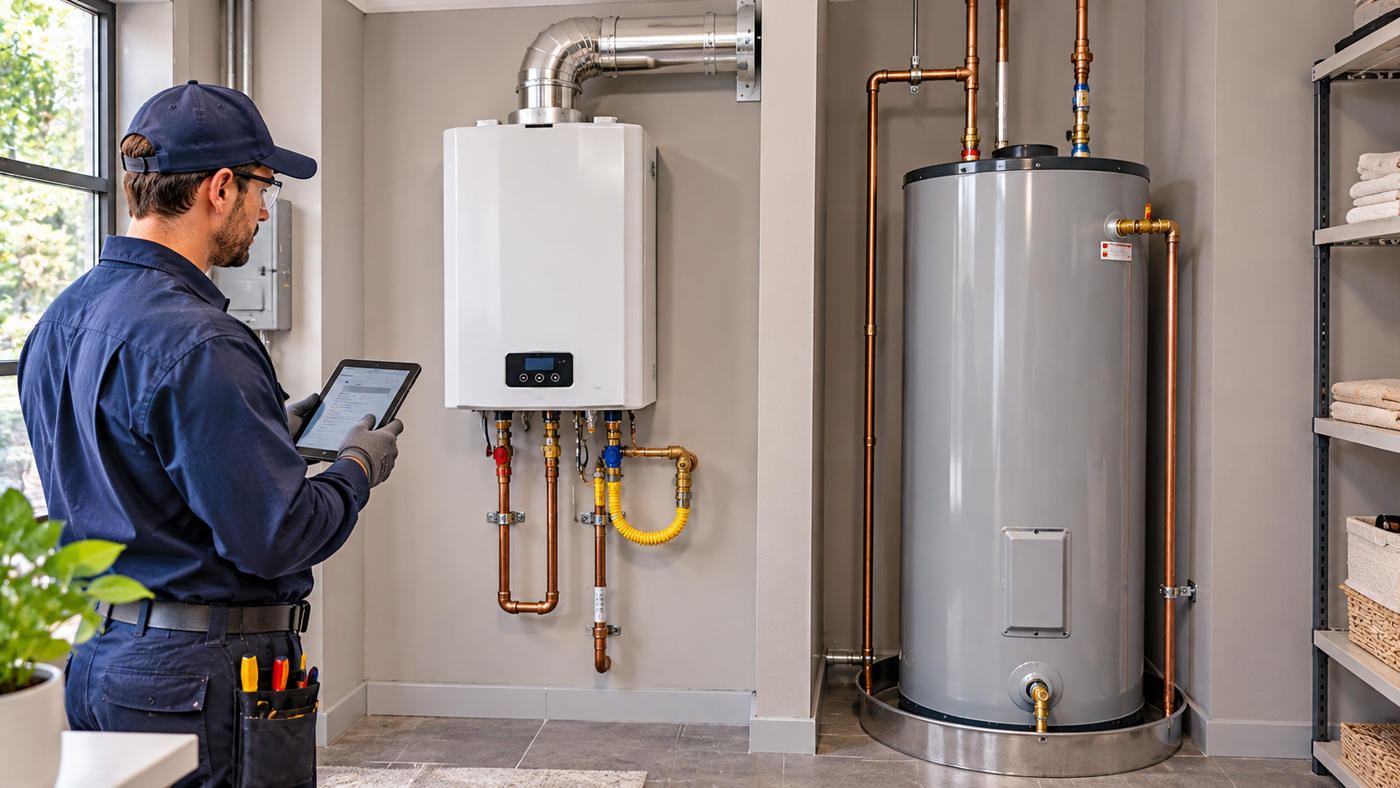
A failing water heater can turn a routine household purchase into an urgent decision. Comparing tankless vs conventional water heater options involves much more than deciding whether a large tank belongs in the utility room. The two technologies deliver hot water differently, respond differently to simultaneous demand, and may require very different installation work. Energy efficiency matters, but so do the existing fuel supply, incoming water temperature, maintenance requirements, and total cost over the years you expect to own the home. Choosing correctly means matching actual household habits to verified equipment performance rather than assuming the newest technology is always better.
What Is the Difference Between a Tankless and Conventional Water Heater?
A conventional storage water heater heats a set amount of water and keeps it in an insulated tank until someone opens a hot-water tap. Electric resistance elements or a gas burner restore the temperature as water is used. A tankless unit, also called a demand-type heater, detects flowing water and heats it as it passes through a heat exchanger. It generally stops heating when demand stops.
The basic tankless vs conventional water heater difference is storage versus immediate heating. A tank delivers water already heated, but extended use can exhaust its stored supply faster than it recovers. An on-demand unit does not have a comparable storage limit, although it has a maximum flow rate at a given temperature rise. If several fixtures request more water than that capacity, the unit may reduce flow or fail to meet the desired outlet temperature.
Does Tankless Mean Instant Hot Water at Every Tap?
No. Water already sitting in the pipes may be cold, and the new hot water still has to travel from the heater to the faucet. Some tankless systems also take a moment to activate. Pipe length, fixture placement, and recirculation design affect the wait. A tankless label does not automatically eliminate wasted water or waiting time.
9 Important Tankless vs Conventional Water Heater Factors
1. Measure Your Household’s Peak Hot-Water Demand
Start with the busiest period of a normal day, not only the number of people living in the home. Two showers running at once, a washing machine filling, and a kitchen faucet in use may create a higher peak load than a larger household that spreads activity throughout the day. The relevant question is how much hot water the system must deliver at the same time.
For a tankless vs conventional water heater decision, installers assess the expected simultaneous flow for a demand system. They consider the incoming water temperature and desired delivery temperature, because colder incoming water requires more heating energy for each gallon. A tankless model advertised at a high flow rate under warm conditions may provide less hot water in winter or a colder region.
For storage equipment, look beyond the nominal tank volume to its first-hour rating, which describes how much hot water a fully heated unit can supply during the first hour under a standard test. This includes water initially stored and water reheated during that hour. A bigger tank does not always outperform a smaller unit with a faster recovery rate.
Sizing a Tankless vs Conventional Water Heater Correctly
List likely simultaneous fixtures and identify the periods when the family needs the most hot water. Ask the installer to show a sizing calculation and the assumptions behind it rather than simply recommending a popular model.
2. Tankless vs Conventional Water Heater Energy Ratings
The tankless vs conventional water heater comparison often begins with energy savings. Tankless systems avoid much of the standby loss from stored hot water, so some models use less energy than conventional units of the same fuel type. The US Department of Energy reports that demand water heaters can be approximately 24–34 percent more energy efficient for households using no more than 41 gallons of hot water daily and about 8–14 percent more efficient for heavy-use households around 86 gallons daily. Those figures describe general scenarios, not guaranteed bill savings for a particular home.
Compare the Uniform Energy Factor, or UEF, among appropriate products in a comparable draw category. Higher UEF generally indicates greater efficiency under the relevant test procedure. Fuel prices and equipment type still determine operating expense. An efficient electric resistance heater can cost more to run than a less efficient gas model in an area with expensive electricity.
Efficiency Is Not the Same as Annual Savings
Request an estimate using the household’s expected gallons, local fuel tariffs, and the candidate models’ rated performance. A percentage improvement in energy efficiency does not necessarily become an identical percentage reduction in the entire utility bill.
3. Calculate Full Installation and Retrofit Costs
For an existing house, switching equipment types can be more expensive than replacing an older unit with a similar model. A gas tankless system may need a different vent arrangement, condensate drainage for a condensing model, adequate combustion-air provisions, or changes to gas supply sizing. An electric tankless unit may require substantial electrical capacity and dedicated circuits. The required work depends on the exact equipment and current building infrastructure.
When assessing tankless vs conventional water heater installation, ask for a complete itemised quotation. It should address the heater, necessary valves, venting or electrical work, permits where required, disposal of the old unit, commissioning, and any changes to surrounding plumbing. The lower advertised appliance price is not the final installed cost.
4. Evaluate Shower Comfort and Continuous Use
Tankless systems are commonly described as providing endless hot water. More precisely, a correctly sized unit can continue heating while water flows and the required energy supply remains available. It does not provide unlimited gallons per minute. If several showers operate simultaneously beyond its capacity, users may notice reduced flow or a temperature problem.
A conventional tank usually supports an initial period of high demand by drawing from stored hot water. As the stored supply is depleted, the delivered temperature may fall until recovery catches up. For a family with a short, intense morning peak, the first-hour rating may be more meaningful than tank size alone.
The tankless vs conventional water heater choice therefore depends on how demand is distributed. A household with long consecutive showers might appreciate continuous heating, while one with several simultaneous fixtures might prefer a well-sized storage system or a suitably powerful on-demand arrangement.
Watch for Low-Flow Activation
Some demand units require a minimum water flow to activate their burner or heating elements. Extremely low-flow fixtures, short tap openings, or rapid on-and-off use may produce inconsistent results. Review the selected model’s specifications if these are common habits.
5. Consider Space, Noise, and Equipment Location
A wall-mounted demand heater generally occupies less floor space than a traditional cylindrical storage tank. That can make a meaningful difference in a compact utility room or apartment, provided local rules, mounting strength, ventilation, and service clearances are satisfied. Saving floor space is useful only if the proposed location remains safe and accessible for maintenance.
For a tankless vs conventional water heater comparison, measure the entire installation footprint rather than the appliance housing alone. A tankless system may require venting, water-treatment fittings, isolation valves, or a nearby electrical connection. A storage system needs sufficient access for future replacement and, where specified, clearance for its safety and drain arrangements.
Consider operating sound. Some tankless units use fans and burners that activate with water demand. A heat pump storage heater uses a compressor and fan. Traditional electric resistance tanks are generally quiet. Ask about the likely sound in rooms near bedrooms or living areas.
6. Tankless vs Conventional Water Heater Maintenance
Mineral scale can accumulate in water-heating equipment, especially in areas with hard water. The narrow heat exchanger passages in many tankless heaters make water quality and manufacturer-recommended descaling particularly important. Some models need periodic cleaning of inlet filters or inspection of combustion and venting components. Service frequency depends on water chemistry, equipment, and use.
Conventional storage heaters need maintenance as well. Sediment can accumulate in tanks, sacrificial anode rods may require inspection or replacement in relevant designs, and temperature-and-pressure relief components must remain functional. Ignoring maintenance can affect efficiency, service life, and safety for either type.
The tankless vs conventional water heater maintenance question should include the cost and availability of qualified service personnel in your area. Ask whether parts are readily available and whether warranty terms specify servicing or water-quality conditions.
Avoid Improvised Servicing
Scalding water, electricity, gas, and pressure create real hazards. Follow the manufacturer’s instructions and use a qualified professional for work involving combustion, electrical connections, pressure controls, or unfamiliar descaling procedures.
7. Look at Expected Lifespan and Repairability
The Department of Energy describes typical tankless water heater life as exceeding 20 years, compared with roughly 10–15 years for conventional storage models. These are general estimates, not warranties. Actual service life depends on installation quality, water hardness, maintenance, usage, and whether replacement components remain available.
When considering tankless vs conventional water heater longevity, review the specific warranty rather than assuming every on-demand product lasts two decades. Heat exchanger coverage, labor exclusions, service requirements, and conditions related to water quality can vary. A ten-year parts warranty does not necessarily cover every repair or the cost of a technician.
Tankless vs Conventional Water Heater Service Availability
Ask how quickly a local installer can obtain replacement parts. A high-end unit without accessible service support can be inconvenient when hot water is urgently needed.
8. Evaluate Outage Performance, Fuel and Safety
Both tankless and conventional systems can be affected by power outages. Most modern gas tankless heaters need electricity for controls, fans, or ignition, even though gas provides the heat. An electric tankless heater needs a substantial electrical supply. Some conventional gas storage heaters with standing pilots can operate without mains electricity, but many newer designs also depend on electric controls. Check the exact model rather than assuming any fuel type guarantees hot water during an outage.
In a tankless vs conventional water heater safety review, discuss combustion venting, carbon monoxide protection, water temperature, pressure relief, electrical capacity, and freeze protection where relevant. Gas equipment must be correctly vented and commissioned. Storage tanks require properly installed temperature-and-pressure relief protection; on-demand systems also have specific safety requirements set by their manufacturer and applicable codes.
Water temperatures that are too high can cause scalding. The Department of Energy commonly recommends around 120°F (49°C) for household water-heater settings, while particular buildings or users may require different storage temperatures and mixing-valve arrangements to manage both scald risk and microbial growth. Follow local health guidance and professional advice.
Do Not Treat Installation as a DIY Experiment
Gas lines, high-load electrical circuits, and combustion vent systems require suitable qualifications and code compliance. A licensed installer should establish safe equipment selection and commissioning.
9. Compare Lifetime Value, Not Just the First Bill
A realistic purchasing decision combines initial installation, annual energy use, maintenance, anticipated repairs, and eventual replacement. Tankless equipment may reduce energy consumption, but a high retrofit cost can extend the payback period. An inexpensive tank might be appropriate for a small budget or a household that seldom uses large amounts of hot water.
For an informed tankless vs conventional water heater analysis, obtain two installed quotes for suitable models and ask each contractor to estimate annual operating use. Include maintenance and plausible major repairs rather than assuming perfect performance. Consider whether you expect to own the home long enough to benefit from any savings, while recognizing that future tariffs and equipment costs can change.
Request Comparable Written Proposals
The two quotes should reflect the same household demand, fuel rates, code requirements, and scope of work. Otherwise, a lower figure may simply represent a system that does less.
Tankless vs Conventional Water Heater: Key Differences at a Glance
For tankless vs conventional water heater choices, the most important metric is not a single advertised percentage. Compare first-hour rating for storage models, flow at a realistic temperature rise for tankless models, appropriate UEF performance, and the complete installed cost. These figures answer different questions and should not be used interchangeably.
Where Does a Heat Pump Water Heater Fit?
A heat pump water heater transfers heat from surrounding air into a storage tank rather than relying mainly on electric resistance heating. According to ENERGY STAR, these products can use substantially less electricity than conventional electric storage heaters, although savings depend on the unit, household, climate, and installation. They also require suitable room conditions, air circulation, and condensate management.
This third option matters in a tankless vs conventional water heater decision when the home currently uses electricity. A buyer seeking lower operating energy might find an appropriately installed heat pump tank more efficient than an electric tankless model. Compare available space, sound, recovery performance, and local electricity costs before choosing.
Tankless vs Conventional Water Heater: Which Fits Your Household?
For a compact home with predictable, moderate hot-water use and limited floor space, a properly sized on-demand unit may be attractive, especially when the existing fuel and vent arrangements support economical installation. For a larger household that regularly uses several fixtures at once, the decision requires detailed peak-demand sizing; a storage tank with adequate first-hour performance can be competitive.
Example: A Family With Back-to-Back Showers
A family with several consecutive showers but limited simultaneous demand may benefit from a tankless system sized to support the shower flow at the local winter inlet temperature. A storage tank could also meet that pattern if its first-hour rating and recovery are sufficient. The better option emerges from actual numbers, not the family size alone.
Example: A Household With Many Simultaneous Fixtures
Where multiple showers, laundry, and kitchen use overlap, verify whether one tankless appliance can supply the combined flow. Larger or multiple units can be possible, but additional equipment and infrastructure may alter the economics. A correctly sized storage or heat-pump storage system deserves comparison.
How to Choose an Installer and Check the Final Quote
Ask the contractor to explain the sizing method, incoming water temperature assumption, required fuel or electric service, venting design, and available efficiency ratings. A professional should inspect the current system and tell you which parts of the installation will be reused and which must change. Verify relevant licensing, insurance, permits, and local requirements.
When discussing tankless vs conventional water heater installation, request details of the equipment model, labor, piping and wiring, pressure safety devices, drainage, disposal, commissioning, and warranty service. A clearly written scope helps prevent surprise charges and makes competing proposals easier to compare.
Common Mistakes to Avoid
The most common mistakes are buying by household size alone, confusing tankless with instant delivery at the faucet, ignoring cold-weather flow reduction, and comparing only retail appliance prices. Other errors include assuming all gas heaters work without electricity and neglecting descaling or tank maintenance.
Treat tankless vs conventional water heater marketing claims as a starting point for questions. The best answer is based on usable hot-water capacity, realistic energy expenses, safe installation, and support over the expected life of the equipment.
Frequently Asked Questions
1. Is a tankless water heater more efficient than a conventional tank?
Often, especially compared with a similar-fuel storage model, because it avoids most storage standby heat loss. Actual savings depend on use, equipment efficiency, and local fuel prices.
2. Does tankless vs conventional water heater performance change in winter?
Yes. Colder incoming water can reduce the flow a tankless heater delivers at the desired temperature. Storage systems also require adequate recovery capacity, but their sizing uses different measures.
3. Can tankless heaters run two showers at once?
Some can, if their rated flow at the required temperature rise meets both showers’ combined demand. Ask an installer to calculate peak flow with local inlet-water conditions.
4. Which option costs less to install?
A like-for-like conventional storage replacement is often less expensive. Converting to tankless may require new venting, gas piping, electrical capacity, or other site work.
5. Is a heat pump water heater better than electric tankless?
It may use much less electricity for suitable households, but it needs appropriate space, airflow, drainage, and sizing. Compare complete installed and operating costs for the specific models.
6. How long do tankless and tank water heaters last?
General guidance places many tankless units above 20 years and conventional storage units around 10–15 years. Water quality, maintenance, installation, and product design affect actual life.
Conclusion
The tankless vs conventional water heater choice is best made through realistic demand sizing, verified efficiency ratings, and a complete installed-cost comparison. Tankless systems can offer continuous heating with less standby loss, while conventional tanks remain practical for many budgets and peak-use patterns. Maintenance, safety, local fuel prices, and long-term service support matter as much as the equipment label. Reviewing a heat pump alternative and getting qualified installation advice can help homeowners make a durable, well-informed decision.
