
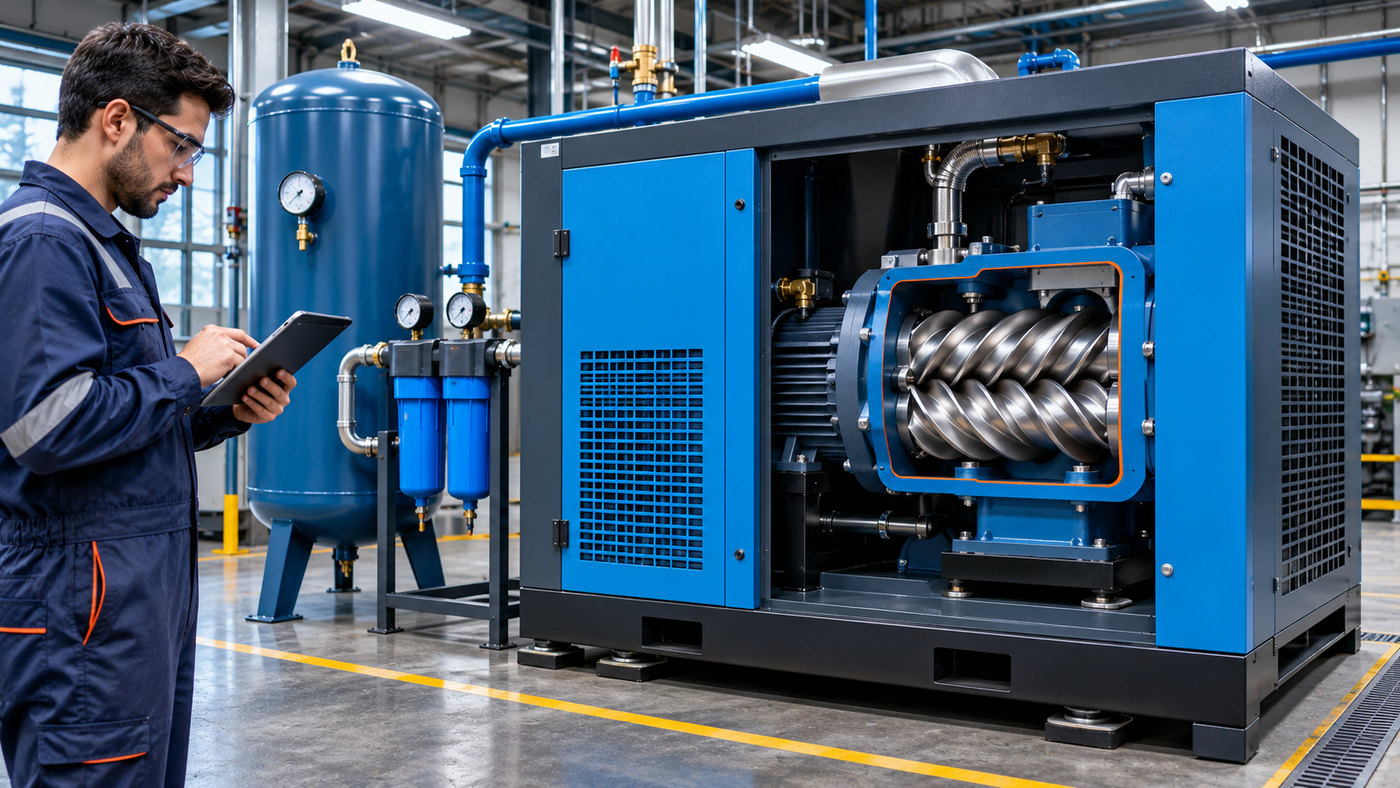
Compressed air plays an essential role in modern industrial operations. Manufacturing plants, automotive workshops, food processing facilities, and many other businesses depend on reliable compressed air systems to power equipment, control automated processes, and maintain productivity. When compressed air equipment operates inefficiently or experiences unexpected failures, the consequences can include higher energy expenses, production delays, and increased maintenance costs.
Industrial rotary screw air compressors are widely used because they can deliver a steady supply of compressed air for demanding applications. Unlike traditional reciprocating compressors, which rely on pistons moving back and forth, rotary screw systems use intermeshing helical rotors to compress air continuously.
These machines are available in several configurations, including oil-injected, oil-free, fixed-speed, variable-speed, single-stage, and two-stage models. Each design offers advantages depending on the required air volume, operating pressure, air quality, and daily demand.
Choosing the appropriate compressor involves more than comparing motor horsepower or purchase prices. Businesses must evaluate long-term operating costs, system efficiency, maintenance requirements, and the reliability of the complete compressed air network.
This guide explains how rotary screw compression works, the main types available, their industrial benefits, and the important considerations for selecting and maintaining a dependable system.
What Are Rotary Screw Air Compressors?
Rotary screw air compressors are positive-displacement machines that compress air using two specially shaped, intermeshing rotors.
The rotors rotate inside a housing, trapping air and gradually reducing the volume available to it. As the trapped volume decreases, the air pressure increases.
The compressed air is then delivered to the downstream system, where it can power tools, machinery, and industrial processes.
Unlike piston compressors, which typically produce air in repeated compression strokes, rotary screw systems provide relatively smooth, continuous airflow.
This operating principle makes them especially suitable for facilities that need compressed air over extended periods.
Why Are They Popular in Manufacturing?
Industrial facilities often require a consistent supply of compressed air to maintain production.
Unexpected pressure fluctuations can affect pneumatic equipment, product quality, and automated machinery.
Rotary screw technology is commonly selected because it combines continuous operation with reliable airflow and a wide range of available capacities.
However, actual performance depends on correct compressor sizing, maintenance, controls, and the overall compressed air system.
How Do Rotary Screw Air Compressors Work?
Understanding the compression process helps explain why these machines perform well in industrial environments.
Most rotary screw compressors contain an air intake system, compression airend, drive motor, cooling system, controls, and components for separating or treating the compressed air.
Step 1: Air Enters the Compressor
Ambient air enters through an intake opening and passes through an inlet filter.
The filter helps prevent dust and other airborne particles from entering the compression chamber.
Clean intake air is important because contaminants can accelerate wear and reduce efficiency.
Step 2: Helical Rotors Compress the Air
Inside the airend, two intermeshing screw-shaped rotors rotate in opposite directions.
As they turn, air becomes trapped between the rotor profiles and the surrounding housing.
The available space decreases as the air travels through the compression chamber.
This reduction in volume raises the pressure.
Step 3: Lubrication and Cooling Take Place
In an oil-injected compressor, specially formulated lubricant enters the compression chamber.
The oil helps lubricate components, seal internal clearances, and remove heat generated during compression.
Oil-free compressors use a different compression arrangement that avoids introducing lubricating oil into the compression chamber.
Step 4: Compressed Air Passes Through Separation and Cooling
In oil-injected systems, the air-oil mixture passes through separation equipment that removes most of the injected lubricant.
The recovered oil is circulated through the lubrication system.
The compressed air then passes through cooling equipment and, where necessary, additional air treatment components.
Step 5: Air Reaches the Distribution System
After compression and appropriate treatment, air is delivered to storage receivers or directly into the distribution network.
The system supplies air to pneumatic tools, production equipment, and other connected applications.
Pressure controls adjust compressor operation according to demand.
Main Types of Rotary Screw Air Compressors
Different industrial applications require different compressor configurations.
Understanding the main categories makes it easier to identify suitable equipment.
Oil-Injected Rotary Screw Compressors
Oil-injected compressors introduce lubricant into the compression chamber.
The oil supports sealing, cooling, and lubrication.
These systems are common in industrial manufacturing because they offer dependable performance across many general-purpose applications.
However, residual oil can remain in the delivered air, and downstream treatment may be necessary.
Oil-Free Rotary Screw Compressors
Oil-free compressors are designed so lubricating oil does not enter the compression chamber.
They are frequently considered for industries where oil contamination presents significant risks.
Examples include food processing, pharmaceutical manufacturing, electronics, and certain medical or laboratory applications.
However, oil-free compression does not automatically guarantee that delivered air meets every purity requirement.
Air quality must be assessed for particles, water, oil, and other relevant contaminants.
Fixed-Speed Rotary Screw Compressors
Fixed-speed compressors operate their motors at a generally constant rotational speed while running.
They can be a practical solution when compressed air demand remains relatively stable.
Their control systems may load, unload, or stop the machine according to operating requirements.
Variable-Speed Rotary Screw Compressors
Variable-speed drive compressors, commonly called VSD compressors, adjust motor speed to better match changing air demand within their designed operating range.
This approach can reduce energy waste in facilities where compressed air consumption varies.
However, VSD equipment is not automatically the most efficient option in every operating condition.
Facilities with stable demand may benefit from carefully selected fixed-speed systems.
Single-Stage and Two-Stage Compressors
A single-stage rotary screw compressor raises air pressure through one compression stage.
A two-stage compressor divides the compression work between two stages.
Some two-stage designs use intercooling to reduce temperatures between stages and improve compression efficiency.
The actual energy benefit depends on machine design, operating pressure, and application requirements.
7 Essential Benefits of Rotary Screw Air Compressors
Rotary screw technology offers several benefits when correctly matched to industrial requirements.
1. Continuous Compressed Air Supply
One of the primary advantages of rotary screw compressors is their ability to support continuous-duty operation.
Manufacturing facilities may require compressed air throughout long production shifts.
A properly specified rotary screw compressor can provide consistent output without relying on repeated piston compression strokes.
This makes the technology suitable for automated production lines and equipment that must operate for extended periods.
2. Improved Energy Efficiency
Compressed air generation can consume substantial electricity.
An efficient rotary screw compressor can help reduce wasted energy when correctly sized and operated.
Energy performance depends on several factors, including motor efficiency, compression design, system pressure, and capacity control.
Businesses should compare equipment using standardized performance data rather than relying only on advertised horsepower.
3. Reliable Performance Under Demanding Conditions
Industrial equipment must withstand repeated operation and changing production requirements.
Rotary screw systems are designed for sustained use when operated within their specified limits.
Their rotating compression mechanism avoids some of the reciprocating movements associated with piston compressors.
However, bearings, seals, filters, motors, and other components still require regular maintenance.
4. More Consistent Airflow
Rotary screw compressors generally provide relatively smooth compressed air delivery.
This can be beneficial for pneumatic automation, industrial machinery, and processes requiring stable pressure.
Properly designed receivers and control systems further support pressure stability.
5. Flexible Capacity Control
Businesses do not always use the same amount of compressed air throughout the day.
Variable-speed controls, load-unload arrangements, and multi-compressor sequencing can help match supply to demand.
An appropriate control strategy may reduce unnecessary energy consumption.
6. Compact and Integrated Equipment Designs
Many packaged rotary screw systems combine major operating components within a single enclosure.
Depending on the model, the package may include controls, cooling equipment, filtration components, and other accessories.
Some configurations also integrate air receivers or dryers.
This can simplify installation planning, although adequate space for ventilation and maintenance remains necessary.
7. Scalable Industrial Applications
Rotary screw compressors are available across a broad range of capacities.
Smaller systems can serve workshops and light industrial operations, while larger systems support production facilities with substantial air demand.
Businesses can also use multiple compressors to improve capacity management and operational resilience.
Rotary Screw vs. Reciprocating Air Compressors
Both rotary screw and reciprocating compressors are used to produce compressed air.
The appropriate choice depends on the application, required output, and operating schedule.
| Feature | Rotary Screw Compressor | Reciprocating Compressor |
|---|---|---|
| Compression mechanism | Rotating helical screws | Moving pistons |
| Typical application | Sustained industrial demand | Intermittent or smaller demand |
| Air delivery | Relatively smooth | Pulsating before storage and controls |
| Continuous operation | Often suitable | Depends on duty rating |
| Initial cost | Often higher | Often lower at small capacities |
| Maintenance focus | Filters, oil, separators, cooling | Valves, rings, belts, lubrication |
| Capacity | Broad industrial range | Broad range, especially small systems |
| Efficiency | Depends on duty and control | Depends on duty and design |
When Is a Rotary Screw Compressor Better?
Rotary screw compressors are often appropriate when a facility needs substantial, sustained airflow.
They can support demanding production schedules and automated industrial systems.
When Is a Piston Compressor Better?
A reciprocating compressor may be a practical choice for occasional pneumatic tool use, smaller workshops, or applications with intermittent demand.
Its lower initial cost can be attractive when continuous compressed air production is unnecessary.
The final decision should be based on technical requirements and total operating costs.
How to Choose the Right Rotary Screw Air Compressor
Selecting a compressor begins with understanding the compressed air system rather than simply choosing a machine from a catalog.
Determine Required Airflow
Airflow is commonly expressed in cubic feet per minute, or CFM.
This measurement represents the volume of air delivered over a given period under defined conditions.
Businesses should identify the air requirements of their equipment and calculate realistic simultaneous demand.
Not every connected tool operates at the same time.
Accurate demand analysis helps avoid unnecessary oversizing.
Identify Operating Pressure
Pressure is commonly measured in pounds per square inch gauge, or PSIG.
The compressor must provide enough pressure to support equipment after accounting for appropriate distribution and treatment losses.
However, excessive pressure wastes energy and can increase leakage.
Choose a pressure setting based on actual production requirements.
Evaluate Air Quality Requirements
Some applications tolerate ordinary industrial compressed air.
Others require carefully controlled moisture, particle, and oil levels.
ISO 8573-1 provides a framework for specifying compressed air purity classes.
The required air quality should be established before selecting compressors, dryers, and filtration equipment.
Consider Operating Hours
A facility running one production shift has different requirements from a plant operating continuously.
Long operating hours make energy efficiency and maintenance planning especially important.
Examine Environmental Conditions
Dust, ambient temperature, humidity, and available ventilation can influence compressor performance.
The installation location should meet the equipment manufacturer’s environmental requirements.
Plan for Future Growth
Businesses expecting additional production lines or equipment should consider future air demand.
However, purchasing an excessively oversized compressor can create unnecessary costs.
A properly planned modular or multi-compressor system may provide more flexibility.
Understanding Compressor Efficiency and Energy Costs
Electricity is frequently a major component of compressed air operating costs.
The purchase price alone therefore provides an incomplete picture of long-term value.
What Is Specific Power?
Specific power compares compressor input power with the volume of compressed air delivered.
It is commonly expressed as kilowatts per 100 CFM under specified conditions.
Lower specific power generally indicates less energy consumption for the same amount of delivered air at comparable pressure and test conditions.
Manufacturers may provide standardized data sheets to support comparisons.
Why Pressure Matters
Higher discharge pressure generally requires more compression work.
Operating at unnecessarily high pressure can increase energy consumption.
Pressure should be reduced only after verifying that all connected equipment will continue receiving sufficient air.
The Importance of Leak Detection
Compressed air leaks waste electricity and reduce system efficiency.
Leaks may occur at fittings, valves, hoses, connectors, and other distribution components.
Regular inspections and appropriate leak detection methods help identify these losses.
Variable-Speed Efficiency
A VSD compressor can reduce power consumption when demand fluctuates and the compressor operates within an efficient speed range.
However, a variable-speed machine may be less economical when demand remains consistently near one operating point.
A proper assessment should examine the facility’s actual demand profile.
Common Industrial Applications
Rotary screw compressors support a wide range of manufacturing and processing activities.
Automotive Manufacturing
Automotive facilities use compressed air for pneumatic tools, assembly equipment, automated systems, and certain finishing operations.
Consistent pressure is important for reliable production.
Food and Beverage Processing
Compressed air may support packaging equipment, automated machinery, cleaning processes, and product handling.
Where air directly or indirectly contacts food, appropriate contamination controls and air quality verification are essential.
Pharmaceutical Manufacturing
Pharmaceutical facilities may use compressed air in processing equipment, packaging machinery, and other controlled operations.
Air purity requirements depend on the application and relevant quality standards.
Electronics Manufacturing
Electronics production may require clean, dry compressed air to support precision equipment and automated processes.
Contamination control can be particularly important for sensitive components.
Metalworking and Fabrication
Compressed air supports pneumatic tools, production machinery, and various metal fabrication operations.
Reliable delivery helps maintain production continuity.
Packaging and Printing
Packaging facilities often use compressed air to operate pneumatic actuators, automated material-handling equipment, and production machinery.
Rotary Screw Air Compressors From Kaishan USA
Kaishan USA offers several compressor series for different industrial requirements.
Its published lineup includes belt-drive, direct-drive, premium, two-stage, low-pressure, and oil-free configurations.
KRSB Belt Drive Series
The KRSB series covers smaller industrial applications and is listed in configurations ranging from 5 to 50 horsepower.
Certain versions are available with tank-mounted packages and dryer options.
KRSD Direct Drive Compressors
The KRSD series includes direct-drive equipment for industrial compressed air applications.
The lineup includes fixed-speed and variable-speed configurations.
KRSP Premium Compressors
The KRSP series is designed for industrial operations seeking reliable performance and efficient compression.
Different capacity and configuration options allow users to select equipment according to their applications.
KRSP2 Two-Stage Compressors
Kaishan’s KRSP2 series uses two-stage compression technology.
This configuration is intended to improve efficiency under suitable operating conditions.
KROF Oil-Free Compressors
The KROF series is designed for applications requiring oil-free compression.
Kaishan describes its KROF two-stage design as capable of providing compressed air meeting ISO 8573-1 Class 0 oil requirements under its stated specifications.
Buyers should verify the relevant certification, operating conditions, and complete air treatment requirements.
These examples illustrate how compressor manufacturers provide different technologies for varying industrial needs. Final product selection should be based on current technical documentation and application-specific assessment.
Essential Rotary Screw Air Compressor Maintenance Tips
Routine maintenance helps protect efficiency and reduce the risk of unexpected equipment failures.
A preventive maintenance program should follow the manufacturer’s instructions and account for actual operating conditions.
Check Lubricant Levels
For oil-injected equipment, monitor lubricant levels according to the operating manual.
Low lubricant levels can affect cooling, sealing, and component protection.
Use the approved lubricant grade.
Inspect Air Filters
Dirty intake filters can restrict airflow and increase the compressor’s workload.
Inspect and replace filters according to operating hours, condition indicators, and manufacturer recommendations.
Maintain Oil Separators
Oil separators play an important role in oil-injected systems.
Excessive separator pressure drop can increase energy consumption.
Monitor separator condition and replace components when required.
Keep Cooling Systems Clean
Blocked coolers and inadequate ventilation can cause excessive operating temperatures.
Keep ventilation passages and heat exchangers clean according to approved maintenance procedures.
Inspect Condensate Drains
Compressed air systems generate condensate as moisture is removed.
Check that condensate drains operate correctly.
Condensate containing oil must be managed and disposed of according to applicable environmental requirements.
Monitor Operating Conditions
Important measurements may include pressure, temperature, operating hours, vibration, and equipment alarms.
Unusual trends can indicate problems requiring investigation.
Follow Preventive Service Intervals
Routine tasks may include lubricant sampling, filter replacement, coupling inspections, and electrical checks.
Service intervals vary by model and operating environment.
Maintenance should be performed by appropriately trained personnel using safe isolation and depressurization procedures.
Common Problems With Rotary Screw Air Compressors
Even well-maintained equipment can develop operating problems.
Recognizing warning signs early can help reduce downtime.
Excessive Operating Temperature
High temperatures may result from inadequate ventilation, blocked coolers, incorrect lubricant conditions, or other system problems.
Technicians should identify the cause rather than repeatedly resetting temperature alarms.
Reduced Air Pressure
Low system pressure may result from excess demand, leaks, restricted filters, incorrect control settings, or equipment faults.
A system assessment can help determine whether the compressor itself is responsible.
Increased Energy Consumption
Higher electricity use may indicate leaks, unnecessary pressure, poor capacity control, or deteriorating equipment performance.
Comparing current operating data with historical performance can help identify changes.
Excessive Moisture
Moisture problems may involve inadequate drying capacity, failed drains, high inlet humidity, or incorrect system operation.
The solution depends on the required pressure dew point and the condition of the air treatment system.
Unexpected Noise or Vibration
Unusual sounds or vibration may indicate mechanical wear or other equipment problems.
The machine should be inspected according to safe maintenance procedures.
How to Reduce Industrial Compressed Air Operating Costs
A cost-effective compressed air system involves more than an efficient compressor.
Businesses should evaluate the entire system, including production, distribution, treatment, and end use.
Conduct an Air System Audit
A compressed air assessment can identify air demand patterns, leakage, pressure problems, and inefficient operating practices.
Measurements provide a more reliable basis for improvements than assumptions.
Eliminate Unnecessary Air Consumption
Some tasks performed with compressed air may have more energy-efficient alternatives.
Evaluate whether air-powered operations are necessary for the application.
Repair Leaks
Leak detection and repair programs can reduce wasted air.
Periodic inspections are especially important in facilities with extensive distribution piping.
Optimize Storage and Controls
Appropriately sized air receivers and suitable control strategies can help stabilize pressure and manage changing demand.
Improve Preventive Maintenance
Regular servicing can protect performance and reduce unexpected repairs.
The U.S. Department of Energy identifies reducing leaks, lowering unnecessary pressure, improving controls, and maintaining equipment as important compressed air efficiency measures.
Common Mistakes to Avoid When Buying Rotary Screw Air Compressors
Choosing Equipment Based Only on Horsepower
Horsepower alone does not determine whether a compressor meets an application’s air requirements.
Compare delivered airflow at the necessary pressure and the required air quality.
Buying an Oversized Compressor
Excess capacity can increase purchase expenses and lead to inefficient operation under some control arrangements.
Select equipment based on measured demand.
Ignoring Air Treatment
A compressor does not automatically provide sufficiently dry or clean air for every application.
Filtration and drying requirements should be included in system planning.
Focusing Only on Initial Price
Lower purchase costs may be offset by higher electricity consumption, maintenance expenses, or downtime.
Evaluate total cost of ownership.
Overlooking Installation Requirements
Inadequate ventilation, poor service access, and unsuitable electrical infrastructure can create problems after installation.
Plan the compressor room carefully.
Neglecting Preventive Maintenance
Routine service is essential for reliable operation.
Delayed filter changes, improper lubrication, and neglected drains can reduce efficiency and reliability.
Future Trends in Industrial Air Compression
Industrial compressed air systems continue to evolve as manufacturers focus on efficiency, reliability, and automated monitoring.
Advanced Compressor Controls
Modern control systems can provide more detailed information about operating conditions and system performance.
This data can support better maintenance planning.
Remote Monitoring
Connected equipment may allow authorized technicians to monitor operating data and receive alerts remotely.
This can improve visibility, although cybersecurity and network access should be managed appropriately.
More Efficient Multi-Compressor Systems
Facilities using multiple compressors can benefit from coordinated control strategies.
Proper sequencing helps match available capacity with actual demand.
Improved Energy Management
Manufacturers increasingly evaluate compressed air as part of broader facility energy management.
System-wide assessments can reveal opportunities beyond replacing individual machines.
Heat Recovery Opportunities
Air compression generates substantial heat.
Some installations can recover part of this energy for suitable heating applications.
Technical feasibility depends on compressor design, operating hours, and available heat demand.
Frequently Asked Questions
1. What are rotary screw air compressors used for?
Rotary screw air compressors are used to supply compressed air for industrial equipment, pneumatic tools, automated production lines, packaging machinery, and other applications requiring dependable airflow. They are especially suitable for continuous or substantial air demand.
2. Are rotary screw air compressors more efficient than piston compressors?
They can be more efficient for certain continuous-duty industrial applications, but efficiency depends on compressor size, operating pressure, capacity controls, and demand patterns. Reciprocating compressors may remain economical for smaller or intermittent uses.
3. What is the difference between oil-free and oil-injected rotary screw compressors?
Oil-injected compressors use lubricant within the compression chamber for cooling, sealing, and lubrication. Oil-free compressors avoid introducing lubricating oil into the compression chamber and are often considered where air purity is especially important.
4. How long do rotary screw air compressors last?
Their service life depends on equipment quality, operating conditions, maintenance practices, and usage. Properly maintained industrial compressors may operate for many years, but no fixed lifespan applies to every model.
5. How often should rotary screw air compressors be serviced?
Maintenance schedules depend on manufacturer specifications, operating hours, environmental conditions, and compressor configuration. Routine checks include lubricant condition, filters, cooling systems, separators, condensate drains, and operating measurements.
6. Are variable-speed rotary screw compressors worth buying?
Variable-speed compressors may offer energy savings where compressed air demand changes substantially. However, a fixed-speed model may be competitive in facilities with stable demand. The best choice requires evaluating actual airflow requirements and long-term operating costs.
Conclusion
Rotary screw air compressors are an important source of reliable compressed air for modern industrial operations. Their continuous compression process, flexible configurations, and suitability for demanding applications make them valuable across manufacturing, automotive, food processing, and other industries. Selecting the right equipment requires careful consideration of airflow, pressure, air purity, energy efficiency, and maintenance requirements. With proper system design and preventive maintenance, businesses can improve operational reliability while managing long-term compressed air costs.
