
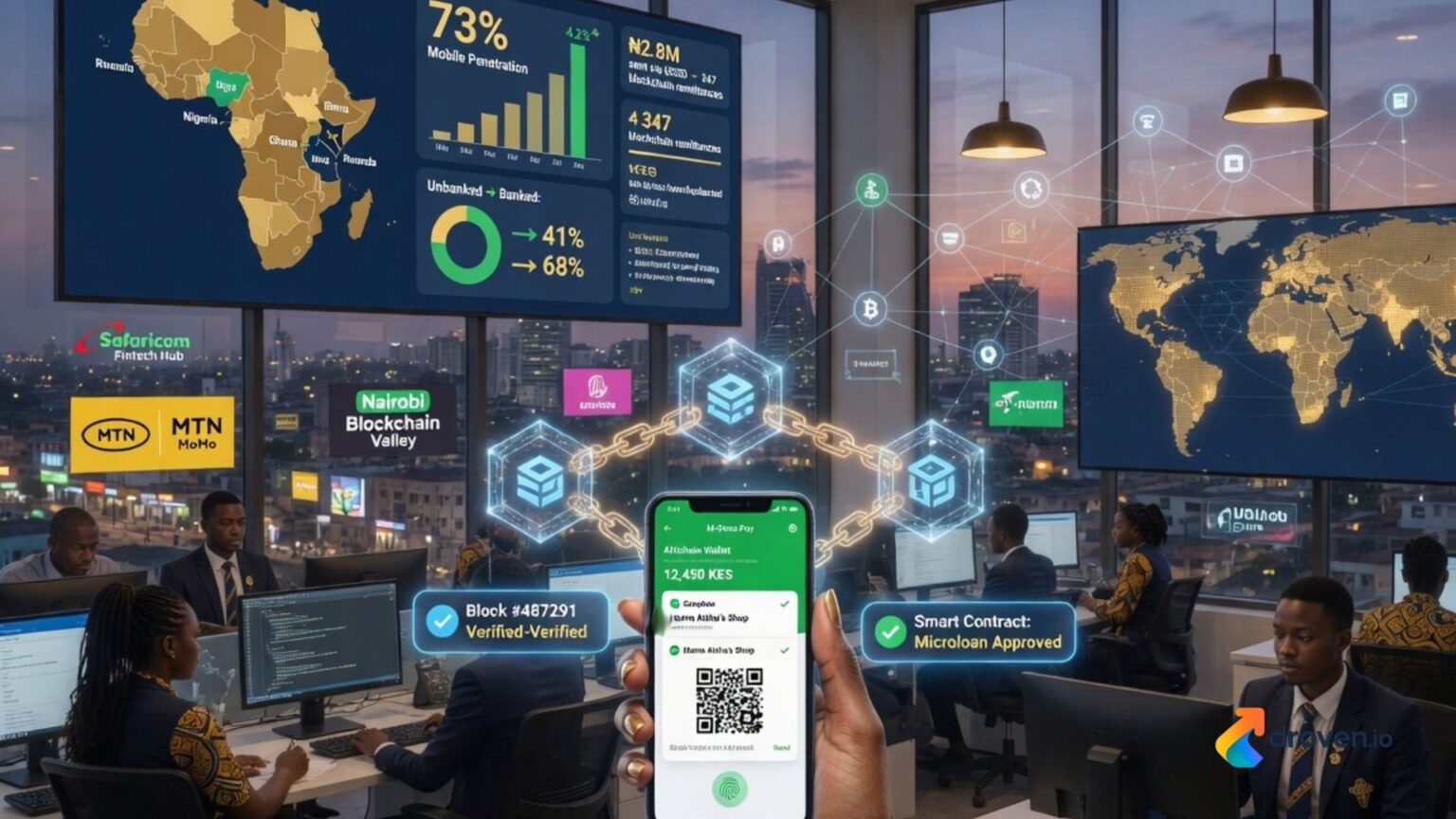
Global financial institutions have expanded digital infrastructure rapidly over the last decade, yet severe economic exclusion persists across emerging markets. World Bank data indicates that approximately 1.3 billion adults globally still unbanked remain completely cut off from formal financial services, lacking access to basic savings accounts, credit facilities, or secure payment rails. Traditional retail banking frameworks fail these populations due to prohibitive account maintenance fees, strict physical documentation demands, and sparse rural branch networks. However, a major paradigm shift is taking place across the African continent. Rather than viewing digital currencies as speculative investment assets, African consumers and entrepreneurs utilize utility-driven crypto to solve everyday financial bottlenecks.
By leveraging mobile phones, stablecoins, and decentralized peer-to-peer networks, African economies redefine how decentralized technology bypasses legacy banking barriers. This comprehensive analysis evaluates how utility-driven digital assets address global financial exclusion, lower remittance costs, preserve purchasing power, and onboard unbanked populations into the modern global economy.
Structural Barriers Facing 1.3 Billion Adults Globally Still Unbanked
Understanding the persistence of global financial exclusion requires analyzing structural barriers inherent in traditional banking models. For millions of citizens in developing nations, opening a standard bank account represents an insurmountable administrative and financial challenge.
| Financial Barrier Category | Traditional Banking Requirement | Structural Impact on Unbanked Citizens |
|---|---|---|
| Identity Documentation | Government passports or utility bills | Excludes rural citizens without formal land titles or IDs |
| Minimum Balance Rules | Mandatory deposit thresholds & fees | Drains low-income household funds through account penalties |
| Geographic Accessibility | Physical bank branches in city centers | Forces rural workers to travel hours to access cash services |
| Transaction Costs | High fees on small cross-border payments | Consumes significant portions of migrant worker remittances |
When evaluating why 1.3 billion adults globally still unbanked remain excluded, commercial unviability stands out as a primary driver. Traditional commercial banks operate on high fixed overhead costs, including physical branch leases, security personnel, and legacy mainframe software. Consequently, financial institutions prioritize high-net-worth clients and corporate entities over low-margin retail customers in rural regions.
Structural Failures of Legacy Financial Systems for the Unbanked
Traditional cross-border payment networks depend on complex intermediary correspondent banks. Every intermediary institution along the payment chain extracts processing fees and delays transaction finality. For unbanked families depending on international migrant remittances, these inefficiencies extract a heavy financial toll. Furthermore, inflation across emerging markets continuously erodes local fiat currency values, rendering traditional cash savings risky for vulnerable households.
Mobile Penetration Closing the Infrastructure Gap
While physical bank branches remain absent in rural areas, mobile network coverage has expanded dramatically. Today, mobile phone adoption across emerging markets far outpaces traditional bank account distribution. Consequently, mobile devices serve as the primary gateway for delivering decentralized financial services directly to excluded populations without requiring brick-and-mortar branch infrastructure.
How Utility Crypto Serves the 1.3 Billion Adults Globally Still Unbanked
African markets demonstrate that digital assets deliver practical economic utility when traditional financial rails fail. Unlike Western markets where crypto adoption focused historically on speculative trading, African adoption centers on everyday economic survival and commercial efficiency.
| Real-World Use Case | Legacy Financial Mechanism | Utility-Driven Crypto Mechanism |
|---|---|---|
| Cross-Border Remittances | Correspondent banks charging 8% to 15% fees | Stablecoin transfers settling under 1% in seconds |
| Inflation Protection | Devaluing local fiat subject to capital controls | Dollar-backed stablecoins providing inflation hedges |
| Commercial Trade Settlement | Slow, expensive foreign exchange allocation | Direct peer-to-peer crypto settlement for importers |
| Micro-Credit & Savings | Rigid credit scoring requiring physical collateral | On-chain reputation models and decentralized pools |
Across nations like Nigeria, Kenya, Ghana, and South Africa, utility-driven digital assets act as essential economic infrastructure. By providing borderless, low-cost financial rails, crypto platforms empower populations historically trapped in cash-based economies.
| Onboarding Pipeline Phase | Infrastructure Requirement | Financial Access Outcome |
|---|---|---|
| Initial Connectivity | Smartphone & Mobile Internet | Connects excluded citizens to decentralized rails |
| Peer-to-Peer Integration | Local Merchant Escrow Networks | Enables cash-to-digital conversions without banks |
| Global Market Access | Utility Stablecoins & Smart Contracts | Delivers instant international commerce & savings |
Stablecoin Protection for 1.3 Billion Adults Globally Still Unbanked
Dollar-pegged stablecoins represent the single most impactful financial innovation for regions where 1.3 billion adults globally still unbanked suffer from local currency volatility. Stablecoins combine the stability of major fiat currencies with the instant settlement speed and low transaction cost of public blockchains. Consequently, street vendors, small business owners, and gig workers store their working capital in digital dollars on mobile wallets, protecting their earnings from local inflation.
Peer-to-Peer Networks Bypassing Financial Exclusion
Peer-to-peer (P2P) trading platforms play a vital role in connecting unbanked citizens to digital financial networks. Through localized P2P escrow systems, individuals exchange local cash or mobile money directly for digital assets with verified local merchants. This decentralized off-ramp mechanism removes traditional banking gatekeepers entirely, allowing unbanked individuals to participate in digital commerce without ever stepping inside a physical bank.
Economic Drivers Supporting 1.3 Billion Adults Globally Still Unbanked
The rapid acceleration of utility-driven digital assets across emerging markets stems from tangible economic incentives that outperform traditional banking options.
| Economic Performance Indicator | Legacy Remittance Channels | Decentralized Stablecoin Channels |
|---|---|---|
| Average Settlement Speed | 2 to 5 Business Days | 3 to 30 Seconds |
| Average Transaction Fee | $15 to $35 per $200 transfer | Under $0.50 per transfer |
| Operating Hours Availability | Standard business banking hours | 24 Hours a Day, 365 Days a Year |
| Prerequisites for Access | Formal bank account & proof of address | Smartphone and internet connection |
When evaluating financial options, unbanked individuals choose digital assets because they resolve real-world daily friction points. Lower transaction costs leave more money in household budgets, directly improving living standards across developing communities.
Mobile Innovations Assisting 1.3 Billion Adults Globally Still Unbanked
A key driver of financial inclusion across Africa is the seamless integration between established mobile money platforms and decentralized digital asset networks.
| Regional Market | Primary Mobile Money Integration | Digital Asset Utility Focus |
|---|---|---|
| Nigeria | Bank Transfer & Local P2P Merchants | Stablecoin commerce & inflation hedging |
| Kenya | M-Pesa Mobile Wallet Bridge | Cross-border payments & micro-remittances |
| Ghana | MTN Mobile Money Integration | Import trade settlement & peer transfers |
| South Africa | Direct Retail API & QR Gateways | Institutional crypto access & consumer payments |
By bridging mobile money services like M-Pesa directly with public blockchain networks, fintech developers allow users to move money effortlessly between local cash and digital assets. Consequently, a small farmer in a remote village can receive international payments on a mobile phone, convert the funds to local mobile money, and purchase agricultural supplies in minutes.
Global Regulators Addressing 1.3 Billion Adults Globally Still Unbanked
As digital asset adoption accelerates across unbanked regions, national governments and central banks adapt regulatory frameworks to balance consumer protection with economic innovation.
| Country Jurisdiction | Historical Regulatory Stance | Modern Compliance Framework |
|---|---|---|
| Nigeria | Banking restrictions on crypto firms | Central Bank licensing for VASP operators |
| South Africa | Unregulated emerging asset class | Formal Financial Sector Conduct Authority licensing |
| Kenya | Cautionary public notices | Draft Virtual Asset Service Provider legislation |
| Ghana | Restricted banking processing | Sandbox testing for digital asset innovation |
Progressive regulatory frameworks shift away from blanket prohibitions toward licensing regimes for Virtual Asset Service Providers (VASPs). Clear regulatory guidelines encourage legitimate investments, protect consumers from fraudulent schemes, and establish clear operational standards for financial inclusion platforms.
Onboarding Pipeline for the 1.3 Billion Adults Globally Still Unbanked
Bringing unbanked populations into the digital financial ecosystem requires a simplified, mobile-first onboarding workflow designed for low-bandwidth environments.
| Onboarding Pipeline Phase | Technical Execution Item | User Inclusion Benefit |
|---|---|---|
| Phase 1: App Download | User installs low-bandwidth mobile wallet | Operates smoothly on basic smartphones |
| Phase 2: Simplified Verification | Tiered Know-Your-Customer (KYC) check | Allows basic access with minimal documentation |
| Phase 3: Cash On-Ramping | P2P cash deposit or mobile money sync | Converts local physical cash into digital assets |
| Phase 4: Active Utility Usage | Send payments, save stablecoins, build yield | Provides instant access to global financial rails |
| Phase 5: Seamless Off-Ramping | Convert crypto to local cash via P2P | Delivers immediate physical spending power |
This streamlined onboarding pipeline demonstrates how mobile technology simplifies financial access, proving that complex traditional documentation is no longer a prerequisite for global market participation.
Technical Hurdles Facing 1.3 Billion Adults Globally Still Unbanked
While utility-driven digital assets offer powerful solutions for financial inclusion, several technical and infrastructure hurdles must be resolved to achieve universal access.
| Technical Challenge Area | Specific Operational Constraint | Proposed Technological Solution |
|---|---|---|
| Connectivity Gaps | Limited 4G/5G coverage in remote areas | Offline SMS and USSD crypto payment protocols |
| Gas Fee Volatility | High network congestion fees on Layer-1 | Transition to Layer-2 scaling & ZK rollups |
| Digital Literacy Barriers | Complex private seed phrases and keys | Social recovery wallets and smart contract accounts |
| Volatility Risk | Price swings in unpegged tokens | Prioritizing audited, asset-backed stablecoins |
Addressing these technical barriers requires ongoing innovation from blockchain developers, telecom operators, and consumer protection advocates. By simplifying user interfaces and lowering transaction fees further, decentralized networks will continue expanding financial access to underserved communities worldwide.
Frequently Asked Questions (FAQs)
Why are 1.3 billion adults globally still unbanked today?
They lack access due to high account fees, strict documentation demands, geographic distance from bank branches, and commercial unviability for traditional banks.
How does utility crypto help the 1.3 billion adults globally still unbanked?
Utility crypto provides borderless, low-cost payment rails on basic smartphones, allowing unbanked individuals to save, transfer, and trade without a traditional bank account.
Why is Africa leading utility-driven digital asset adoption?
African consumers face high inflation and expensive remittance costs, driving them to use stablecoins and P2P networks for daily commercial payments and wealth preservation.
Are stablecoins safe for unbanked populations in inflation-prone countries?
Audited, fully backed stablecoins provide a stable store of value by pegging their worth to major fiat currencies like the US dollar, protecting savings from local inflation.
Can unbanked citizens access digital assets without internet coverage?
Developers are launching offline SMS and USSD blockchain payment protocols, enabling users to execute basic digital asset transfers on feature phones without internet.
What is the role of P2P networks for unbanked crypto users?
Peer-to-peer networks allow users to convert physical cash or local mobile money into digital assets through local verified merchants, bypassing traditional banks entirely.
Conclusion
The persistent reality that 1.3 billion adults globally still unbanked remain excluded from basic financial infrastructure represents a major systemic failure of traditional retail banking. However, as demonstrated across African markets, utility-driven digital assets provide a proven, scalable alternative to legacy financial rails. By combining widespread smartphone adoption with stablecoins, decentralized peer-to-peer networks, and low-cost mobile money integrations, emerging economies bypass outdated banking barriers entirely.
Furthermore, utility-focused digital assets empower individuals to protect their earnings from domestic currency devaluation, send international remittances at a fraction of traditional costs, and participate directly in global digital commerce. As regulatory frameworks mature and layer-2 scaling solutions drive transaction fees lower, decentralized financial technology will play an increasingly vital role in closing the global financial inclusion gap, establishing a borderless economic environment for all.
