
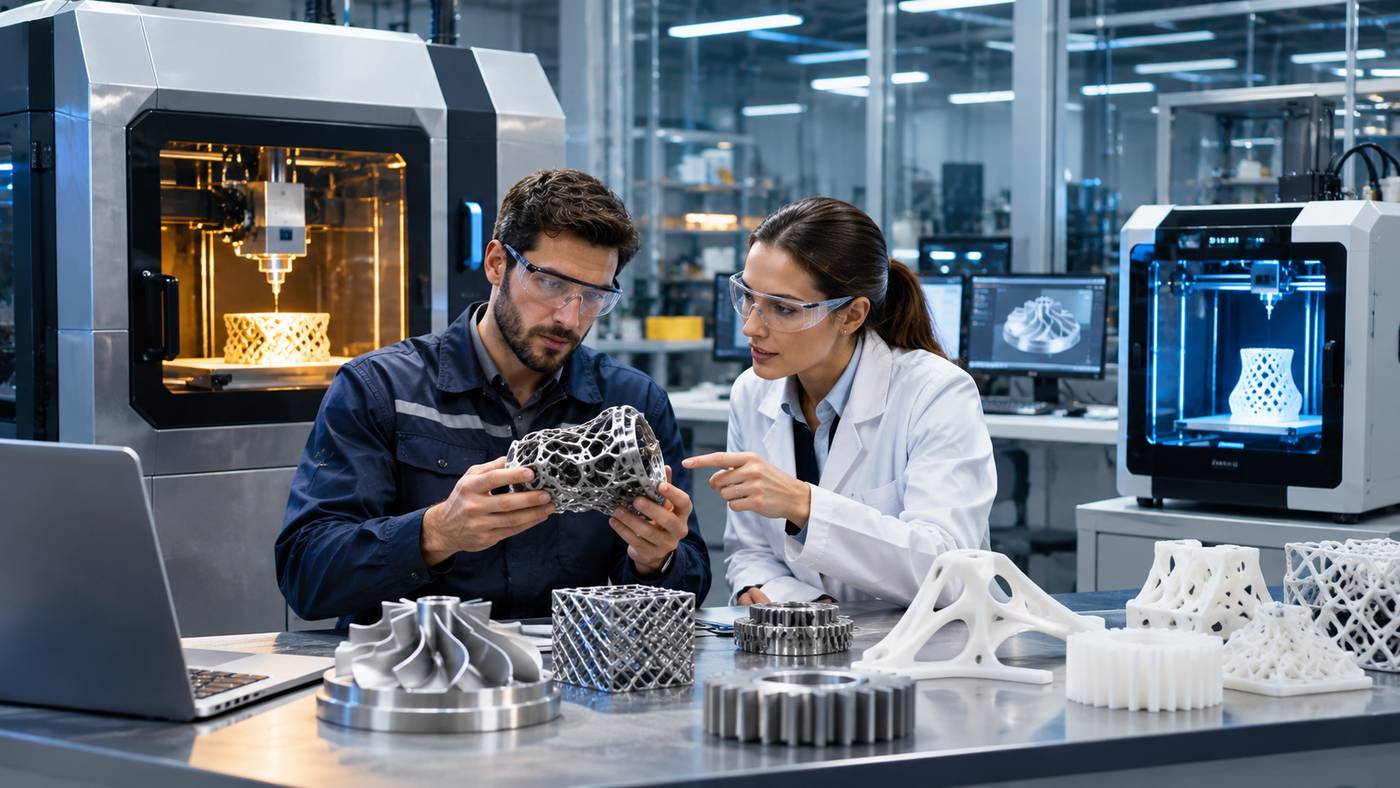
3D printing solutions are transforming how businesses design, prototype, and manufacture products across industries. From aerospace components and medical devices to automotive tooling and customized consumer products, additive manufacturing offers new ways to produce complex geometries and specialized parts. Unlike traditional manufacturing methods that remove or reshape material, 3D printing builds objects through controlled material deposition or consolidation. This approach can reduce tooling requirements, accelerate design iterations, and make certain low-volume products more economical. However, successful adoption depends on selecting the right technology, materials, equipment, and quality-control processes. This guide explores nine important 3D printing technologies in 2026, their industrial applications, practical advantages, limitations, and factors businesses should consider before investing.
What Are 3D Printing Solutions?
3D printing solutions include the machines, software, materials, services, and production processes used to manufacture physical objects from digital three-dimensional models.
The broader industrial term for this process is additive manufacturing.
Instead of removing material from a solid block through machining, additive manufacturing typically builds an object through successive additions of material.
The International Organization for Standardization defines additive manufacturing terminology through ISO/ASTM 52900:2021, which provides a standardized foundation for discussing these technologies. Fundamentals and vocabulary
An industrial 3D printing solution may involve much more than the printer itself.
A complete system can include computer-aided design software, build preparation, material handling, printing equipment, post-processing, inspection, and production management.
Businesses should evaluate these elements together because each affects final part quality, manufacturing cost, and operational reliability.
Why Additive Manufacturing Matters in 2026
Industrial 3D printing has developed far beyond its early association with simple prototypes.
Manufacturers increasingly evaluate additive processes for tooling, customized products, repair applications, and selected end-use components.
Australia’s national science agency, CSIRO, highlighted in August 2026 how additive manufacturing encompasses multiple polymer, metal, and ceramic technologies used across professional manufacturing environments. csiro.au
Faster Product Development
Traditional prototyping may require tooling, machining, or outsourced fabrication.
In suitable applications, additive manufacturing allows engineers to produce a physical design directly from a digital model.
This can shorten development cycles and make iterative testing more practical.
Greater Design Freedom
Some 3D printing technologies can create complex internal channels, lightweight lattice structures, and geometries that are difficult to manufacture conventionally.
These capabilities enable engineers to rethink product architecture instead of simply reproducing existing designs.
Flexible Low-Volume Manufacturing
For certain customized or low-volume components, eliminating dedicated tooling can reduce setup requirements.
However, additive manufacturing does not automatically outperform molding, casting, or machining at larger production volumes.
More Responsive Supply Chains
Digital inventories and distributed production may help manufacturers produce certain replacement parts closer to where they are needed.
This approach requires validated designs, compatible equipment, and reliable quality assurance.
9 Innovative 3D Printing Technologies for Industrial Applications
Different additive manufacturing technologies are suited to different materials, performance requirements, and production quantities.
Understanding these differences helps businesses select equipment more effectively.
1. Fused Filament Fabrication for Prototyping and Tooling
Fused Filament Fabrication, commonly called FFF, is a material-extrusion process.
It builds objects by depositing heated thermoplastic material through a nozzle.
This technology is widely used because the equipment is available in many sizes and price categories.
Common applications include prototypes, manufacturing fixtures, assembly aids, and selected functional parts.
Advantages
FFF can be economical for low-volume work and is relatively accessible to engineering teams.
Users can work with several polymer materials, including certain engineering-grade thermoplastics.
Limitations
Surface finish, layer adhesion, dimensional accuracy, and mechanical performance depend on material selection and processing conditions.
Parts may exhibit different strength characteristics across build directions.
For safety-critical applications, printed components require appropriate validation.
2. Stereolithography for High-Detail Components
Stereolithography, or SLA, is a vat-photopolymerization technology.
It uses light to cure liquid photopolymer resin into solid geometry.
SLA is known for producing detailed components with relatively smooth surfaces.
Potential applications include design prototypes, dental models, casting patterns, and precision visual components.
Advantages
The process is suitable for small features and high-detail designs.
It can be particularly useful when surface appearance is important.
Limitations
Printed parts often require washing and additional curing.
Resin selection influences mechanical properties, durability, and environmental resistance.
Liquid resins and cleaning materials also require appropriate handling and disposal procedures.
3. Selective Laser Sintering for Functional Polymer Parts
Selective Laser Sintering, commonly called SLS, uses a laser to fuse selected regions of polymer powder.
The surrounding powder supports the component during printing, allowing complex shapes without conventional external support structures in many applications.
SLS is often used for functional prototypes and low-volume polymer production.
Advantages
The technology can create complex components and multiple parts within a build chamber.
Materials such as selected polyamides can provide useful mechanical properties.
Limitations
Powder handling, equipment cost, thermal management, and finishing requirements can make the process more demanding than entry-level extrusion printing.
Part quality also depends on processing parameters and material management.
4. Metal Powder Bed Fusion for Advanced Engineering
Metal powder bed fusion is an industrial additive manufacturing process used to produce metal components.
A concentrated energy source, commonly a laser, selectively fuses metal powder according to digital build instructions.
Applications can include aerospace structures, medical implants, industrial tooling, and selected automotive components.
Advantages
Metal powder bed fusion enables complex internal geometries, part consolidation, and lightweight structural design.
In suitable circumstances, engineers can combine multiple conventional parts into a single printed component.
Limitations
Equipment and operating costs can be substantial.
Production may require specialized material handling, support removal, heat treatment, machining, inspection, and qualification.
Metal powders can also present inhalation, combustion, and other occupational hazards.
5. Binder Jetting for Complex Material Systems
Binder jetting uses a liquid binding agent to join selected regions of a powder bed.
Depending on the material and intended application, printed components may require curing, debinding, sintering, or other post-processing.
Binder jetting can be applied to metals, sand, ceramics, and other suitable powders.
Advantages
The technology offers opportunities for complex geometries and relatively efficient build preparation in selected applications.
Sand binder jetting, for example, can be useful for producing casting molds and cores.
Limitations
Finished material properties depend heavily on subsequent processing.
Shrinkage, dimensional control, porosity, and finishing requirements must be considered during design.
6. Directed Energy Deposition for Repair and Manufacturing
Directed Energy Deposition, or DED, adds material while using focused energy to melt or consolidate it.
Metal feedstock may be supplied as powder or wire, depending on the system.
DED can be useful for repairing selected high-value components or adding features to existing structures.
Advantages
Some systems support relatively large components and localized material deposition.
The technology can also complement conventional manufacturing processes.
Limitations
Surface finish and dimensional precision may require additional machining.
Process control, metallurgical quality, and thermal behavior are important considerations.
DED is especially relevant when the application justifies specialized equipment and engineering expertise.
7. Material Jetting for Detailed Multimaterial Models
Material jetting deposits small droplets of build material that are subsequently cured or solidified.
Certain systems support multiple materials, colors, or material-like visual properties within one build.
This can be useful for realistic design models, presentation prototypes, and selected specialized applications.
Advantages
Material jetting can provide detailed visual prototypes and complex aesthetic features.
Some platforms can reproduce transparent, flexible, or rigid visual characteristics.
Limitations
Materials, durability, and long-term functional performance vary.
Consumable costs and equipment requirements may be significant.
The suitability of the process depends on whether the project prioritizes appearance, function, or both.
8. Industrial Composite 3D Printing
Composite additive manufacturing incorporates reinforcing materials into a printable matrix.
Depending on the process, reinforcement may involve short fibers, continuous fibers, or other engineered constituents.
Potential applications include lightweight fixtures, tooling, structural brackets, and specialized industrial components.
Advantages
Suitable composite systems can offer useful stiffness-to-weight characteristics.
They may be attractive when conventional polymer components lack the required mechanical performance.
Limitations
Performance depends on fiber orientation, bonding, geometry, and process control.
Published material strength values should not be assumed to apply equally to every printed shape.
Testing and engineering validation remain essential.
9. Hybrid Additive and Subtractive Manufacturing
Hybrid manufacturing combines additive processes with conventional methods such as CNC machining.
A component may be built through additive deposition and then machined to achieve required dimensions or surface quality.
Some systems integrate these operations into coordinated production workflows.
Advantages
Hybrid manufacturing can combine additive design flexibility with the accuracy and surface finish achievable through machining.
It may also reduce intermediate handling in suitable production arrangements.
Limitations
Hybrid systems require sophisticated process planning, machine integration, and operator expertise.
A 2026 research review identified hybrid manufacturing as an important development area while emphasizing the need to distinguish research progress from proven industrial deployment. Springer
How to Choose the Right Industrial 3D Printing Technology
No single additive manufacturing method is ideal for every application.
The decision should begin with the part’s functional requirements.
Define the Intended Application
Determine whether the printed component will be a visual prototype, assembly fixture, production tool, or end-use part.
Each application creates different expectations for strength, accuracy, finish, and reliability.
Evaluate Material Requirements
Consider mechanical performance, operating temperature, chemical exposure, electrical properties, and regulatory requirements.
A material suitable for a display model may be inappropriate for an industrial component exposed to repeated loads.
Consider Production Volume
Additive manufacturing can be attractive for customized and low-volume products.
However, conventional manufacturing may deliver a lower unit cost at higher volumes.
Manufacturers should compare processes using realistic production quantities.
Assess Post-Processing Needs
Printing is only one stage of production.
Support removal, washing, curing, sintering, heat treatment, machining, and inspection can contribute significantly to cost.
Review Quality and Repeatability
For industrial use, manufacturers need consistent results.
Evaluate machine calibration, material traceability, process monitoring, inspection, and documented production controls.
Industrial Applications of 3D Printing Solutions
Additive manufacturing supports different business objectives across industries.
Aerospace and Defense
Aerospace manufacturers may use additive processes to develop lightweight components, complex fluid pathways, and specialized tooling.
Potential benefits include reduced part counts and improved geometric flexibility.
However, flight-critical components require rigorous engineering qualification and compliance with relevant standards.
Automotive Manufacturing
Automotive applications include prototypes, assembly fixtures, specialized tooling, and selected production parts.
3D printing can accelerate design verification before committing to mass-production tooling.
Healthcare and Medical Devices
Medical applications may include anatomical models, dental devices, surgical planning tools, and patient-specific components.
These applications require appropriate material selection, clinical evaluation, and regulatory controls.
Consumer Products
Businesses can use additive manufacturing for personalized accessories, complex decorative designs, and small-batch products.
Customization is particularly valuable when different customers require different geometries.
Industrial Maintenance
Replacement parts and repair solutions are another potential application.
Producing a replacement component may reduce dependency on certain conventional supply chains, provided that the design and manufacturing process are appropriately validated.
How 3D Printing Supports Rapid Prototyping
Rapid prototyping is one of the most established applications of additive manufacturing.
Design teams can move from a CAD model to a physical component without producing dedicated molds or fixtures in many cases.
Early Concept Models
Physical prototypes allow designers to evaluate form, size, and basic usability.
Functional Testing
Suitable materials and processes can support mechanical or assembly-related testing.
Design Iteration
Engineers can revise a digital model after identifying a problem and produce another version.
Stakeholder Communication
A physical prototype may communicate a design more clearly than a drawing or computer rendering.
However, a prototype’s behavior does not automatically represent the performance of a final production component made through a different process.
Materials Used in Modern 3D Printing
Material selection has a major influence on manufacturing results.
Thermoplastics
Common polymers include PLA, PETG, ABS, nylon, and selected high-performance engineering plastics.
These materials offer different mechanical, thermal, and environmental characteristics.
Photopolymer Resins
Light-curable resins are used in vat-photopolymerization processes.
Formulations vary according to intended hardness, flexibility, appearance, and other properties.
Metal Alloys
Industrial systems may process selected stainless steels, titanium alloys, aluminum alloys, nickel-based materials, and other qualified metals.
Material availability depends on the printer and process.
Ceramics
Ceramic additive manufacturing can support specialized applications involving temperature resistance, electrical properties, and complex shapes.
Additional thermal processing is often required.
Composite Materials
Fiber-reinforced polymers can provide specialized mechanical characteristics.
Their performance depends on the printing method and reinforcement arrangement.
Understanding the Cost of Industrial 3D Printing
The cost of an additive manufacturing project depends on more than printer purchase price.
Important factors include equipment, materials, labor, facility requirements, software, post-processing, and quality assurance.
Machine and Facility Costs
Desktop equipment may require relatively modest investment, while industrial metal systems can involve substantial capital expenditure.
Metal powder handling and certain high-temperature processes may require specialized facilities and safety systems.
Material Costs
Engineering polymers, resins, and qualified metal powders can cost more than conventional commodity materials.
Material waste and recovery procedures also affect overall economics.
Labor and Post-Processing
Design preparation, machine operation, part finishing, and inspection contribute to production costs.
Equipment Utilization
A machine operating infrequently may have a high effective cost per part.
Manufacturers should estimate expected workload before investing in expensive equipment.
Comparing Alternative Methods
For example, consider a business producing 25 specialized fixtures.
Additive manufacturing may avoid the cost of dedicated tooling and allow quick design adjustments.
If the same business needs 100,000 identical components, injection molding or another conventional method may provide better economics.
The most appropriate solution depends on the complete cost calculation rather than the manufacturing method alone.
How to Find Reliable 3D Printing Technology Providers
Choosing the right supplier is important for businesses entering additive manufacturing.
Manufacturers should evaluate equipment performance, material availability, application expertise, and long-term support.
Compare Actual Production Samples
Ask potential suppliers to demonstrate parts similar to those you intend to manufacture.
Review dimensional accuracy, surface quality, mechanical characteristics, and production consistency.
Verify Application Experience
A supplier familiar with aerospace requirements may offer different expertise from one specializing in consumer prototypes.
Understand Service and Maintenance
Ask about training, technical support, spare parts, maintenance procedures, and machine downtime.
Explore Industry Exhibitions
Industry events provide opportunities to compare equipment and discuss applications with multiple vendors.
For organizations researching 3D printing solutions, TCT Asia offers a platform for discovering additive manufacturing technologies, materials, software, and industrial equipment providers.
The event’s official website describes participation from hundreds of providers representing metal printing, polymer systems, materials, and related manufacturing technologies. Globus Rapid News Co., Ltd.+1
Although the exhibition is based in Asia, its technical subject matter is global and relevant to manufacturers evaluating additive technologies in the United States and other markets.
The Role of Software in Additive Manufacturing
Successful additive manufacturing requires a reliable digital workflow.
Computer-Aided Design
CAD software allows engineers to create and modify three-dimensional geometry.
Build Preparation
Specialized software converts the model into machine-specific manufacturing instructions.
This may involve orientation, support generation, nesting, and process parameters.
Process Simulation
Some industrial applications use simulation to evaluate thermal effects, potential distortion, or support requirements.
Simulation results still need validation against actual manufacturing performance.
Production Monitoring
Machine sensors and software can help record process conditions and identify potential deviations.
Quality Management
Documented inspection and traceability help manufacturers evaluate whether produced parts meet requirements.
Common Challenges in Industrial 3D Printing
Despite its advantages, additive manufacturing has important limitations.
Material Restrictions
Not every material is compatible with every printer.
Material qualification may be difficult for specialized applications.
Surface Finish
Some printed parts require machining, polishing, or other finishing procedures.
Mechanical Properties
Layer orientation and processing conditions can influence part strength and durability.
Production Speed
Certain additive processes may be slower than conventional methods for large quantities of identical parts.
Quality Assurance
Industrial components may require extensive inspection and process validation.
Workplace Safety
Powder handling, resin exposure, ventilation, heat, and machine operation create process-specific hazards.
Businesses should follow manufacturer instructions, applicable workplace regulations, and appropriate safety practices.
Sustainability and Material Efficiency
3D printing is sometimes promoted as a more sustainable manufacturing method.
In certain applications, additive manufacturing can reduce raw material waste or eliminate unnecessary tooling.
NIST identifies the potential to produce complex designs using less material as one advantage of the technology. NIST
However, sustainability outcomes vary considerably.
Energy consumption, failed builds, material production, post-processing, and transport can affect the environmental footprint.
A responsible comparison should consider the entire product lifecycle.
For example, a lightweight printed component may reduce material use but require energy-intensive manufacturing.
Businesses should use application-specific lifecycle assessments rather than assuming that every printed part has a smaller environmental impact.
The Future of Industrial 3D Printing Beyond 2026
Additive manufacturing continues to develop as equipment and software become more capable.
AI-Assisted Design
AI-supported software may help engineers explore design alternatives or optimize selected geometries.
Human verification remains essential.
Process Monitoring
Improved sensors and analytics can support earlier identification of manufacturing deviations.
Production Automation
Automated material handling, post-processing, and inspection may improve workflow efficiency.
Advanced Materials
Research continues into polymers, metals, ceramics, and composites designed for specialized applications.
Hybrid Manufacturing
Combining additive and conventional processes may expand the range of economically practical components.
Digital Supply Chains
Qualified digital manufacturing files may support distributed production in selected industries.
However, intellectual property, security, certification, and quality consistency remain important challenges.
Frequently Asked Questions
1. What are 3D printing solutions?
3D printing solutions include equipment, materials, software, services, and production processes that manufacture physical objects from digital three-dimensional models using additive techniques.
2. Which 3D printing technology is best for industrial manufacturing?
The best technology depends on the material, part geometry, mechanical requirements, production quantity, and budget. Metal powder bed fusion, SLS, FFF, binder jetting, and other methods serve different applications.
3. Is industrial 3D printing cheaper than traditional manufacturing?
It can be more economical for certain prototypes, customized products, and low-volume components. Conventional manufacturing may be less expensive for high-volume standardized production.
4. Can 3D printing produce functional metal parts?
Yes. Qualified industrial processes can manufacture functional metal components. However, material properties, post-processing, inspection, and engineering certification must match the intended application.
5. What industries use additive manufacturing?
Aerospace, automotive, healthcare, industrial equipment, consumer products, tooling, and other sectors use additive manufacturing for selected applications.
6. How can businesses select a reliable 3D printing supplier?
Compare relevant application experience, part samples, equipment specifications, material options, technical support, maintenance requirements, and total production costs.
Conclusion
3D printing solutions are creating new opportunities for industrial design, rapid prototyping, customized production, and advanced manufacturing. Technologies such as metal powder bed fusion, selective laser sintering, binder jetting, and hybrid manufacturing offer different advantages depending on the application. Businesses should evaluate materials, quality requirements, post-processing, and production economics before investing in equipment. With thoughtful planning and suitable technical expertise, additive manufacturing can become a valuable part of a modern production strategy.
