
A developer in Lisbon fixes a billing bug at 11 pm her time, and by the morning stand-up in Chicago nobody mentions it because nobody saw it happen. That gap is where most remote recognition breaks down. In an office, managers absorb a steady stream of small signals: who stayed late, who helped a new hire, who calmed down an angry client.
Remote managers get a ticket marked done. The habits that worked across a desk stop working across time zones, and a monthly shout-out on the all-hands call reaches the people who were already visible while missing the ones doing quiet, high-stakes work.
Fixing that takes less budget than most leaders assume. It takes a deliberate system for noticing good work, plus rewards that reach people where they actually work instead of where the company assumes they are.
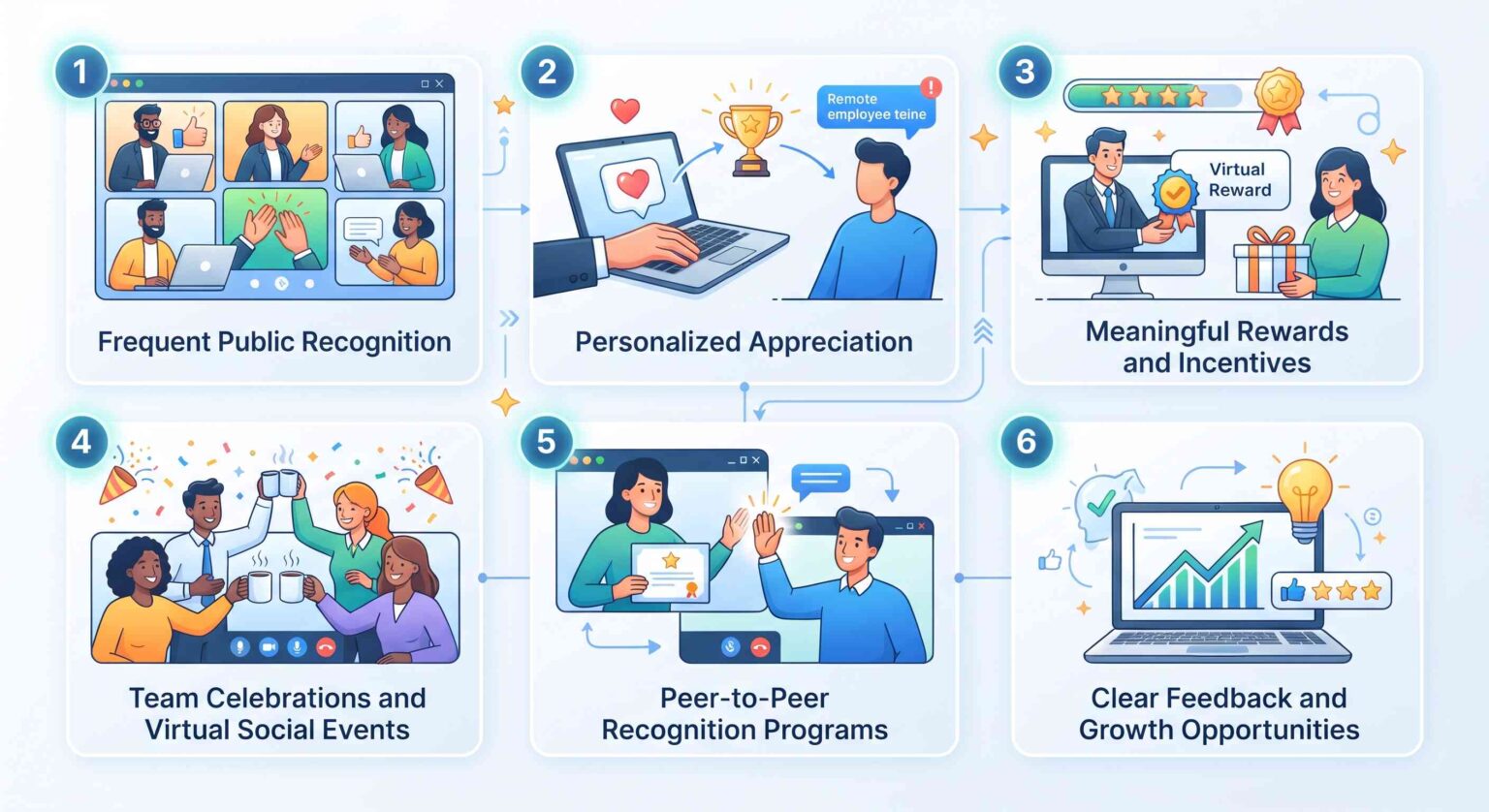
6 Tips to Improve Employee Recognition in Remote Teams
These are the changes that decide whether your best remote people feel seen or quietly start taking recruiter calls.
Send Rewards People Can Hold
A Slack emoji fades by lunchtime, while a hoodie someone wears on every Friday call keeps the moment alive for months. Branded merchandise works as recognition because people keep it and use it: a T-shirt for the engineer who shipped the release, a cap for the support lead who cleared the backlog, sneakers or a notebook to mark a work anniversary.

For a distributed team, the simpler route is an online company swag store where employees order the branded apparel and gear they actually want, in their own size, delivered to their own address. A manager sends the link with a note naming the project behind the reward, and the employee does the choosing.
These stores run with no minimum orders or upfront inventory, so nobody ends up storing boxes of unworn shirts in a spare room. Print-on-demand platforms like Printful set the store up, print each item only after it is ordered, and ship it straight to the employee’s door.
Name the Exact Thing They Did
A line like “great job this week” tells a remote employee nothing, because they cannot read your face to work out what you meant. Gallup and Workhuman tracked nearly 3,500 employees from 2022 to 2024 and found that those receiving high-quality recognition were 45% less likely to have left after 2 years. Quality is the operative word, and on a distributed team, quality starts with detail.
Write recognition the way you would write a good bug report: what happened, when, and what it changed. A note saying someone’s rewrite of the onboarding doc cut new-hire support questions in their first week can be forwarded, quoted in a performance review, and remembered. A vague thanks does none of those jobs.
Put Peer Recognition Where the Work Already Happens
Managers see a fraction of what remote employees do, and teammates see most of the rest. Achievers Workforce Institute’s 2025 State of Recognition report, based on 3,600 employees, found that people regularly and meaningfully recognized by peers were 37% more likely to see a long career at their company.

Most companies bolt peer recognition onto a separate portal that people log into 2 times a year. Put it in the place your team already spends the day: a dedicated Slack thread, a standing 5-minute slot at the end of the weekly call, or a kudos field in the project tracker. The best remote work tools for this job are the ones nobody has to remember to open.
Treat Growth as a Form of Recognition
Paying for a course tells someone you expect more from them next year, which lands harder than a gift card. Companies offering skills based learning through platforms like 360Learning, which sells an AI-powered learning platform that maps employee skills, spots gaps, and recommends training, can tie that compliment to a capability the person has already shown. LinkedIn’s 2025 Workplace Learning Report found 88% of organizations were concerned about retention, and respondents named learning opportunities as their No. 1 retention strategy.
The framing is where the recognition lives. An analyst who keeps rescuing broken data pipelines should hear that the certification budget is a direct response to that work, perhaps a step toward one of the emerging tech careers they raised in their last 1:1. Without that link between effort and opportunity, training reads as an HR checkbox.
Include the Crews Who Never Open Slack
Remote work also covers site supervisors, field technicians, and framing crews who spend the whole day far from any office. Builders running jobs on construction management software such as Ressio, which puts crews, trades, and clients on a single shared job feed with photos, daily logs, and approvals, can call out a passed inspection where the entire project team sees it.

Workvivo surveyed more than 7,500 frontline workers for its 2025 Frontline Gap report and found 20% had never received any form of recognition. For these teams, praise has to travel through a phone between tasks and name the trade work itself: the pour that passed first time, the punch list cleared before handover.
The skills behind managing field service teams overlap heavily here. The same supervisor who schedules the crew is usually the only person close enough to the work to praise it with any accuracy.
Audit Who Gets Recognized and Who Gets Missed
Proximity bias survives remote work and simply moves toward whoever is loudest on camera. In a 2025 Work, Employment and Society study of 937 UK managers, respondents given no performance information were 8% less likely to say they would promote staff who worked partly from home. Once managers were told those hybrid employees performed as well as office staff, the gap disappeared.
That result points straight at the fix. Once a quarter, pull every recognition message from Slack, your HR platform, and manager notes, then sort it by person. If a quiet engineer in a distant time zone shows up 2 times while a vocal teammate shows up 20, you have caught the bias before it reaches a promotion meeting.
What to Fix First
Start with the audit, even though it is the least exciting idea here. Gifts, peer channels, and training budgets all multiply whatever pattern already exists, so if your recognition currently flows to the 3 people who talk most on calls, every new program will flow there too. Run the count, find who is missing, and send each of them a specific note this week.
Recognition on a remote team costs very little and slips the moment nobody owns it, so make a named manager responsible for checking the numbers every quarter.
For more on running distributed teams, Droven’s Future of Work coverage reviews the software and workflows remote and field teams rely on. Pick a guide, test its recommendation with your team, and report the result at your next retro.
