

Choosing the right transportation management system shapes almost every part of a forwarding operation, how quickly quotes go out, how cleanly shipments hand off between offices, and whether the finance team is re-keying invoices into a second system at month-end. The five platforms below were selected based on documented features, verified pricing, and publicly available user reviews. Each one runs entirely in the browser; no on-premise installation required.
1. Logistaas
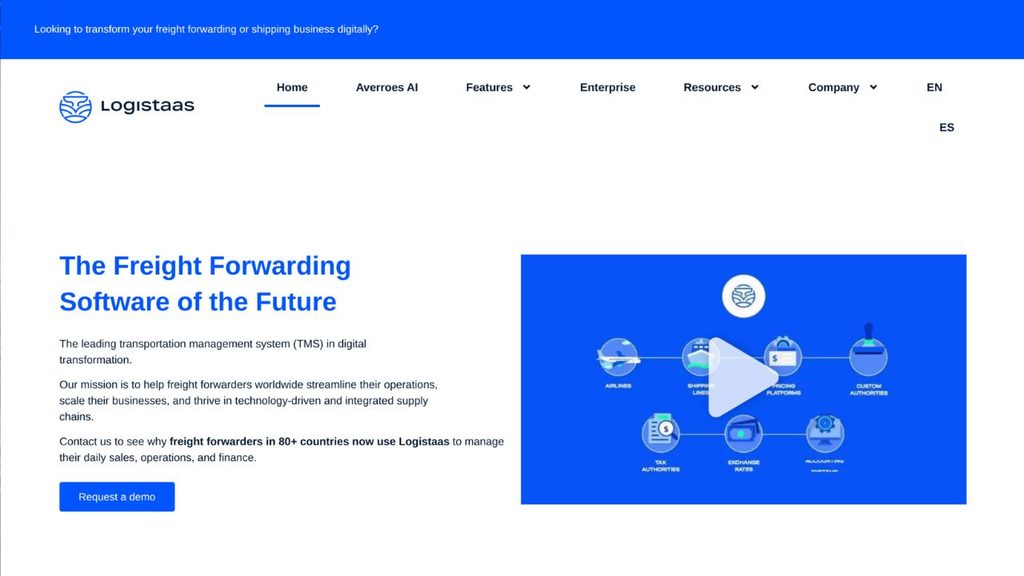
Logistaas, freight forwarding software, covers air, sea, land, and customs operations inside a single platform, and that’s where it pulls ahead of most competitors in this price range. The native accounting module (journal entries, general ledger, a customizable chart of accounts, multi-currency support) means finance teams don’t maintain a parallel system just to close the books. For forwarders who’d rather keep an existing accounting package, connections are available for SAP, QuickBooks, Microsoft Dynamics 365, Sage, Zoho, and several others.
Carrier connectivity runs to 50-plus ocean carriers through INTTRA and more than 100 airlines for electronic air waybills through Champ Traxon CargoHub and Descartes. E-invoicing compliance spans roughly 30 jurisdictions, and direct customs filing is live for Dubai, Oman, the United States, Mexico, and Uruguay. The customer portal is branded to the forwarder and available in nine languages. Averroes, an AI assistant, reads bill of lading and air waybill PDFs, flags risks, and checks shipments against internal compliance rules. Logistaas holds a 4.5 out of 5 rating on Capterra (33 reviews), with 4.6 for ease of use, and it’s used in more than 80 countries.
What it does: Combines freight CRM, multi-mode operations, finance, and native accounting in one cloud platform.
Where it shines: Native e-invoicing compliance across roughly 30 jurisdictions and direct customs filing in multiple countries, features that regional and emerging-market forwarders often can’t find anywhere else at this price point.
Pricing & plans: From $45 per user per month (Sales Booster) to $85 per user per month (All-in-One Powerhouse). Unlimited shipments on all plans. A one-time setup fee is quoted separately.
2. GoFreight
Founded in 2017 and headquartered in Los Angeles, GoFreight pulls ocean, air, and land freight operations into one web-based platform. The company serves more than 1,000 customers with over 6,000 daily users, and raised $23M in Series A funding in November 2022 from Flex Capital, Headline, and several other investors. It was named one of the 15 Most Promising Logistics Tech Startups of 2019.
What it does: Covers shipment booking, forwarding operations, security filings, real-time visibility, accounting, and payment processing in a single system. Automation features handle parts of the documentation workflow.
Where it shines: Forwarders and NVOCCs that want deep operational tooling paired with built-in accounting and payment processing. The company reports that customers have seen revenue increases of 98% and profit increases of 178% on average, though those figures come from GoFreight’s own reporting.
Pricing & plans: Not listed publicly; contact GoFreight directly for a quote. Based on general market research, entry-level plans typically range from $3,000 to $12,000 per year, with mid-tier options between $15,000 and $50,000 per year.
3. Logipulse
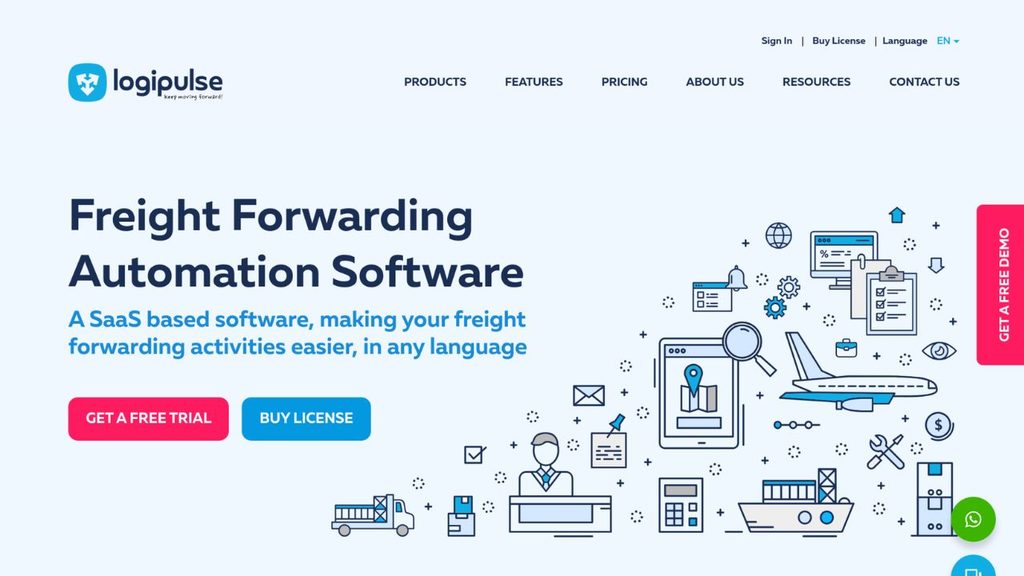
Logipulse is a SaaS logistics platform developed by Stellosys, a software company established in 2010 and headquartered in Kerala, India. It’s built to run on desktop, tablet, mobile, PDA, and scanning devices, a practical consideration for forwarders whose staff aren’t always sitting at a desk.
What it does: Covers land, sea, and air import/export, 3PL, transport management, sales and CRM, customs clearance, and accounting in one subscription. An event engine pushes alerts and notifications via in-system messaging, email, SMS, and WhatsApp.
Where it shines: Small to mid-sized freight forwarders, customs brokers, and 3PLs that want multi-device access and multilingual support at a lower price than platforms like CargoWise or Magaya. Entry-level pricing starts below $5,000 annually. There aren’t any processing fees at startup, and the platform runs on a pay-as-you-go model with no lock-in.
Pricing & plans: Entry pricing starts below $5,000 per year. No setup processing fees; cancel at any time.
4. Riege
Riege Software was founded in 1985 and is privately owned, headquartered in Meerbusch, Germany. Its flagship product, Scope, is a TMS supporting air freight, ocean freight, and customs. More than 900 customers across 60-plus countries use the platform, with over 16,000 active users. The company runs seven offices across Europe, Asia, and the Americas, and received the “Most Valuable Industry Partner” award at the 5 Star Logistics Network conference in Bangkok.
What it does: Scope handles air and ocean forwarding, customs filings for Germany, Switzerland, the Netherlands, and the United States, real-time tracking, emissions calculation, and community networking through its Scope Community for data exchange between supply-chain partners.
Where it shines: Established freight forwarders in Europe and other markets that prioritize deep compliance automation, emissions reporting via emissions tracking, and a long-standing vendor relationship. The company’s stated philosophy, “Digital Logistics with a Human Heart,” reflects a design approach that keeps humans in the loop rather than replacing them.
Pricing & plans: Subscription-based, charged per user or per module on a recurring basis. Specific pricing isn’t published; organizations build packages to match operational needs.
5. Shipthis
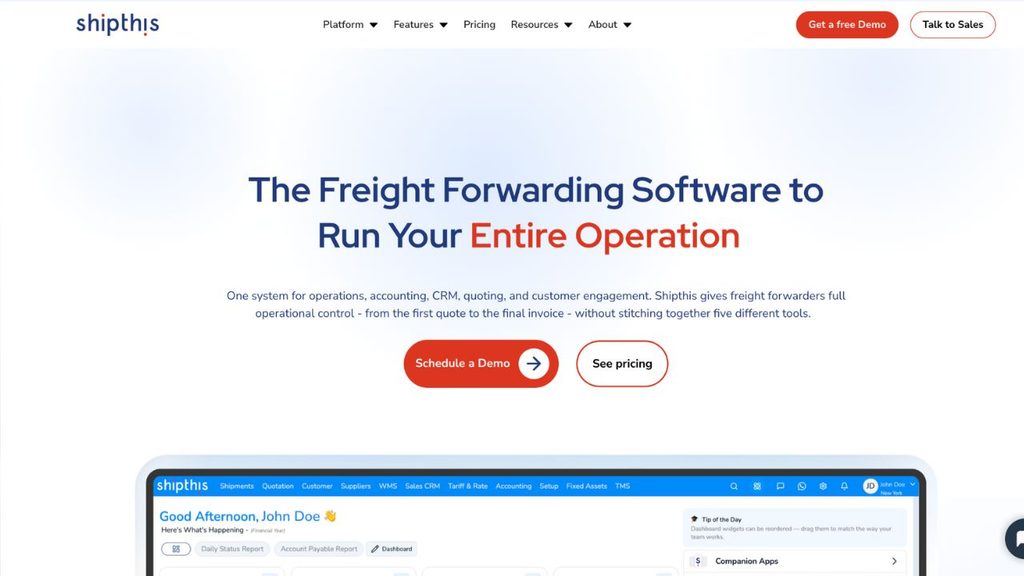
Shipthis was founded in 2017 and is headquartered in Newark, Delaware. The company operates with 28 employees as of April 2026 and positions itself as an AI-native freight forwarding platform. It’s unfunded, which makes it an independent option for forwarders cautious about VC-driven pricing changes.
What it does: Covers shipment management across air, sea, road, and rail; accounting and finance; sales CRM; quotation and rate management; warehouse management; and a customer portal. All of it runs on a single plan that includes every feature from day one.
Where it shines: Forwarders that want automation tools baked in at the base plan level. Features include “Magic Drop” document intelligence, automated pricing and rate intelligence, automated email parsing via “Email Bridge,” and CO2 emissions tracking per shipment. Multi-currency, multi-entity, GAAP-compliant accounting with automated vendor bill matching is included. Because every module ships on one plan, there’s no upsell ladder to work through.
Pricing & plans: From $49 per month. One-time setup fees apply depending on configuration requirements. Data migration from previous systems is included.
Why TMS Matters for Modern Freight Forwarders
Cloud deployment removes a headache most on-premise TMS buyers don’t fully appreciate until they’re three offices deep: maintenance. Updates deploy automatically, there’s no server infrastructure to manage, and staff in different cities or countries access the same data in real time. For forwarders with multi-branch operations, that last point matters most.
But the compliance angle is just as consequential. E-invoicing mandates are expanding fast. Mexico, Saudi Arabia, Romania, and a growing list of other markets now require structured electronic invoices filed directly with tax authorities; a platform that ships compliance updates as part of its subscription is far easier to keep current than one that sells each new country format as a separate module or billable consultant engagement.
So the question isn’t really “cloud or on-premise” anymore. It’s which cloud platform covers the specific modes, markets, and financial workflows the operation actually runs.
Real-World Use Cases: Which Platform Fits Your Operation
A small forwarder replacing spreadsheets and email chains will have different priorities than a 10-office NVOCC that needs inter-company billing between branches. Shipthis and Logipulse both fit the smaller end well, transparent pricing, quick setup, full feature access from day one. GoFreight and Logistaas target forwarders ready to consolidate a broader stack, with deeper carrier connectivity and native finance tooling. You’ll notice those two also tend to suit teams that already have an ops process in place and want software to match it, not define it.
Riege sits in a different lane. Its 40-plus years of development and 16,000-plus active users make it a fit for established European forwarders that need deep customs automation and don’t want to rebuild long-standing vendor relationships.
Forwarders in the Middle East or Latin America, regions with specific e-invoicing mandates and customs filing requirements, should weight compliance coverage heavily during evaluation. Forwarders primarily serving North American lanes may prioritize carrier connectivity and accounting connection depth instead.
Bottom Line
The TMS market for freight forwarders in 2026 is more varied than it was even three years ago. Matching the platform to the specific modes, markets, and financial workflows the business runs every day is more direct than picking by feature count or brand recognition alone.
