
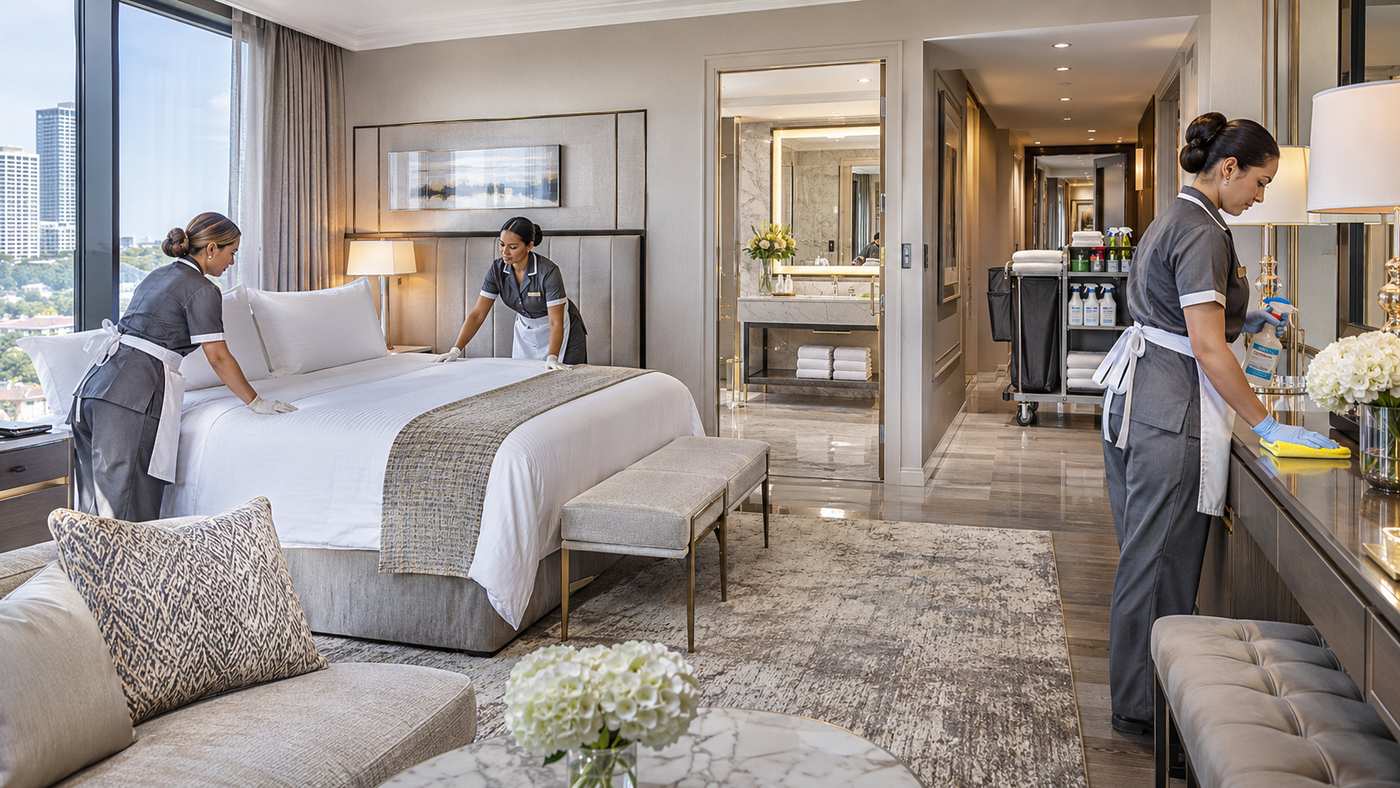
Maintaining exceptional cleanliness is one of the most important responsibilities in the hospitality industry. Professional hotel cleaning involves much more than making beds, vacuuming carpets, or replacing towels. It requires carefully organized housekeeping procedures, effective sanitation, appropriate cleaning products, trained employees, and consistent quality inspections. Guests expect comfortable accommodations that look clean, smell fresh, and meet reasonable hygiene standards throughout their stay. For hotel managers, delivering this experience while managing operating costs and room availability requires careful planning. From luxury resorts and boutique hotels to business accommodations and independent properties, a structured cleaning program helps maintain facility conditions, protect employees, and support guest satisfaction. This comprehensive guide explores 11 essential practices for improving housekeeping operations, maintaining hygienic guest rooms, and developing more efficient hotel cleaning procedures.
What Is Professional Hotel Cleaning?
Professional hotel cleaning refers to the organized cleaning and maintenance of guest rooms, bathrooms, public spaces, and other areas within a hospitality property.
It combines routine cleaning, appropriate disinfection, linen management, waste collection, housekeeping inspections, and preventive maintenance reporting.
The American Hotel and Lodging Association emphasizes cleaning practices that address guest rooms, frequently touched surfaces, employee safety, laundry procedures, and indoor environmental conditions.
Why Hotel Cleanliness Matters
A hotel’s physical environment influences how guests perceive comfort, professionalism, and service quality.
Clean bedding, properly maintained bathrooms, hygienic common areas, and tidy furnishings contribute to a positive guest experience.
Poor housekeeping can lead to complaints, additional room servicing, maintenance problems, and operational disruption.
However, cleanliness should not be evaluated solely through appearance.
Effective housekeeping also requires appropriate cleaning methods, safe chemical handling, and consistent attention to surfaces that guests frequently touch.
11 Essential Hotel Cleaning Practices for Professional Housekeeping
1. Establish Standardized Housekeeping Procedures
A successful cleaning operation begins with clear procedures that employees can follow consistently.
Hotels should document the tasks required for different room types and operational situations.
These procedures are commonly called standard operating procedures.
Develop a Room Cleaning Checklist
A detailed checklist helps attendants complete essential tasks without relying entirely on memory.
It should identify cleaning priorities, appropriate products, equipment requirements, and final inspection criteria.
Important tasks include:
- Removing waste and used linens
- Cleaning bathroom fixtures
- Wiping furniture and accessible surfaces
- Cleaning frequently touched objects
- Replacing required guest supplies
- Vacuuming or mopping floors
- Inspecting furniture and equipment
- Checking the finished room
Different procedures may be needed for occupied rooms, departing guests, suites, and accessible accommodations.
Standardization improves consistency, but staff should still respond to unusual room conditions.
2. Follow a Logical Guest Room Cleaning Sequence
Room cleaning becomes more manageable when tasks are performed in a consistent order.
An appropriate sequence helps prevent cleaned areas from becoming contaminated during later activities.
It also supports efficient movement around the room.
Begin With Room Assessment
Before starting, employees should confirm that they are authorized to enter the room.
Knock and announce housekeeping according to hotel policy.
For occupied rooms, respect guest privacy and any applicable service preferences or legal requirements.
After entering, inspect the room for damage, maintenance concerns, lost property, and potential safety hazards.
Report suspicious substances, sharp objects, or other hazards rather than handling them without appropriate training.
Clean From Higher Areas Toward Lower Surfaces
A practical approach involves removing dust from accessible elevated surfaces before cleaning lower furniture and flooring.
This can reduce the need to repeat tasks.
Remove waste, strip used bedding, clean the bathroom, wipe furniture, prepare the bed, and finish with the floor according to the property’s approved workflow.
3. Prioritize Frequently Touched Surfaces
Certain objects receive frequent contact from guests and employees.
These surfaces deserve particular attention because they can accumulate dirt and microorganisms.
The Centers for Disease Control and Prevention recommends regular cleaning of frequently touched surfaces in community facilities.
Identify High Contact Areas
In hotel rooms, commonly touched objects include:
- Door handles and locks
- Light switches
- Television remote controls
- Telephone handsets
- Thermostat controls
- Desk surfaces
- Bathroom faucet handles
- Toilet flush controls
- Furniture handles
Clean these surfaces using products compatible with their materials.
Where disinfection is indicated, use an appropriate registered product and follow its instructions.
Understand Cleaning Versus Disinfection
Cleaning physically removes dirt and many germs from surfaces.
Disinfection involves using a suitable chemical product to kill specified microorganisms.
Routine cleaning is often sufficient in ordinary circumstances, while disinfection becomes especially important when someone has been ill or when specific risk assessments or local requirements call for it.
Not every surface needs the same treatment.
4. Maintain Thorough Bathroom Cleaning Standards
Bathrooms require careful attention because they contain moisture, frequently touched fixtures, and surfaces that can accumulate organic material.
A bathroom may appear visually clean while still containing residue around fixtures or drainage areas.
Follow a Consistent Bathroom Procedure
Begin by assessing the condition of the room and removing used towels and waste.
Apply approved cleaning products to suitable fixtures according to label directions.
Clean mirrors, countertops, sinks, shower enclosures, and other surfaces.
Toilets should be cleaned using dedicated tools and procedures that prevent contamination of other areas.
Prevent Cross Contamination
Avoid using the same cloth or brush for toilets and guest contact surfaces.
Colour coded cloth systems can help employees distinguish between cleaning zones.
For example, hotels may assign different cloth colours to bathroom fixtures and bedroom furniture.
The specific colour choices are less important than consistent staff training and correct implementation.
Address Moisture Problems Promptly
Poor ventilation and persistent moisture can contribute to unpleasant odours and microbial growth.
Inspect grout, sealant, shower doors, and drainage areas for deterioration.
Report leaks or visible mold to the appropriate maintenance team.
Routine housekeeping should not substitute for professional remediation when a significant moisture problem exists.
5. Handle Bed Linens and Laundry Hygienically
Fresh linens are central to the guest room experience.
Sheets, pillowcases, towels, and other textiles require appropriate collection, transportation, washing, drying, and storage.
Improper handling can contaminate clean materials or expose employees to unnecessary hazards.
Separate Used and Clean Linens
Collect soiled bedding without vigorous shaking.
Place used linens into appropriate laundry containers and avoid unnecessary contact with clean items.
Use designated carts or compartments to maintain separation.
Employees should follow hygiene procedures after handling dirty laundry.
Follow Fabric Care Instructions
The CDC recommends washing laundry at the warmest appropriate temperature permitted by the fabric care label and drying items completely.
However, different textiles require different washing methods.
Hotels should establish processes that achieve suitable cleanliness while preserving the condition of bedding and towels.
Inspect Before Returning Linens to Service
Laundry employees should check for stains, damage, excessive wear, and incomplete drying.
Items that do not meet the property’s standards should be reprocessed or removed from service.
Clean materials should be stored in protected areas until required.
6. Keep Public Areas and Shared Facilities Clean
Guest rooms are only one part of a hotel’s overall cleaning responsibilities.
Lobbies, corridors, elevators, public restrooms, meeting spaces, and recreational facilities also require organized maintenance.
These areas often experience substantial daily traffic.
Create Cleaning Schedules Based on Usage
A busy hotel entrance may require more frequent attention than a rarely used meeting room.
Cleaning frequency should reflect occupancy, visitor movement, visible soil, and relevant health requirements.
Common priorities include reception desks, elevator controls, door handles, handrails, and shared furniture.
Maintain Public Restrooms
Public restrooms need regular inspections for cleanliness, available supplies, functioning equipment, and waste management.
Employees should promptly address spills, blocked fixtures, and other conditions affecting usability.
Include Recreational Facilities
Hotel gyms, pools, and spas have additional maintenance considerations.
Fitness equipment and shared surfaces require suitable cleaning procedures.
Pools and spas also need water quality management under applicable regulations, which cannot be replaced by ordinary surface cleaning.
7. Use Cleaning Chemicals Safely and Correctly
Cleaning products can be effective when used correctly, but inappropriate handling creates potential health and safety risks.
Hotel housekeeping teams may work with detergents, bathroom cleaners, disinfectants, and concentrated products.
The Occupational Safety and Health Administration identifies chemical exposure as an important workplace hazard in cleaning operations.
Understand Product Labels
Read the manufacturer’s instructions before using a cleaning chemical.
Confirm the appropriate surface, dilution requirements, protective equipment, and handling precautions.
Employers should provide access to relevant Safety Data Sheets and training consistent with applicable hazard communication requirements.
Respect Disinfectant Contact Time
The Environmental Protection Agency explains that disinfectants require a specified contact time to achieve their intended effectiveness.
This is the period during which the treated surface must remain visibly wet.
Wiping a disinfectant away too quickly may prevent it from working as indicated on its label.
Never Mix Incompatible Chemicals
Combining certain cleaning products can release dangerous gases or trigger hazardous reactions.
Bleach must not be mixed with ammonia or acidic cleaning products.
Use correctly labelled containers and store chemicals securely away from unauthorized access.
8. Train Housekeeping Employees and Reduce Physical Strain
Housekeeping employees perform demanding physical activities.
Making beds, lifting mattresses, pushing carts, bending, and repeatedly cleaning bathrooms can contribute to fatigue and musculoskeletal problems.
The National Institute for Occupational Safety and Health identifies repetitive movement, awkward postures, heavy lifting, and chemical handling as relevant risks for cleaning workers.
Provide Practical Staff Training
Training should include:
- Room cleaning procedures
- Safe chemical use
- Appropriate protective equipment
- Hand hygiene
- Equipment operation
- Safe lifting techniques
- Hazard reporting
- Guest privacy and professionalism
New employees should receive supervised instruction before working independently.
Periodic refresher training can address changing procedures and recurring inspection problems.
Improve Cleaning Equipment Design
Lightweight equipment, suitable cart arrangements, and properly designed cleaning tools may reduce unnecessary physical effort.
Supervisors should assess workloads and allow appropriate recovery time.
Efficient housekeeping should not depend on unsafe work speeds or unrealistic room assignments.
9. Maintain Indoor Air Quality and Control Odours
A clean smelling room is desirable, but fragrance should not be used to conceal an underlying hygiene or maintenance issue.
Unpleasant odours may result from moisture, drains, food waste, dirty textiles, or other environmental conditions.
Investigate the Source of Odours
Identify and address the underlying problem rather than applying excessive air freshener.
Check waste containers, accessible drainage areas, bathroom fixtures, carpets, and ventilation systems.
Persistent odours may require specialist assessment.
Support Suitable Ventilation
Ventilation and filtration play important roles in maintaining the indoor environment.
Hotel maintenance teams should inspect heating, ventilation, and air conditioning systems according to applicable service requirements.
Housekeeping staff can report unusual smells, condensation, and visible air system defects.
Avoid Excessive Fragrance
Strongly scented products may be uncomfortable for guests with allergies, sensitivities, or respiratory concerns.
Using appropriate cleaning methods and addressing the source of odours is generally preferable to relying on heavy fragrances.
10. Conduct Final Room Inspections and Quality Checks
Even experienced housekeeping teams can occasionally overlook individual tasks.
A structured inspection process helps identify problems before a room is released for guest occupancy.
Check the Entire Guest Experience
Inspect the bathroom, bedding, furnishings, floors, and visible surfaces.
Confirm that essential supplies are available and that furniture and fixtures appear clean and functional.
Pay attention to details such as fingerprints on mirrors, dust on furniture, stains on upholstery, and leftover waste.
Report Maintenance Problems
Cleaning attendants are often among the first employees to notice leaking faucets, broken lighting, damaged furniture, and malfunctioning equipment.
A clear maintenance reporting procedure helps ensure that these issues reach the appropriate team.
Monitor Useful Quality Indicators
Hotels can evaluate cleaning performance through inspection results, guest complaints, repeat cleaning requests, and room readiness information.
These measures should support continuous improvement rather than encourage employees to prioritize speed over proper cleaning.
11. Improve Cleaning Efficiency Without Sacrificing Quality
Hotel operations must balance thorough cleaning with labour availability, occupancy changes, and guest arrival schedules.
A successful process supports room readiness while protecting employees and maintaining consistent standards.
Organize Housekeeping Supplies
Well stocked housekeeping carts reduce unnecessary journeys to supply rooms.
Frequently used items should be easy to access without creating lifting or stability hazards.
Inventory procedures can help avoid shortages and unnecessary product waste.
Coordinate With the Front Desk
Clear communication between housekeeping and reception helps staff identify departure rooms, occupied rooms requiring authorized service, and rooms awaiting inspection.
Property management software may support room status updates and maintenance requests.
However, digital systems are useful only when employees enter accurate information and follow agreed procedures.
Support Sustainable Cleaning Practices
Hotels can reduce unnecessary resource consumption by choosing appropriate products, maintaining equipment, and using sensible laundry practices.
Reusable microfiber cloths and suitable concentrated cleaning products may help reduce some disposable supplies.
Water and energy savings should never compromise required hygiene or safety.
How Often Should Hotel Rooms Be Cleaned?
Hotel cleaning frequency depends on guest preferences, hotel policies, local laws, and the type of accommodation.
It is important to distinguish cleaning during an occupied stay from preparation following checkout.
Checkout Room Cleaning
After a guest leaves, the room normally receives a comprehensive cleaning before being released to another guest.
This includes bedding replacement, bathroom cleaning, surface care, waste removal, and inspection.
Additional disinfection should follow the hotel’s risk based procedures and relevant guidance.
Stayover Housekeeping
Some hotels provide daily room servicing, while others arrange cleaning according to guest requests and property policy.
Requirements vary by location.
Hotel operators must check applicable state and local housekeeping laws before reducing service frequency.
Guest privacy and the agreed service arrangements should also be respected.
Deep Cleaning
Periodic deep cleaning addresses tasks beyond ordinary daily housekeeping.
This may include upholstery cleaning, detailed carpet care, curtain maintenance, inaccessible dust removal, and examination of heavily used furnishings.
The schedule depends on wear, occupancy, material requirements, and observed conditions.
Professional Hotel Cleaning Services Versus In House Housekeeping
Hotel operators may choose to maintain an internal housekeeping department or hire an external cleaning service.
Both approaches can be effective when properly managed.
Benefits of In House Housekeeping
An internal team can develop familiarity with the property’s room layouts, service expectations, and operating procedures.
Managers may also have more direct control over staff scheduling and training.
However, the property must manage recruitment, supervision, equipment, payroll, and training responsibilities.
Benefits of Outsourced Hotel Cleaning Services
An external provider may offer additional staffing flexibility, specialized equipment, or support during high occupancy periods.
Outsourcing can also be useful for periodic deep cleaning and specific maintenance tasks.
Nevertheless, service quality depends on the provider’s training, supervision, staffing arrangements, and contractual obligations.
Choosing a Hotel Cleaning Contractor
Review relevant hospitality experience, liability insurance, staff training, service standards, and quality inspection procedures.
Request a written description of cleaning responsibilities, staffing arrangements, supplies, and reporting requirements.
A dependable contractor should clearly explain how it handles guest complaints, unexpected staffing shortages, and urgent cleaning requests.
How Much Do Hotel Cleaning Services Cost?
The cost of hotel housekeeping varies according to the property and the required services.
There is no reliable universal price per room because operating conditions differ substantially.
Factors Influencing Cleaning Costs
Important considerations include:
- Number and size of guest rooms
- Bathroom configurations
- Average room occupancy
- Checkout and stayover cleaning requirements
- Labour costs in the local market
- Linen and laundry arrangements
- Cleaning product expenses
- Deep cleaning requirements
- Quality inspections and supervision
Hotels should compare the complete cost of providing the required standard of service rather than focusing exclusively on the lowest quoted price.
Measuring Operational Efficiency
Useful operational measurements may include labour hours, rooms serviced, inspection outcomes, and cleaning expenses.
However, comparisons should account for differences between standard rooms, suites, and heavily soiled accommodations.
A large suite should not automatically be assigned the same cleaning time as a compact guest room.
Common Hotel Cleaning Mistakes to Avoid
Several preventable mistakes can undermine even a well organized housekeeping program.
One common problem is prioritizing visible cleanliness while overlooking frequently touched surfaces.
Another is using the same cleaning tools in bathrooms and bedrooms without appropriate separation.
Incorrect chemical dilution, inadequate disinfectant contact time, and poor laundry handling can also create concerns.
Other problems include inadequate staff training, failing to report maintenance issues, and assigning unrealistic workloads.
A successful program addresses these concerns through clear procedures, appropriate equipment, supervision, and consistent feedback.
Frequently Asked Questions
What is included in professional hotel cleaning?
Professional hotel cleaning includes guest room preparation, bathroom cleaning, linen replacement, dusting, vacuuming, waste removal, appropriate surface disinfection, and final housekeeping inspections.
How often should hotel rooms be cleaned?
Checkout rooms require thorough cleaning before the next guest arrives. Cleaning during occupied stays depends on guest preferences, hotel policies, and applicable local requirements.
What cleaning products are best for hotels?
Hotels should use products appropriate for each surface and task. Where disinfection is required, choose suitable EPA registered disinfectants and follow label instructions.
How can hotels improve housekeeping efficiency?
Hotels can improve efficiency through standardized checklists, staff training, organized equipment, accurate room status communication, and realistic workload planning without compromising hygiene.
Why are hotel cleaning checklists important?
Cleaning checklists help employees follow consistent procedures, reduce overlooked tasks, support supervisor inspections, and maintain more dependable housekeeping standards.
Should hotels outsource cleaning services?
Outsourcing may be useful for staffing flexibility or specialized cleaning. Hotels should compare service quality, contractor experience, employee training, insurance, and total operating costs.
Conclusion
Effective hotel cleaning combines consistent housekeeping procedures, appropriate hygiene practices, trained employees, and dependable quality control. Hotels that prioritize guest room cleanliness, safe chemical handling, proper linen management, and regular inspections can create more comfortable and professionally maintained accommodations. Improving operational efficiency also requires realistic workloads, reliable communication, and ongoing staff development. By maintaining clear cleaning standards and responding promptly to problems, hospitality businesses can protect their facilities and support a better guest experience.
