
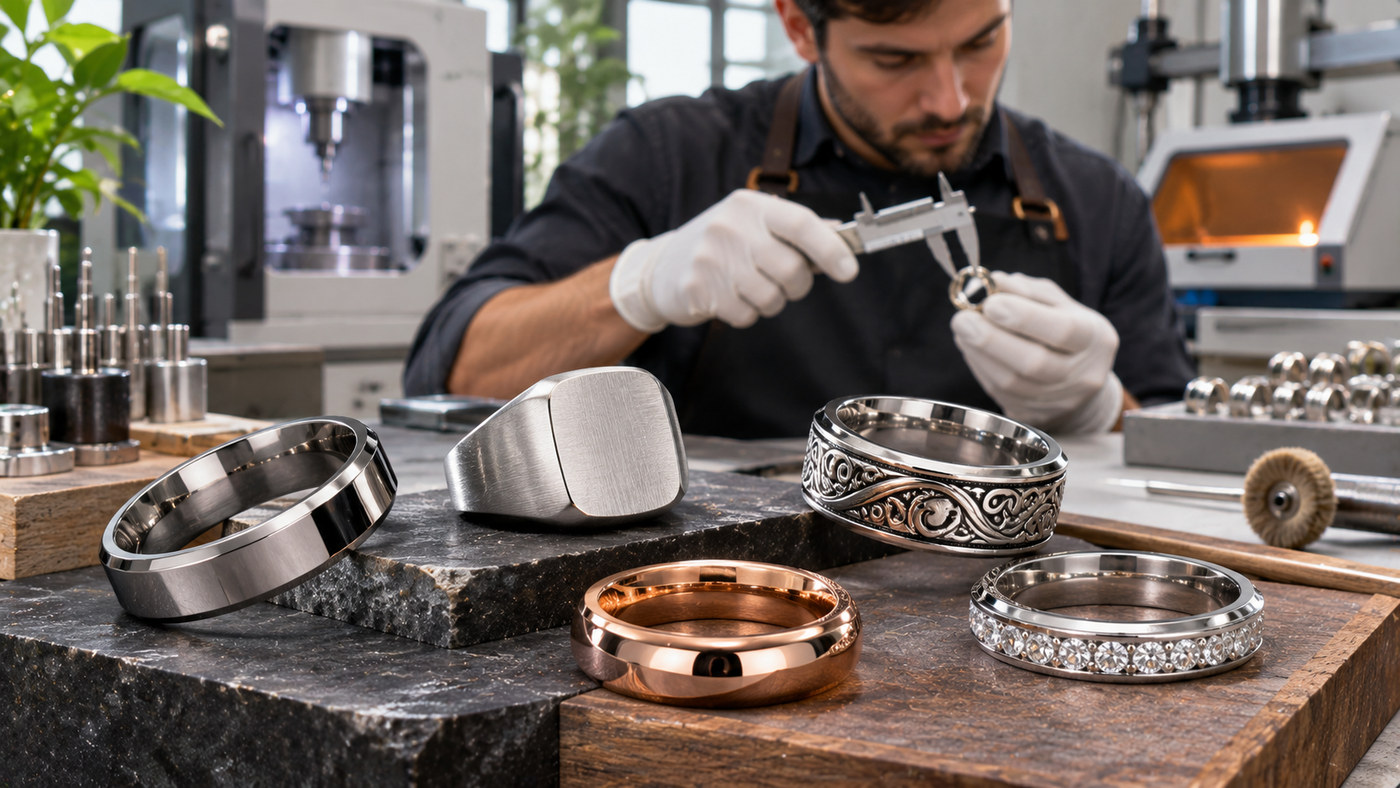
The global jewellery market offers significant opportunities for fashion brands, independent designers, ecommerce businesses, and retailers seeking attractive products at competitive prices. Stainless steel rings have become an appealing product category because they combine contemporary designs, practical durability, and flexible manufacturing options. However, creating a successful jewellery collection requires more than selecting attractive ring styles. Businesses must identify manufacturers capable of delivering consistent materials, accurate sizing, reliable finishes, and dependable production.
Choosing professional stainless steel ring suppliers can help jewellery brands develop customised collections, manage manufacturing requirements, and establish reliable production relationships. Experienced suppliers may provide services ranging from material selection and CAD design to prototype development, surface finishing, private-label packaging, and bulk manufacturing.
For growing jewellery businesses, supplier selection can directly influence product quality, customer satisfaction, inventory management, and long-term profitability. A manufacturer offering the lowest initial price may not provide the most suitable solution if its products have inconsistent dimensions, poor plating adhesion, or unreliable delivery schedules.
Understanding stainless steel grades, manufacturing processes, minimum order quantities, and quality control requirements is therefore essential.
This comprehensive guide explores seven important factors to consider when choosing stainless steel ring manufacturers, the differences between common materials, available customisation options, and how companies such as Star Harvest support OEM and ODM jewellery production.
Why Stainless Steel Rings Are Popular in Modern Jewellery
Stainless steel has become an established material in contemporary fashion jewellery.
Its combination of strength, corrosion resistance, and design versatility makes it suitable for many everyday accessories.
Unlike certain softer jewellery metals, stainless steel can provide structural durability while supporting a variety of decorative finishes.
Durability for Everyday Wear
Stainless steel generally offers good resistance to corrosion under ordinary conditions.
This makes it useful for rings intended for regular wear.
However, stainless steel is not completely scratchproof, rustproof under every condition, or immune to damage.
Actual performance depends on the alloy, manufacturing quality, surface treatment, and environment.
Accessible Product Pricing
Compared with solid gold and certain precious-metal jewellery, stainless steel often provides a more economical starting point for fashion accessories.
This allows brands to explore different price segments.
Manufacturing expenses still depend on design complexity, order quantity, finishing, and additional components.
Flexible Design Possibilities
Stainless steel rings are available in minimalist, classic, statement, signet, and contemporary styles.
Manufacturers can also incorporate engravings, decorative textures, coloured coatings, and selected gemstones.
Suitability for Different Customer Groups
Stainless steel collections may appeal to customers seeking everyday fashion accessories, men’s jewellery, stacking rings, or personalised gifts.
Successful product positioning depends on understanding actual customer preferences rather than assuming one style suits everyone.
What Do Stainless Steel Ring Suppliers Provide?
Stainless steel ring suppliers may operate as manufacturers, wholesalers, trading companies, or sourcing intermediaries.
These business models offer different advantages.
Direct Manufacturers
Manufacturers produce jewellery using their own equipment, employees, and production processes, although some operations may still be subcontracted.
They may offer greater involvement in technical design, material selection, and manufacturing specifications.
Wholesale Distributors
Traditional wholesalers purchase or hold finished jewellery inventory and resell it to retailers.
They may offer ready-made stock with shorter purchasing cycles.
However, extensive customisation may be limited.
OEM Jewellery Manufacturers
OEM stands for Original Equipment Manufacturer.
Under an OEM arrangement, a factory manufactures products according to a client’s approved specifications.
This can include ring dimensions, surface finishes, branding, and packaging.
ODM Jewellery Manufacturers
ODM stands for Original Design Manufacturer.
An ODM supplier may provide existing designs that brands can select, adapt, or customise under agreed terms.
This can reduce some of the effort involved in developing products from the beginning.
Private-Label Manufacturing
Private-label jewellery production allows businesses to offer products under their own brand identity.
Depending on the arrangement, customisation may involve logos, packaging, selected materials, and design modifications.
Understanding these differences helps businesses choose suppliers aligned with their purchasing needs.
7 Essential Tips for Choosing Stainless Steel Ring Suppliers
Selecting a reliable manufacturing partner requires evaluating materials, capabilities, production quality, communication, and overall commercial terms.
The following seven steps provide a practical supplier selection framework.
1. Verify Stainless Steel Grades and Material Quality
Material selection is one of the most important factors influencing the performance of stainless steel jewellery.
Not every stainless steel alloy has identical properties.
Understanding 304 Stainless Steel
Grade 304 is an austenitic stainless steel commonly used in consumer and industrial products.
It generally provides good corrosion resistance under ordinary conditions.
For fashion jewellery, 304 can offer a practical balance between cost, strength, and manufacturability.
However, corrosion performance may be less suitable for certain challenging environments.
Understanding 316L Stainless Steel
Grade 316L contains molybdenum and has a low-carbon composition.
Compared with 304, it generally provides improved resistance to certain forms of corrosion, particularly in chloride-containing environments.
This makes 316L a popular option for stainless steel jewellery.
However, neither material is completely immune to corrosion.
Is 316L Stainless Steel Hypoallergenic?
316L stainless steel is frequently marketed as suitable for sensitive skin.
However, it normally contains nickel.
Therefore, describing all 316L jewellery as completely nickel-free would be inaccurate.
For customers with nickel sensitivity, the rate at which nickel is released from the finished product is particularly important.
Request Material Documentation
Professional buyers should ask for material specifications and relevant test documentation.
For European Union markets, nickel release requirements can apply to rings intended for prolonged skin contact.
Important Compliance Consideration
Under EU REACH Annex XVII, Entry 27, finger rings intended for direct and prolonged skin contact must satisfy applicable nickel release restrictions.
For these products, the relevant limit is 0.5 micrograms per square centimetre per week.
Businesses should request suitable evidence of compliance rather than relying exclusively on broad marketing claims.
Match Materials to Product Positioning
An affordable fashion collection and a premium everyday jewellery range may have different requirements.
Choose materials according to intended wear, product design, customer expectations, and applicable market standards.
2. Evaluate OEM and ODM Customisation Capabilities
A reliable supplier should be able to explain how it converts a design concept into a finished product.
Customisation requirements vary considerably between brands.
Custom Ring Shapes
Manufacturers may offer classic bands, signet rings, stackable rings, open rings, and more complex statement designs.
Some styles require additional machining or specialised production processes.
Laser Engraving
Laser engraving can add brand logos, personal messages, patterns, and decorative details.
Buyers should evaluate the clarity, depth, positioning, and consistency of the engraving.
CAD Design and Prototyping
Computer-aided design, or CAD, allows manufacturers to create digital representations of proposed products.
These files help evaluate dimensions and design feasibility before physical production begins.
Custom Surface Textures
Popular surface treatments include mirror polishing, brushed finishes, matte textures, and vintage-inspired effects.
Different finishes influence the appearance and feel of the ring.
Stone Setting
Manufacturers may offer rings incorporating cubic zirconia, moissanite, lab-grown diamonds, or other decorative stones.
Buyers should confirm stone specifications, setting methods, and relevant disclosure requirements.
Brand Identity
A private-label collection may incorporate distinctive engravings, packaging colours, and product presentation.
These details help differentiate a jewellery brand from competitors.
Protect Original Designs
When submitting proprietary designs, businesses should discuss confidentiality, intellectual property ownership, and appropriate contractual protections.
An NDA may provide useful confidentiality obligations, but it does not automatically resolve every question about design ownership.
3. Review Minimum Order Quantities and Production Capacity
Minimum order quantity, commonly called MOQ, is an important commercial consideration for jewellery businesses.
It identifies the minimum quantity a manufacturer will accept under specified conditions.
Why Manufacturers Set MOQs
Custom manufacturing may require tooling, production setup, material purchasing, and quality control preparation.
Factories use minimum quantities to help cover these expenses.
Understand MOQ Per Design
A supplier advertising a minimum of 200 pieces may mean 200 pieces per design rather than 200 pieces across an entire collection.
Buyers should clarify whether different sizes, finishes, or colours count as separate variants.
Start With Manageable Collections
New brands may reduce inventory exposure by beginning with a smaller number of designs.
For example, launching three carefully selected ring styles may be easier to manage than introducing twenty designs immediately.
Evaluate Size Distribution
Rings require accurate sizing.
A manufacturer should understand how quantities will be divided between sizes.
Poor size planning can lead to excess stock in unpopular sizes and shortages in frequently requested sizes.
Review Production Capacity
A factory’s production capacity can influence its ability to handle larger orders.
However, published capacity figures should not automatically be treated as available capacity for every customer or product.
Plan Reorders
Ask how repeat orders are managed and whether production specifications remain available.
Consistency between initial and repeat orders is important for established jewellery collections.
Balance Flexibility and Reliability
The ideal stainless steel ring supplier should support realistic purchasing volumes while maintaining consistent production standards.
4. Inspect Samples and Manufacturing Quality
Product samples allow businesses to assess the actual appearance and performance of a design before committing to bulk manufacturing.
Digital photographs alone cannot provide a complete assessment.
Examine Ring Dimensions
Check internal diameter, band width, thickness, and overall proportions.
Confirm that measurements correspond with the approved design.
Evaluate Surface Finishing
Polished surfaces should be consistent.
Brushed finishes should display the intended texture without obvious irregularities.
Inspect Edges and Comfort
Sharp edges and unfinished surfaces can make rings uncomfortable.
The inner surface should be evaluated for smoothness.
Review Plating Quality
For coloured products, examine coating consistency and visible defects.
The supplier should explain which finishing process is used and what durability testing is available.
Evaluate Stone Settings
Gemstone-set rings require particular attention to setting security.
Loose stones can create customer complaints and product returns.
Compare Samples With Specifications
An approved sample should serve as a reference for later production.
Written specifications and photographs can help establish acceptance criteria.
Request Quality Control Information
Manufacturers may use dimensional checks, visual inspection, coating assessments, and appropriate laboratory testing.
The exact methods should reflect the product and market requirements.
5. Understand PVD Coating and Decorative Finishes
Many stainless steel jewellery collections use coloured finishes to create distinctive designs.
Physical Vapour Deposition, commonly abbreviated PVD, is one method used to apply thin coatings.
What Is PVD Coating?
PVD is a process that deposits a thin film of material onto a surface under controlled conditions.
Depending on the coating system, it can provide decorative colour and selected surface properties.
Popular Ring Finishes
Manufacturers may offer gold-tone, rose gold-tone, black, bronze, and other decorative appearances.
The composition and appearance depend on the specific coating process.
PVD vs. Traditional Electroplating
PVD and electroplating involve different coating technologies.
Certain PVD systems can provide good wear resistance.
However, durability depends on coating composition, substrate preparation, thickness, adhesion, and product usage.
It would be inaccurate to assume that every PVD finish lasts longer than every electroplated finish.
Understand Gold-Tone Claims
Gold-coloured stainless steel is not necessarily solid gold.
A product described as gold-plated or gold-tone should accurately disclose the materials and coating used.
Ask About Testing
Relevant tests may include abrasion resistance, coating adhesion, corrosion resistance, and colour consistency.
The appropriate tests depend on the material and intended market.
Consider Customer Care Instructions
Coated jewellery can experience wear through friction, chemicals, and repeated contact with hard surfaces.
Clear care information helps customers understand how to maintain the finish.
6. Compare Pricing, Sampling Costs, and Delivery Terms
The cheapest manufacturing quote does not necessarily provide the best value.
Businesses should consider all costs involved in developing, manufacturing, importing, and selling the rings.
Understand Unit Pricing
Unit prices may depend on order quantity, material grade, design complexity, finishing, and packaging.
Request quotations based on identical specifications when comparing suppliers.
Ask About Tooling Costs
Custom designs may require tooling, moulds, fixtures, or additional development work.
Clarify whether these costs are charged separately.
Review Sampling Fees
Some manufacturers charge for prototype development.
Ask whether sample fees can be credited against a later production order.
Understand Production Lead Times
A supplier may advertise a typical sampling or production period.
However, actual delivery depends on design approval, material availability, factory scheduling, and logistics.
Confirm Shipping Terms
International orders may use commercial delivery terms such as EXW, FOB, or DDP.
These terms affect how responsibilities and costs are allocated.
Buyers should understand the agreed Incoterms and applicable version.
Consider Import Duties and Taxes
Customs charges, import taxes, and compliance requirements differ between destinations.
A supplier’s factory price may exclude these expenses.
Calculate Landed Cost
Landed cost considers relevant product, transportation, insurance, import, and other acquisition expenses.
Illustrative Cost Example
Imagine ordering 500 custom rings at a factory price of $3.20 each.
The manufacturing cost would be $1,600.
If shipping, duties, and other relevant expenses total an additional $400, the simplified landed cost would be $2,000.
The landed cost per ring would therefore be $4.00.
This example is hypothetical and does not represent a Star Harvest quotation.
Retail pricing should also account for marketing, platform fees, returns, operating expenses, and the desired margin.
7. Evaluate Communication, Reliability, and Long-Term Support
Supplier relationships are often ongoing.
A manufacturer should be able to support repeat orders, product updates, and appropriate quality concerns.
Assess Responsiveness
Clear communication is important during design development and production.
A supplier should provide understandable answers to technical and commercial questions.
Request Production Updates
Manufacturers may provide updates about sample approval, material purchasing, production progress, and shipping preparation.
Confirm Quality Responsibilities
Agreements should explain how defects, incorrect dimensions, or other quality problems will be handled.
Understand Replacement and Remediation Policies
A buyer should know what happens when delivered products fail agreed specifications.
Possible remedies depend on contractual terms.
Review Business Credentials
Prospective buyers can examine company registration, available certifications, production experience, and relevant independent information.
Certification claims should be verified when important to procurement decisions.
Protect Commercial Information
Custom product designs, price agreements, and customer information may require contractual confidentiality protections.
Plan for Product Development
A reliable manufacturer may support future collection expansion and design refinements.
Strong supplier relationships are built on consistent performance rather than promotional guarantees.
Star Harvest: Custom Stainless Steel Ring Manufacturing
Star Harvest is a China-based custom jewellery manufacturer focused on producing brass and stainless steel accessories for established and growing brands.
The company states that it has operated since 2005 and provides OEM and ODM manufacturing services.
Its stainless steel ring collection includes options for men’s, women’s, and unisex jewellery.
Stainless Steel Ring Designs
Star Harvest advertises manufacturing capabilities for several styles, including:
- Classic bands and minimalist rings.
- Signet rings.
- Stackable rings.
- Statement rings.
- Wrap and open-ring designs.
- Gemstone-set rings.
These options provide flexibility for businesses developing distinctive product collections.
Available Material Options
The company’s product pages identify 304 and 316L stainless steel among its available materials.
Buyers should confirm the exact grade for their proposed design.
Custom Surface Finishes
Star Harvest advertises polished, brushed, vintage, and PVD-coated finishes.
Its colour options include gold-tone, rose gold-tone, gun black, bronze, and other decorative variations.
Custom Stones and Engravings
The manufacturer describes customisation options involving stones, logos, textures, and decorative patterns.
Actual feasibility depends on the approved design.
Minimum Order Quantity
Star Harvest advertises an MOQ starting at 200 pieces per design or item.
However, customers should confirm whether that threshold applies to the exact ring, material, colour, and size distribution requested.
Sampling and Prototyping
Its stainless steel ring page describes a typical sampling cycle of approximately 7–15 days.
This is a supplier-advertised timeframe, not a guaranteed delivery date.
Quality Control
Star Harvest describes internal quality procedures involving material checks, dimensional inspection, surface assessment, and finished-product review.
Buyers should request relevant documentation for the specific production batch.
OEM and Private-Label Focus
An important distinction is that Star Harvest describes itself as a custom manufacturing partner rather than a traditional retailer or stock wholesaler.
Businesses seeking ready-to-ship rings without custom production should confirm whether the manufacturer is appropriate for their purchasing model.
How to Order Custom Stainless Steel Rings From a Manufacturer
A structured ordering process helps minimise misunderstandings and unnecessary revisions.
Step 1: Prepare a Design Brief
Describe the intended ring style, target customer, preferred material, colours, finish, and expected quantity.
Provide drawings or references where available.
Step 2: Discuss Manufacturing Feasibility
Ask the supplier whether the design can be produced using its available manufacturing processes.
Some complex shapes may require modifications.
Step 3: Request a Quotation
Confirm unit pricing, MOQ, tooling expenses, sampling charges, estimated lead time, and delivery terms.
Step 4: Review CAD Drawings
Check dimensions, proportions, engravings, stone placements, and other technical details.
Approve the design only after reviewing the relevant specifications.
Step 5: Order Samples
Inspect physical samples before approving large-scale production.
Step 6: Confirm Production Standards
Document accepted dimensions, materials, finishes, packaging, and inspection requirements.
Step 7: Begin Manufacturing
The supplier proceeds according to the agreed order and approved sample.
Step 8: Conduct Quality Inspection
Arrange suitable inspection before shipment.
For higher-value orders, independent inspection may provide additional assurance.
Step 9: Organise Shipping
Confirm shipping documents, customs responsibilities, insurance, and expected delivery arrangements.
Step 10: Review Received Products
Inspect the delivered products and compare them with the agreed specifications.
Document any discrepancies promptly.
Stainless Steel Ring Trends for Modern Jewellery Brands
Product development should reflect both customer preferences and practical manufacturing requirements.
Several design directions offer opportunities for jewellery businesses.
Minimalist Stainless Steel Bands
Simple designs can complement different clothing styles.
They may suit customers seeking versatile accessories for regular wear.
Men’s Signet Rings
Signet rings provide opportunities for engraving, decorative textures, and personalised branding.
Stackable Ring Collections
Stackable designs allow customers to combine multiple rings.
Sizing consistency and comfortable proportions are particularly important.
Gold-Tone Stainless Steel Rings
Coloured coatings can create jewellery that resembles certain precious-metal finishes without using solid gold construction.
Accurate product descriptions remain essential.
Personalised Engraved Rings
Engraving can support gift collections and customised jewellery.
Brands should establish a reliable process for approving spelling, positioning, and artwork.
Textured Statement Rings
Brushed surfaces, geometric details, and sculptural shapes can differentiate fashion collections.
Market trends should be validated through customer research rather than assumed demand.
Quality Control Checklist for Bulk Ring Orders
Bulk production requires consistency across numerous pieces.
A structured quality review helps reduce defects and customer complaints.
Material Verification
Confirm the agreed stainless steel grade and review relevant documentation.
Ring Size Accuracy
Check internal dimensions against the approved size specification.
Surface Quality
Inspect scratches, polishing defects, inconsistent textures, and sharp edges.
Coating Consistency
Review colour uniformity, adhesion, and relevant durability testing.
Stone Security
Inspect settings and decorative components.
Engraving Accuracy
Confirm spelling, alignment, and logo presentation.
Packaging Inspection
Check packaging quality, product protection, and accurate labelling.
Sampling Method
Agree on inspection sampling and acceptance criteria before production.
Some buyers use recognised acceptance quality limit methods, but the chosen approach should match the product and commercial requirements.
Common Mistakes When Choosing Stainless Steel Ring Manufacturers
Businesses can avoid several sourcing problems through careful preparation.
Selecting a Supplier Based Only on Price
Very low prices may involve compromises in materials, finishing, or quality control.
Ignoring Metal Grades
304 and 316L have different compositions and performance characteristics.
The material should match the intended use.
Assuming Stainless Steel Is Nickel-Free
Common stainless steel grades may contain nickel.
Applicable nickel release testing is more meaningful than unsupported allergy-related claims.
Skipping Physical Samples
Photographs do not reveal every manufacturing defect.
Failing to Confirm MOQ Details
Minimum quantities may apply separately to each design, finish, or product variation.
Overlooking Plating Quality
Decorative coatings require appropriate manufacturing and testing.
Ignoring Import Requirements
Product documentation, labelling, and chemical restrictions may vary between markets.
Failing to Document Specifications
Verbal discussions alone may not provide sufficient clarity for bulk manufacturing.
Written production specifications help reduce disputes.
How to Build a Profitable Stainless Steel Ring Collection
A successful jewellery collection requires balancing product quality, market demand, and financial sustainability.
Define Your Target Customers
Determine whether the collection will focus on minimalist fashion, men’s accessories, personalised gifts, or another segment.
Develop a Clear Product Identity
Choose designs that reflect the brand’s positioning.
Avoid introducing unrelated styles without a coherent strategy.
Start With Tested Products
Initial samples and limited product launches can help businesses evaluate customer response.
Calculate Real Costs
Include manufacturing, import, packaging, marketing, platform fees, and expected returns.
Create Accurate Product Descriptions
Specify material grades, finishes, ring dimensions, and relevant care requirements.
Invest in Product Photography
Clear photographs help customers understand the design and finish.
Images should represent the actual products accurately.
Monitor Customer Feedback
Reviews and return reasons may reveal sizing, comfort, or finish-related problems.
Use these insights when planning future production.
The Future of Stainless Steel Jewellery Manufacturing
Jewellery manufacturing continues to evolve through improvements in design software, production equipment, surface treatment, and quality control.
More Precise Customisation
CAD and CNC technologies can support increasingly detailed ring designs.
Faster Prototype Development
Digital design and suitable manufacturing equipment may reduce the time required to evaluate certain concepts.
Greater Demand for Transparency
Brands may request more detailed information about materials, manufacturing conditions, and product compliance.
Improved Surface Finishing
Coating and polishing technologies continue developing.
Their practical value should be assessed through appropriate product testing.
Small-Batch Brand Development
Flexible production arrangements may help growing brands introduce new designs without committing to extremely large inventories.
Better Supply Chain Coordination
Clear specifications, production schedules, and quality reporting can improve relationships between manufacturers and buyers.
The strongest opportunities will come from combining useful design innovation with consistent quality and realistic commercial planning.
Frequently Asked Questions
1. What should I look for in stainless steel ring suppliers?
Look for suitable material grades, customisation capabilities, accurate sizing, reliable samples, quality control procedures, clear minimum order quantities, transparent pricing, and dependable communication. Buyers should also verify relevant compliance documents and delivery terms.
2. Is 316L stainless steel better than 304 for rings?
316L generally offers improved resistance to certain forms of corrosion because of its alloy composition. However, both materials can be suitable for selected jewellery applications. The appropriate choice depends on cost, design, intended wear, and product requirements.
3. Does Star Harvest manufacture custom stainless steel rings?
Yes. Star Harvest advertises OEM and ODM manufacturing for stainless steel rings, including bands, signet rings, stackable designs, coloured finishes, engravings, and selected stone settings. It focuses on custom production for jewellery brands rather than direct retail.
4. What is the minimum order quantity for Star Harvest rings?
Star Harvest advertises a starting MOQ of 200 pieces per design or item. Actual minimum quantities may depend on the selected material, dimensions, customisation, and order configuration. Buyers should confirm the requirements directly before placing an order.
5. Are stainless steel rings suitable for sensitive skin?
Some stainless steel jewellery may be well tolerated, but common grades such as 304 and 316L contain nickel. People with nickel sensitivity may react to nickel release. Buyers should request appropriate test documentation, especially when selling in markets with specific jewellery safety requirements.
6. How long does custom stainless steel ring manufacturing take?
Production timelines vary according to design complexity, sampling, material availability, order quantity, and factory capacity. Star Harvest advertises a typical sampling period of approximately 7–15 days, while mass production and international delivery require separate confirmation.
Conclusion
Choosing reliable stainless steel ring suppliers is essential for jewellery brands seeking consistent quality, distinctive designs, and sustainable production. Material verification, OEM capabilities, accurate sampling, coating durability, transparent pricing, and dependable delivery should guide the selection process. Manufacturers such as Star Harvest offer custom production options worth evaluating for private-label jewellery collections. By establishing clear specifications and maintaining effective quality control, businesses can build stronger supplier relationships and develop products that meet customer expectations.
