
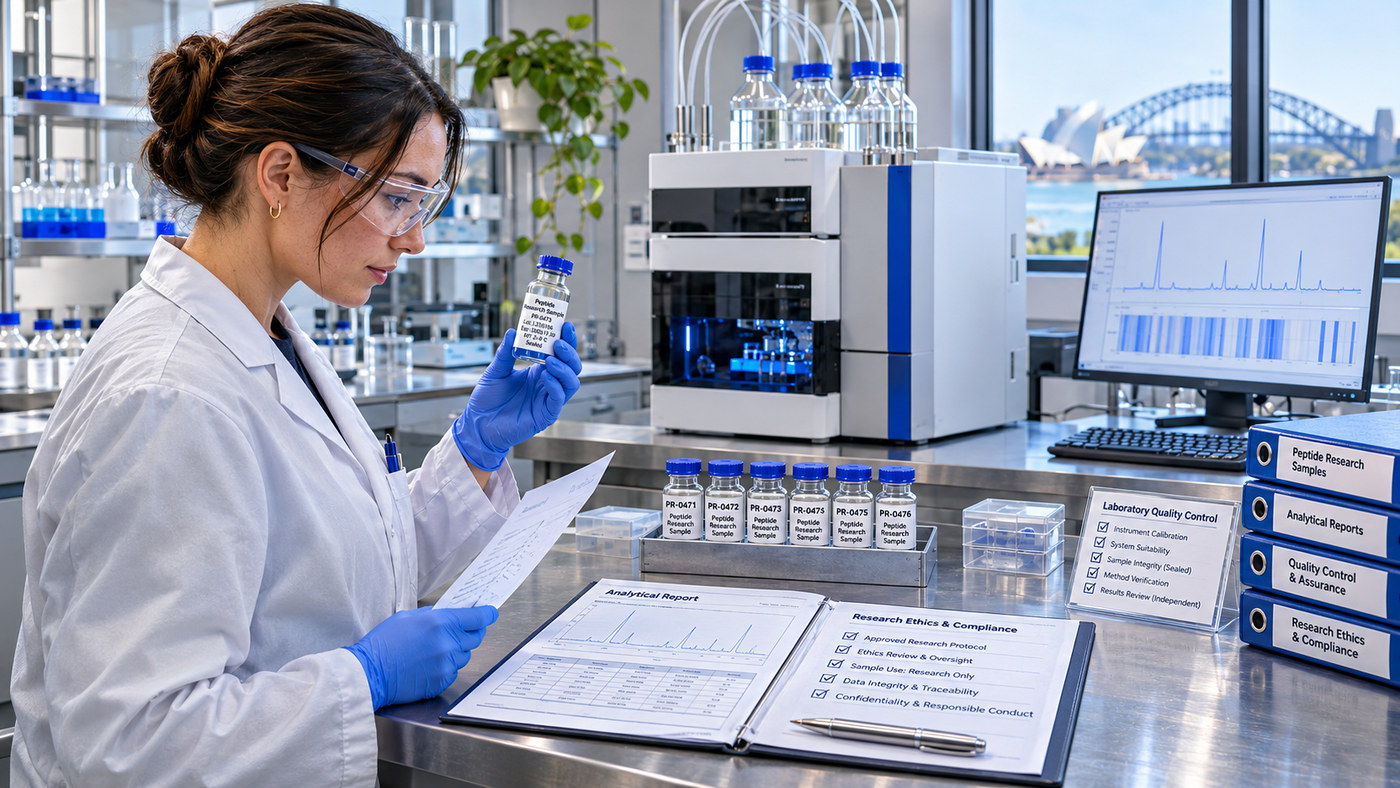
Peptide research has attracted increasing attention across biotechnology, molecular biology, pharmaceutical development, and analytical chemistry. Scientists study peptides to understand biological signalling, molecular interactions, and potential applications in medicine and other fields. As interest grows, laboratory researchers must consider the quality, traceability, and regulatory status of the materials used in their work.
aussie peptides is an Australian online supplier that advertises a range of peptide compounds intended for laboratory research. The website provides product descriptions, stated purity information, Certificates of Analysis, and information about its Australian shipping services. It explicitly labels its products as research materials rather than products intended for human consumption.
However, choosing appropriate research materials requires more than reviewing online product listings. Researchers must verify analytical documentation, evaluate supplier credibility, establish appropriate laboratory procedures, and understand the regulations governing particular substances.
This distinction is especially important in Australia, where the Therapeutic Goods Administration (TGA) has raised concerns about unapproved peptides promoted through online retailers and social media.
A Certificate of Analysis may provide useful information about a laboratory sample, but it does not establish that a substance is safe for human administration, approved as a medicine, or lawful to supply.
This guide explores the fundamentals of peptide research, seven essential quality and compliance checks, common analytical testing methods, the publicly advertised features of AussiePeptides, and the importance of responsible scientific practice.
What Are Peptides?
Peptides are molecules made from chains of amino acids joined together by peptide bonds.
Amino acids are the fundamental building blocks of proteins, and peptide chains occur naturally throughout biological systems.
Their structure and function vary according to the number, sequence, and chemical characteristics of the amino acids they contain.
How Do Peptides Work?
Certain peptides function as signalling molecules, helping cells communicate with one another.
Others participate in biological processes involving metabolism, immune responses, and tissue regulation.
Their effects depend on molecular structure and interactions with biological targets.
Researchers investigate these processes to improve understanding of normal physiology and disease mechanisms.
However, observing a particular effect in laboratory experiments does not automatically establish that a peptide will be effective or safe in humans.
Peptides vs. Proteins
Peptides and proteins are both composed of amino acids.
The distinction generally involves molecular size, structure, and complexity, although there is no universally accepted length threshold separating every peptide from every protein.
Proteins often possess more extensive three-dimensional structures and functional domains.
Peptides may be shorter molecules with specific biological activities.
Natural and Synthetic Peptides
Some peptides are produced naturally within living organisms.
Others can be created through laboratory synthesis.
Synthetic peptide research enables scientists to examine particular molecular sequences under controlled conditions.
The quality of synthetic research materials depends on the production process, analytical verification, and handling procedures.
Why Peptide Research Matters
Peptides are studied in several scientific disciplines because their molecular structures can interact with biological systems in different ways.
Molecular Biology
Researchers investigate how peptide molecules participate in cellular communication.
These studies may improve understanding of signalling pathways and receptor interactions.
Biochemistry
Peptide research supports investigations into molecular structure, chemical stability, and biochemical reactions.
Pharmaceutical Research
Some approved medicines are peptide-based.
For example, insulin is a well-established therapeutic peptide used in diabetes management.
However, the existence of approved peptide medicines does not mean that all experimental peptides are approved treatments.
Analytical Chemistry
Laboratories develop methods for identifying peptides, assessing sample composition, and detecting impurities.
Biotechnology
Peptides may be investigated as components of experimental systems, molecular probes, or other research applications.
Scientific conclusions require properly designed experiments, reproducible observations, and appropriate interpretation.
Understanding Research-Grade Peptides
The term research-grade is frequently used by laboratory suppliers.
However, it should not be confused with a universal regulatory certification or an approval for medical use.
What Does Research-Grade Mean?
In commercial descriptions, research-grade generally indicates that a material is intended for laboratory investigation rather than direct medical administration.
The precise quality specifications can vary between suppliers.
A laboratory should therefore review the actual documentation rather than relying exclusively on this label.
Does Research-Grade Mean Pharmaceutical-Grade?
No.
Research materials and finished pharmaceutical products are subject to different requirements depending on their intended use and regulatory status.
A material suitable for a particular analytical experiment may not satisfy the manufacturing, sterility, quality, or regulatory requirements applicable to a medicine.
Why Intended Use Matters
The use of a substance can determine which laws, safety practices, and institutional procedures apply.
Laboratory research, clinical research, pharmaceutical manufacturing, and medical treatment are distinct activities.
A research label must never be interpreted as permission for unsupervised human experimentation.
7 Essential Checks for Evaluating Peptide Research Materials
Research institutions and laboratories should establish clear criteria before approving any new chemical or biological research material.
The following seven considerations help identify important quality, documentation, and compliance questions.
1. Verify the Regulatory Status Before Procurement
Regulatory compliance should be considered before assessing price, delivery, or advertised purity.
Australia has specific laws governing therapeutic goods, including many peptide products.
Understand the Role of the TGA
The Therapeutic Goods Administration regulates therapeutic goods under Australia’s federal regulatory framework.
Medicines generally require appropriate regulatory approval or a valid exemption, authority, or other permitted pathway.
Check Whether a Substance Is an Approved Medicine
The Australian Register of Therapeutic Goods, commonly called the ARTG, contains information about relevant therapeutic products approved for Australian supply.
The regulatory status of a particular product should be confirmed rather than inferred from its molecular name.
Recognise Unapproved Therapeutic Goods
A substance may be investigated scientifically without being approved for therapeutic use.
The TGA has specifically identified concerns involving substances such as BPC-157, TB-500, GHK-Cu, retatrutide, and CJC-1295 when promoted as unapproved therapeutic products.
Research Labels Do Not Override the Law
The TGA explicitly warns that statements such as “research use only” or “not for human use” do not automatically change how a product is regulated.
Such labels do not independently authorise otherwise unlawful importation, supply, manufacture, or advertising.
Understand Institutional Responsibilities
Universities, research organisations, commercial laboratories, and other entities should determine their obligations before acquiring controlled or regulated materials.
The appropriate procedures depend on the compound, research purpose, and applicable legal requirements.
Seek Qualified Regulatory Advice
Where a substance’s classification or intended use is unclear, appropriate regulatory or legal guidance should be obtained before proceeding.
Compliance should be an essential part of scientific planning, not an afterthought.
2. Evaluate the Certificate of Analysis
A Certificate of Analysis, or COA, is a document reporting analytical findings for a particular material.
It can provide useful information about identity, purity, and other tested characteristics.
However, its value depends on the reliability of the underlying testing.
What Should a COA Include?
A useful certificate may identify:
- The compound name and relevant molecular information.
- A batch or lot identifier.
- The analytical methods used.
- The date of testing.
- The reported results.
- Relevant specifications or acceptance criteria.
- The laboratory responsible for the analysis.
The exact requirements depend on the material and research application.
Confirm Batch Traceability
The certificate should correspond to the actual batch being evaluated.
A generic certificate for a different production lot may provide limited assurance about the supplied material.
Review Testing Dates
Testing dates can help researchers determine when the reported analysis occurred.
However, the passage of time does not establish stability without relevant evidence.
Ask About Independent Testing
A supplier may perform testing internally or commission another laboratory.
Independent laboratory testing can provide additional assurance when the laboratory is suitably qualified.
Understand Documentation Limitations
A professional-looking certificate does not automatically guarantee authenticity or accuracy.
Laboratories should evaluate the evidence and verification procedures behind important claims.
COA Does Not Mean Medical Approval
A laboratory certificate does not establish that a product is clinically safe, sterile, therapeutically effective, or approved for human use.
These are separate questions requiring different evidence.
3. Understand Purity and Analytical Identification
Purity is frequently used in promotional descriptions of research peptides.
However, an isolated percentage does not provide a complete picture of sample quality.
What Is HPLC?
High-performance liquid chromatography, or HPLC, is an analytical technique used to separate components within a sample.
It can help laboratories examine sample composition and estimate the relative abundance of detected substances.
What Does 99% HPLC Purity Mean?
A reported HPLC purity of 99% generally refers to a result calculated according to the particular chromatographic method.
It should not automatically be interpreted as proving that 99% of the vial’s total mass is the intended peptide.
The calculation depends on the analytical method and its limitations.
Why Identity Testing Matters
A chromatographic purity result alone may not conclusively establish the molecular identity of a compound.
Mass spectrometry and other appropriate analytical methods can provide additional identification evidence.
Understand Impurities
Synthetic materials may contain unwanted compounds resulting from production, purification, or handling.
Their significance depends on their identity, concentration, and intended application.
Evaluate Method Suitability
A testing method must be appropriate for the particular substance and analytical question.
Researchers should consider whether the method was adequately validated for its intended purpose.
Avoid Overinterpreting Advertised Results
A high purity claim may be useful as an initial reference, but independent verification may still be necessary.
Analytical quality should be evaluated through complete evidence, not a single number.
4. Review Packaging, Labelling and Traceability
Accurate identification is essential when managing research materials.
Poor labelling can create confusion, compromise laboratory records, and introduce safety risks.
Clear Compound Identification
A sample should be identified using an appropriate compound name or other reliable scientific identifier.
Ambiguous abbreviations can make materials difficult to distinguish.
Batch Numbers
Batch identifiers allow laboratories to connect individual samples with relevant production and testing records.
Packaging Integrity
The condition of containers and protective packaging should be assessed according to laboratory procedures.
Damaged or poorly sealed containers may require further investigation.
Storage Documentation
Different research compounds may have different stability requirements.
Laboratories should rely on validated supplier information and their own approved protocols.
Chain of Custody
Research documentation should record relevant receipt, transfer, and handling information when required.
This supports traceability and reproducibility.
Accurate Laboratory Records
Researchers should document which material and batch were used in a particular experiment.
Reliable recordkeeping makes it easier to investigate inconsistent findings.
Safety Information
Appropriate hazard and handling information should be available to authorised personnel.
The absence of obvious warning labels does not mean a substance is harmless.
5. Assess Supplier Transparency and Quality Claims
A supplier’s public statements can help researchers identify questions to investigate.
However, marketing descriptions should not be treated as independently verified evidence.
Identify the Business Entity
A professional procurement assessment should establish which legal business is responsible for the supply arrangement.
Review Publicly Available Documentation
Product specifications, analytical reports, and relevant company information may provide useful background.
Check Testing Claims
If a supplier advertises independent testing or a particular purity threshold, determine what evidence supports those statements.
Understand Manufacturing Arrangements
A retailer may obtain compounds from external manufacturers.
The identity and oversight of the manufacturing source may be relevant to quality assessment.
Review Quality Procedures
Where appropriate, institutional buyers may request information about quality management practices, batch traceability, and complaint handling.
Assess Communication
Clear answers to legitimate technical and compliance questions are important.
Avoid Unsupported Guarantees
Claims such as guaranteed purity, complete safety, or universal regulatory compliance require appropriate evidence.
No online listing should replace an institution’s own due diligence.
6. Distinguish Laboratory Research From Human Use
This distinction is particularly important because some peptide products are promoted online using terminology associated with fitness, weight loss, recovery, or anti-ageing.
Such claims may create dangerous misunderstandings.
Research Findings Are Not Clinical Proof
An experiment involving cells or animals may identify a biological mechanism.
It does not automatically establish a treatment’s effectiveness or safety in humans.
Medical Approval Requires Different Evidence
Therapeutic products are evaluated under regulatory frameworks that consider quality, safety, and effectiveness.
Experimental materials have not necessarily undergone that assessment.
Risks of Unapproved Peptides
The TGA has identified concerns about contamination, incorrect ingredients, inaccurate labelling, sterility, adverse reactions, and other health risks associated with unapproved peptide products.
Avoid Self-Administration
Research-labelled peptide products should not be used for self-treatment.
Consumers should not interpret an online research listing as medical guidance.
Approved Treatments Are Different
Certain peptide-based medicines are legally available through appropriate healthcare pathways.
Patients seeking treatment for a medical condition should consult a qualified healthcare professional.
Clinical Research Requires Oversight
Human research involving investigational medicines requires appropriate approvals, ethics review, and regulatory compliance.
Responsible Communication Matters
Suppliers, researchers, and publishers should avoid suggesting that preliminary laboratory findings establish confirmed health benefits.
Scientific accuracy protects both research integrity and public health.
7. Evaluate Research Ethics, Procurement and Documentation
Responsible scientific research depends on established procedures for acquiring and managing materials.
A laboratory should evaluate procurement as part of its broader quality and safety system.
Institutional Approval
Research organisations may require approval from designated personnel before obtaining particular compounds.
Define Research Objectives
A project should have clear scientific questions and appropriate methods.
Document Material Specifications
Relevant material information should be recorded before the project begins.
Maintain Reliable Records
Research records should support accurate reporting and reproducibility.
Review Relevant Safety Requirements
Laboratory personnel should follow appropriate institutional safety policies.
Plan for Quality Problems
Organisations should establish procedures for managing materials that fail identification, documentation, or other acceptance requirements.
Preserve Research Integrity
Results should be reported accurately, including relevant limitations and uncertainties.
Responsible research depends on transparent methodology and appropriate oversight rather than promotional claims.
AussiePeptides: Website Features and Research Categories
AussiePeptides describes itself as an Australian research peptide supplier.
Its website organises products into several research categories and advertises analytical documentation.
These are company-reported offerings and should not be interpreted as independent endorsements.
Metabolic Research
The website lists compounds such as retatrutide and tirzepatide in its metabolic research category.
Some substances in this general field have established medical applications, while others remain investigational.
Regulatory status must be determined for the specific product.
Tissue Research
The site includes listings for BPC-157, TB-500, KPV, and related materials.
These substances are frequently discussed online using health-related claims.
However, experimental interest does not establish clinical approval or treatment effectiveness.
Cosmetic Research
AussiePeptides organises selected compounds under cosmetic research.
The category includes GHK-Cu and other substances associated with laboratory investigation of biological processes.
A research category does not make a product an approved cosmetic or therapeutic good.
Growth Hormone Axis Research
The website lists compounds associated with growth hormone signalling research, including CJC-1295 and ipamorelin.
These substances can raise important medical and regulatory questions.
Cellular and Cognitive Research
The catalogue also includes molecules associated with cellular research and experimental neurological investigations.
Scientific interpretations should reflect the quality and limitations of available evidence.
Laboratory Supplies
The website advertises certain related laboratory items.
A supplier’s product range does not establish that every item is appropriate or authorised for every research purpose.
AussiePeptides Quality and Purity Claims
AussiePeptides prominently advertises a purity standard of at least 99% for its peptide products.
It also states that compounds are supported by Certificates of Analysis.
Advertised HPLC Testing
The website describes HPLC-based purity testing as part of its quality documentation.
Certificate Availability
Its educational content explains how to examine chromatographic reports and relevant analytical information.
Compound Identification
The company provides product names and listed vial quantities.
Sample Form
The website describes its peptide materials as lyophilised powders supplied in sealed containers.
Important Verification Limitations
The presence of these descriptions does not establish that every product has been independently authenticated.
A laboratory should verify information relevant to its intended project.
Regulatory Considerations
A high-purity result does not establish lawful supply, clinical safety, or regulatory approval.
These matters require separate evaluation.
Understanding Australia’s Peptide Regulations in 2026
Australia’s regulatory environment is an essential consideration for anyone researching peptide products advertised online.
In 2026, the TGA issued several warnings about unapproved products and associated risks.
Therapeutic Goods Act Requirements
Therapeutic goods are regulated under Australia’s relevant legislative framework.
Importing, manufacturing, supplying, and advertising certain compounds may require appropriate authorisation.
Australian Register of Therapeutic Goods
The ARTG provides information about relevant therapeutic products included in the Australian regulatory system.
Research-Only Disclaimers
The TGA states that research-only disclaimers do not automatically alter a product’s therapeutic goods classification.
Advertising Restrictions
Australian law restricts the advertising of prescription-only medicines and certain unapproved therapeutic goods.
Importation Requirements
Importing unapproved products is subject to applicable rules and cannot be assumed lawful merely because an online retailer offers delivery.
Safety Warnings
The TGA has reported serious adverse reactions involving unapproved peptide products and highlighted the uncertainty surrounding their composition and quality.
Independent Regulatory Verification
Researchers and organisations should consult official guidance rather than rely solely on supplier descriptions.
Why Certificates of Analysis Have Limitations
Certificates of Analysis play a useful role in laboratory quality assessment.
However, they address specific analytical questions rather than every possible property of a sample.
Purity Is Not Identity
A sample can produce a strong chromatographic peak without the reported result establishing its complete molecular identity.
Purity Is Not Sterility
A purity test may not demonstrate the absence of microorganisms or endotoxins.
Purity Is Not Stability
A satisfactory test at one point in time does not establish that material properties remain unchanged during all subsequent storage conditions.
Purity Is Not Regulatory Approval
Analytical documentation is not a substitute for inclusion in the ARTG or another legally applicable pathway.
Purity Is Not Clinical Effectiveness
A chemically identified substance may still lack reliable evidence supporting a proposed therapeutic use.
Why Complete Evaluation Matters
Meaningful laboratory quality assessment considers the purpose of the research and the evidence required to answer relevant scientific questions.
How Peptide Quality Can Affect Research Reliability
Research findings can be influenced by the quality of the materials used.
Inaccurately identified or inconsistent samples can create unreliable results.
Reproducibility
Researchers should be able to understand and reproduce experimental methods under comparable conditions.
Chemical Identity
Using an incorrectly identified compound can undermine conclusions about a biological pathway.
Batch Consistency
Different batches may require comparison or verification when their properties could affect experimental outcomes.
Contamination
Unwanted substances can influence analytical results or introduce safety concerns.
Recordkeeping
Accurate material and batch information supports the interpretation of findings.
Scientific Transparency
Research reports should describe relevant materials and methods with sufficient accuracy.
Common Misconceptions About Research Peptides
Online discussions can create misunderstandings about peptide products and scientific evidence.
All Peptides Are Approved Medicines
False. Some peptide-based medicines are approved, while many experimental compounds are not.
Research-Grade Means Safe for Injection
False. A research-grade label does not establish sterility, clinical safety, or permission for human administration.
A 99% Purity Certificate Guarantees Quality
False. Purity is only one aspect of analytical evaluation.
Online Availability Means Legal Approval
False. A product appearing on a website does not prove its supply is lawful.
Preliminary Studies Guarantee Human Benefits
False. Findings from early laboratory research must not be treated as established clinical outcomes.
Research Labels Remove Regulatory Obligations
False. Australia’s TGA has explicitly rejected this assumption.
The Future of Peptide Research in Australia
Peptide science continues to develop as researchers investigate molecular interactions and potential medical applications.
Improved Analytical Techniques
Advances in chromatography, mass spectrometry, and related technologies can support more detailed chemical characterisation.
Better Research Documentation
Digital records and improved traceability systems may help laboratories manage material information.
Continued Pharmaceutical Research
Peptide-based medicines remain an active area of scientific and pharmaceutical development.
Stronger Research Oversight
Regulatory attention highlights the importance of distinguishing legitimate scientific investigation from unauthorised therapeutic promotion.
Greater Transparency
Researchers benefit from reliable information about analytical methods, material identity, and manufacturing quality.
Responsible Scientific Communication
The future of peptide research depends on reproducible evidence, ethical practice, and accurate representation of scientific findings.
Frequently Asked Questions
1. What is aussie peptides?
Aussie peptides refers to AussiePeptides, an Australian online supplier advertising peptide compounds for laboratory research. Its website lists various research categories and provides supplier-stated information about purity, Certificates of Analysis, and delivery. These claims do not establish independent quality certification or medical approval.
2. Are AussiePeptides products intended for human consumption?
No. The company’s website explicitly states that its products are sold for laboratory research only and are not intended for human consumption. Research-only labelling does not automatically establish that a product is lawful to supply under Australian therapeutic goods legislation.
3. What does a peptide Certificate of Analysis show?
A Certificate of Analysis reports selected analytical findings about a material. It may include identity information, purity results, testing methods, dates, and batch references. It does not independently prove sterility, clinical safety, treatment effectiveness, or regulatory approval.
4. Are research peptides legal in Australia?
The legal position depends on the particular compound, its classification, intended use, and applicable authorisations. The TGA warns that research-only disclaimers do not automatically remove regulatory requirements and that unlawful supply or importation may result in enforcement action.
5. What is the difference between 304-style chemical purity claims and pharmaceutical approval?
Chemical purity describes a measured characteristic of a sample under a particular analytical method. Pharmaceutical approval involves a much broader regulatory assessment of quality, safety, effectiveness, manufacturing standards, and relevant evidence. One cannot substitute for the other.
6. How can researchers assess peptide supplier quality?
Research organisations can review regulatory status, compound identity, batch-specific analytical documentation, testing methods, material traceability, supplier transparency, and institutional safety requirements. Important claims should be independently verified when appropriate.
Conclusion
AussiePeptides provides an example of an online supplier advertising peptide compounds for laboratory research in Australia. Evaluating these materials requires careful attention to analytical documentation, compound identity, batch traceability, research ethics, and applicable legislation.
Certificates of Analysis and purity claims can provide limited scientific information, but they do not establish medical approval or safety for human use. Responsible peptide research depends on credible evidence, appropriate regulatory oversight, and accurate scientific communication.
