
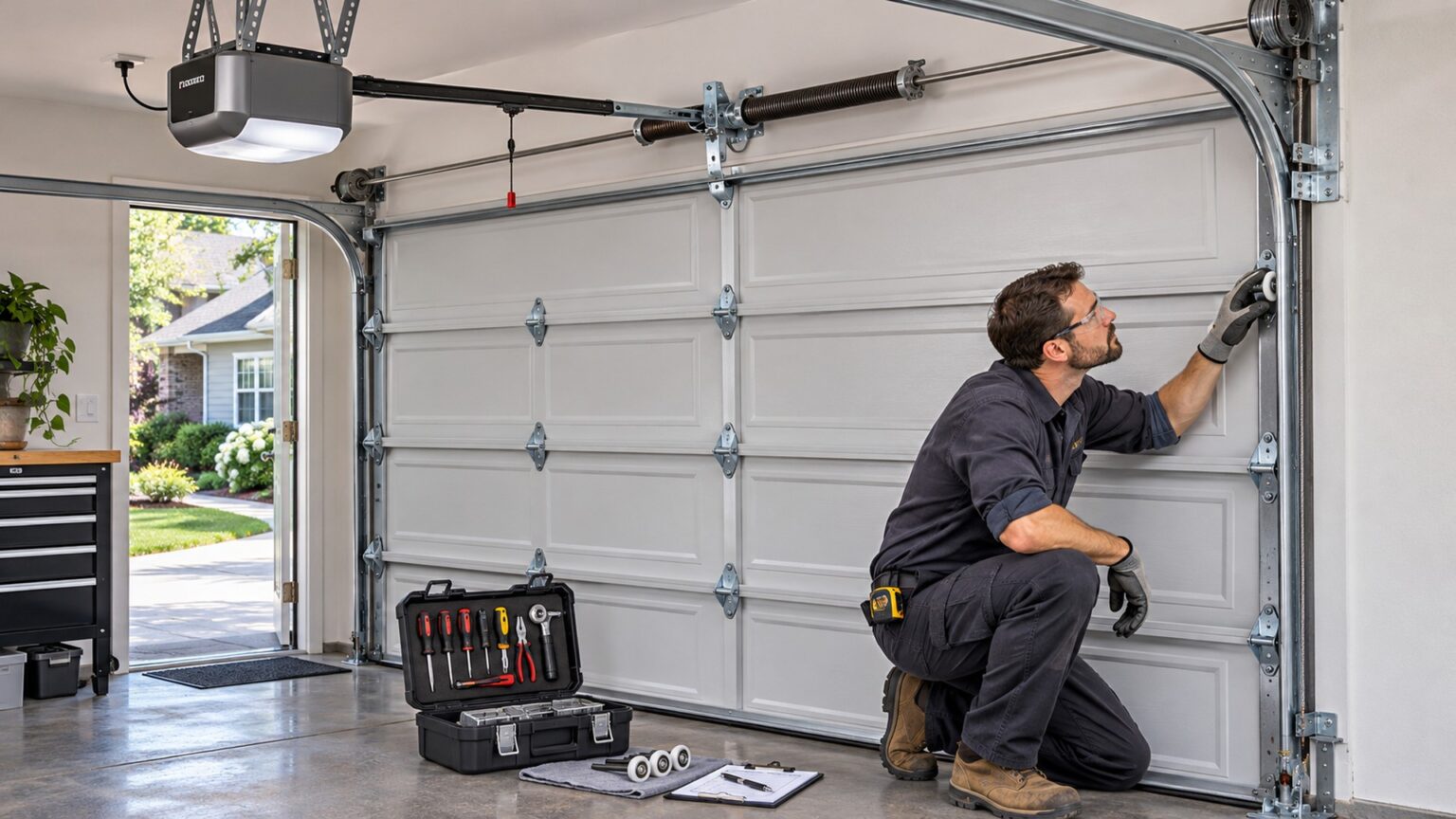
A Garage door repair contractor helps homeowners diagnose and correct problems with one of the heaviest moving systems in a home. A door that sticks, slams, makes unusual noises, or refuses to close may have issues with springs, cables, tracks, rollers, safety sensors, or the opener. Some faults are inconvenient; others create immediate injury risks. Knowing what a qualified technician should inspect, explain, and test makes it easier to choose dependable service without paying for unnecessary parts.
The best hiring decision combines safe work practices with a clear diagnosis, a written estimate, appropriate replacement components, and a meaningful final inspection. This guide explains eighteen practical checks and the questions worth asking before you approve repairs.
When Should You Call a Garage Door Professional?
A garage door that moves unevenly, has a broken spring, shows a loose cable, or appears ready to fall should be taken out of service. Keep children and pets away, and do not attempt to lift or support a damaged door. Even if the electric opener still operates, forcing movement can make the problem worse.
Less urgent concerns include worn weather seals, intermittent remote operation, and minor noise that has not been diagnosed. These still deserve timely attention. A technician can distinguish a straightforward maintenance issue from damage to the counterbalance system.
Why Garage Door Repairs Require Special Care
Garage doors can weigh hundreds of pounds, and the springs store substantial mechanical energy. Cables, drums, and some mounting brackets are part of that loaded system. Adjusting or removing them without proper training and tools can cause severe injury. Homeowners should observe visible symptoms from a safe position, not dismantle spring assemblies or loosen tensioned hardware.
How to Choose a Garage Door Repair Contractor: 18 Smart Checks
1. Describe the Symptoms Before Booking
Tell the company what the door does, when the problem started, and whether the opener responds. Mention a loud bang, a crooked door, a cable hanging loose, or a door that reverses unexpectedly. Photos taken without touching the equipment may help the dispatcher understand the situation. An accurate description improves scheduling and helps ensure that the technician brings suitable diagnostic equipment. It does not replace an on site assessment.
2. Confirm the Business Is Identifiable
Look for a business name, service address or verifiable operating area, and a consistent phone number. Ask whether the technician works for that business or an independent subcontractor. A company can operate legitimately without an elaborate storefront, but it should be clear who is providing the service and who will stand behind the work. Be cautious when the business name on the invoice differs unexpectedly from the one you contacted.
3. Check Insurance and Applicable Requirements
Ask about liability insurance and any registration or licensing rules that apply in your state or municipality. Requirements for garage door service vary, so do not assume that one nationwide credential is mandatory everywhere. For work involving electrical circuits, structural changes, or permits, confirm that appropriately qualified people will perform those tasks. Keep copies of the agreement and information about the business for your records.
4. Ask About Experience With Your Door
Residential sectional doors, one piece doors, custom wood designs, and commercial rolling systems can use different hardware. Tell the provider the door material, approximate age, and opener type if known. Ask whether the technician routinely services that configuration. A person familiar with the system is better positioned to identify compatible components and understand the manufacturer’s procedures. Experience is particularly relevant when the door has unusual weight or a modified track arrangement.
5. Expect Diagnosis Before Replacement
A reputable technician should inspect the relevant system and explain what is actually defective. A noisy door may have a worn roller, poor alignment, or an opener issue rather than a broken spring. Request a demonstration or clear description of the findings where safe. Be wary of a recommendation to replace multiple costly components without showing how each contributes to the problem. Diagnosis should connect symptoms, inspection results, and proposed repairs.
6. Treat Spring Work as Professional Only
Torsion springs commonly sit above the opening, while extension springs may run beside the horizontal tracks. Both support the door’s counterbalance system, and their failure can make the door difficult or dangerous to move. Spring replacement must use components matched to door weight and configuration. Do not attempt to wind springs, remove winding hardware, or release cables yourself. Ask whether the quote covers the spring, required adjustment, and a final balance and safety check.
7. Inspect Lift Cables and Bottom Brackets
Frayed or displaced lift cables are warning signs, especially when the door tilts or rises unevenly. Lower corner brackets can be connected to loaded cables and should not be loosened by an untrained homeowner. Ask the technician to evaluate cable condition, routing, drums, and attachment points as part of the diagnosis. Replacing a visibly damaged cable without correcting its cause may allow the fault to return.
8. Review Tracks, Rollers, and Hinges
Bent tracks, loose support brackets, worn rollers, or damaged hinges can cause grinding, shaking, and uneven travel. A technician should assess alignment, hardware condition, and whether a door section has been damaged. Small adjustments can sometimes restore smooth movement, while severely bent components may require replacement. Ask why the proposed part is needed rather than accepting a full hardware overhaul as the default response to ordinary noise.
9. Verify Opener and Sensor Diagnosis
If the motor runs but the door does not move, the problem may involve the opener drive, trolley, release mechanism, or another component. A door that reverses while closing may have an obstruction, misaligned photoelectric sensors, or a force setting problem. Modern automatic openers use safety features intended to reduce entrapment hazards. Ask the technician to identify whether the problem lies with the opener, the door’s mechanical operation, or both.
10. Request an Itemised Written Estimate
A clear estimate from a garage door repair contractor should identify the diagnosed issue, parts, labor, service fees, and any extra charges for urgent work. Confirm whether taxes, disposal, and additional testing are included. If the price is only a verbal total, ask for a written breakdown before authorising replacement. Itemisation makes competing quotes easier to compare and helps prevent arguments about what was actually included in the repair.
11. Compare Repair With Replacement Honestly
A single damaged roller or worn spring does not automatically justify replacing an entire garage door. Conversely, widespread panel damage, severe corrosion, unsupported replacement parts, or a compromised structure may make larger work reasonable. Ask what remains serviceable, how long the repair is expected to remain practical, and whether replacement provides any meaningful advantage. The decision should reflect condition, safety, compatibility, and total cost rather than a sales target.
12. Ask What Parts Will Be Installed
Replacement components must suit the door’s size, weight, and operating system. Ask for the manufacturer or part description when available, particularly for springs, openers, cables, and safety hardware. A component advertised as heavy duty is not necessarily correct for your installation. Request documentation of the work and confirm whether the parts are new, refurbished, or otherwise described. Compatibility matters more than marketing language.
13. Clarify Emergency and After Hours Fees
A stuck door can prevent a vehicle from leaving or leave a home unsecured. Explain the immediate concern and ask whether the company can safely stabilise the door before attempting a full repair. Confirm the dispatch charge, evening or weekend premiums, and what happens if a part must be ordered. Do not assume an emergency appointment guarantees immediate completion. For an unstable door, keeping the area clear is more important than forcing a temporary opening.
14. Read Warranty Terms Carefully
Ask whether the warranty covers installed parts, workmanship, or both, and how long each protection lasts. Find out whether a return visit has a labour or dispatch charge. Some warranties exclude unrelated damage or ordinary wear, so the details matter. Keep the invoice, part descriptions, and any maintenance recommendations. A warranty is most useful when you know exactly who to contact if the same fault reappears.
15. Assess Worksite Safety Practices
A qualified garage door repair contractor should keep bystanders away from moving components, control the door against unexpected movement, and use suitable tools and protective equipment. The technician should not ask you to hold a heavy door or assist with tensioned hardware. Electrical power and stored spring energy both require attention. If the approach appears careless, stop the job and request clarification before further work proceeds.
16. Examine Reviews Without Relying on Ratings Alone
Read customer feedback for specific descriptions of punctuality, diagnostic explanations, pricing changes, and follow up service. A high overall rating is less informative than consistent reports of clear estimates and completed repairs. Check how the business responds to complaints. Be cautious of reviews that appear unrelated or provide no details, and do not treat a single negative comment as definitive proof of poor service.
17. Watch for Pressure and Pricing Red Flags
Warning signs include refusing to identify the company, insisting on immediate approval without explaining the defect, presenting a surprisingly low quote that changes dramatically on arrival, or demanding unusual payment arrangements. Ask for an explanation of necessary work and take time to review it when the situation is safe. A trustworthy contractor should not need intimidation or unsupported claims to secure the job. An urgent safety concern warrants prompt action, not an unexamined purchase.
18. Require a Final Demonstration and Receipt
Before the technician leaves, ask for a demonstration of normal opening and closing from a safe position. Confirm that the door travels evenly, the opener and safety features operate as designed, and unusual noises have been addressed. The provider should explain the completed work and any remaining concerns. Request a final itemised invoice showing the parts and services supplied. This creates a useful record for future maintenance or warranty questions.
What Does a Professional Garage Door Repair Visit Include?
The technician normally begins by asking about symptoms and inspecting visible door and opener components. Depending on the problem, the assessment may cover panels, tracks, rollers, hinges, springs, cables, sensors, and electrical controls. The technician should explain the suspected cause before requesting approval for major work.
Diagnosis, Approval, and Repair
Once the problem is identified, the homeowner should receive an estimate and any meaningful alternatives. After approval, the repair should be completed using compatible components and safe procedures. A professional may need to stop and order parts if the correct component is not available. Temporary arrangements should never leave an unstable door in use.
What Should Be Tested After Service?
The closing and opening functions, mechanical travel, and required safety features should be checked using the manufacturer’s procedures. Ask whether the door’s counterbalance condition was assessed after spring work. A functioning remote is not, by itself, proof that the complete system is safe.
How Much Does Garage Door Repair Cost?
Repair pricing depends on the defective component, door configuration, local labor rates, access, and whether service is requested outside normal hours. Replacing a weather seal is different from repairing a counterbalance system or replacing an opener. A reliable quote must be based on the actual fault rather than a generic price displayed for all jobs.
What Can Increase the Final Invoice?
Unusual door dimensions, heavy custom panels, difficult access, damaged hardware, and hard to source components can increase costs. Some jobs require several parts because one failure damaged another. Ask the contractor to distinguish necessary work from optional upgrades and explain each cost change before proceeding.
How to Compare Two Repair Quotes
Give each company the same description of the problem and request similar details. Compare the proposed parts, labor, warranty, arrival charges, and testing. A cheaper quote is not better if it excludes essential safety work. Equally, a higher price should be justified by actual scope and service rather than vague promises of superior quality.
Warning Signs That Need Prompt Attention
A broken spring, a door hanging crookedly, a loose cable, a damaged track support, or a panel at risk of falling calls for professional assessment before further use. Do not pull the emergency release on a door that appears unsupported or has a suspected counterbalance failure. The release disconnects the opener but does not remove the door’s weight.
A door that closes despite an obstructed safety sensor, or fails its manufacturer recommended reversal test, should not be used automatically until the problem is corrected. Keep people clear of the opening and arrange service. Avoid trying to solve safety failures by bypassing sensors or increasing force settings without proper diagnosis.
Special Repair Situations That Need Extra Planning
Not every garage door failure follows the same repair process. Damage from an impact, an outdated opener, or severe weather can create problems beyond a single worn component. Explain these circumstances when arranging the appointment so the contractor can plan the assessment and recommend the right expertise.
When the Door Has Come Off Its Tracks
A door that has left its guide tracks may be unstable, especially if a cable has also come loose. Keep people and vehicles away from the opening and do not try to force the rollers back into place. An experienced garage door repair contractor should inspect the tracks, rollers, supports, cables, and door sections before deciding what can be reused. If the opening is unsecured, ask about safe temporary protection until the proper repair is completed. Avoid improvised restraints that could shift or collapse.
When the Opener Is Old or Unsupported
Older openers may lack certain modern safety features, or compatible replacement components may no longer be available. That does not mean every aging opener must be replaced. Ask whether a fault can be repaired safely using approved parts and whether the model still meets the applicable safety expectations. If replacement is recommended, compare suitable motor types, backup power options where available, manual release arrangements, and the required safety devices. The new opener must be matched to the door’s design rather than chosen only by advertising claims.
When Damage Follows Severe Weather or Impact
High winds, falling debris, or a vehicle collision can damage panels, tracks, anchors, and the surrounding garage opening. Take photographs from a safe distance and document what happened before repairs, especially if an insurance claim may be involved. A qualified garage door repair contractor should check whether the damage affects the door’s structural support or its specified wind resistance in regions where that matters. Do not assume a replacement panel restores the complete assembly to its original condition. Insurance coverage depends on the actual policy and circumstances.
Basic Maintenance Between Professional Visits
Homeowners can observe whether the door moves smoothly, keep the opening free from clutter, and clean the sensor lenses according to the opener manual. Look for visible changes such as frayed cables, bent tracks, or loose parts without touching them. Follow the manufacturer’s maintenance and safety testing instructions.
Some hinges and rollers may require product specific lubrication, while certain components should not be lubricated. Never apply grease indiscriminately or adjust springs to silence a noise. If a check reveals unusual movement, stop operation and call a qualified technician instead of attempting a mechanical adjustment.
Frequently Asked Questions
1. When should I hire a Garage door repair contractor?
Arrange service for broken springs, loose cables, uneven movement, repeated reversals, or unexplained noise. Stop using the door if it appears unstable.
2. Can I replace a garage door spring myself?
Spring systems store dangerous energy. Replacement and tension adjustment should be handled by a trained door professional with appropriate equipment.
3. Does a noisy garage door always need replacement?
No. Worn rollers, hinges, alignment problems, or opener faults may be repairable. A proper inspection should identify the cause before major work is approved.
4. What should a garage door repair estimate include?
It should describe the diagnosis, parts, labor, service charges, possible extras, and warranty terms so the total scope is clear.
5. How can I check whether a contractor is reliable?
Verify the business identity, applicable credentials, insurance, relevant experience, written pricing, and specific customer feedback before hiring.
6. Should I keep using a door with a broken cable?
No. A damaged cable can leave the door unstable. Keep the area clear and arrange professional assessment rather than operating or lifting it.
Conclusion
Choosing a garage door repair contractor involves more than finding someone who can arrive quickly. A sound decision depends on accurate diagnosis, safe handling of loaded components, compatible parts, and a written explanation of costs and warranties. Insist on proper testing before the door returns to normal use, and avoid pressure to approve repairs that have not been justified. Careful hiring and routine observation can help keep the garage door dependable while reducing avoidable risks and expenses.
