
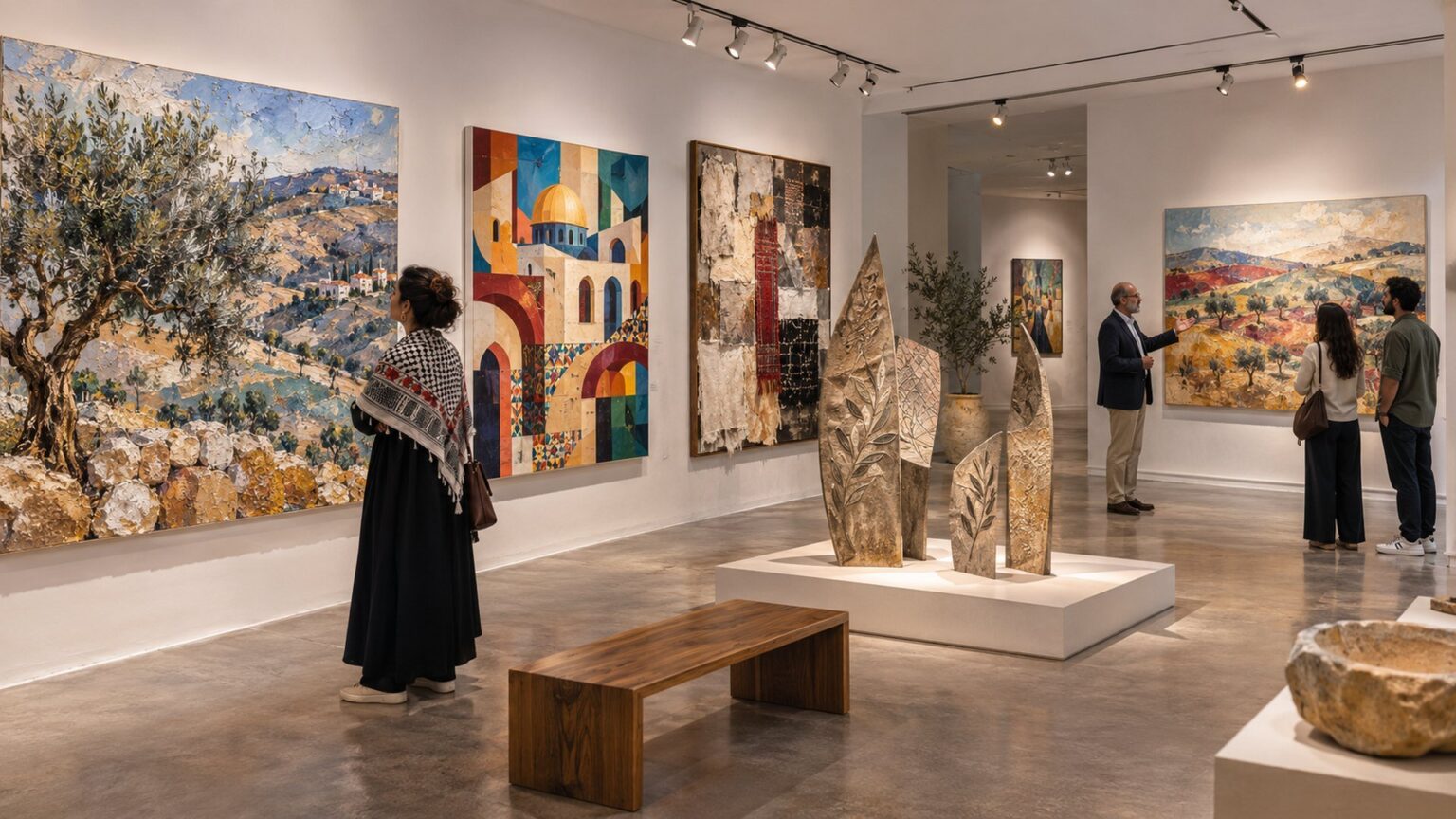
Zawyeh Gallery is an independent art gallery founded in Ramallah in 2013 by Ziad Anani, with a second location established in Dubai in 2020. Its programme focuses on Palestinian modern and contemporary art, bringing established and emerging artists into conversations with local visitors, international audiences and collectors. For someone discovering Palestinian art for the first time, the gallery offers an accessible way to explore painting, sculpture, photography, video and experimental installations. Understanding its history, exhibition approach and visitor experience makes the work easier to appreciate beyond a quick look at an image.
The gallery is not simply a room containing paintings. Exhibitions can introduce different generations of artists, reveal how visual language changes across locations and explore questions of memory, place and identity. This guide presents thirteen practical insights into its role, notable programmes, what visitors can expect and how to approach buying artwork thoughtfully.
What Is Zawyeh Gallery Known For?
Zawyeh Gallery is known for promoting Palestinian artists through exhibitions and international participation, with physical spaces in Ramallah and Dubai. The organisation presents a variety of artistic practices, from figurative painting and landscape to conceptual work and mixed media. Its stated mission includes supporting artists at different career stages and bringing Palestinian visual expression to wider audiences.
The gallery’s focus does not mean every artist uses the same subject, palette or artistic language. Some address personal experience through abstraction, while others explore architecture, land, contemporary life or historical memory. Looking at those differences is an essential part of understanding what a contemporary art programme contributes.
13 Inspiring Insights Into the Gallery and Its Artistic Programme
1. Its Story Began in Ramallah
Zawyeh Gallery was founded by Ziad Anani in 2013 in Ramallah, Palestine. That origin matters because the gallery developed within an existing community of Palestinian artists, cultural practitioners and audiences. A local space can provide artists with opportunities to show new work, receive critical feedback and build relationships beyond a single exhibition.
For visitors, the Ramallah location offers a setting in which to encounter art while recognising the place where the gallery began. Exhibitions may change throughout the year, so the programme is more informative than assuming that one signature group of works is permanently displayed.
2. Dubai Expanded Its International Reach
The gallery opened a second space in Dubai in 2020, at Alserkal Avenue in Al Quoz. This places its programme within an established arts district where visitors can encounter multiple creative organisations. Dubai provides another context for viewing Palestinian art and meeting collectors, curators and people who may be unfamiliar with the artists.
The two locations should not be treated as identical showrooms. Their exhibitions, staff arrangements and available artworks can differ. Anyone planning a visit should check the programme for the actual city rather than relying on a photograph from the other branch.
3. The Programme Includes Established and Emerging Artists
A valuable gallery programme can connect widely recognised practitioners with artists at earlier stages of their careers. Zawyeh Gallery explicitly works with both groups. This can help audiences understand developments in artistic practice without treating contemporary work as disconnected from what came before.
When exploring an exhibition, read the artist biography and consider the date of the work. A recent piece by a long established artist may connect decades of ideas, while a younger artist may approach a familiar theme through photography, digital methods or unconventional materials. Career stage alone does not determine artistic merit.
4. Painting Is Important but Not the Whole Story
Paintings form part of the gallery’s visible identity, but its wider programme includes sculpture, photography, installation, video and other contemporary media. Different formats invite different viewing habits. A painting may reward close attention to pigment and composition; a video may unfold through sound and duration; an installation may depend on the space around it.
Visitors who arrive expecting only framed pictures can miss work designed to be experienced from several viewpoints. Give each medium an appropriate amount of time, and follow any instructions about sound, movement or handling. The exhibition label may explain a work’s materials, but personal observation remains important.
5. Landscape Can Carry More Than Scenic Meaning
Land, trees, towns and cultivated spaces frequently appear in Palestinian visual traditions, although artists approach them in very different ways. A landscape can be a record of place, an image of familiarity or an imaginative arrangement of memory and colour. It should not automatically be read as a literal map or an identical statement by every artist.
Nabil Anani’s exhibition The Land and I, presented in Dubai during 2024 and 2025, is one documented example of the gallery exploring the relationship between an artist and the land. Viewers can begin with visual details such as perspective, rhythm and texture before considering the exhibition’s wider themes.
6. Exhibitions Can Explore Memory and Personal Experience
Contemporary artworks often communicate through fragments rather than a single explanation. An image of a room, object or building might refer to an individual memory while also engaging with wider social questions. Zawyeh’s exhibition history includes projects that examine displacement, memory and changing relationships with place.
A thoughtful visitor should distinguish an artist’s stated intention from their own response. Both have value, but they are not the same claim. Reading a curatorial statement provides context; observing the actual forms, colours and materials helps the viewer develop an independent interpretation.
7. Named Exhibitions Reveal Different Artistic Approaches
The gallery’s programme offers useful examples of how artists vary in method. Recent documented projects include The Field of Dreams by Bashar Khalaf in Dubai in 2026 and Fragile Nest by Yazan Abu Salameh in Ramallah during the same year. Earlier exhibitions include The Land and I by Nabil Anani and Refined Compositions by Ruba Salameh.
These titles indicate different bodies of work rather than a permanent display available on every visit. Check the dates carefully if one exhibition interests you. A past exhibition can still be explored through available documentation, but a visitor should not expect its physical artworks to remain on the walls indefinitely.
8. The Ramallah Art Fair Introduces a Wider Range of Work
The Ramallah Art Fair is a notable part of the gallery’s programming. Its fifth edition, held in early 2026, brought together numerous artists and works across contemporary and rare sections. This type of event can make it easier to encounter different approaches within one visit and offers an entry point for people beginning to collect art.
An art fair differs from a solo exhibition because it may prioritise variety over a sustained examination of one artist’s ideas. Compare the works slowly rather than trying to take in everything at once. Ask about media, edition details and how works were selected if those questions matter to your understanding.
9. International Art Fairs Bring Work to New Audiences
Participation in external fairs allows a gallery to present artists beyond its own walls. Zawyeh has appeared in Art Dubai and other international art contexts. Such events may introduce artists to curators, institutions and collectors who would not otherwise visit Ramallah or the Dubai location.
A fair booth is usually smaller than a gallery exhibition, so its selection offers only a partial view of an artist’s practice. If one piece catches your attention, ask whether related work, exhibition catalogues or additional documentation are available. This gives the encounter more depth than a brief impression at a crowded fair.
10. Art Can Bridge Generations Without Flattening Differences
When established and younger artists appear within one programme, visitors can compare techniques and questions across time. One painter may use recognisable architecture, another might use abstraction, and a third may focus on documentary photography. These approaches can share cultural contexts without communicating identical messages.
Avoid assuming that every artwork must stand for an entire community. Artists have individual practices and distinctive priorities. Understanding the specific creator, date, medium and exhibition context leads to more accurate discussion than applying one interpretation to all Palestinian art.
11. Curatorial Choices Shape How Art Is Experienced
The way artworks are positioned can influence interpretation. Scale, lighting, spacing and the sequence of rooms affect what a visitor notices. A group exhibition might place works in dialogue through similar materials or contrasting perspectives, while a solo show may trace changes within one artist’s practice.
Look at the relationship between neighbouring works without assuming their proximity proves that the artists agree. Ask whether there is a curatorial statement and consider how the exhibition design supports its argument. The most rewarding gallery visit often combines patient looking with a willingness to revise a first impression.
12. Collecting Should Begin With Knowledge, Not Urgency
Zawyeh Gallery also works with collectors and advises on acquisitions. For a first time buyer, an important starting point is understanding what is being offered. An original painting, a unique photograph and a numbered print can have different production methods, availability and pricing considerations.
Ask for the artist’s name, title, year, medium, dimensions, edition information where applicable and documentation of authenticity. Confirm who is responsible for framing, delivery, insurance and any import requirements. Buying should follow a clear assessment of the artwork and its terms, not pressure to make an immediate decision.
13. The Best Visit Starts With Curiosity
You do not need specialist art history knowledge to enjoy Zawyeh Gallery. Begin by noticing what attracts your attention. Perhaps it is an unexpected colour combination, an arrangement of familiar objects or a photograph that changes meaning when viewed closely. Spend time with that response before searching for a definitive interpretation.
Ask staff questions where appropriate, but respect the time and needs of other visitors. An open minded approach creates room for learning while allowing the artwork to remain complex. Appreciation does not require pretending to understand every piece on the first encounter.
How to Visit Zawyeh Gallery in Dubai or Ramallah
The Dubai branch is located at Unit 27, Alserkal Avenue, Al Quoz 1, Dubai, United Arab Emirates. The Ramallah branch is listed at 7A President Circle, Al Balo’, Ramallah, Palestine. These addresses identify two different venues, so confirm the city before making travel plans. The official contact details list Dubai visits daily from 10 a.m. to 6 p.m. and Ramallah visits Saturday through Thursday from 10 a.m. to 6 p.m., with appointments also mentioned. Hours, public holidays and exhibition installation schedules can change.
What to Check Before Leaving Home
Confirm which exhibition is running, whether the venue is open on your chosen day, and whether an appointment is needed. Ask about admission or special event arrangements rather than assuming that every occasion follows the same policy. Allow time to travel and consider accessibility requirements, especially if stairs, parking or seating arrangements matter to your group.
Visiting the Dubai Space
Alserkal Avenue is a cultural district in Al Quoz, making it possible to combine a gallery visit with other nearby exhibitions and creative spaces. The best approach is to plan a manageable route instead of rushing between every venue. Check each organisation’s separate opening schedule, and leave enough time to view one exhibition properly.
Visiting the Ramallah Space
The Ramallah venue offers access to the gallery in the city where it was established. Confirm current local access and transport arrangements in advance, as travel conditions and schedules can change. Visitors should respect the building’s policies, the artworks and other guests. Contacting staff ahead of a planned group or research visit can help clarify practical questions.
Photography, Children and Guided Visits
Photography policies can vary between exhibitions because of artwork rights, installation requirements and the comfort of other visitors. Ask before using a flash, tripod or professional camera, and avoid photographing someone who has not agreed to be included. Families can make a gallery visit more engaging by encouraging children to choose one artwork and describe its colours or shapes. Keep a respectful distance from objects and follow staff instructions about touching displays. If visiting with students or a larger group, inquire about suitable arrangements beforehand. A planned group discussion can be valuable, but it should not obstruct other visitors or assume every artwork needs one correct explanation.
How to Understand an Artwork Beyond Its Label
Art interpretation begins with observation. Start with the physical features of the work before moving to its possible meanings. Is the composition crowded or open? Are the colours subdued or intense? Does the artist use recognisable objects, layered surfaces or repeated shapes? These choices can reveal artistic decisions even before you know the subject.
Examine Medium and Technique
Material changes how meaning is presented. A drawing can preserve a sense of immediacy; a carefully constructed installation may create a physical relationship with the viewer. In photography, framing and sequence shape what is included and excluded. Ask what the medium allows the artist to do rather than treating technique as decoration alone.
Separate Facts From Interpretation
A wall label may state the title, year and material. It may also offer curatorial interpretation. Your response is another layer. Distinguishing these categories makes discussion more precise and respectful, especially when a work engages with difficult history or personal experience.
A Practical Guide to Buying Palestinian Contemporary Art
Collectors who discover Zawyeh Gallery may be interested in original works, editions or works on paper. The gallery’s role includes advising collectors, but purchase terms should still be understood independently. A transparent transaction identifies the precise artwork, condition, price, taxes and responsibilities for delivery. Ask whether any framing or conservation work has already been performed.
Understand Editions and Authenticity
A limited edition print should come with clear information about edition size, numbering, medium and artist approval or documentation as applicable. An edition is not the same as an open reproduction. Avoid relying solely on a seller’s description of rarity; ask what the edition actually means and whether more copies exist in other formats or sizes.
Budget for Ownership After the Purchase
Consider packing, transport, installation, insurance and conservation requirements. Works on paper may need careful light exposure and appropriate framing materials. Large paintings require safe wall support and suitable environmental conditions. These practical costs can be meaningful even when the purchase price fits your budget.
Avoid Treating Art as a Guaranteed Investment
Art prices can change, and resale may be difficult. There is no dependable promise that an emerging artist’s work will appreciate or that an established name will maintain a particular value. Buy with an understanding of your personal interest, the artist’s practice and the documentation available. Seek specialist advice when financial stakes are high.
Why Galleries Matter to Artists and Audiences
Independent galleries can provide exhibition opportunities, professional relationships, interpretation and access to potential collectors. Their programmes can also help audiences encounter art outside familiar museum narratives. For Palestinian artists working in different places, an organisation with more than one venue may create additional opportunities to present work to varied audiences.
That contribution should not be exaggerated into a claim that one gallery represents every artistic perspective. Palestinian contemporary art includes diverse histories, methods and independent practices. A gallery is most useful when understood as one active participant within a much broader creative landscape.
Frequently Asked Questions
1. What is Zawyeh Gallery known for?
Zawyeh Gallery is known for presenting modern and contemporary Palestinian art through exhibitions, international fairs and engagement with collectors and institutions.
2. Where is Zawyeh Gallery located?
It has locations in Ramallah, Palestine, and at Alserkal Avenue in Al Quoz, Dubai, United Arab Emirates. Check which branch hosts the exhibition you want to see.
3. When was Zawyeh Gallery founded?
The gallery was founded in Ramallah in 2013 by Ziad Anani. Its Dubai location opened in 2020.
4. What types of artwork does the gallery exhibit?
Its programme includes paintings, sculpture, photography, installation, video and other contemporary practices. Individual exhibitions vary in medium and theme.
5. Can visitors buy artwork at Zawyeh Gallery?
The gallery works with collectors on acquisitions. Ask staff about current availability, prices, authenticity documentation and delivery terms for a specific work.
6. How can I plan a visit to Zawyeh Gallery?
Confirm the latest exhibition, opening hours and any appointment or admission requirements for the branch you plan to visit before travelling.
Conclusion
Zawyeh Gallery offers an important setting for exploring Palestinian contemporary art through artists working across generations, media and themes. Its spaces in Ramallah and Dubai connect local artistic activity with wider audiences, while exhibitions and fairs provide different ways to encounter individual practices. Visitors can deepen their experience by researching current shows, looking carefully at materials and asking thoughtful questions. Whether you are discovering a new artist or considering a purchase, patience and reliable information make the encounter more rewarding.
