
Essential Digital Tool for Long Study Sessions Without Burnout
The right digital tools can make long study sessions more manageable, while thoughtful graphic design can improve the clarity and usability of study materials.Staring down an eight-hour study session can feel completely overwhelming. When you are alone in your room with nothing but a towering stack of textbooks and a looming deadline, the silence quickly becomes deafening. Mental fatigue sets in, isolation takes a toll, and before you know it, you are scrolling through your phone to escape the monotony.
Relying entirely on your own willpower to push through massive stretches of work is a losing battle. Willpower acts like a battery. The longer you force yourself to focus in total isolation, the faster that battery drains.
But there is a secret to surviving these long, grueling days without burning out. The most productive students do not just try harder; they externalize their motivation. They use a powerful psychological concept called “body doubling.”
By simply having others working quietly alongside you, your brain naturally shifts into a state of deep focus. This method is incredibly effective. In fact, according to ADHD Coach Ryan Mayer, clients who use this technique “experience increased focus and productivity, reduced procrastination, enhanced motivation, improved self-esteem, and better results.”
Why Studying Alone Leads to Procrastination (And How to Fix It)
Why is it so incredibly difficult to maintain focus when studying alone for long periods? The simple answer is that human beings are social creatures, and solitary environments lack external pacing. When you are the only person holding yourself accountable, every distraction feels magnified.
Your bed looks incredibly comfortable. The dishes suddenly need washing. You convince yourself that a five-minute social media break will not hurt, but that break easily turns into an hour of lost time. This happens because your willpower is finite. When you study alone, you have to spend a massive amount of mental energy just keeping yourself in your chair.
Contrast that feeling of being trapped alone in a room with the energetic “study flow” of being surrounded by motivated peers. Think about the last time you worked in a busy café or a packed university library. The ambient hum of productivity changes your mindset. Seeing others deeply engaged in their work makes you want to work, too. It creates a silent social contract that pulls you away from procrastination and pushes you toward progress.
The Psychology of Body Doubling
This phenomenon has a name, and understanding it can completely change how you approach your coursework.
As defined by the Attention Deficit Disorder Association, “ADHD body doubling is a productivity strategy” used to finish tasks by having another person beside them to reduce distractions.
While it started as a highly effective coping mechanism for neurodivergent individuals, body doubling is now recognized as a universal productivity hack. It works through subconscious accountability. Simply seeing another person working acts as a visual anchor. It reminds your wandering brain what you are supposed to be doing, keeping you on task without anyone actually watching over you or judging your progress.
Once you understand that isolation is the absolute enemy of focus, the next logical step is finding a workspace that provides this instant, silent accountability. Instead of relying purely on willpower to get through an 8-hour day, you can join a 24/7 virtual focus room. This instantly connects you with thousands of students worldwide, giving you the immediate benefit of a body double at any hour of the day or night.
Replicating the Library Vibe: “Cameras On, Mics Off”
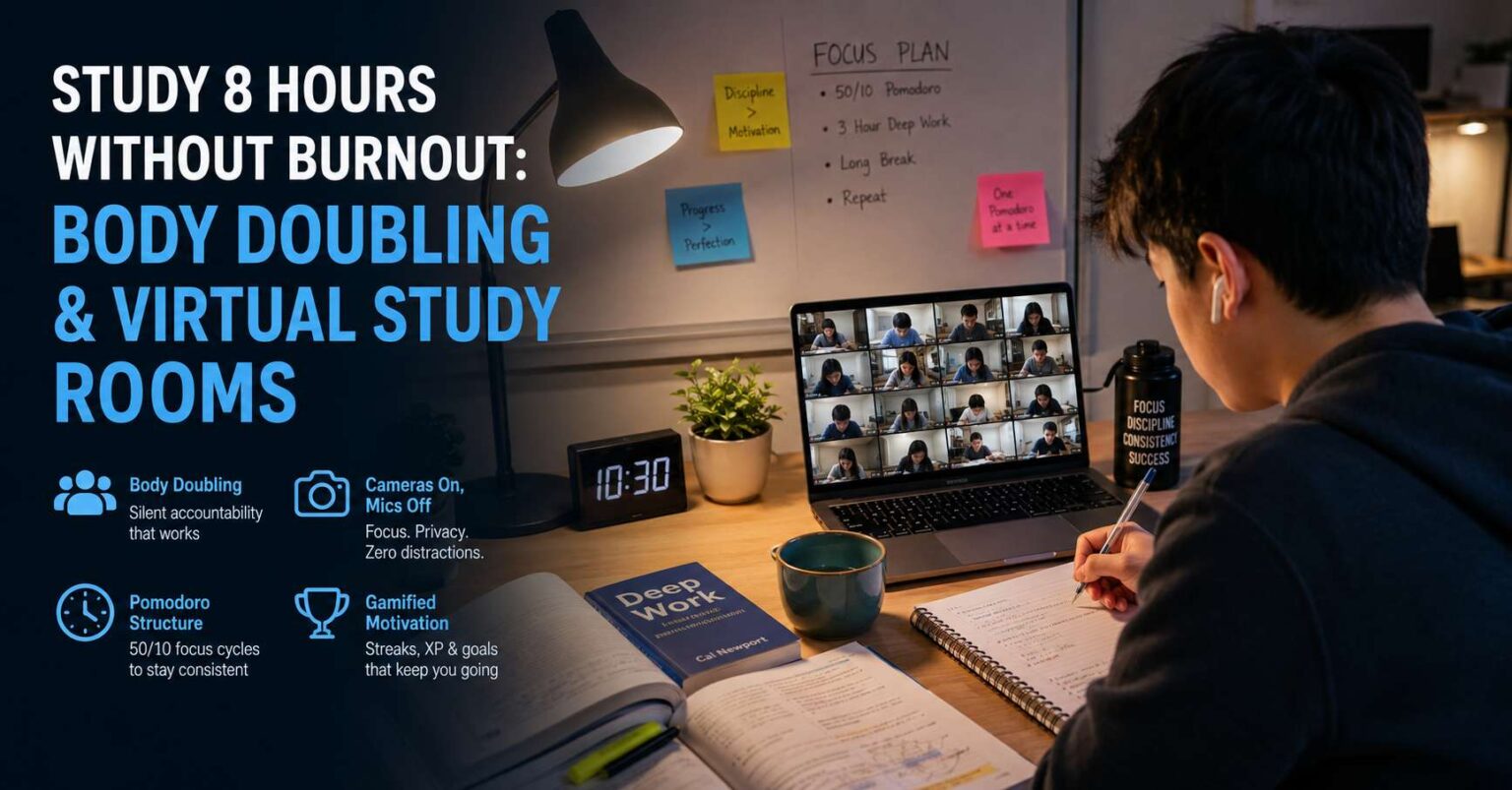
How can virtual study rooms possibly replicate the accountability of an in-person library? It comes down to establishing the right ground rules for the community. The most important of these rules is the “Cameras On, Mics Off” standard.
This environment ensures a completely quiet workspace while maintaining the visual motivation you need. When you log in, you see hundreds of other students with their heads down, actively highlighting notes, typing essays, and reading. You get all the ambient, productive energy of a university library without ever having to leave your house.
For many students, the idea of turning on a camera sounds intimidating. But the “Cameras On, Mics Off” rule actually reduces anxiety. It completely removes the pressure to interact, network, or socialize. There is no small talk to navigate. Users simply show up, open their laptops, and ease right into “focus mode.” You are present, but you are left alone to do your work.
To make the experience even more tailored to your specific needs, modern study platforms offer a “Pinning Study Partners” feature. If you notice a specific user who has been incredibly focused for the last hour, you can pin their video feed to your screen. Keeping a highly focused peer visible gives you a dedicated accountability partner, pushing you to match their level of dedication.
Structuring the 8-Hour Marathon Without Burning Out
Even with the best accountability tools, sitting down and staring at a screen for eight unbroken hours is a terrible strategy. What is the best way to break up an 8-hour study session to avoid burnout? The answer is creating “structure without stress” through timed intervals.
The Pomodoro technique is the gold standard for this type of pacing. It breaks down an intimidating, massive block of time into small, manageable intervals. Instead of dreading a full day of work, you only have to focus on the next 50 minutes. After that, you get a guilt-free 10-minute break. Built-in platform timers help synchronize these deep work sessions with thousands of other students. When you take a break, your virtual study partners are taking a break too.
As you push deeper into your marathon, those short 10-minute breathers will not be enough to sustain your cognitive energy.
Science backs this up: for longer study periods, a longer break is recommended to stay fresh after about every 3 hours of intense study, and should last at least 30-60 minutes.
Step away from your desk entirely during these longer blocks. Eat a proper meal, go for a quick walk, or stretch. When you return to your virtual study room, your brain will have processed the information from the morning, and you will be ready to tackle the afternoon with renewed energy.
Conclusion
Relying solely on pure willpower for an 8-hour study session is a guaranteed recipe for burnout, procrastination, and crushing isolation. Your brain simply is not wired to sustain that level of solitary focus without a heavy cognitive toll.
By changing your environment, you change your outcomes. Combining the proven psychology of body doubling with a silent “cameras on, mics off” space gives you the ultimate study advantage. Add structured Pomodoro pacing and gamified rewards, and suddenly, those intimidating marathon sessions feel effortless.
Productivity does not have to be a lonely experience. Externalizing your motivation is a smart, evidence-based strategy that top students use to protect their mental health while achieving massive results. The next time you have a mountain of coursework to get through, do not do it alone. Log in, turn on your camera, and experience the power of global, silent accountability.
